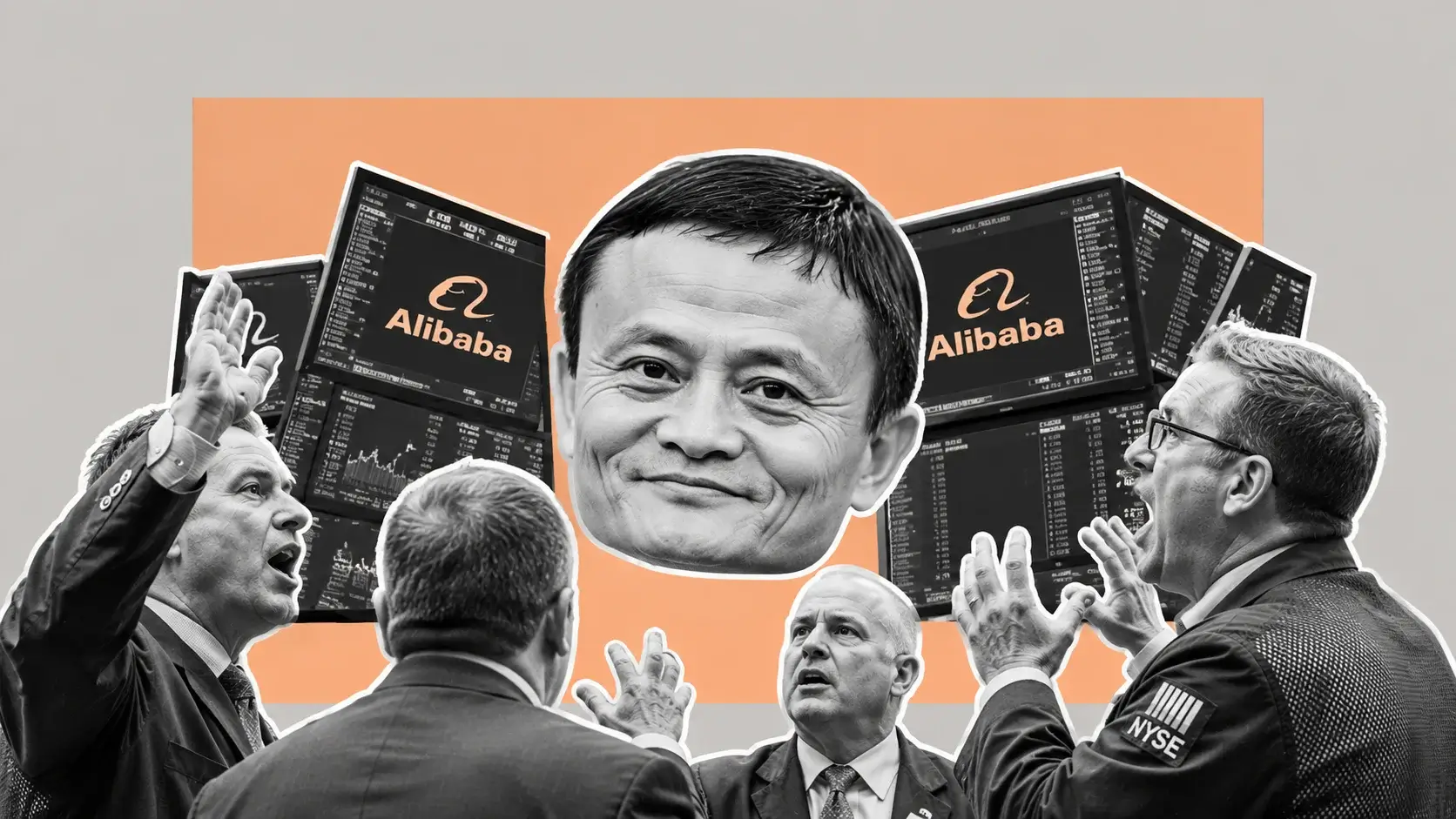
Alibaba's Cloud Grew 45% and the Stock Still Lost $3.43 — Capex Is Now Bigger Than the Cloud Business
Free cash outflow more than doubled to RMB44.67B and the AI Labs segment lost RMB13.86B | That's TradingNEWs
Key Points
- Alibaba slid 2.66% to $125.47 as net income dropped 76% to RMB10.54 billion
- Cloud revenue ripped 45% to RMB48.44 billion, the fastest pace in 22 quarters
- Capex jumped 75% to RMB67.68 billion with free cash outflow at RMB44.67 billion
Alibaba trades at $125.47, down $3.43 or 2.66%, after opening down as much as 5% from Wednesday's $128.90 close. The stock went into the print at $128.76 with the options market pricing a roughly 6% earnings move against a six-quarter average realized move of 7.6%.
The company delivered the single number the bull case was built on and the stock sold off anyway.
Revenue for the June quarter came in at RMB268,953 million, or US$39,639 million, growth of 9% year over year against a consensus near RMB268.88 billion. That is a beat, and it triples the 3% growth rate posted in the March quarter. Adjusted EBITA landed at RMB27,330 million, or US$4,030 million, against a consensus of RMB26.6 billion — also a beat.
AI Cloud and Compute Services, the newly consolidated segment covering the cloud business and the T-Head chip arm, produced RMB48,437 million, or US$7,139 million, up 45% from RMB33,418 million. That is the fastest growth pace in twenty-two quarters and an acceleration from 40% external growth in the March quarter and 36% in the December quarter. Segment adjusted EBITA more than doubled, rising 133% to RMB5,630 million, or US$830 million, taking the EBITA margin to 12%, per Alibaba's investor relations disclosures.
Then the profit line. Net income fell 76% to RMB10,540 million, or US$1,550 million. Non-GAAP net income dropped 38% to RMB20,720 million, or US$3,050 million. Adjusted EBITA declined 30% year over year despite beating the estimate.
The funding cost is what broke the stock. Capital expenditure hit RMB67,680 million, or US$9,980 million, a 75% increase from the same period a year earlier. Free cash flow was an outflow of RMB44,670 million, or US$6,580 million, against an outflow of RMB18,820 million a year ago — more than double.
Alibaba generated RMB48.44 billion of quarterly cloud revenue and spent RMB67.68 billion of quarterly capex to do it. Until that ratio inverts, the growth rate does not set the multiple.
RMB268.95 Billion Beat and the Line That Broke It
The composition of the beat matters more than the beat itself.
Total revenue of RMB268,953 million represents 9% growth, which sits comfortably above the RMB268.5 billion Bloomberg consensus and the RMB268.88 billion LSEG estimate. It is also a sharp reacceleration from the March quarter, when revenue of RMB243,380 million grew just 3% and missed a RMB247.09 billion consensus outright.
That March quarter was the worst print in the company's recent history. Net income collapsed to RMB86 million — effectively zero — adjusted EBITA fell 84% to RMB5.1 billion, and the company posted its first operating loss since 2021. Non-GAAP diluted earnings per ADS came in at RMB0.62, a 95% year-over-year decline.
Against that base, the June quarter is a material improvement on every operating line. Adjusted EBITA of RMB27.33 billion is more than five times the RMB5.1 billion posted three months earlier. Non-GAAP net income of RMB20.72 billion compares to RMB86 million of adjusted net income in the prior period.
The problem is the year-over-year comparison rather than the sequential one. Net income at RMB10.54 billion is down 76%. Non-GAAP net income at RMB20.72 billion is down 38%. Adjusted EBITA at RMB27.33 billion is down 30%.
Four consecutive earnings-per-share misses preceded this report. The setup going in was explicit: sentiment only resets if AI demand shows up in profitability rather than just in revenue. Cloud growth landed at the high end of expectations. Cloud margins expanded to 12%. Segment profit more than doubled.
Group profitability still fell 30% at the EBITA line and 76% at the net line.
That is the specific risk the market flagged before the print and it materialized exactly as described. Cloud growth is strong, cloud margins are expanding, and group earnings momentum remains broken because the AI investment cycle is consuming everything the cloud business generates and considerably more.
The revenue beat is real. It is not what sets the stock price at this stage of the cycle.
RMB48.44 Billion of Cloud and the Fastest Growth in 22 Quarters
The cloud segment is genuinely inflecting and the numbers are not ambiguous.
Revenue from AI Cloud and Compute Services reached RMB48,437 million in the June quarter against RMB33,418 million a year earlier, growth of 45%. The trajectory across the last four quarters reads 34% for fiscal 2026 as a whole, then 36% in the December quarter, 38% in the March quarter with 40% external growth, and now 45%. That is four consecutive quarters of acceleration.
Twenty-two quarters is the relevant frame. The segment has not grown this fast since 2021, before the regulatory reset and the cloud price war that compressed Chinese hyperscaler economics for three years.
The margin story is the more important development. Segment adjusted EBITA rose 133% to RMB5,630 million, lifting the EBITA margin to 12%. Compare that to fiscal 2026, when full-year cloud revenue of RMB158,132 million produced adjusted EBITA of RMB14,265 million — a 9.0% margin. The segment has added roughly 300 basis points of margin while accelerating revenue growth by eleven percentage points.
Growth and margin expanding simultaneously is the configuration that justifies a re-rating. It is rare and it is difficult to fake.
The segment reorganization matters for how the numbers should be read. AI Cloud and Compute Services now consolidates the cloud business with the T-Head chip arm, which changes the comparison base against the old Cloud Intelligence Group reporting. T-Head had shipped 470,000 chips as of February with annual revenue at the RMB10 billion level, so a meaningful portion of the segment's scale is silicon rather than services.
Public cloud revenue growth is cited as the primary driver, with increasing adoption of AI products layered on top. The Zhenwu chip family, including the Zhenwu M890 processor, has reached broad commercial adoption through Alibaba Cloud with more than 650 external customers across over 20 industries spanning autonomous driving, internet and financial services.
That customer count is the metric to track. It converts a chip program from an internal cost center into an external revenue line.
RMB12.38 Billion of AI Product Revenue and Twelve Straight Quarters
The AI monetization line is where the structural argument sits.
AI-related product revenue reached RMB12,380 million, or US$1,820 million, in the June quarter, up from RMB8,970 million in the March quarter. That is 38% sequential growth in a single quarter and it extends triple-digit year-over-year growth to twelve consecutive quarters.
Three years of uninterrupted triple-digit expansion on a line that now runs above RMB12 billion per quarter annualizes toward RMB50 billion. Against the company's stated commitment to reach US$100 billion in combined annual revenue from cloud and AI within five years, the June quarter run rate puts the combined segment at roughly RMB194 billion annualized, or about US$27 billion. Getting to $100 billion requires roughly 30% compound growth for five straight years.
That is demanding but not implausible given the current 45% rate.
The model portfolio is doing the work. Alibaba launched Qwen3.8-Max in August within three months of the prior version and opened its weights at 2.4 trillion parameters, with improvements across coding, real-world work, research, long-horizon tasks and multimodal agents. The frontier language, coding, video, audio, image and music models are all positioned as top-tier.
QwenWork, an enterprise workforce agent, is the new commercial vehicle. The Qwen consumer interface surpassed 300 million monthly active users as of the December quarter.
The open-weight strategy is the strategically interesting choice. Releasing a 2.4 trillion parameter model publicly forfeits direct licensing revenue and instead drives inference demand onto Alibaba Cloud infrastructure. It is a deliberate trade of software margin for compute volume, and it only works if the compute layer captures the value.
The 45% cloud growth rate and the 12% segment margin say it is working. The RMB13.86 billion loss in the AI Labs segment says it is being paid for somewhere else.
That somewhere else is the entire problem with the stock at $125.47.
Capex of RMB67.68 Billion Is Larger Than the Cloud Business It Funds
This is the number that produced the 5% opening decline.
Capital expenditure reached RMB67,680 million, or US$9,980 million, in the June quarter, up 75% from a year earlier. Set that against AI Cloud and Compute Services revenue of RMB48,437 million in the same period.
Alibaba spent RMB1.40 of capex for every RMB1.00 of cloud revenue it generated. On segment adjusted EBITA of RMB5,630 million, the ratio is RMB12.02 of capex for every RMB1.00 of segment profit.
The drivers cited are uneven timing of customer purchases, an increase in CPU-compute capacity, and higher prices across a broad range of chip components. The last item is the one that compounds. Component cost inflation across the AI hardware supply chain is an industry-wide condition, not an Alibaba-specific timing issue, and it means the same physical capacity costs more each quarter.
The full-year context sharpens it. Fiscal 2026 capex ran US$18.3 billion across four quarters, averaging roughly US$4.6 billion per quarter. The June quarter alone hit US$9.98 billion — more than double the fiscal 2026 average run rate in a single period.
If the current quarterly pace holds, fiscal 2027 capex lands near US$40 billion against fiscal 2026's US$18.3 billion. That is a 118% step-up in the capital intensity of the business inside one year.
The comparison that matters is what the spending buys. Cloud revenue grew RMB15,019 million year over year, from RMB33,418 million to RMB48,437 million. Capex grew from roughly RMB38.7 billion to RMB67.68 billion, an increase of approximately RMB29 billion. Alibaba added RMB29 billion of annual capital spending to generate RMB15 billion of incremental quarterly revenue.
On an annualized basis that incremental revenue is RMB60 billion against RMB29 billion of incremental quarterly spend, or RMB116 billion annualized. The math only works if the capacity built this quarter serves revenue in future quarters at improving utilization.
That is the bet. It is a reasonable bet. It is also unverifiable until the capex curve flattens and the revenue curve does not.
Free Cash Outflow of RMB44.67 Billion Is the Constraint
Free cash flow was an outflow of RMB44,670 million, or US$6,580 million, against an outflow of RMB18,820 million in the year-ago quarter. The deterioration is 137% and it is the fastest-moving number in the entire release.
Fiscal 2026 free cash flow ran negative US$6.76 billion across the full year. The June quarter alone consumed US$6.58 billion — essentially an entire prior fiscal year of cash burn in three months.
Extrapolate the quarterly pace and fiscal 2027 free cash outflow reaches roughly US$26 billion. That is the number that determines whether the balance sheet can carry this cycle without dilution or leverage that changes the equity story.
The March quarter provides the trend line. Net cash from operating activities in that period was RMB9,410 million, down 66% from RMB27,520 million a year earlier. Operating cash generation has been compressing while capital intensity has been expanding, and those two lines moving in opposite directions is what turns an investment cycle into a funding problem.
The offsetting argument is that this is a timing mismatch rather than an economic one. Capacity gets paid for upfront and monetizes across a multi-year depreciation schedule. Cloud revenue accelerating from 34% to 45% while segment margin expands from 9% to 12% is consistent with capacity coming online and filling.
The counterargument is that the AI Labs and Applications segment loss widened to RMB13,860 million from RMB3,220 million, and inference costs tied to the Qwen consumer app are explicitly named as a driver. Consumer inference at 300 million monthly active users is a variable cost that scales with usage and carries no direct revenue attached.
That is not a capacity-timing mismatch. That is an ongoing operating drain that grows with adoption.
The distinction determines the stock. Capex that fills with paying enterprise workloads justifies the cash burn. Inference costs subsidizing a free consumer app do not.
Both are happening simultaneously and the release does not separate them cleanly.
AI Labs Lost RMB13.86 Billion and That Is the Honest Number
The most useful disclosure in the entire report is the newly broken-out AI Labs and Applications segment, and it is not flattering.
Adjusted EBITA for the segment came in at a loss of RMB13,860 million, or US$2,040 million, against a loss of RMB3,220 million a year earlier. The loss expanded 330% in twelve months. The segment houses AI model development, the Qwen consumer app and the QwenWork enterprise agent, with the widening loss attributed to increased investment in AI capabilities and higher inference costs tied to Qwen.
Set the two AI segments against each other. AI Cloud and Compute Services generated RMB5,630 million of adjusted EBITA. AI Labs and Applications lost RMB13,860 million. Net across Alibaba's AI operations: a loss of RMB8,230 million in the quarter.
The company's AI business, taken as a whole, is losing roughly RMB8.2 billion per quarter, or RMB33 billion annualized, or approximately US$4.6 billion.
That is the number that explains why group net income fell 76% while cloud revenue grew 45%. The profitable half of the AI franchise is being consumed by the unprofitable half, and the unprofitable half is growing its losses faster than the profitable half is growing its profits.
The disclosure itself is a positive. Breaking out AI Labs gives a clear view of how much is being invested and how the products are progressing, and companies rarely volunteer a RMB13.86 billion loss line unless they intend to show it shrinking.
The path to it shrinking runs through QwenWork. An enterprise workforce agent carries seat-based or consumption-based pricing that attaches revenue directly to inference cost. The Qwen consumer app at 300 million monthly active users does not, at least not yet.
Watch the ratio of segment loss to cloud segment profit over the next two quarters. If RMB13.86 billion against RMB5.63 billion narrows toward parity, the AI franchise reaches breakeven and the group earnings picture transforms. If it widens, the 45% cloud growth rate is funding a hole rather than building a business.
The Cash Cow Is Shrinking: China E-Commerce Down 8%
The part of the report nobody is discussing is the part that funds everything else.
China E-commerce revenue fell 8% year over year to RMB110,900 million. Customer management revenue — the highest-margin line in the entire company and the historical engine of group profitability — declined 7% year over year.
Customer management revenue is advertising and commission income from merchants on Taobao and Tmall. It carries incremental margins that no other Alibaba business approaches. A 7% decline in that line is worth more to group EBITA than a 45% increase in cloud revenue, because cloud carries a 12% margin and customer management carries a multiple of that.
The company flags a contra-revenue impact from a new business development program, which means part of the decline is accounting treatment of merchant subsidies rather than underlying demand deterioration. Excluding that impact, the trend is described as better than the headline figure.
That framing deserves scrutiny. Merchant subsidies are a real economic cost regardless of where they land in the income statement. Moving them from an expense line to a contra-revenue line changes the revenue optics and does not change the cash.
The March quarter provides context on the direction. China e-commerce customer management revenue grew 8% on a like-for-like basis in that period. Three months later the reported figure is down 7%. That is a fifteen-point swing in the core monetization line at the core business.
88VIP membership grew double digits year over year to approximately 64 million as of June 30, which is the one clean positive in the e-commerce disclosure. High-frequency, high-basket members are the correct base to defend against competitive pressure.
International commerce is genuinely improving. AliExpress achieved operating profit in the quarter, driven by logistics optimization and cost efficiency, with local product supply contributing a rising share of sales. That segment lost RMB3,574 million in the year-ago March quarter and had narrowed to a RMB138 million loss by this March.
The domestic engine is stalling. The international one is fixing itself. The AI business is burning both.
Read More
-
Yen Stalls at 160 Despite a 3% JGB and Tokyo Core CPI at 2.0% — Intervention Sits at 164, Friday's Payrolls Decide
02.09.2026 · TradingNEWS ArchiveEnergy
-
QQQ ETF ($706.22) Slides 7.4% Below Its High as the Market Reprices the AI Capex Bill — $686.57 Target if $700 Breaks
22.10.2026 · TradingNEWS ArchiveStocks
-
XRPI ($7.00) and XRPR ($10.74) Slide Toward 52-Week Lows as Spot XRP ETF Flows Stall at $708,510
22.10.2026 · TradingNEWS ArchiveCrypto
-
NG ($2.775) Decoupled From Europe’s €88 Gas Crisis as LNG Feedgas Hits 18.9 Bcf/d — $3.30 Upside on Cold Weather
22.10.2026 · TradingNEWS ArchiveCommodities
-
Dollar-Yen (157.35) Loses 157.65 as the Yen Rallies on Haven Demand — 155 Target if 156 Breaks
22.10.2026 · TradingNEWS ArchiveForex
Quick Commerce Up 45% and the Price of Market Share
China Quick Commerce revenue surged 45% to RMB53,300 million, and that segment is now larger than the entire AI Cloud and Compute Services business at RMB48,437 million.
Management describes continued improvement in unit economics while maintaining market share. That framing has been consistent across three consecutive quarters — the December release cited scaling with steadily improving unit economics, and the March release cited improving unit economics and average order value.
Three quarters of "improving unit economics" without a disclosed profit figure is the tell. Taobao Instant Commerce and Ele.me operate in the most competitively brutal segment of Chinese consumer internet, against opponents willing to subsidize indefinitely for delivery density.
The March quarter release described spending on AI infrastructure and quick commerce delivery as the twin drags that produced the first operating loss since 2021. Quick commerce was named alongside AI as a primary cause of near-zero group profitability.
The strategic logic is defensible. Instant delivery drives frequency, frequency drives 88VIP retention, and 88VIP retention protects the customer management revenue line that is currently declining 7%. Quick commerce is a defensive moat spend disguised as a growth segment.
The financial reality is that Alibaba is now running two simultaneous cash-consuming build-outs — AI infrastructure at RMB67.68 billion of quarterly capex and quick commerce at whatever the unit economics actually cost — while its highest-margin revenue line contracts.
That is three problems compounding rather than one problem with two offsets.
The e-commerce business is described as delivering resilient profits overall, and adjusted EBITA of RMB27.33 billion beating a RMB26.6 billion consensus supports that. Resilient is not the same as growing. Group adjusted EBITA fell 30% year over year.
For the stock, the question is which spend gets cut first if free cash outflow keeps running at US$6.58 billion per quarter. Quick commerce is the discretionary one. AI capex is not.
The Balance Sheet Can Fund This — For Now
The solvency question has a clear answer and it is worth stating precisely before the bear case runs too far.
The chief financial officer has flagged a net cash position of roughly US$38 billion. The company raised US$3.2 billion in convertible notes and HK$12 billion in exchangeable bonds specifically to fund this investment cycle. Approximately US$19 billion of buyback authorization remains outstanding.
Against a quarterly free cash outflow of US$6.58 billion, a US$38 billion net cash position provides roughly six quarters of runway at the current burn rate before the balance sheet position turns negative — and that ignores the convertible and exchangeable issuance already completed.
Six quarters is enough time. It is not a comfortable margin.
The financing choices are informative. Convertible notes and exchangeable bonds are equity-linked instruments issued when management believes the share price is depressed relative to intrinsic value and wants to avoid outright dilution at current levels. Issuing US$3.2 billion of converts while holding US$19 billion of unused buyback authorization is a specific signal: the company would rather borrow against future equity than spend cash retiring current equity.
That is the correct choice if the AI capex cycle produces returns. It is dilutive if it does not.
The buyback authorization is the swing factor for the stock. At $125.47 with a market capitalization near US$300 billion, deploying the full US$19 billion would retire roughly 6.3% of shares outstanding. Management has not signalled an acceleration, and with free cash flow running at negative US$6.58 billion per quarter, funding buybacks from the balance sheet while simultaneously funding capex from the same balance sheet is a difficult argument to make.
Expect the buyback to stay dormant while capex runs at this level. That removes a support mechanism the stock has leaned on repeatedly over the past three years.
The strong liquidity position and resilient cash generation cited by management are real. They are also being drawn down at a pace nobody modeled twelve months ago.
Valuation: 19 Trailing, 20 Forward, PEG 0.517
The multiple is where the bull case has always lived and the arithmetic deserves honest handling.
Alibaba went into the print at a trailing price-to-earnings ratio of 19, a forward multiple of 20, and a PEG of 0.517. The published consensus price target sits at $189.62 against a pre-print price of $128.76, implying 47% upside, with 30 Buy ratings, eight Strong Buy ratings and a single Hold.
At $125.47 the implied upside expands to 51%.
That distribution — 38 positive ratings against one neutral and zero negative — is the most crowded consensus in large-cap technology, and crowded consensus is exactly what produces a 5% opening drop on a revenue beat.
The problem with the multiple is the denominator. A trailing P/E of 19 is computed on earnings that just fell 76% at the net line and 38% on a non-GAAP basis. A forward P/E of 20 requires an estimate of forward earnings, and the forward estimates that produced a $189.62 consensus target were largely constructed before capex stepped up 75% and free cash flow turned to a US$6.58 billion quarterly outflow.
The PEG of 0.517 implies growth roughly double the multiple. Group revenue grew 9%. Group adjusted EBITA fell 30%. The growth in that PEG calculation is cloud growth applied to a group multiple, which is a category error at a company where cloud represents 18% of revenue.
The honest valuation frame is a sum of parts. AI Cloud and Compute Services at RMB48.44 billion quarterly revenue, growing 45%, with a 12% and expanding margin, deserves a premium multiple in isolation. China E-commerce, contracting 8% with customer management down 7%, deserves a discount. AI Labs, losing RMB13.86 billion, carries negative value until the loss narrows.
The consensus target embeds a re-rating of the whole company on the cloud segment's characteristics. That happens only when the group free cash flow line inflects, and the June quarter moved it decisively in the wrong direction.
Levels, Targets and What Kills the Setup
Three scenarios with defined triggers.
The bull path requires the stock to reclaim $128.90 — Wednesday's close and the pre-print reference — and then clear $135 on a weekly close. The catalyst that delivers it is the next report showing capex flattening while cloud growth holds above 40% and the AI Labs loss narrows from RMB13.86 billion. On confirmation, the path runs to $150, which represents a modest re-rating toward the cloud segment's economics rather than the full $189.62 consensus. The extended target on a genuine free cash flow inflection is $165.
The base case is range work between $115 and $132. The stock digests a quarter that beat on revenue and margin while deteriorating on cash, with the 45% cloud growth rate providing a floor and the RMB67.68 billion capex line providing a ceiling. That path holds until the December quarter report gives a second data point on the capex trajectory. Base-case band into the September quarter: $118 to $135.
The bear case triggers on a close below $115. That level marks the base of the summer range and losing it opens $105, with the psychological $100 handle beneath. The catalyst that produces it: fiscal 2027 capex guidance above US$40 billion, a second consecutive quarter of customer management revenue declining, or an AI Labs loss exceeding RMB16 billion. Any combination of two forces the market to model a multi-year cash burn without a visible return date.
The near-term technical reference is the gap. The stock closed at $128.90 and opened near $122 before recovering to $125.47. That opening gap between roughly $122 and $128.90 becomes the immediate battleground — filling it on a close above $128.90 within a week neutralizes the print, while failing to fill it within two sessions confirms distribution.
Volume is the confirmation tool. Wednesday's Chinese internet complex saw broad strength; if Thursday's decline comes on volume materially above the three-month average and the rest of the complex holds, the selling is Alibaba-specific and structural rather than sector rotation.
The Verdict: Own the Cloud Segment, Not the Group
Alibaba delivered the quarter the bulls asked for and the stock fell 2.66% because the bulls were asking the wrong question.
Cloud growth accelerated to 45%, the fastest in twenty-two quarters, with segment adjusted EBITA up 133% to RMB5,630 million and the margin expanding to 12%. AI product revenue reached RMB12,380 million and extended triple-digit growth to twelve consecutive quarters. Revenue of RMB268,953 million beat consensus. Adjusted EBITA of RMB27,330 million beat consensus. AliExpress turned an operating profit. The 88VIP base grew double digits to 64 million.
Every one of those is real and every one of those was already priced by a consensus running 38 positive ratings against one neutral with a $189.62 target.
What was not priced: capex of RMB67,680 million, up 75%, exceeding the cloud revenue it funds by RMB19.2 billion. Free cash outflow of RMB44,670 million, more than double the year-ago figure and larger in one quarter than all of fiscal 2026. An AI Labs segment loss of RMB13,860 million against RMB3,220 million a year earlier, expanding 330%. And China E-commerce revenue down 8% with customer management revenue down 7% — the highest-margin line in the company contracting while everything else consumes cash.
Net across the AI franchise, Alibaba lost RMB8,230 million in the quarter. Annualized that is roughly US$4.6 billion against a net cash position of US$38 billion.
The trade is defined by $128.90 above and $115 below. Reclaiming Wednesday's close within a week neutralizes the print and puts $135 then $150 in range. Losing $115 opens $105 and forces the market to price a multi-year burn.
Own this for the cloud segment and size it for the group. The $189.62 consensus is anchored to forward estimates built before capital intensity doubled, and it will come down before it is reached. A realistic twelve-month target on cloud momentum holding and capex flattening is $150, with $165 requiring the free cash flow line to actually inflect.
The growth is authentic. The price of it is now visible. Until the capex curve bends, 45% cloud growth does not set this multiple.