Crude Jumps Then Fades — Brent $94.38, WTI $91.60 After Iran Missile Barrage and Trump's 60-Day Ceasefire Push
Oil rebounded Monday after Iran launched its first direct missile attack on Israel since the April ceasefire | That's TradingNEWS
Key Points
- Brent rose 1.39% to $94.38 and WTI 1.17% to $91.60 after an intraday spike of more than 5%, as Iran's first direct strike on Israel since April shattered the ceasefire.
- The Strait of Hormuz remains near-closed, providing structural support; both benchmarks are still up more than 30% since the Feb. 28 war began.
- OPEC+ added 188,000 bpd to July quotas and China is drawing inventory instead of importing, capping the upside; Q4 forecasts see Brent ~$90 and WTI ~$83 with two-sided risk.
Crude is back on the front foot Monday. Brent crude futures rose 1.39% to $94.38 a barrel, and US West Texas Intermediate added 1.17% to $91.60, both rebounding after two straight sessions of losses as a weekend missile exchange between Iran and Israel slammed a fresh geopolitical premium back into the market. The intraday move was far more violent than the closing numbers suggest — prices spiked more than 5% earlier in the session, with WTI jumping above $94 and Brent touching $96.47, before the gains faded as the worst-case escalation fears eased. That spike-and-fade pattern captures exactly where oil sits right now: hostage to headlines, swinging hard on every report out of the Middle East, but ultimately anchored in the $90-$100 band that has defined the market through this conflict. The war premium that had been draining out of crude all of last week came roaring back over the weekend, and the question for traders is whether this is a one-day spike or the start of another leg higher.
The Weekend That Broke the Ceasefire
The catalyst was unambiguous. On the evening of June 7, Iran launched at least three rounds of ballistic missiles at the Israeli mainland in retaliation for Israeli airstrikes on the southern suburbs of Beirut — the first direct Iranian attack on Israeli territory since the April 8 ceasefire. Israel's military reported intercepting all incoming missiles with no casualties, then responded by striking military targets in western and central Iran. The exchange shattered the fragile truce that had held since April and exposed just how thin the ceasefire really was. For an oil market that had spent the prior week pricing in diplomatic progress and demand weakness, the re-escalation was a jolt. Geopolitical risk was repriced instantaneously, with crude gapping higher in early Asia-Pacific trading. The attack confirmed the bears' worst fear — that the conflict, which began with the US and Israeli-led campaign against Iran on February 28, is nowhere near resolved, and that every de-escalation rally is vulnerable to exactly this kind of sudden reversal.
Trump's Scramble for a 60-Day Truce
The diplomatic response was immediate and is now the most important variable for prices. President Trump criticized Israel's strikes on Beirut, said he would urge Prime Minister Benjamin Netanyahu to avoid retaliatory action against Iran, and called on Tehran to return to the negotiating table. The administration is working to secure a new 60-day ceasefire intended to pave the way for broader negotiations to end the conflict permanently. Iran's Foreign Ministry told reporters that Tehran had ceased its strikes against Israel — which is what allowed crude to pare its intraday spike — but warned it would resume hostilities if Israel attacks Lebanon again. That conditional truce is the knife's edge the entire oil market is balanced on. If Trump's 60-day ceasefire takes hold, the war premium bleeds out and crude drifts back toward the low $90s or below. If the diplomacy collapses and the strikes resume, the premium expands fast and $100 comes into play. The price of oil this week is, in effect, a real-time wager on whether Washington can hold the two sides apart.
The Spike-and-Fade Price Action
Monday's tape was a textbook geopolitical risk event. WTI crude jumped more than 4% to above $94 in the immediate aftermath of the missile exchange, with the spike reaching as high as $93.45 in early trading, while Brent surged 3.6% to touch $96.47 and at one point ran more than 5% off the prior close. Then, as Iran signaled it had halted its strikes and Trump moved to contain the escalation, the gains compressed — Brent settled back to $94.38 and WTI to $91.60 by mid-session. That fade is significant: it tells you the market priced a worst-case scenario at the open and then walked it back as the de-escalation headlines landed. The pattern has repeated throughout this conflict — a sharp spike on escalation, followed by a partial give-back as cooler heads or diplomatic intervention caps the move. For traders, the takeaway is that the geopolitical premium is real but unstable, and chasing the spike has been a losing trade when the de-escalation follows within hours. The volatility itself is the defining feature of this market.
The Strait of Hormuz Wildcard
The single biggest tail risk under oil prices is the Strait of Hormuz, and it remains near-closed. The protracted conflict has kept the critical shipping passage in a state of near-closure, cutting off energy supplies from the Persian Gulf and providing ongoing structural support to crude even on days when the headlines calm down. This is the difference between the current setup and a normal geopolitical scare — the supply disruption is already happening, not just threatened. The world's largest oil company has warned that if the Strait stays blocked beyond mid-June, the market won't normalize until 2027, and that even if it reopened immediately, rebalancing would take months. That's a sobering timeline that puts a hard floor under prices regardless of the day-to-day diplomacy. The Hormuz situation is why oil hasn't simply collapsed back to pre-war levels despite the ceasefire hopes — roughly a fifth of the world's seaborne oil normally transits the strait, and with that flow disrupted, the supply side of the equation stays tight. Any sign the strait is reopening would be the most bearish catalyst available; any sign of it staying shut keeps the premium intact.
OPEC+ Adds Barrels Into the Chaos
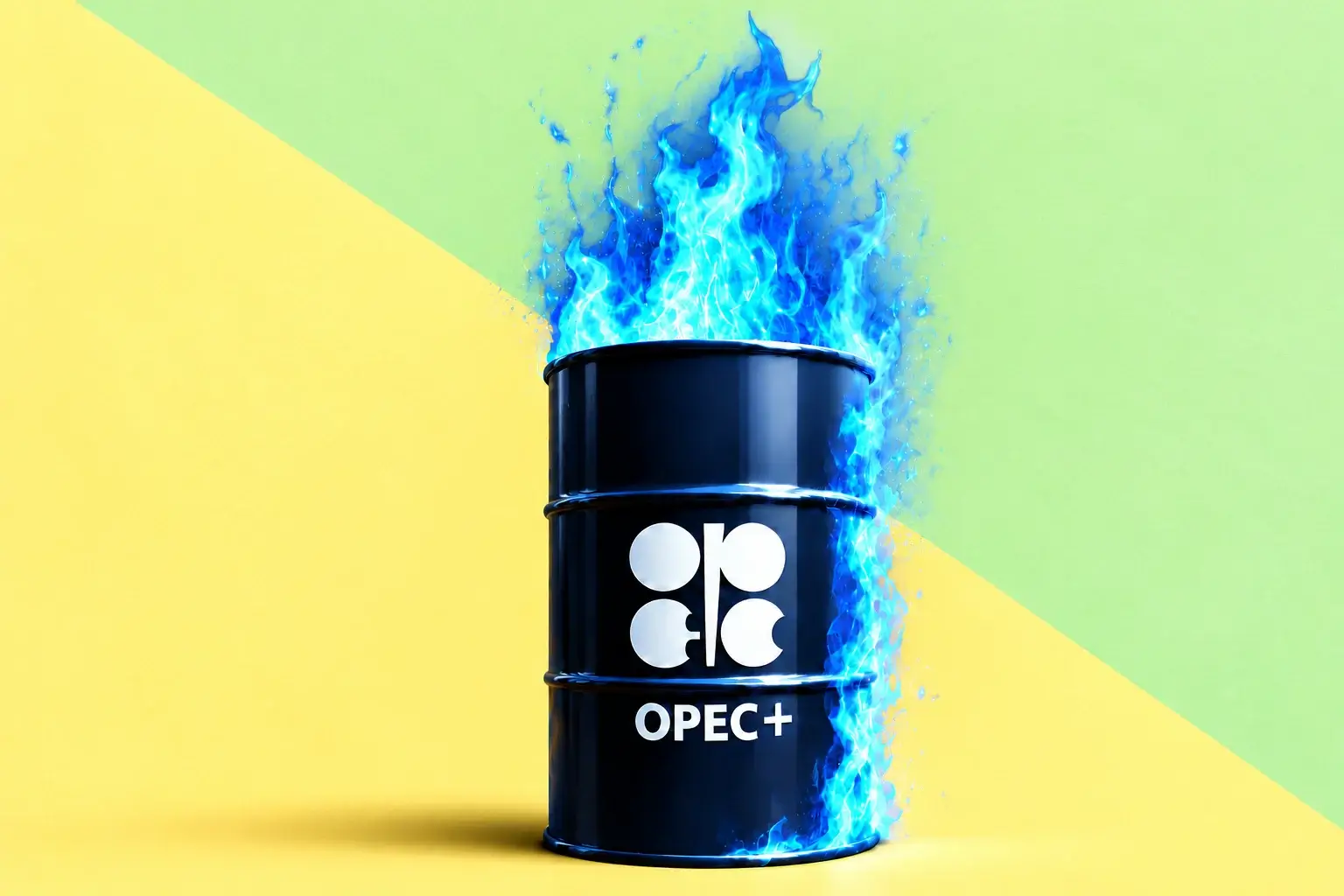
Working against the war premium is the supply response from the cartel. OPEC+ approved another increase in July production quotas of 188,000 barrels per day, continuing its policy of adding barrels back to the market despite the persistent supply risks stemming from the Middle East tensions. The decision is a bet that the group can capture market share and meet demand while prices are elevated, and it adds a bearish counterweight to the geopolitical bid. The math is delicate: OPEC+ is pumping more into a market where Hormuz is disrupting Persian Gulf flows, which partly offsets the supply loss from the conflict. If the war de-escalates and Hormuz reopens, the additional OPEC+ barrels would hit a market that suddenly has too much supply, accelerating any downside move. For now, the production increase is a modest headwind against the much larger geopolitical force, but it's a reminder that the supply side isn't a one-way bet — the cartel is actively adding volume even as the war removes it.
China's Demand Pullback
The demand side has its own bearish wrinkle. Fresh data has indicated an aggressive pullback in oil imports by China, the world's largest importer, which has leaned on its own inventories rather than overseas supply since the start of the conflict. That inventory-drawdown strategy has limited the upward pressure on prices by reducing China's marginal demand in the spot market precisely when the war premium was pushing prices higher. It's a rational response — why pay elevated, war-inflated prices when you can draw down stockpiles — but it caps the rally and signals softer underlying demand from the key consumer. The China pullback is part of the broader demand-weakness story that drove crude down roughly 11% last week before the weekend re-escalation. If Chinese buyers stay on the sidelines and continue drawing inventory, the demand floor under oil weakens, which is one of the reasons forecasters see two-sided risk rather than a clear path higher. The interplay between China's demand restraint and the Middle East supply premium is the central tension in the market.
The Backdrop: From War to Ceasefire to Re-escalation
To read today's price action, you have to track the arc. The US and Israeli-led war against Iran began February 28, sending crude sharply higher through the spring and lifting both benchmarks more than 45% at the peak. Brent topped out near $107 and WTI near $102 in mid-May as the conflict raged and Hormuz fears mounted. Then an April 8 ceasefire and subsequent hopes for a US-Iran deal began draining the premium, and the decline accelerated last week — Brent and WTI closed off 11.1% and 9.6% respectively, their worst weekly performance since mid-April, on weaker global demand and the lack of a diplomatic breakthrough. By Friday, Brent had slid 2% to around $93 as the bears took control. Then the June 7 missile exchange flipped the script overnight. Even after last week's selloff, both benchmarks remain up more than 30% since the war started. That arc — war spike, ceasefire fade, re-escalation bounce — is the whole story, and it explains why oil is whipsawing inside the $90-$100 band rather than trending cleanly in either direction.
The Technical Map: The $90-$100 Battleground
The chart reflects a market trapped in a wide, volatile range. WTI is holding the $90 handle after Monday's bounce, with the session's spike to around $94 marking the immediate resistance, followed by the $98 area that prices touched during prior escalations and the psychologically critical $100 level, with the May high near $102 the bigger ceiling. On the downside, WTI support sits around $90, then the high-$80s, with last week's lows the deeper floor. Brent mirrors the setup: holding $94 with resistance at the $96.47 spike high, then $98 and the round $100 level, and the May peak near $107 as the longer-term cap; support runs at $93, then $90. The $90-$100 band is the operating range that has held through the conflict, and the technical question is binary — a sustained break above $100 would signal the war premium is expanding and target the May highs, while a clean break below $90 would confirm the de-escalation and demand-weakness narrative is winning. Until one of those levels gives way, expect more spike-and-fade volatility within the range.
Read More
-
Yen Stalls at 160 Despite a 3% JGB and Tokyo Core CPI at 2.0% — Intervention Sits at 164, Friday's Payrolls Decide
02.09.2026 · TradingNEWS ArchiveEnergy
-
QQQ ETF ($706.22) Slides 7.4% Below Its High as the Market Reprices the AI Capex Bill — $686.57 Target if $700 Breaks
22.10.2026 · TradingNEWS ArchiveStocks
-
XRPI ($7.00) and XRPR ($10.74) Slide Toward 52-Week Lows as Spot XRP ETF Flows Stall at $708,510
22.10.2026 · TradingNEWS ArchiveCrypto
-
NG ($2.775) Decoupled From Europe’s €88 Gas Crisis as LNG Feedgas Hits 18.9 Bcf/d — $3.30 Upside on Cold Weather
22.10.2026 · TradingNEWS ArchiveCommodities
-
Dollar-Yen (157.35) Loses 157.65 as the Yen Rallies on Haven Demand — 155 Target if 156 Breaks
22.10.2026 · TradingNEWS ArchiveForex
The Two-Sided Forecast: Supply Risk vs. Demand Weakness
The institutional view captures the standoff perfectly. Fourth-quarter 2026 forecasts put Brent around $90 and WTI around $83, with the explicit warning that the risks are two-sided. On one side, persistent Middle East supply disruptions — the Hormuz near-closure, the conflict, the threat of renewed escalation — could push prices meaningfully higher, well above $100 if the strait stays blocked or the war intensifies. On the other side, weakening global demand, led by China's import pullback and broader economic softness, could create real downside risk, dragging crude back toward the low $80s. The two-sided framing is the honest assessment: this isn't a market with a clear directional bias, it's a market where two powerful, opposing forces are roughly balanced, and the outcome depends on which one breaks first. The forecast range below current prices reflects the view that, absent a major escalation, the demand weakness and OPEC+ supply additions eventually win out — but that's a Q4 call, and between now and then, the geopolitical headlines dominate.
The Macro Crosswind
Oil's move feeds directly into the broader macro picture that's driving every other market this week. The crude spike is one of the forces lifting inflation expectations, pushing Treasury yields to around 4.57%, and reinforcing the case for the Federal Reserve to stay restrictive — or hike — after Friday's hot jobs report. Higher energy prices are a direct input into the May Consumer Price Index due Wednesday, which is expected to show inflation accelerating, in part because of the energy surge. That creates a feedback loop: the oil spike stokes inflation fears, which lift yields and the dollar, and a stronger dollar mechanically pressures dollar-denominated crude. It's why oil and the rate story can't be analyzed in isolation right now. A hot CPI on Wednesday would confirm the energy-driven inflation narrative and keep the Fed hawkish, while also reflecting the very oil prices doing the driving. The crosswind cuts both ways — the conflict that's supporting crude is also the conflict feeding the inflation that's pressuring risk assets and, eventually, demand.
Price Forecast: The Range and the Triggers
The base case is continued range-bound trading between $90 and $100 for Brent, with WTI a few dollars below, marked by sharp spike-and-fade volatility on every Middle East headline. The bullish path: the 60-day ceasefire collapses, the strikes resume, and the Hormuz blockage extends beyond mid-June — a combination that would push Brent through $100 toward the May high near $107 and WTI toward $100-$102. The bearish path: Trump's diplomacy holds, Iran and Israel stand down, and the strait shows signs of reopening, which would drain the war premium and send Brent back toward $90 and below, with Q4 forecasts pointing toward the low $80s for WTI as OPEC+ barrels and China's demand pullback take over. The swing factors are the durability of the ceasefire, the status of the Strait of Hormuz, and Wednesday's CPI. For now, the re-escalation has the premium back in the market, but the speed of Monday's fade shows how quickly that can reverse. Trade the range until a level breaks.
The Verdict
Range-bound and headline-driven, with the geopolitical premium back but unstable. Oil's rebound — Brent to $94.38, WTI to $91.60, after an intraday spike of more than 5% — reflects the weekend re-escalation reigniting a war premium that had drained out over the prior week. The structural floor is real: the Strait of Hormuz remains near-closed, the conflict is unresolved, and both benchmarks are still up more than 30% since the war began. But the bearish counterweights are equally real — OPEC+ is adding 188,000 barrels per day, China is drawing down inventory instead of buying, and global demand is softening. The line is clean: above $100, the escalation thesis takes over and the May highs come into view; below $90, the de-escalation and demand-weakness narrative wins and the low $80s beckon by Q4. In between, expect more spike-and-fade volatility on every headline out of the Middle East. The single most important variable is whether Trump's 60-day ceasefire holds — and with the truce already conditional on Israel staying out of Lebanon, that's a fragile foundation. Trade the range, respect the Hormuz tail risk, and watch Wednesday's CPI for the macro overlay.