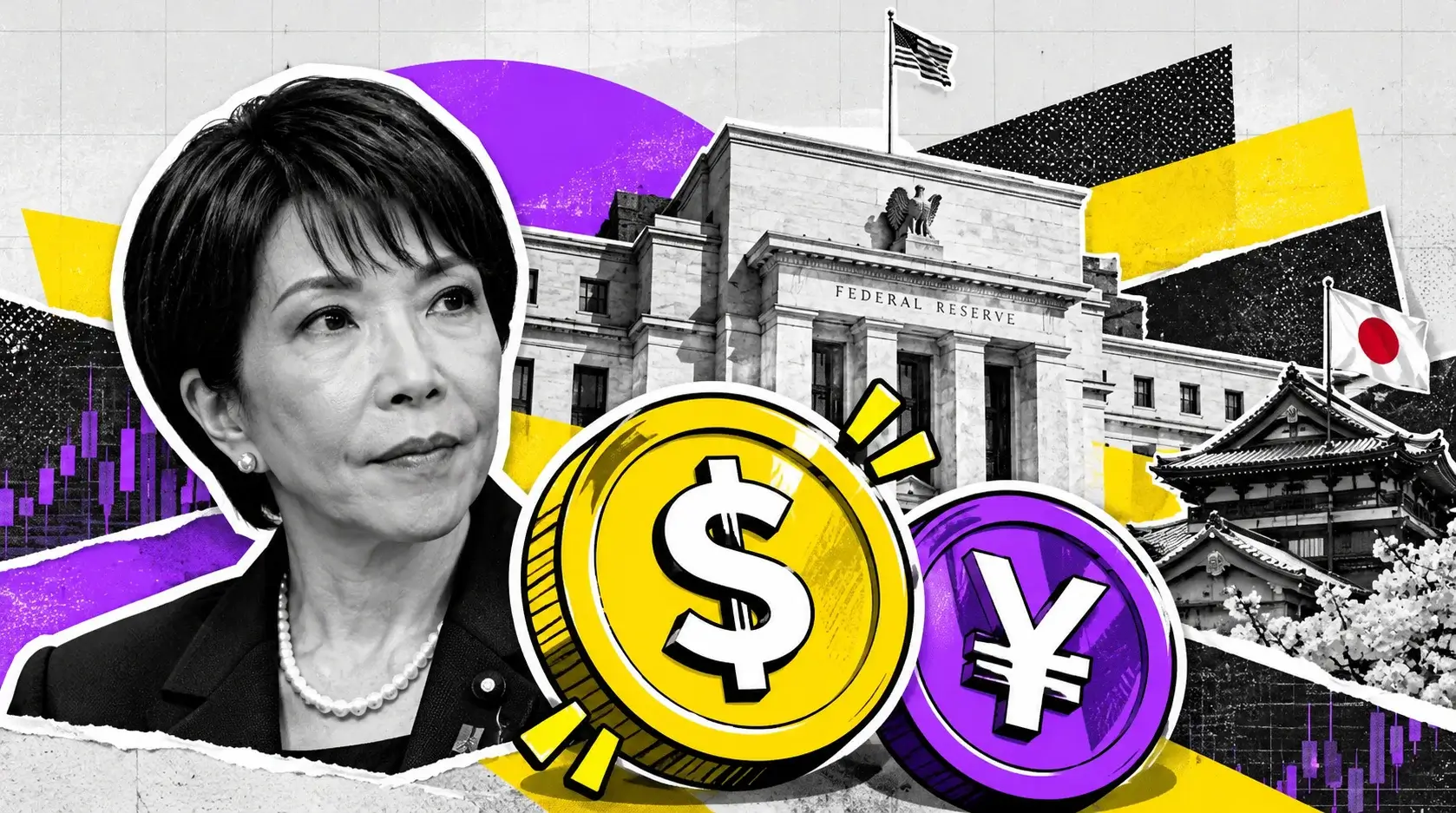
Dollar-Yen Coils at 160 Before the Fed-BoJ Double Header — The 250bp Rate Gap Is the Anchor
Both central banks decide June 17 — the BoJ hiking to 1.00%, the Fed holding with hawkish dot-plot risk | That's TradingNEWS
Key Points
- USD/JPY sits at the 160 battleground into a same-day Fed-BoJ showdown June 17; support at the 20-day EMA near 158.84, resistance at 161.
- The BoJ is expected to hike 25bp to 1.00%, but the ~250bp gap vs the Fed's 3.50%–3.75% keeps the carry trade alive and the yen weak.
- The yen is down 10.45% over the year despite BoJ tightening; intervention risk from Tokyo caps the upside near the 1986-era 161 level.
The setup is a pair pinned at its battleground. The 160 level has been the line USD/JPY has consolidated just below since late March, with multiple attempts to break decisively above it stalling. That makes 160 the pivot for the whole forecast — a level loaded with technical significance, intervention risk from Tokyo authorities, and now a dual central-bank catalyst that will determine which way it breaks. The yen recovering toward 160 from the prior session's losses reflects the market positioning for a BoJ hike that should, in theory, support the currency.
The tension is that the yen has been chronically weak despite the BoJ tightening, and the reason is the rate gap. Even with the BoJ going to 1.00%, the Fed at 3.50% to 3.75% leaves a differential of roughly 250 basis points in the dollar's favor — wide enough that the carry trade keeps the yen pinned near its weakest levels in decades. The yen has weakened 1.02% over the past month and 10.45% over the past year even as the BoJ normalized policy. The head-to-head showdown on June 17 is the test: a BoJ hike plus a dovish Fed could finally crack the 160 wall lower and strengthen the yen, while a BoJ hike against a hawkish Fed keeps the gap wide and the yen weak. At 160, USD/JPY sits at the battleground, with both central banks holding the matches.
The Yen Is Down 10% in a Year Despite a Tightening BoJ
The defining paradox of USD/JPY is that the yen has kept weakening even as the Bank of Japan has been raising rates. The Japanese currency has weakened 1.02% over the past month and is down 10.45% over the past twelve months, a steady depreciation that has persisted through a period when the BoJ moved decisively away from its decades-long ultra-loose policy. A currency whose central bank is tightening should be strengthening — yet the yen has done the opposite, and understanding why is the key to the whole forecast.
The answer is the still-wide interest-rate gap between Japan and the US, which has largely offset the BoJ's gradual tightening path and the repeated intervention efforts by authorities in Tokyo. Even as the BoJ raised rates, the gap to US rates remained so large that the carry trade — borrowing cheap yen to buy higher-yielding dollar assets — kept the structural pressure on the yen firmly to the downside. The BoJ's hikes narrowed the gap at the margin, but not nearly fast enough to flip the fundamental math that keeps the yen weak.
That paradox frames the June 17 showdown. The BoJ going to 1.00% is another step in the normalization, but the yen's 10.45% annual decline shows that incremental BoJ hikes haven't been enough to overcome the gap. The currency has been fighting a losing battle — tightening at home offset by a far higher rate structure abroad and the carry flows that exploit it. The yen's chronic weakness despite the BoJ's tightening is the structural reality that makes the bulls cautious even as the central bank normalizes. For the yen to genuinely strengthen, either the BoJ has to accelerate its hikes or the Fed has to ease meaningfully — and until the gap closes, the carry trade keeps the pressure on. The 10% annual depreciation is the evidence: a tightening BoJ hasn't been able to save the yen, because the gap is too wide. That's the anchor the June 17 decisions have to overcome.
The BoJ Goes to 1% — Historic Normalization, Slow Pace
The Japanese half of the showdown is a historic milestone delivered at a glacial pace. The Bank of Japan is widely expected to raise its benchmark interest rate by 25 basis points to 1.00% at the conclusion of its two-day meeting on June 17 — a level that, while still extraordinarily low by global standards, represents a continuation of the most significant policy shift in modern Japanese monetary history. The BoJ ended yield curve control in March 2024, abandoned negative rates, and has been gradually hiking since, with the move to 1.00% extending a normalization that marks the end of decades of zero and negative rate policy.
The case for the hike is inflation and the currency. The BoJ Summary of Opinions from recent meetings showed a majority of policymakers supporting interest-rate hikes in the near term while warning of high inflation risks, and the December meeting's opinions advocated remaining on the tightening path through 2026. The move to 1.00% is aimed at containing inflation and supporting the weak yen — a currency whose depreciation has been importing inflation and squeezing Japanese households. The BoJ controls the single most important variable in any USD/JPY forecast: Japanese interest rates, and it's slowly raising them.
The historic significance is real, but so is the slow pace, and that's the rub for the yen. After decades of ultra-loose policy, the shift toward normalization is a generational turning point — Japan moving from the world's anchor of cheap money toward a more normal rate structure. But the pace is gradual, 25 basis points at a time, and at 1.00% the BoJ rate is still a fraction of the Fed's 3.50% to 3.75%. The normalization is historic in direction but modest in magnitude, which means each hike narrows the gap only incrementally. The move to 1.00% is the right direction for yen bulls — a tightening BoJ is the structural force that, over time, closes the gap and strengthens the currency. But the slow pace means the yen's recovery is a long, grinding process rather than a sharp reversal. The BoJ going to 1% is a milestone. It's also a reminder of how far the BoJ still has to go before the rate gap stops crushing the yen.
The Fed Side: Hawkish Risk Holds the Dollar Firm
The American half of the showdown is the Fed, and the dollar's firmness reflects the hawkish risk in the dot plot. The FOMC concludes its two-day meeting June 17, with the rate decision, the updated dot plot, and Chair Kevin Warsh's debut press conference all landing the same day the BoJ decides. The Fed is near-certain to hold at 3.50% to 3.75% — the decision itself is a non-event — but the dot plot and Warsh's tone carry real hawkish risk that supports the dollar against the yen.
US inflation at 4.2% in May, the highest since April 2023, has the market pricing meaningful odds of a Fed hike by December, and that hawkish expectation keeps the dollar firm. If Wednesday's dot plot confirms the tilt — showing the committee penciling in hikes or removing references to cuts — the dollar firms further and USD/JPY pushes back above 160, because a hawkish Fed widens the rate gap that already favors the dollar. The greenback's resilience through 2026, propped by sticky inflation and the Iran-war risk premium, has been a persistent force keeping the yen weak.
Warsh is the wildcard, sworn in May 22 as the 17th Fed chair, making his debut at the podium. His tone on whether the oil collapse eases the inflation path will shape the dollar's direction. A hawkish Warsh strengthens the dollar and pushes USD/JPY higher toward the intervention zone; a dovish-leaning Warsh softens the dollar and gives the yen room to strengthen, helping the BoJ hike crack 160 lower. The Fed half of the showdown is the dollar-positive force, set directly against the BoJ's yen-positive hike. The two decisions hitting the same day make USD/JPY the purest expression of the relative-hawkishness trade — the BoJ tightening to support the yen, the Fed holding with hawkish risk to support the dollar. The dollar's firmness into the decision reflects a market that leans toward the hawkish Fed outcome, which is why the yen needs the BoJ hike plus a dovish Fed to genuinely break 160 lower.
The Rate Gap Is the Whole Story — and It's Still 250bp
Every move in USD/JPY ultimately reduces to one number: the interest-rate differential between the US and Japan. With the Fed at 3.50% to 3.75% and the BoJ moving to 1.00%, the gap sits at roughly 250 to 275 basis points in the dollar's favor — still enormous by the standards of major currency pairs, and the gravitational force that keeps the yen weak. The gap is the entire trade: as long as US rates dwarf Japanese rates, the carry math favors borrowing yen and buying dollars, and that flow pins the yen near its lows.
The crucial dynamic is that the gap is shrinking for the first time in years, but slowly. The differential has compressed from roughly 325 basis points in early 2026 toward 250 to 275 basis points, driven by the BoJ hiking while the Fed holds and is eventually expected to ease. The BoJ tightening narrows the gap from below; the eventual Fed easing would narrow it from above. The pace of that compression determines whether the yen bulls or the dollar bulls are right — faster compression strengthens the yen, slower compression keeps it weak.
The problem for yen bulls is that 250 basis points is still a wide gap, wide enough to sustain the carry trade and keep the structural pressure on the yen. Even after the BoJ's hike to 1.00%, the differential remains large enough that the fundamental math hasn't flipped — the dollar still pays vastly more than the yen, and the carry flows persist. That's why the yen has weakened 10.45% over the past year despite the BoJ tightening: the gap narrowed but stayed wide. For the yen to genuinely strengthen, the gap needs to compress meaningfully below 250 basis points, which requires either the BoJ to accelerate hikes or the Fed to cut. The rate gap is the whole story, and at 250 basis points it's still firmly in the dollar's favor. The June 17 decisions move the gap at the margin — a BoJ hike narrows it, a hawkish Fed dot plot could widen the expected path — but the structural reality is that the gap remains wide enough to keep the yen on the back foot until the compression accelerates.
Read More
-
Yen Stalls at 160 Despite a 3% JGB and Tokyo Core CPI at 2.0% — Intervention Sits at 164, Friday's Payrolls Decide
02.09.2026 · TradingNEWS ArchiveEnergy
-
QQQ ETF ($706.22) Slides 7.4% Below Its High as the Market Reprices the AI Capex Bill — $686.57 Target if $700 Breaks
22.10.2026 · TradingNEWS ArchiveStocks
-
XRPI ($7.00) and XRPR ($10.74) Slide Toward 52-Week Lows as Spot XRP ETF Flows Stall at $708,510
22.10.2026 · TradingNEWS ArchiveCrypto
-
NG ($2.775) Decoupled From Europe’s €88 Gas Crisis as LNG Feedgas Hits 18.9 Bcf/d — $3.30 Upside on Cold Weather
22.10.2026 · TradingNEWS ArchiveCommodities
-
Dollar-Yen (157.35) Loses 157.65 as the Yen Rallies on Haven Demand — 155 Target if 156 Breaks
22.10.2026 · TradingNEWS ArchiveForex
Why a BoJ Hike Might Not Save the Yen
The counterintuitive reality heading into June 17 is that the BoJ hiking to 1.00% might not strengthen the yen much, and the reason is the gap. Markets have largely anticipated the BoJ move — the Summary of Opinions telegraphed it, the market priced it, and the yen recovered toward 160 in anticipation. A hike that's already expected is partly priced, which means the actual delivery may produce a muted reaction unless the BoJ surprises with hawkish guidance about the pace of future hikes.
The deeper issue is that even a hike to 1.00% leaves the rate gap at roughly 250 basis points, still wide enough to sustain the carry trade. A 25-basis-point move narrows the differential marginally, but it doesn't flip the fundamental math that keeps yen-borrowing attractive. For the yen to genuinely rally, the BoJ would need to signal a faster, more aggressive hiking path that compresses the gap meaningfully — and the BoJ has consistently favored gradualism, raising rates slowly while watching inflation and growth. A measured hike with cautious guidance keeps the carry trade alive and the yen weak.
This is the trap for yen bulls. The BoJ hike is yen-positive in direction, but the slow pace and the still-wide gap mean it may not be enough to overcome the dollar's structural advantage, especially if the Fed stays hawkish the same day. The scenario that genuinely strengthens the yen is a BoJ hike combined with hawkish forward guidance and a dovish Fed — the BoJ accelerating while the Fed eases, compressing the gap from both ends. The scenario that keeps the yen weak is a BoJ hike with cautious guidance against a hawkish Fed, leaving the gap wide. Given the BoJ's gradualist track record and the Fed's hawkish risk, the muted outcome is a real possibility. A BoJ hike to 1.00% is the right step for the yen, but a single gradual hike against a 250-basis-point gap and a firm dollar may not save the currency. The yen needs the BoJ to be more hawkish and the Fed to be more dovish — and getting both on the same day is the bull's narrow path.
The 160 Wall and Intervention Risk
The 160 level is more than a technical marker — it's a battleground loaded with intervention risk that caps USD/JPY's upside. The pair has been consolidating just below 160 since late March, with multiple attempts to break decisively above it stalling, and that repeated rejection reflects both technical resistance and the looming threat of intervention by Japanese authorities. Tokyo has intervened repeatedly to support the yen, and the 160-to-161 zone is where the risk of official action rises sharply, because that's the level associated with the yen's weakest readings in decades.
The historical context gives the level its weight. USD/JPY hit 161 in July 2024, a level not seen since 1986, and that extreme prompted aggressive intervention from Japanese authorities to halt the yen's slide. The memory of that intervention hangs over the pair every time it approaches 160 — the market knows that pushing USD/JPY meaningfully above 160 invites official yen-buying that can produce sharp, violent reversals. That intervention risk acts as a soft ceiling, capping the dollar's gains against the yen even when the rate gap argues for a higher pair.
The 160 wall is the technical and political line that defines the near-term forecast. On the upside, a hawkish Fed and a muted BoJ could push USD/JPY toward 160-161, but the intervention risk caps how far it can run — Tokyo authorities have shown they'll act to prevent disorderly yen weakness. On the downside, the BoJ hike plus a dovish Fed could finally crack 160 lower, opening the path toward the yen-strengthening scenario the bulls want. The 160 battleground is where the rate-gap pressure pushing USD/JPY higher meets the intervention threat capping it, and the June 17 decisions will determine which force wins. The repeated stalls just below 160 since late March show the market respects the intervention risk, and that risk is the reason USD/JPY hasn't broken decisively higher despite the wide rate gap. The 160 wall holds the pair in check, and breaking it in either direction is the near-term trade.
The Carry Trade That Won't Die
The structural force keeping the yen weak is the carry trade, and it has proven remarkably durable. The mechanics are simple: borrow cheap yen at near-zero rates, convert to dollars, and invest in higher-yielding US assets, pocketing the rate differential. As long as the gap between US and Japanese rates stays wide — and at 250 basis points it does — the carry trade is profitable, and the flows it generates keep the yen pinned near its lows. The yen has become the world's premier funding currency, structurally shorted by money exploiting the rate gap.
The carry trade is why the yen's weakness has been so persistent. Even as the BoJ raised rates and Tokyo intervened, the gap remained wide enough that the carry trade stayed attractive, and the structural yen short kept the currency depressed. The 10.45% annual depreciation is the carry trade in action — a steady drain on the yen as money borrows it to fund higher-yielding positions elsewhere. The trade ripples through carry positioning, corporate hedging flows, and speculative positioning, all of which lean against the yen.
The risk to the carry trade — and the upside scenario for the yen — is the unwind. Carry trades are profitable until they aren't, and a sharp narrowing of the rate gap or a spike in volatility can trigger a violent unwind as the borrowed yen positions get covered all at once, sending the yen surging. The August 2024 carry-trade unwind was a reminder of how fast that can happen. For now, the carry trade persists because the gap stays wide, but the BoJ's tightening and the Fed's eventual easing are slowly eroding its profitability. The carry trade that won't die is the structural anchor on the yen, and it's the reason incremental BoJ hikes haven't been enough to strengthen the currency. The longer-term yen bull case rests on the gap compressing enough to make the carry trade unattractive and trigger an unwind. Until then, the carry trade keeps the yen weak, and the June 17 decisions either accelerate its erosion or extend its life.
The Differential Compression Trade
The longer-term bull case for the yen is the differential compression trade, and it's the structural story underneath the near-term battleground. The rate gap between the US and Japan is shrinking for the first time in years — the BoJ tightening from below while the Fed is expected to ease from above — and that compression is the force that eventually strengthens the yen. The differential has narrowed from roughly 325 basis points in early 2026 toward 250 to 275 basis points, and the projections assume it compresses further toward 250 basis points or below by the fourth quarter as the BoJ reaches 1.00% to 1.25% and the Fed cuts toward 3.50% to 3.75%.
The compression trade is what makes the yen bulls' case. As the gap narrows, the carry trade becomes less profitable, the structural yen short loses its appeal, and the flows that have depressed the yen begin to reverse. The pace of that compression determines whether the yen bulls or the dollar bulls are right — faster compression, driven by accelerated BoJ hikes or aggressive Fed cuts, strengthens the yen; slower compression keeps it weak. The trade is a bet on the relative paths of the two central banks, and the June 17 decisions are a data point in that longer arc.
The challenge for the compression trade is timing and pace. The BoJ has been gradualist, and the Fed's easing is on hold given 4.2% inflation, which means the compression has been slow. The yen bulls need the BoJ to keep hiking and the Fed to eventually cut, and both have been slower than the bulls hoped — which is why the yen has stayed weak despite the compression being underway. The differential compression trade is the structural reason to expect the yen to strengthen over time, but the gradual pace means it's a slow grind rather than a sharp reversal. The June 17 showdown advances the compression — a BoJ hike narrows the gap, while a hawkish Fed could stall the expected easing and slow it. The compression trade is the long-term yen bull case; the near-term reality is that the gap is still wide and the pace is slow. The yen strengthens when the compression accelerates, and that requires both central banks to move in the yen's favor faster than they have been.
The Technical Map: 158.84 Floor, 161 Ceiling
The chart frames the battleground, and it's defined by the 160 level. USD/JPY has maintained a bullish near-term bias by holding above its 20-day exponential moving average, which has sat in the 158.84 to 159.69 range — that EMA is the near-term floor, and as long as spot holds above it, the recent uptrend structure stays intact. The Relative Strength Index around 58 sits in positive territory without yet signaling overbought conditions, consistent with a pair grinding higher within its range rather than at an extreme.
On the upside, the 160 level is the immediate battleground, with the 161 zone — the July 2024 high not seen since 1986 — as the ceiling where intervention risk peaks. The repeated stalls just below 160 since late March define the resistance, and a decisive break above 160 would target 161 and the intervention zone, though Tokyo's threat caps how far the pair can run. On the downside, below the 20-day EMA at 158.84, the longer-term pivot points sit lower — LiteFinance has flagged declining-bias pivots in the 151 to 157 range, reflecting the view that USD/JPY is likely to decline over the medium term as the differential compresses.
The technical posture matches the fundamental standoff. USD/JPY at 160 sits right at the battleground, above the 20-day EMA floor with a bullish near-term bias but capped by the 160-161 intervention zone. The 158.84 EMA is the line that has to hold to keep the uptrend intact; a break below it would signal the yen is strengthening and shift the structure toward the yen-bull compression scenario. A break above 160 toward 161 would signal the dollar is winning the rate-gap battle, but into the teeth of intervention risk. The map is a coiled range at the battleground: 158.84 floor, 160-161 ceiling, with the June 17 decisions as the catalyst to break it. The bullish near-term bias above the EMA reflects the wide rate gap, while the medium-term declining pivots reflect the compression trade. The technicals capture the tension — near-term dollar-firm, medium-term yen-recovery, with 160 as the line that decides the next move.
The Dual-Decision Sequencing
The structure of June 17 creates a unique simultaneity that makes USD/JPY the most volatile pair of the week. Both the BoJ and the Fed conclude two-day meetings the same day, which means the yen has to digest two central-bank decisions from opposite sides of the trade in rapid succession. The BoJ decision comes during Asian hours, the Fed decision during US afternoon hours — close enough that the market is processing both within a single trading day, with the potential for a sharp two-step move.
The combinations define the outcomes. The most yen-bullish scenario is a hawkish BoJ — hiking to 1.00% with guidance signaling faster future hikes — followed by a dovish Fed that softens the dollar. That combination compresses the gap from both ends and could crack USD/JPY below 160 toward the 158.84 EMA and lower. The most yen-bearish scenario is a cautious BoJ — hiking but with gradualist guidance — followed by a hawkish Fed that pencils in a December hike. That keeps the gap wide and pushes USD/JPY toward 160-161 and the intervention zone. The mixed scenarios produce choppier, range-bound outcomes as the two signals partly offset.
The sequencing risk is why USD/JPY is pinned at 160 rather than positioning aggressively. The market can't price the combined outcome until both decisions land, and the simultaneity means a potential whipsaw — an initial move on the BoJ's Asian-hours decision, then a second, possibly opposing move on the Fed's US-hours decision. For a pair caught between two central banks deciding the same day, the dual-decision sequencing creates the conditions for a violent move once both are known. The base case — given the BoJ's gradualism and the Fed's hawkish risk — tilts toward the gap staying wide and USD/JPY holding near 160, but the simultaneity means the path could be volatile, with the BoJ and Fed pulling the pair in sequence. Two decisions, one day, one pair at its battleground — the recipe for the week's sharpest currency move.
What the Iran Unwind Does to the Yen
The Iran deal adds a cross-current to the yen story through the risk-appetite and haven channels. The yen has historically functioned as a safe-haven currency, strengthening during periods of risk aversion as money seeks safety — but in 2026, that haven role has been overwhelmed by the carry trade and the rate gap. As the US-Iran peace deal lifted risk appetite and sent equities to records, the risk-on rotation worked against the yen, since money flowed out of safe havens and into higher-yielding and higher-beta assets, reinforcing the carry trade that funds those positions with borrowed yen.
The risk-on environment is broadly yen-negative in the near term. When risk appetite is high and volatility is low, the carry trade thrives — money borrows cheap yen to fund risk positions, and the yen weakens. The Iran deal's calming effect on markets, by reducing the geopolitical fear that might otherwise drive haven demand for the yen, removes a potential source of yen strength and lets the carry trade run. The resilient risk appetite that defined the post-deal rally is part of why the yen recovered only modestly toward 160 rather than strengthening sharply.
The flip side is the dollar dynamic. As the Iran deal's haven premium fades from the dollar, the greenback's safety bid softens, which is marginally yen-supportive in the USD/JPY cross. But that effect is secondary to the rate gap and the carry trade, which dominate the pair. The Iran unwind's net effect on the yen is modestly negative through the risk-on channel — a calmer, risk-seeking market favors the carry trade and weakens the yen — partially offset by the softening dollar haven bid. For the USD/JPY forecast, the Iran deal is a minor cross-current relative to the June 17 central-bank decisions and the rate gap. The risk-on rotation keeps the carry trade alive and the yen weak; the fading dollar haven premium provides a small offset. The macro backdrop nudges the yen, but the central banks and the gap move it. The Iran unwind reinforces the carry-trade pressure that's been the yen's anchor all year.
The Forecasts: 150 to 164 and the Compression Bet
The forecast dispersion captures the genuine disagreement over whether the yen finally strengthens or the dollar stays dominant. Year-end 2026 forecasts for USD/JPY range from 150 to 164 — a 14-point spread that reflects the uncertainty over the pace of the differential compression. The bears on USD/JPY, who are bulls on the yen, see the pair declining toward 150-155 as the BoJ keeps hiking, the Fed eventually eases, and the gap compresses enough to trigger a carry-trade unwind and yen strength. LiteFinance's declining-bias pivots in the 151-157 range reflect this medium-term yen-recovery view.
The bulls on USD/JPY, who are bears on the yen, see the pair holding near or above 160 toward 164 as the rate gap stays wide, the BoJ's gradualism keeps the carry trade alive, and the dollar's resilience persists. This view rests on the structural reality that has defined 2026 — the yen weakening 10.45% despite the BoJ tightening, because the gap is too wide and the compression too slow. The projections that assume the BoJ raises rates to 1.00-1.25% by late 2026 and the Fed cuts to 3.50-3.75% see the differential compressing from 325 basis points toward 250-275, with the pace determining whether the yen bulls or dollar bulls win.
The dispersion from 150 to 164 isn't analysts disagreeing on the direction of policy — both sides agree the BoJ is tightening and the Fed is eventually easing. The disagreement is about pace. The yen bulls bet the compression accelerates enough to strengthen the yen toward 150-155; the dollar bulls bet the gap stays wide enough to keep USD/JPY near 160-164. The compression bet is the whole trade. Given the BoJ's gradualist track record and the Fed's hawkish hold on 4.2% inflation, the near-term reality favors the dollar bulls — the gap stays wide, the carry trade persists, and USD/JPY holds near 160. The medium-term structural case favors the yen bulls — the compression is underway and will eventually bite. The 14-point spread reflects the timing uncertainty, and the June 17 decisions are the first major test of which side the pace favors.
The Forecast: 160 Is the Line, the Gap Is the Anchor
The forecast resolves into three scenarios, gated by the June 17 dual decision. The yen-bullish case: a hawkish BoJ — hiking to 1.00% with guidance signaling faster future hikes to contain inflation — combined with a dovish Fed that acknowledges the oil collapse and softens the dollar. That compresses the gap from both ends, triggers carry-trade unwinding, and cracks USD/JPY below the 158.84 EMA and the 160 battleground, opening the path toward 155 and the medium-term yen-recovery the compression trade envisions. This is the scenario the yen bulls need, and it requires both central banks moving in the yen's favor the same day.
The base case: a gradualist BoJ — hiking to 1.00% but with cautious guidance — combined with a Fed that holds with a neutral-to-hawkish dot plot. The rate gap stays wide at roughly 250 basis points, the carry trade persists, and USD/JPY holds near the 160 battleground, capped by intervention risk on the upside and supported by the wide gap on the downside. The pair chops around 160, with the yen unable to break decisively higher despite the BoJ hike because the gap remains too wide and the BoJ too gradual. This is the most probable near-term path given both central banks' track records.
The yen-bearish case: a cautious BoJ against a hawkish Fed that pencils in a December hike and emphasizes inflation vigilance. The gap stays wide or widens on the expected path, the carry trade strengthens, and USD/JPY pushes through 160 toward 161 and the intervention zone — though Tokyo's intervention threat caps the upside and risks a violent reversal. The verdict: USD/JPY at 160 sits at the 2026 battleground, into the cleanest dual-central-bank showdown of the week, with the BoJ hiking to 1.00% and the Fed holding the same day. The yen has weakened 10.45% over the past year despite the BoJ tightening, because the rate gap — though shrinking from 325 toward 250 basis points — remains wide enough to sustain the carry trade. The BoJ hike is yen-positive in direction but may not save the yen given the slow pace and the wide gap, especially against a hawkish Fed. The 160 wall is the line, loaded with intervention risk that caps the upside; the rate gap is the anchor that keeps the yen weak. A hawkish BoJ plus a dovish Fed cracks 160 lower toward 155. A cautious BoJ plus a hawkish Fed pushes USD/JPY toward 161 and intervention. The base case holds near 160 as the gap stays wide. The compression trade is the yen's long-term hope; the wide gap is its near-term burden. June 17 decides the next move.