EUR/USD Price Forecast: Euro Holds 1.1640 as Iran Truce Sinks the Dollar — Narrowing Rate Gap vs 1.154 Support Test
The euro is wedged between a softening dollar driven by the tentative Iran ceasefire | That's TradingNEWS
Key Points
- EUR/USD holds near 1.1640 as a 60-day U.S.-Iran ceasefire MoU keeps the dollar on the back foot.
- The Fed sits at 3.50%–3.75% versus the ECB at 2.00%, but the gap is now narrowing.
- Support runs at 1.154 then 1.1470; sticky US inflation and a hawkish Warsh Fed cap upside.
EUR/USD enters the final session of May trading around the 1.1640 region, holding a handful of pips above recent multi-week lows and consolidating in a tight band as the market weighs a finely balanced mix of euro-positive and dollar-positive catalysts. The pair has come back to life over the past week, settling above the 1.1600 handle and at points pressing toward 1.1655 in early Friday trade, as safe-haven demand for the dollar faded following confirmation that Washington and Tehran have reached a memorandum of understanding to extend their ceasefire by 60 days. Yet the recovery is being met with caution rather than conviction, and the technical structure tells the story of a pair that has bounced but not broken out: on the shorter timeframes EUR/USD remains below its key simple moving averages, a configuration that signals rallies are likely to face supply, with the risk of a retest of nearby support firmly on the table. The honest read into month-end is that the euro is holding its ground rather than seizing the initiative — the dollar's retreat on ceasefire optimism has handed the single currency a tailwind, but the structural rate gap, the sticky U.S. inflation backdrop, and a Fed under hawkish new leadership are all conspiring to cap the advance, leaving the pair to consolidate while the market awaits the cluster of central-bank meetings and data releases that will set direction into June.
The Iran Ceasefire Is the Dollar's Swing Factor
The single most important short-term driver for EUR/USD is the on-again, off-again U.S.-Iran ceasefire saga, which acts almost entirely through the dollar channel and has produced some of the most violent currency moves of the year. The White House has confirmed an agreement on a memorandum of understanding to extend the ceasefire for 60 days and allow formal negotiations to proceed, but President Trump has pointedly withheld his approval, and Vice President JD Vance has flagged that several sticking points — chiefly Iran's uranium enrichment and control over the Strait of Hormuz — remain unresolved. The market mechanics are straightforward: when ceasefire hopes rise, safe-haven demand for the dollar fades, the greenback weakens, and EUR/USD rallies, which is exactly the dynamic that lifted the euro this week and at one point earlier in the period drove such a sharp unwind of safe-haven dollar flows that the Bloomberg Dollar Spot Index erased its entire 2026 gain in a single session. Conversely, every escalation or accusation of breach — and there have been many, with Iran at one point accusing the U.S. of violating the agreement — revives the dollar's haven bid and pressures the euro. The truce remains extremely fragile, with back-and-forth attacks in the Persian Gulf continuing and the Strait of Hormuz nowhere near fully reopened, which means EUR/USD will remain hostage to headlines: a confirmed, signed peace deal could knock the dollar lower within hours, while a collapse of the talks could send it surging on a flight to safety.
The Rate Gap Favors the Dollar — But It Is Narrowing
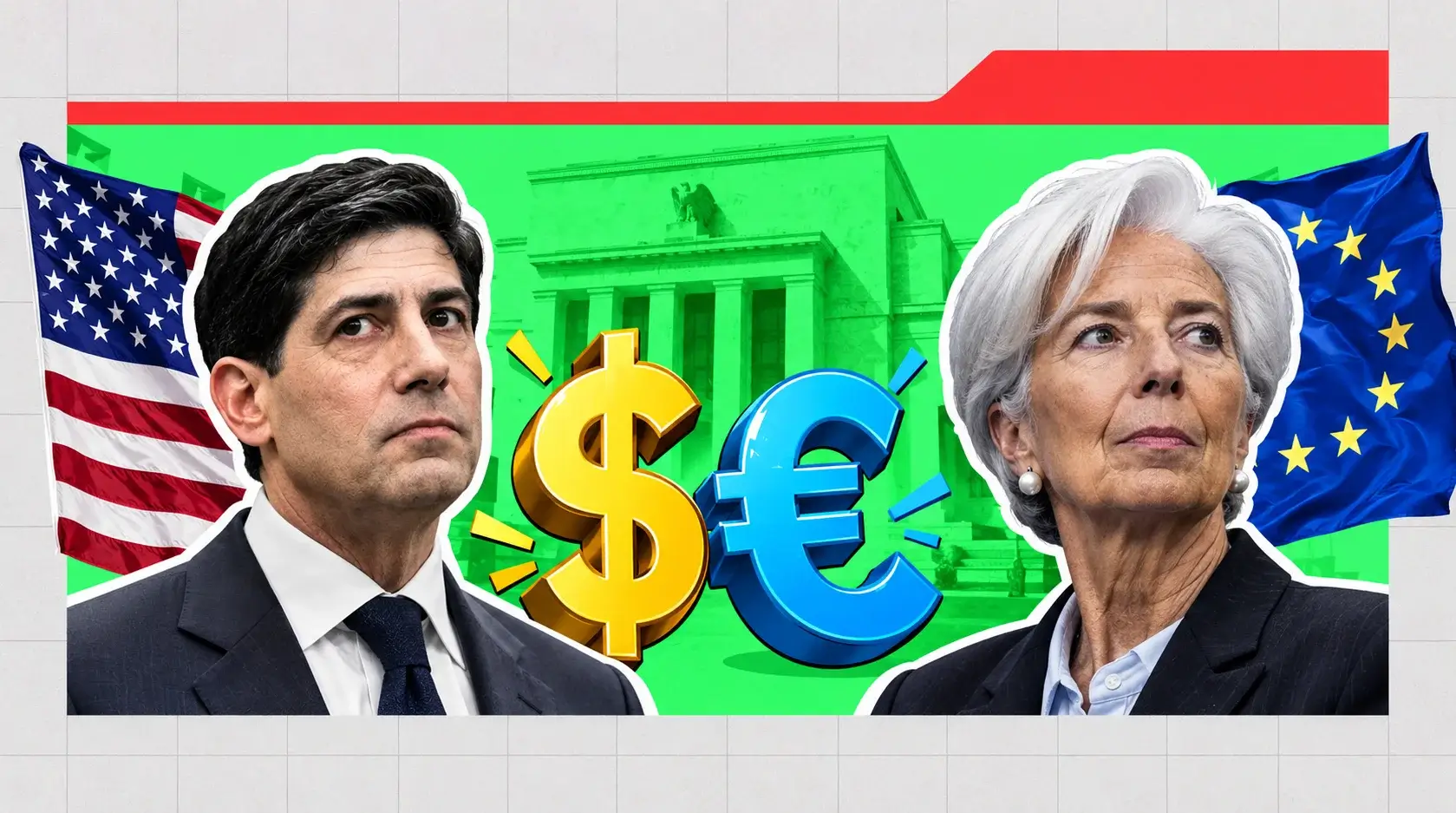
Beneath the geopolitical noise sits the structural foundation of the EUR/USD trade, and it is the interest-rate differential between the two central banks that ultimately anchors the pair's medium-term trajectory. The gap currently favors the dollar decisively, with the Federal Reserve holding its policy rate in the 3.50% to 3.75% range against a European Central Bank sitting far lower at 2.00% — a 150-to-175-basis-point advantage that, all else equal, draws capital toward dollar assets and weighs on the euro. The crucial development, however, is that this gap is now beginning to narrow, and that narrowing is the main structural story supporting the euro over the medium term. The convergence is being driven from both ends: in the United States, sticky inflation has left the Fed with little room to cut even as growth cools, but the more important shift is on the European side, where the ECB is increasingly signaling that its next move is a hike rather than a hold, which would shrink the differential and improve the euro's relative appeal. The takeaway for the forecast is that while the absolute rate gap remains a dollar-positive force in the here and now, the direction of travel has turned euro-supportive, and currency markets trade on the change in expectations rather than the level — so as the market prices the ECB catching up and the Fed staying put, the structural pressure that has held EUR/USD down for much of the cycle is gradually being relieved.
America's Stagflation Problem
A central pillar of the medium-term euro case is the deteriorating quality of U.S. economic data, which is starting to take on a distinctly stagflationary character — slow growth paired with sticky inflation, the worst possible combination for a central bank and, by extension, for a currency. The first-quarter GDP figure was revised down to a 1.6% annualized pace, below the 2.0% forecast and a clear signal that growth momentum is fading, while the consumer side has softened in tandem, with April consumer spending rising just 0.1% and personal income actually slipping 0.1% on the month. This matters enormously for EUR/USD because it boxes the Fed into an uncomfortable corner: the cooling growth would normally argue for rate cuts to support the economy, but the persistence of inflation removes the Fed's freedom to ease, leaving policy stuck at a restrictive level even as the expansion loses steam. A central bank trapped between weak growth and high inflation cannot deliver the kind of decisive, growth-supportive easing that would normally underpin its currency, and the longer the U.S. economy displays stagflationary symptoms, the more the market will question the dollar's resilience. For the euro, this is a relative-strength story: if the U.S. is sliding toward stagflation while the eurozone's central bank is preparing to hike into its own inflation problem, the policy divergence that long favored the dollar begins to reverse, and EUR/USD finds a fundamental tailwind that operates independently of the daily ceasefire headlines.
Sticky U.S. Inflation and the Warsh Fed's Bind
The inflation side of the American equation is what gives the dollar its residual strength and keeps the euro's advance capped, even as growth disappoints. Core PCE, the Fed's preferred inflation gauge, held at 3.3% year over year in April — its fastest pace in roughly three years — confirming that price pressures are not fading and leaving the Fed with little justification to cut. This sticky inflation is the reason the dollar has shown resilience even amid the ceasefire-driven safe-haven unwind, as investors increasingly reassess the Fed's trajectory and conclude that policymakers may need to keep a firmer grip on policy while energy-driven inflation risks linger. The complication for the dollar is the leadership transition: Kevin Warsh will preside over his first FOMC meeting in mid-June, and he inherits a genuinely thankless bind — increasing inflationary pressures and tepid growth on one hand, and a President demanding lower interest rates on the other, the opposite of what markets are betting on. This political tension introduces a wildcard for EUR/USD, because the market's hawkish read of Warsh has supported the dollar, but any sign that the new chair will bend to White House pressure for cuts would undermine the greenback sharply and propel the euro higher. For now the base case is a hawkish hold that keeps the dollar firm, but the June meeting looms as a binary event that could resolve the EUR/USD range in either direction depending on how Warsh navigates the politics of his inheritance.
The ECB Turns Hawkish
The mirror image of the Fed's bind is playing out across the Atlantic, where the European Central Bank is increasingly leaning hawkish in a way that directly supports the euro. The eurozone faces the same inflationary pressures stemming from the Iran war and elevated energy prices, with the euro-area annual inflation rate climbing to 3.0% in April from 2.6% in March, and the broader EU rate rising to 3.2% from 2.8% — an acceleration that has emboldened the hawks on the Governing Council. ECB board member Isabel Schnabel has explicitly stated that the central bank should raise interest rates in June even if the peace talks with Iran yield a deal, arguing that the conflict has lasted far longer than expected and that the inflation it has generated warrants a policy response regardless of the geopolitical outcome. This hawkish ECB pricing is a genuine euro tailwind, because it accelerates the narrowing of the rate gap that is the structural heart of the bullish EUR/USD case — if the ECB hikes from 2.00% in June while the Fed holds, the differential compresses and the euro's relative appeal improves. The risk to this thesis is that a significant cooling in eurozone inflation would reduce the urgency for an ECB hike and weaken the euro's fundamental tailwind, which is precisely why the upcoming eurozone CPI release is such a pivotal catalyst. For now, the ECB's hawkish posture is one of the clearest positives in the euro's column and a key reason the pair has been able to hold above 1.1600 despite the dollar's underlying rate advantage.
The Data Calendar Is Loaded and Two-Sided
The path for EUR/USD over the coming days runs through a densely packed and finely balanced data calendar, with catalysts that cut in both directions and explain why the pair is consolidating rather than trending. The eurozone May CPI release on June 3 is the first major hurdle: a hot print would reinforce the case for an ECB hike and lift the euro, while a significant cooling would reduce the ECB's hiking urgency and undercut the single currency's fundamental support at exactly the wrong moment. On the U.S. side, the May nonfarm payrolls report on June 6 carries enormous weight, because an upside surprise would likely find the dollar renewed support by easing fears of a sharp labor-market deterioration and giving the hawkish Fed cover to stay put, whereas a weak print would feed the stagflation narrative and pressure the greenback. Layered on top of these data points is the mid-June FOMC meeting — Warsh's first — which sits as the dominant event risk for the entire pair. The data flow this week and into next is, by design, evenly balanced between EUR-positive and USD-positive catalysts, which is why traders are reluctant to commit to a directional bet and why the pair has settled into a holding pattern. The practical implication is that EUR/USD is likely to remain range-bound and headline-driven until this cluster of releases resolves, after which a clearer trend can emerge depending on whether the data tilts toward euro strength or dollar resilience.
The Technical Map: 1.154 Support, 1.1470 the Line in the Sand
The chart reinforces the cautious, range-bound fundamental picture, with EUR/USD displaying a structure that is mildly constructive on the bounce but still vulnerable beneath its averages. On the four-hour timeframe the pair remains below both of its key simple moving averages, a setup that keeps rallies capped and tilts the near-term risk toward a retest of support, with the daily S1 pivot at 1.154 identified as the first downside target should the dollar firm. Below that, the critical support that bulls must defend sits at 1.1470 — the level flagged as the line that, if broken, would signal a more serious bearish shift, with a fresh multi-week low at 1.1576 having already been printed during the recent selling pressure. On the upside, the pair needs to reclaim and hold above its moving-average cluster to improve the short-term setup, with the 1.1700 region serving as the near-term resistance the euro must clear to build momentum, and the broader 2026 range topping out near the 1.2019 high posted on January 27. The pair's recovery from the March low of 1.1435 illustrates the broader uptrend that remains intact on the longer-term charts, but the immediate technical bias is for consolidation with downside risk, meaning traders should watch 1.154 and 1.1470 as the levels that would confirm a bearish resolution, while a sustained break above 1.1700 would be needed to signal that the euro's medium-term tailwinds are translating into a genuine breakout.
Read More
-
Yen Stalls at 160 Despite a 3% JGB and Tokyo Core CPI at 2.0% — Intervention Sits at 164, Friday's Payrolls Decide
02.09.2026 · TradingNEWS ArchiveEnergy
-
GLD ETF Sheds Value With Bullion as North American Funds Stay $7.7B in the Red
10.09.2026 · TradingNEWS ArchiveStocks
-
XRP ETF Flows: 7 Funds Split $1.682B With the Complex at Just 1.68% of Market Cap
10.09.2026 · TradingNEWS ArchiveCrypto
-
NG Breaks $2.90 With Production at 113 Bcf/d and LNG Feedgas Capped at 18.3 Bcf/d
10.09.2026 · TradingNEWS ArchiveCommodities
-
USD/JPY Holds Below the 157.23 Average as 2 Central Banks Tighten in 48 Hours
10.09.2026 · TradingNEWS ArchiveForex
The Dollar Index Is the Real-Time Tell
Because EUR/USD is so heavily driven by the dollar side of the equation, the U.S. Dollar Index has become the most useful real-time gauge of the pair's likely direction, and its recent behavior captures the tug-of-war perfectly. The greenback has been on the back foot amid the renewed ceasefire hopes, with the dollar index sliding as risk appetite improved and safe-haven flows reversed — at one point the broader Bloomberg Dollar Spot Index erased its entire 2026 gain on the ceasefire unwind, a dramatic illustration of how much haven premium had been built into the currency. Yet the dollar has repeatedly found support on the dips, rebounding mildly as investors reassessed the Fed's trajectory and concluded that sticky inflation would keep policy firm, which points to a market that is reluctant to abandon the greenback entirely while the rate advantage persists. This push-and-pull in the dollar index is the direct mirror of EUR/USD's own indecision: when the dollar weakens on ceasefire optimism the euro rallies, and when the dollar firms on hawkish Fed repricing the euro retreats. For traders, the cleanest approach is to treat the dollar index as the leading indicator — a sustained breakdown in the greenback on a signed Iran deal or a dovish Warsh surprise would be the green light for EUR/USD to extend toward 1.1700 and beyond, while a dollar rebound on strong U.S. data or a ceasefire collapse would send the euro back toward its support zone.
The Tariff Wildcard
An additional risk that sits largely outside the central-bank and geopolitical framework is the trade dimension, which has the potential to blindside EUR/USD with a euro-negative shock. The threat of escalating U.S.-EU trade tensions has emerged as a genuine concern, with the administration having threatened much higher tariffs on European goods unless the bloc eliminates its own tariffs on U.S. products by an early-July deadline. A breakdown in EU-U.S. trade talks would be unambiguously euro-negative, because tariffs would damage the eurozone's export-dependent economy, weaken the growth outlook, and potentially force the ECB to reconsider its hawkish stance — undercutting the very rate-convergence story that has been supporting the single currency. Conversely, a resolution of the trade dispute would likely lift EUR/USD toward the top of its range by removing a significant overhang and reinforcing the constructive medium-term thesis. This tariff risk is a reminder that the EUR/USD forecast cannot be reduced to a simple central-bank-divergence story; the pair sits at the intersection of monetary policy, geopolitics, and trade, and any one of these channels can dominate price action for stretches at a time. For the near-term forecast, the tariff deadline adds another layer of event risk to an already crowded calendar, and traders should treat headlines on EU-U.S. trade negotiations as a potential catalyst capable of overriding the central-bank narrative on any given session.
The Bull Case for the Euro
The constructive scenario for EUR/USD rests on the convergence of several medium-term tailwinds overpowering the dollar's residual rate advantage. In this view, the ECB delivers its signaled June hike while the Fed remains stuck on hold by sticky inflation and weak growth, narrowing the rate differential and improving the euro's relative appeal in a way that currency markets reward by pricing further convergence. The U.S. stagflation narrative deepens as growth data continues to disappoint and the dollar loses its safe-haven premium on a confirmed Iran peace deal, while a resolution of the EU-U.S. trade dispute removes a key euro-negative overhang. The bullish trigger is a clean break above the 1.1700 resistance and the moving-average cluster, which would flip the technical structure constructive and open a path back toward the upper end of the 2026 range near 1.2019. This scenario does not require the euro's own fundamentals to be strong in absolute terms — it merely requires the dollar to weaken faster than the euro, which is plausible given the combination of a stagflationary U.S. economy, a Fed boxed in by inflation, and a fading geopolitical premium. For patient traders, the bull case is the more compelling medium-term narrative precisely because the structural rate-gap dynamics have turned, and the path of least resistance over a multi-month horizon increasingly favors a gradual grind higher in EUR/USD as the policy divergence that long supported the dollar reverses.
The Bear Case for the Euro
The bearish scenario is equally coherent and arguably carries the near-term momentum, resting on the dollar's rate advantage and safe-haven appeal proving more durable than the euro's tailwinds. In this view, the Iran ceasefire collapses or remains perpetually unsigned, reviving the dollar's haven bid and pressuring EUR/USD back toward and through its support zone, while sticky U.S. inflation keeps the Fed firmly on hold and the rate gap continues to favor the greenback in absolute terms. A hot U.S. payrolls report on June 6 would reinforce the dollar's strength, and a significant cooling in eurozone CPI on June 3 would simultaneously undercut the ECB's hiking urgency and remove the euro's fundamental support, creating a doubly euro-negative setup. Layered on top is the tariff risk: a breakdown in EU-U.S. trade talks would deliver a direct blow to the eurozone economy and the single currency. The bearish trigger is a daily close below the 1.154 pivot and then the critical 1.1470 support, which would confirm the breakdown signaled by the pair's position beneath its moving averages and open a path toward deeper losses. The bear case does not require any single catastrophic event — merely a continuation of the dollar's rate advantage combined with a stalling of the euro's central-bank tailwind, which the evenly balanced data calendar makes entirely plausible if the prints tilt dollar-positive.
Price Targets and the Final Read
Pulling the threads together, EUR/USD sits in a genuine equilibrium between powerful opposing forces, and the near-term roadmap is defined by a well-marked range with binary catalysts on the horizon. The immediate picture has the euro holding near 1.1640 with support at the 1.154 pivot and the critical 1.1470 line below, and resistance at the 1.1700 region and the moving-average cluster above, with the broader 2026 range bounded by the March low near 1.1435 and the January high at 1.2019. The defining tension is that the dollar's absolute rate advantage and safe-haven appeal are euro-negative in the here and now, while the narrowing rate gap, the U.S. stagflation dynamic, and the hawkish ECB are euro-positive over the medium term — which is precisely why the pair is consolidating rather than trending. The final read is that EUR/USD is likely to remain range-bound and headline-driven into the cluster of June catalysts — the eurozone CPI on June 3, the U.S. payrolls on June 6, and Warsh's first FOMC meeting in mid-June — after which a clearer direction should emerge. For traders, this argues for respecting the 1.1470-to-1.1700 range and trading the boundaries rather than forcing a directional view: the dollar index and the Iran headlines are the real-time tells, the central-bank data is the medium-term arbiter, and the structural narrowing of the rate gap provides a modest upward bias that favors buying dips toward support over chasing the pair lower, so long as the 1.1470 floor holds.