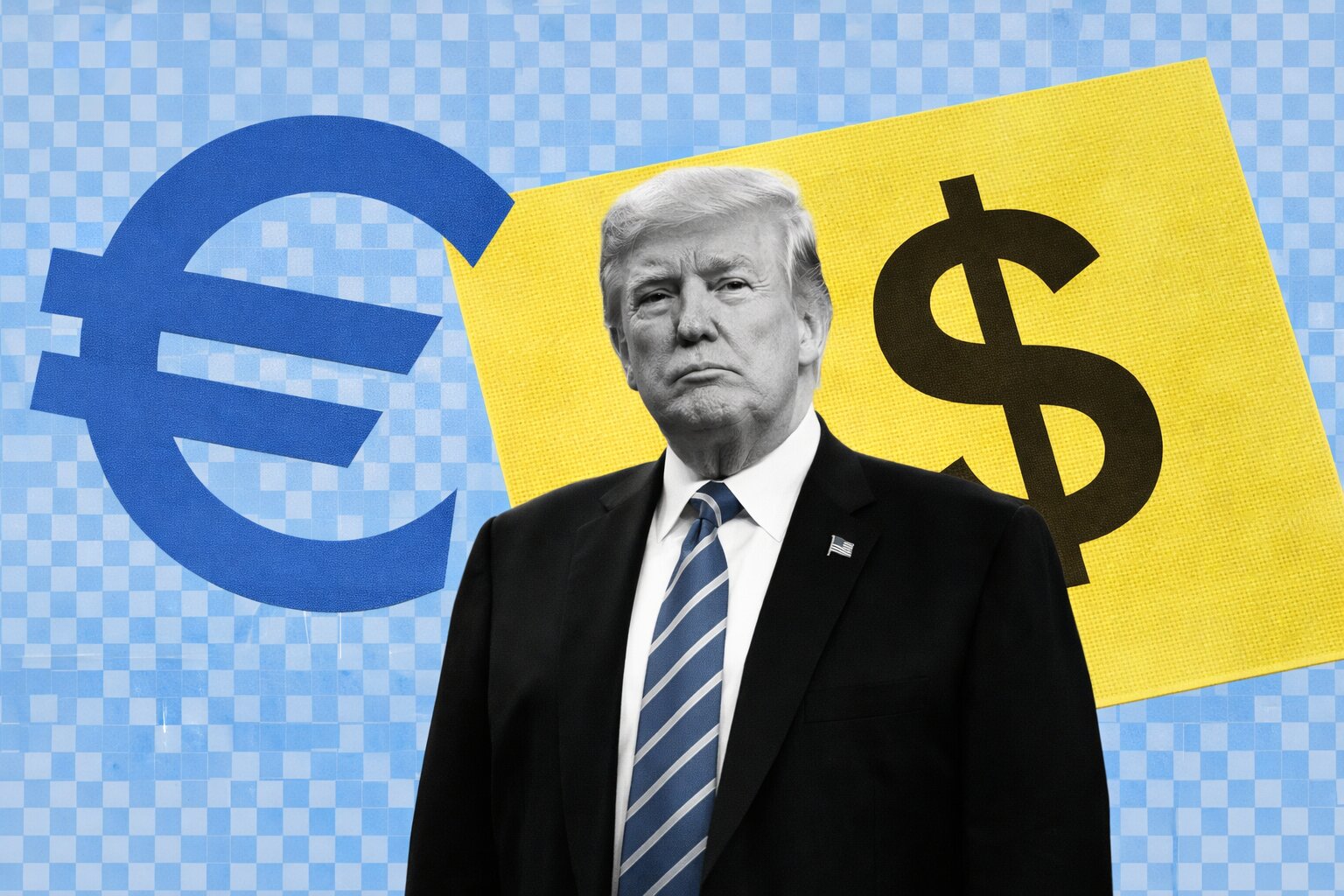
EUR/USD Price Forecast: Symmetrical Triangle Coils at 1.1800 as Scorching PPI and 15% Tariffs
Pair moves just 0.36% in four sessions with RSI pinned at neutral 47-55; DXY holds 97.70 as 10-year yield breaks below 4%; Fed holds at 3.75% with 97.9% probability | That's TradingNEWS
EUR/USD Price Forecast: The Pair Is Trapped at 1.1800 Inside a Symmetrical Triangle as Hot PPI, 15% Tariffs, and Dueling Central Banks Create a Coiled Spring — Here's What Breaks First
EUR/USD is going nowhere fast — and that's precisely what makes it dangerous. The world's most traded currency pair spent Friday oscillating in a suffocatingly tight range around 1.1800, posting a cumulative move of just 0.36% over the past four sessions while every other asset class was exploding in one direction or the other. Gold surged past $5,234. The Dow cratered 715 points. Silver ripped 6%. Bitcoin shed 2%. Yet the euro-dollar cross sat there, perfectly balanced on the razor's edge of its 20-day exponential moving average at 1.1810, refusing to commit. The symmetrical triangle that has been compressing since mid-February is approaching its apex, and when this thing breaks — whether toward 1.1915 or 1.1670 — the move will be violent. The DXY index at 97.70, a scorching January PPI print of 0.5% headline and 0.8% core, 15% global tariffs, collapsed U.S.-Iran talks, and two central banks locked in parallel policy paralysis have created conditions where volatility is being stored, not eliminated. Every day that EUR/USD spends coiling between 1.1742 and 1.1860 adds energy to the eventual breakout.
Friday's PPI Shock and Why EUR/USD Barely Flinched — The Dollar's Contradictory Signal
January's producer price index should have sent the dollar screaming higher. Headline PPI came in at 0.5% month-over-month, well above the 0.3% consensus, while core PPI — excluding food and energy — printed at a stunning 0.8%, more than doubling the 0.3% expectation. On a twelve-month basis, wholesale prices rose 2.9%. Pipeline inflation is accelerating at a pace that makes the Federal Reserve's two projected rate cuts for 2026 look increasingly unrealistic.
And yet the Dollar Index barely moved. DXY hovered around 97.70-97.83, stuck in the same non-committal range it has occupied all week. The 10-year Treasury yield actually fell below 4% to 3.978% — the first time since November — signaling that the bond market is more worried about a growth collapse than an inflation spiral. EUR/USD absorbed the PPI data with the indifference of a pair that has already priced in maximum uncertainty in both directions. The greenback couldn't rally on hot inflation because the market simultaneously fears that those same inflationary forces — amplified by the 15% global tariff regime — will choke economic activity. That internal contradiction is the reason the dollar is stuck, and by extension, why EUR/USD refuses to break its range.
The CME FedWatch tool confirms the stalemate: there is a 97.9% probability that the Fed holds rates at 3.50%-3.75% at both the March and April meetings. For June, the probability of unchanged rates remains above 50%. No cuts, no hikes, no movement. The Fed is, in Chair Jerome Powell's own characterization, "in a good place" — comfortable but not committed, data-dependent without any data pointing clearly in one direction. That policy fog translates directly into the EUR/USD flatline.
The 15% Tariff Wildcard — Washington Is Driving EUR/USD More Than Frankfurt or the Fed
Since last Friday's Supreme Court ruling overturning previous emergency tariffs under the International Emergency Economic Powers Act, the Trump administration has imposed a 10% global tariff that was subsequently bumped to 15%. U.S. Trade Representative Jamieson Greer escalated further, warning that individual countries could face rates of 15% or higher — a statement that poured cold water on any remaining optimism about de-escalation.
The tariff situation creates a uniquely confounding dynamic for EUR/USD. On one hand, tariffs are inflationary for the U.S. economy, which should theoretically support the dollar by keeping Fed policy tight. On the other hand, tariffs threaten global trade flows, weigh on growth expectations, and introduce massive uncertainty — conditions that historically weaken the dollar as capital flees toward perceived safety elsewhere. The European Union has requested clarification on the tariff scope but received no detailed guidance, keeping markets in a prolonged wait-and-see posture.
The net effect is paralysis. The DXY's slope has lost momentum after its earlier recovery, hovering at 97.7 with diminishing conviction. For EUR/USD, tariff ambiguity acts as a suppressor of volatility — neither side of the pair can build sustained directional momentum because the trade policy outcome remains binary and unpredictable. A full-blown trade war with Europe would likely strengthen the dollar initially (flight to safety) before weakening it as U.S. growth deteriorates. A negotiated resolution would remove a key source of uncertainty and likely weaken the dollar as the risk premium evaporates. Until one of those outcomes materializes, EUR/USD stays pinned.
ECB's Lagarde Holds the Line — Confident, Cautious, and Offering Zero Catalysts
Christine Lagarde's Thursday commentary delivered exactly what EUR/USD didn't need: more of the same. The ECB president insisted inflation remains on track to return to the 2% target over the medium term. Food price pressures are easing gradually into 2026. Wage growth is solid, the labor market resilient, and investment strengthening. She explicitly stated the ECB monitors the euro but does not target it, and flagged no signs of AI-driven job losses — a notable contrast to the U.S., where Block just eliminated 40% of its workforce explicitly because of artificial intelligence tools.
The ECB left rates unchanged at a deposit rate of 2.00% in a unanimous decision. The probability table shows a 96.2% chance rates hold at March 17th's meeting. For April and June, the likelihood of unchanged policy exceeds 60%. There is no expectation of higher rates — meaning no prospect of improved euro-denominated yields that could attract capital and support the currency. The ECB's messaging was "disciplined" in the most boring possible sense: nothing new, nothing surprising, nothing to trade.
The interest rate differential remains the elephant in the room. The Fed's 3.50%-3.75% range versus the ECB's 2.00% deposit rate creates a 150-175 basis point spread that structurally favors the dollar. That differential provides a natural floor under the greenback against the euro. If markets begin to perceive that the Fed could adopt a more restrictive posture than the ECB — which the hot PPI data supports — the carry advantage widens further and could become a catalyst for consistent EUR/USD selling pressure over the medium term. Right now, both central banks are in holding patterns. But the Fed is holding at a much higher altitude, and that gravitational pull hasn't disappeared just because the dollar is temporarily directionless.
Speculative Positioning — A Genuine Tug of War With Record Longs AND Rising Shorts
The CFTC positioning data reveals something unusual and important: speculative net longs in the euro have climbed to their highest level since 2020. That would normally be a bullish signal. But simultaneously, short positions have also risen sharply. When both sides of the trade are building exposure at the same time, it signals conviction and tension — not a one-way bet. Open interest remains elevated, confirming this isn't a thin, illiquid market — it's a crowded battlefield where large players hold opposing views with real capital behind them.
Net positioning still favors the euro, but the aggressive buildup of offsetting shorts makes the upside fragile and hypersensitive to incoming data. Any macro catalyst that tips the balance — a decisive tariff announcement, a hawkish Fed surprise, or a deterioration in European economic indicators — could trigger a violent unwind of one side. The risk is asymmetric: if the shorts are right and EUR/USD breaks below 1.1742, the cascade of long liquidation could accelerate the move dramatically. Conversely, a breakout above 1.1860-1.1915 would force short covering that could push the pair rapidly toward 1.2000+. The positioning setup doesn't tell you which way it breaks — it tells you the break will be outsized when it comes.
German HICP Preview — The Eurozone's Inflation Pulse Check
The flash German Harmonized Index of Consumer Prices for February was published Friday at 13:00 GMT. Consensus called for 0.5% month-over-month growth after January's -0.1% decline, with the annual figure holding steady at 2.1%. Germany's inflation trajectory matters because it anchors expectations for the broader Eurozone aggregate, which directly influences ECB policy timing.
A reading in line with expectations would reinforce the narrative that European inflation is well-behaved and on glide path to the 2% target — giving the ECB no reason to deviate from its hold posture and providing zero fresh fuel for euro bulls. An upside surprise, however, would complicate the picture: it would suggest that upstream price pressures from tariffs and energy costs are filtering through to the Eurozone's largest economy, potentially forcing the ECB to rethink its timeline. For EUR/USD, the German data acts as a secondary catalyst — not powerful enough on its own to break the range, but capable of tilting sentiment within it.
Technical Landscape — The Symmetrical Triangle Approaching Its Apex at 1.1830
The technical picture for EUR/USD is extraordinarily clean — and extraordinarily dangerous for anyone positioned in the wrong direction when it resolves. On the two-hour chart, the pair has formed a textbook symmetrical triangle with lower highs descending from 1.1927 and higher lows rising from 1.1742. Price is currently compressed near 1.1813, sitting directly on the 50-EMA at 1.1810 and approaching the 200-EMA at 1.1830 from below.
The recent candle structure tells the story: small bodies with prominent upper wicks, indicating persistent selling pressure above 1.1825-1.1850. The RSI on multiple timeframes hovers around 47-55 — dead neutral, right on the midline, confirming the absence of momentum in either direction. The MACD histogram oscillates near zero with no dominant signal. The Average Directional Index (ADX) has fallen below 20 on the daily chart, a quantitative confirmation that the trending environment has completely dissolved.
The broader daily structure remains within a wide sideways channel that has contained price since June 2025, bounded by resistance at 1.1870 and support at 1.1509. The 55-day and 100-day simple moving averages have clustered in the 1.1770-1.1690 zone, while the critical 200-day SMA sits lower at 1.1660. Price above all three moving averages technically maintains a mild bullish tilt — but the flattening of the shorter-term averages signals that directional conviction has evaporated.
Key Levels That Define the March Playbook
Resistance: 1.1825-1.1850 (supply zone and 200-EMA convergence) → 1.1860 (initial resistance) → 1.1870 (upper channel boundary) → 1.1915 (recent swing high) → 1.2082 → 1.2266 → 1.2350.
Support: 1.1773 (near-term floor) → 1.1742 (February 19th low and horizontal support — the critical level) → 1.1670 (January 22nd low and 200-day SMA convergence at 1.1660) → 1.1578 → 1.1509 (lower channel boundary) → 1.1491 → 1.1469.
The 1.1742 level is the line in the sand. A decisive break below it would crack the triangle to the downside, trigger long liquidation from the record speculative positioning, and expose a rapid move toward the 200-day SMA at 1.1660 — a level that hasn't been tested since early 2025. Conversely, a sustained close above 1.1870 would break the triangle to the upside, force short covering, and potentially ignite a move toward 1.1915 and eventually the 1.2000 psychological handle.
DXY at 97.70 — The Dollar's Own Technical Trap
The Dollar Index is fighting its own battle at 97.65-97.70, holding just above a rising trendline support near 97.35. The 50-EMA at 97.70 acts as immediate resistance while the 200-EMA around 97.55 provides underlying support. Horizontal resistance stands at 97.99, followed by 98.31 and 98.61. A sustained move above 98.00 would shift the DXY structure back toward higher highs and likely trigger the EUR/USD break below 1.1742. A failure at 97.35 — the rising trendline — would signal a major trend reversal in the dollar and potentially launch EUR/USD toward 1.1915+.
UBS added a structural overlay to the technical picture by forecasting EUR/USD at $1.22 by the end of Q1 2026 — a call driven by their assessment of "asymmetric structural downside risks" for the greenback. The MSCI World ex-US index has gained roughly 8% year-to-date while the S&P 500 sits flat, confirming that international capital flows are rotating away from dollar-denominated assets. If UBS is right about the dollar's structural vulnerability, the EUR/USD triangle resolves higher and the 1.22 target comes into play by late March. That's a 3.4% move from current levels — significant for a major currency pair that has moved 0.36% in four days.
Read More
-
Yen Stalls at 160 Despite a 3% JGB and Tokyo Core CPI at 2.0% — Intervention Sits at 164, Friday's Payrolls Decide
02.09.2026 · TradingNEWS ArchiveEnergy
-
QQQ ETF ($706.22) Slides 7.4% Below Its High as the Market Reprices the AI Capex Bill — $686.57 Target if $700 Breaks
22.10.2026 · TradingNEWS ArchiveStocks
-
XRPI ($7.00) and XRPR ($10.74) Slide Toward 52-Week Lows as Spot XRP ETF Flows Stall at $708,510
22.10.2026 · TradingNEWS ArchiveCrypto
-
NG ($2.775) Decoupled From Europe’s €88 Gas Crisis as LNG Feedgas Hits 18.9 Bcf/d — $3.30 Upside on Cold Weather
22.10.2026 · TradingNEWS ArchiveCommodities
-
Dollar-Yen (157.35) Loses 157.65 as the Yen Rallies on Haven Demand — 155 Target if 156 Breaks
22.10.2026 · TradingNEWS ArchiveForex
Geopolitical Crosscurrents — Iran Talks Fail, Middle East Tensions Escalate
The third round of indirect U.S.-Iran nuclear talks in Geneva ended without a deal on Thursday, injecting fresh geopolitical risk into every asset class. Oil surged nearly 4% to $67.70 WTI, gold pushed above $5,234, and safe-haven flows intensified across the board. For EUR/USD, the Iran dynamic creates a cross-current: geopolitical uncertainty typically supports the dollar as the global reserve currency, but it simultaneously raises the inflation outlook through higher energy prices, which paradoxically undermines the case for dollar strength by threatening U.S. growth.
The Middle East tensions, combined with warnings about potential military action, are keeping the dollar's safe-haven bid alive as a floor — preventing EUR/USD from breaking higher even as the fundamental case for euro appreciation strengthens. This geopolitical support is the primary reason the DXY hasn't already broken below its 97.35 trendline despite the broad-based rotation out of U.S. assets flagged by UBS and others. Remove the Iran premium, and the dollar's technical picture deteriorates significantly.
U.S. Labor Market — Steady but Cooling at 212,000 Claims
Initial jobless claims ticked up 4,000 to 212,000 for the week ended February 21st. The labor market characterization remains "low-hire, low-fire" — a steady-state environment where employers aren't aggressively expanding but aren't mass-laying-off either (with the notable exception of AI-driven restructurings like Block's 4,000-employee cut). This data point doesn't move the needle for EUR/USD directly, but it reinforces the broader narrative: the U.S. economy is resilient enough to prevent the Fed from cutting, but not strong enough to justify tightening. That goldilocks-gone-stale labor backdrop is another ingredient in the policy paralysis that keeps EUR/USD anchored.
The Rate Differential Math — 175 Basis Points Still Favor the Dollar
Strip away the noise — the tariffs, the geopolitics, the positioning — and the fundamental gravity acting on EUR/USD comes down to one number: the 175 basis point interest rate differential between the Fed's 3.75% upper bound and the ECB's 2.00% deposit rate. That spread makes it expensive to hold euros versus dollars on a carry basis. Every day that differential persists, it creates a structural headwind for EUR/USD that the euro must overcome with either stronger growth, capital inflows, or dollar-specific weakness.
Both central banks show no urgency to move. The Fed's January minutes reinforced that cuts remain possible if inflation cools — but hikes haven't been ruled out if price pressures prove sticky. The 10-to-2 vote, with two FOMC members favoring a 25 basis point cut, shows debate is alive but consensus firmly favors patience. The ECB's unanimous hold signals even less internal tension. Until one bank blinks — either the Fed cutting or the ECB hiking (neither of which is priced) — the rate differential acts as a slow, steady gravitational pull toward a lower EUR/USD. The pair can trade sideways against that pull, but it requires constant offsetting forces from other catalysts to prevent a drift lower.
GBP/USD as a Dollar Proxy — Cable Struggling at 1.3450 Reinforces EUR/USD Ceiling
The British pound's performance offers a useful cross-check on dollar dynamics. GBP/USD was rejected at its descending trendline drawn from the 1.3700 swing high and dropped to 1.3450 on Friday, adding to Thursday's losses. The 50-EMA near 1.3510 acts as resistance while the 200-EMA at 1.3560 maintains a bearish structure. Support comes in at 1.3450 and 1.3408.
Cable's inability to sustain any rally despite broad dollar weakness suggests that the greenback still has enough residual strength — likely from the geopolitical safe-haven bid and the rate differential — to cap gains in European currencies. If GBP/USD can't break above 1.3550, it's difficult to construct a scenario where EUR/USD sustainably clears 1.1870. The two pairs tend to move directionally in tandem against the dollar, and cable's weakness is a real-time confirmation that the euro's upside is capped as well.
The Verdict — EUR/USD Is a Sell Below 1.1742, a Buy Above 1.1870, and a Wait in Between
EUR/USD is the definition of a coiled spring. The symmetrical triangle, the record speculative positioning on both sides, the neutral RSI and MACD, the sub-20 ADX, the 0.36% four-session range — every single indicator points to compressed volatility that will resolve into an explosive directional move. The question is which direction, and the honest answer is that the fundamental picture is genuinely balanced.
The case for a break lower is built on the 175 basis point rate differential, the hot PPI data that makes Fed cuts less likely, the geopolitical safe-haven dollar bid, and the technical reality that 1.1742 is the last support before the 200-day SMA at 1.1660. If the DXY clears 98.00, EUR/USD likely breaks 1.1742 and accelerates toward 1.1660-1.1578. The speculative long unwind would amplify the move.
The case for a break higher rests on UBS's $1.22 forecast, the structural rotation out of U.S. assets (MSCI World ex-US up 8% versus flat S&P 500), the weakening DXY slope, and the possibility that tariff-driven inflation ultimately damages the dollar more than it supports it. If 1.1870 breaks, the short-covering rally could carry EUR/USD to 1.1915 and eventually toward 1.2000.
The weight of near-term evidence tilts slightly bearish. The rate differential is real and persistent. The PPI data was unambiguously hot. The Fed has more room to stay hawkish than the ECB has to tighten. And the geopolitical backdrop continues to support the dollar as a haven. Sell EUR/USD on a confirmed break below 1.1742 with a target of 1.1660 and a stop above 1.1810. For those already short, hold positions with a stop above 1.1870. A close above 1.1870 on the daily chart would invalidate the bearish thesis and flip the bias to neutral-bullish, targeting 1.1915 and then 1.2082. Until one of those levels breaks, there is no edge in forcing a trade inside the triangle — the risk-reward of entering at 1.1800 with no directional catalyst is terrible in both directions. Patience pays. The breakout is coming. March will deliver it