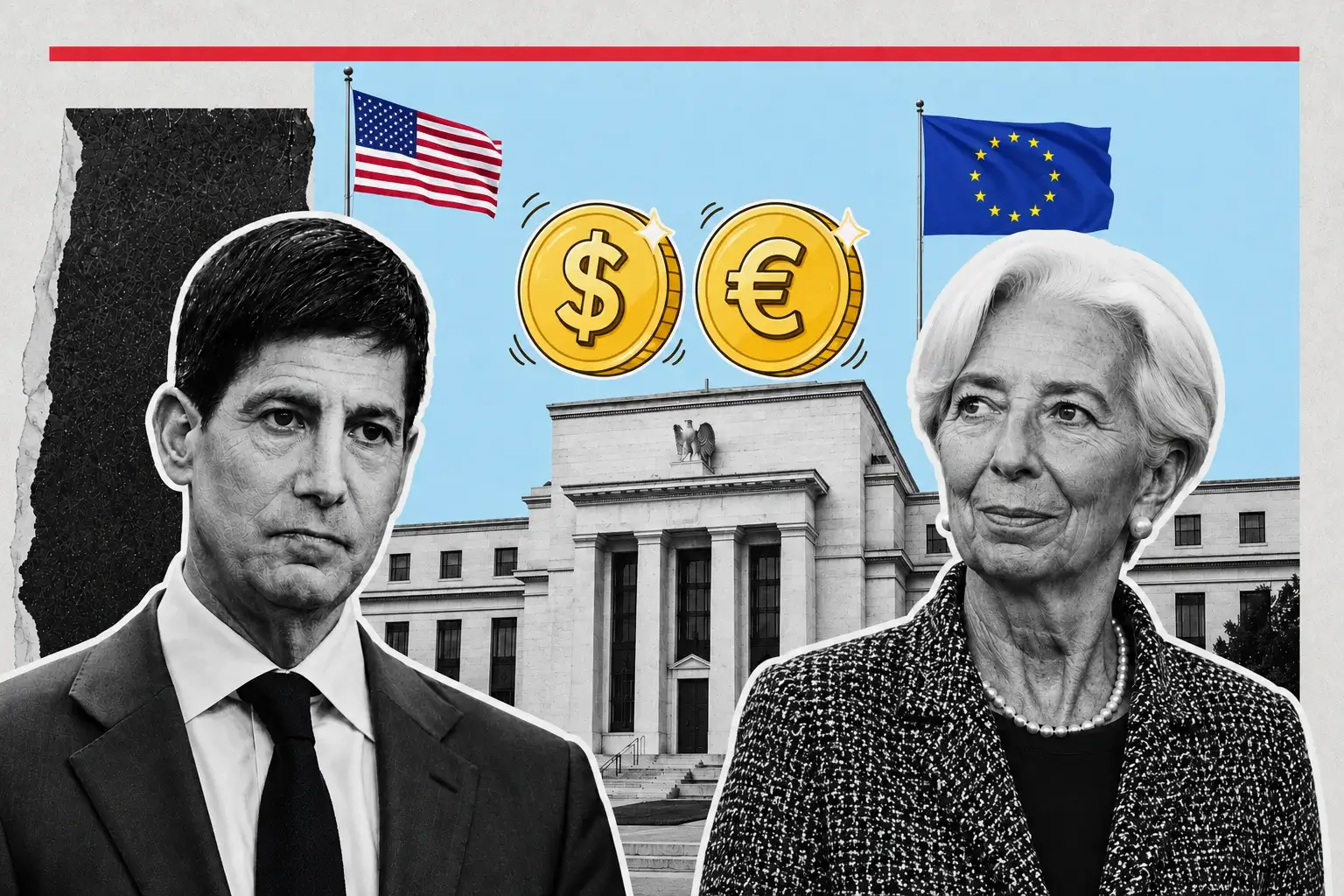
Euro Defends 1.1620 After Failing At Fibonacci Wall — Warsh's 10:00 ET Jackson Hole Debut Decides The Break
The Fed-ECB differential sits at 137.5 basis points and narrows to 112.5 if Frankfurt hikes into a September hold | That's TraidngNEWs
Key Points
- EUR/USD holds 1.1650 after twice failing at the 1.1685 May high and 1.1692 Fibonacci confluence.
- ECB July accounts call the hold a "pause"; governors are ready to move 2.25% to 2.50% on September 9-10.
- Fed September hold odds fell to 60% from 64% after headline PCE printed 3.7% against 3.6% expected.
EUR/USD trades 1.1638 to 1.1650 through the European session, down 0.1% and flat against the Wednesday close, in a market that has stopped trying to go anywhere until Friday morning.
The pair pulled back from last week's high past 1.1700 and this month's peak at 1.1710, and the failure point is precise: bulls could not find acceptance above the late May highs at 1.1685. That level, and the 78.2% Fibonacci retracement of the May-June selloff at 1.1692, form a $7-pip confluence that has now rejected the pair twice. The three-month high near 1.1697 printed on August 21 and has not been threatened since.
The correction underneath that rejection is mild and orderly. Spot holds above previous resistance at 1.1620 — the June 16 and August 17 highs — which keeps the near-term bullish structure intact. The daily Relative Strength Index sits above 65 and MACD remains in modestly positive territory, both consistent with constructive momentum rather than a topping pattern. The pair trades 0.96% above its 50-day EMA and 1.01% above its 100-day EMA.
The context for the current level is a two-month recovery. EUR/USD bottomed at 1.1355 on June 24 and has climbed 2.72% since. From roughly 1.14 in late July, it ran to the high 1.16s inside four weeks. The 50-day simple moving average sits at 1.1508.
The wider frame is less flattering. The pair opened 2026 as the consensus long trade with year-end targets clustered at 1.24 to 1.25. It reached 1.20 and then reversed hard when the Strait of Hormuz conflict pushed both US and eurozone inflation sharply higher, the ECB hiked on June 11 for the first time since 2023, and the Fed signalled hikes rather than cuts on June 17. The pair fell to 1.14 and has been building from there.
Both central banks are now hawkish. Neither is providing the clean rate-divergence signal that produces a trend move. The pair is stuck between two tightening cycles running at different speeds, and the ECB accounts published this morning just made the euro side of that equation considerably more specific.
The ECB Accounts: July Was A "Pause," Not The End Of The Cycle
The euro's fundamental support arrived at 13:30 CET and it was more explicit than the market expected.
The account of the July 22-23 Governing Council meeting shows policymakers were already penciling in a further rate increase, potentially as soon as September. The language is direct: while decisions remained data-dependent, another rate hike would likely be necessary unless the inflation outlook improved significantly.
The word that matters most appears twice. Policymakers described the July decision to hold rates steady as nothing more than a "pause" in rate hikes. The account states that it was important not to suggest the pause meant the end of the tightening cycle had been reached.
That is a central bank that held rates while telling itself it was not finished, and then published the evidence five weeks later while its currency was consolidating below a three-month high.
The mechanics of the July decision followed the standard pattern. Chief economist Philip Lane proposed keeping the three key ECB rates unchanged based on the incoming inflation outlook, the dynamics of underlying inflation and the strength of policy transmission. All members agreed. Following the June hike, the Council judged itself well positioned to navigate the current uncertainty, with the September meeting providing the next opportunity for a comprehensive assessment of the inflation outlook — explicitly taking into account the evolution of the conflict in the Middle East.
The Council also noted the global economy was proving more resilient than expected despite the fluid situation in the Middle East. That resilience assessment is what has since hardened into conviction.
The communication decision inside the account is the tell for how the euro trades from here. The ECB agreed its official communication should not yet commit to a September hike, in case the inflation outlook improved. The bank deliberately withheld guidance it privately expected to act on.
Those doubts have since been resolved. Reporting earlier this week indicated Governing Council members are now prepared to move, and the account confirms the internal groundwork was already laid a month ago.
EUR/USD held its range through the release rather than rallying, which tells you the September hike was already in the price. What the account changes is the conviction level, not the expectation.
September 9–10: 2.25% To 2.50% Is Close To Fully Priced
The specific decision the euro is trading is a 25-basis-point move on September 9-10, lifting the deposit facility rate from 2.25% to 2.50%.
Three inputs are driving it. Eurozone inflation is running near 3% against a 2% target. The Iran conflict continues to push energy costs through the price level. And the euro area economy has demonstrated more resilience than most projections allowed for.
The rate structure heading in: deposit facility at 2.25% following the June increase, main refinancing operations at 2.4%, marginal lending facility at 2.65%. The June 11 move was the first hike in nearly three years, taken specifically to prevent a war-driven rise in energy prices from becoming embedded.
Market pricing has tracked the energy path almost mechanically. In early July, following the Sintra forum where officials signalled less urgency for additional tightening, September hike probability sat near 70% — the renewed oil surge after US-Iran strikes outweighing the dovish tone. By the July 23 meeting, a September move was almost fully priced, with the caveat that unless energy prices eased materially, that view was unlikely to change.
Energy has not eased materially in Europe. Diesel prices are rising across the continent and natural gas has jumped to its highest level since 2023 — a critical distinction, because governments have cushioned the oil-price pass-through through fiscal measures while gas prices have received far less policy protection and have risen roughly three times as much.
Executive board member Isabel Schnabel indicated earlier this week that forthcoming data would dictate the extent of further adjustments, explicitly leaving open the possibility of additional increases beyond September.
The credit channel supports the case. Corporate lending across the currency bloc accelerated to a three-year high in July at 4.4% growth. A central bank tightening into accelerating credit demand faces none of the transmission concerns that constrained it through 2024 and 2025.
For EUR/USD, a fully priced hike delivers no upside on the day. What matters is the guidance attached to it — whether the ECB signals September is the last move or the second of several. That question resolves on September 10, two weeks after Warsh speaks.
Eurozone Inflation At 2.9% With Energy Running 10%
The inflation data behind the ECB's conviction is deteriorating in exactly the way that forces action.
Euro area annual inflation accelerated to 2.9% in July from 2.8% in June, matching expectations and sitting well above the 2.0% target. Core inflation, excluding energy and food, rose to 2.5% from 2.4%. Services inflation edged up to 3.3% from 3.2%. Non-energy industrial goods rose to 0.9% from 0.7%. Food, alcohol and tobacco eased to 1.2% from 1.5%.
Energy did the damage. Energy inflation accelerated to 10.0% from 8.5% as hostilities between the US and Iran resumed — a single component running at five times the headline target and pulling the entire index higher on its own.
The national breakdown shows the pressure is broad. Germany accelerated to 2.8% from 2.4%. France to 2.4% from 2.0%. Spain to 3.8% from 3.6%. The Netherlands to 2.9% from 2.5%. Italy eased slightly to 2.9% from 3.0%. Four of the five largest economies moved higher in the same month.
The trajectory across 2026 tells the story. Annual inflation fluctuated between 1.9% and 2.5% through 2025 and started 2026 at 1.7% in January. It rose every month from there, hitting 3.2% in May before easing to a four-month low of 2.8% in June and reaccelerating to 2.9% in July.
The forward path is where the ECB's hawkishness stops looking like caution and starts looking like necessity. Projections point to headline inflation rising from around 3.4% in August toward a peak near 4.2% by January 2027, driven by the gas component that fiscal measures have not cushioned.
Household expectations have not yet destabilized, which is the one favorable data point. Perceived inflation over the past twelve months dropped to 3.5% in July from 3.6% in June, and the twelve-month-ahead outlook declined slightly to 2.9% from 3.0%.
The first hard read on August arrives Friday, when France and Spain publish flash estimates — the earliest euro-area-wide signal before the ECB meets. The full euro-area flash follows September 1. Two prints, eight days before the decision.
The German Data Turn: Ifo At 88.8 And GfK's Fourth Straight Month
The resilience argument the ECB is leaning on is coming primarily from Germany, and the August surveys made it considerably stronger.
The Ifo Business Climate Index rose to 88.8 in August from 86.6 in July, beating a consensus of 87.1 and reaching its highest level in a year. That, combined with the detailed second-quarter GDP release, added to evidence of surprising economic resilience and supports the case for near-term ECB tightening.
The GfK Consumer Climate reading published this morning showed German consumers more optimistic about their income and about the general economic context. Sentiment improved slightly, marking a fourth consecutive month of rising economic optimism, driven by a significant increase in income expectations.
Two caveats sit inside that. The index remains in negative territory, and willingness to buy stays at rock bottom. German households are less pessimistic without being willing to spend.
The recovery from the spring trough has been substantial. The GfK indicator dropped to -33.3 heading into May, the weakest since February 2023, with income expectations collapsing to -24.4 from -6.3 and economic expectations at -13.7, near levels last seen at the onset of the Ukraine war. It rebounded to -29.3 heading into June on an 11.4-point jump in income expectations, and has improved each month since.
The euro-area growth backdrop underneath this is less encouraging. Euro area GDP fell 0.2% quarter over quarter in the first quarter of 2026, reversing the 0.2% increase recorded in the fourth quarter of 2025. Industrial production rose 0.1% in April, construction 0.6%, and retail trade sales fell 0.4%.
Energy-driven inflation is set to erode real household income and weigh on consumption through the rest of 2026, with stronger real wage growth and improving sentiment expected to lift private consumption only in 2027. The residential construction recovery has been pushed to the second half of 2026 on high uncertainty, tightening financing conditions and energy costs feeding into construction inputs.
That is an economy resilient enough to justify a hike and weak enough that the hike carries real cost. The euro trades the first half of that sentence.
The Fed Side: Core PCE At 3.3%, Hold Odds At 60%, Three July Dissents
The dollar leg of this pair is the messier of the two.
Wednesday's PCE data showed headline inflation rising 0.2% month over month against a 0.1% consensus and 3.7% year over year against 3.6% expected. Core PCE rose 0.2% monthly and 3.3% annually, both in line and both unchanged from June. Full detail publishes through the Bureau of Economic Analysis.
The supporting releases complicated rather than clarified. Second-quarter GDP came in at 1.5% annualized on the second estimate, matching the advance reading and down from 2.1% in the first quarter. Durable goods orders rose 1.1% in July against 0.5% expected. Consumer spending and income came in slightly above forecasts.
Sticky headline, in-line core, soft growth, strong business investment. Every camp inside the Committee got something.
Market pricing sits at roughly 60% for a hold at the September 15-16 meeting, down from 64% before the data, with hike probability between 32% and 40% depending on the measure. The target range is 3.50%-3.75%.
The internal split is not hypothetical. Minutes from the July 28-29 FOMC meeting, released August 19, leaned hawkish, with many participants judging that tightening could be needed if inflation did not ease. Three regional presidents — Lorie Logan, Beth Hammack and Neel Kashkari — dissented in favor of an immediate 25-basis-point hike at that same meeting.
Three dissents for a hike, in a meeting where the Committee held. That is the most fractured the Fed has been in this cycle, and it is the reason Friday's speech carries weight beyond the usual.
The dollar's reaction Wednesday was a modest advance on the sticky headline print, which pushed EUR/USD to its lowest level in a week below 1.1650. The greenback has since consolidated rather than extended, with the euro holding its range as hawkish ECB expectations offset the PCE-driven dollar bid.
Expectations had shifted toward a hold amid signs of cooling price pressures and a sluggish labor market before Wednesday. The 3.7% headline pushed back on the first half of that thesis. Jobless claims at 8:30 a.m. ET test the second.
The Rate Differential That Actually Drives This Pair
Strip away the narrative and EUR/USD is trading a spread that is closing slowly.
The Fed funds target range sits at 3.50%-3.75%, a 3.625% midpoint. The ECB deposit facility sits at 2.25%. That is a 137.5-basis-point differential in the dollar's favor — historically wide, and the fundamental reason the pair spent 2026 well below the 1.24-1.25 targets it opened the year with.
A September ECB hike to 2.50% with a Fed hold narrows that to 112.5 basis points. A 25-basis-point compression on a 137.5-basis-point spread is an 18% reduction in the carry advantage, and it is the single most euro-supportive outcome available in the next three weeks.
The alternative scenarios are worth pricing explicitly. If both hike, the spread stays at 137.5 and the pair goes nowhere — the current condition, projected forward. If the ECB hikes and the Fed also hikes, the differential is unchanged but the dollar likely firms on the relative surprise, since ECB tightening is already priced and Fed tightening is not. If the ECB holds and the Fed hikes, the spread widens to 162.5 basis points and EUR/USD breaks 1.1500.
That last scenario is the one the market assigns lowest probability and the one with the largest price consequence.
The structural framing is that the pair sits stuck in the middle rather than poised for a break, because both central banks lean hawkish and neither provides the clear divergence signal that generates a trend. The base case across most projections has EUR/USD range-bound between 1.13 and 1.21 as both banks hold or move in small increments, with no sustained direction absent a clear inflation surprise in either jurisdiction.
Consensus forecasting reflects that flatness. Quarterly checkpoints cluster near 1.1493 for September 2026, 1.1621 for December 2026 and 1.1715 for March 2027 — a projected twelve-month move of less than a cent from spot, with wide provider dispersion around it.
Spot at 1.1650 already sits above the September checkpoint and near the December one. The pair has front-run its own consensus.
Read More
-
Yen Stalls at 160 Despite a 3% JGB and Tokyo Core CPI at 2.0% — Intervention Sits at 164, Friday's Payrolls Decide
02.09.2026 · TradingNEWS ArchiveEnergy
-
QQQ ETF ($706.22) Slides 7.4% Below Its High as the Market Reprices the AI Capex Bill — $686.57 Target if $700 Breaks
22.10.2026 · TradingNEWS ArchiveStocks
-
XRPI ($7.00) and XRPR ($10.74) Slide Toward 52-Week Lows as Spot XRP ETF Flows Stall at $708,510
22.10.2026 · TradingNEWS ArchiveCrypto
-
NG ($2.775) Decoupled From Europe’s €88 Gas Crisis as LNG Feedgas Hits 18.9 Bcf/d — $3.30 Upside on Cold Weather
22.10.2026 · TradingNEWS ArchiveCommodities
-
Dollar-Yen (157.35) Loses 157.65 as the Yen Rallies on Haven Demand — 155 Target if 156 Breaks
22.10.2026 · TradingNEWS ArchiveForex
The Dollar At 98.80 And The Buyback That Put It There
The dollar index sits near 98.80 after dipping into the 98.50s — its lowest level since May.
The catalyst was fiscal rather than monetary. The US Treasury announced it would at least double the size of its long-dated bond buybacks, reportedly to at least $32 billion per quarter from early next month, with individual operations rising to a minimum of $4 billion running September 9 through November 4. The Bloomberg Dollar Spot Index fell as much as 0.8% on the day to its lowest since May 12.
The July FOMC minutes landed hours later that same afternoon and the market's reaction was muted relative to the buyback surprise — a hawkish central bank communication getting overwhelmed by a debt management announcement, which tells you what is actually driving the currency right now.
The pressure that forced the intervention is the wider story. The 30-year Treasury yield hovers at its highest level in two decades, having scored a fresh 19-year high on August 17. National debt crossed $40 trillion. Cracks in the long end of the bond market are the thing Warsh will be asked about, whether or not he addresses it.
The current curve has stabilized. The 10-year sits at 4.645%, down 2 basis points. The 30-year at 5.161%, down 2 basis points. The 2-year at 4.211%, down 1 basis point. That leaves 43.4 basis points between 2s and 10s and 95.0 basis points between 2s and 30s.
The euro's advance from 1.14 in late July to the high 1.16s maps almost exactly onto the dollar index falling from above 99.40 to 98.80. That is not a euro story. It is a dollar story that the euro has been the primary beneficiary of, because it is the largest weight in the index.
The implication for positioning is that EUR/USD longs are effectively short the US fiscal picture. If the buyback program succeeds in capping the long end and confidence returns, the dollar firms and the euro gives back the August advance regardless of what the ECB does on September 10.
The dollar has consolidated after the PCE-driven advance rather than extending. That consolidation holds until Friday.
Jackson Hole: Warsh At 10:00 ET Plus The Payroll Benchmark Revision
Two events land within minutes of each other Friday morning and both matter for the dollar.
Fed Chair Kevin Warsh delivers his Jackson Hole keynote at 10:00 a.m. ET — his first since taking office on May 22. The Kansas City Fed hosts the symposium from August 27 to 29 under the theme "Financial Innovation: Implications for Payments and Policy." The program publishes through the Kansas City Fed.
Expectations extend well beyond whether rates are raised or held in September. Warsh faces a genuine communication dilemma: say too much and he commits the Committee ahead of a meeting where three regional presidents already dissented for an immediate hike; say too little and he leaves a market that has moved hold probability from 64% to 60% inside 24 hours without an anchor.
The theme gives him room to spend the speech on payments architecture and financial innovation rather than the policy path. Chairs have used exactly that latitude at exactly this venue. A speech that avoids the rate question entirely is a plausible outcome and would leave EUR/USD in its range.
The second Friday event deserves more attention than it typically receives. The Bureau of Labor Statistics publishes its preliminary annual benchmark revision to nonfarm payrolls. The September 2025 preliminary benchmark indicated a downward revision of 911,000, with the final figure in February remaining at 862,000 on a non-seasonally-adjusted basis.
A revision of that magnitude carries genuine information about the labor market rather than functioning as a statistical footnote. If the preliminary benchmark shows another large downward restatement, the sluggish-labor-market thesis gets hard evidence, hold probability rises toward 70%, and the dollar softens into the weekend.
The third Friday input is European. France and Spain publish flash August inflation, the earliest euro-area-wide signal before the ECB's September 10 decision.
Three data events, one speech, one session. EUR/USD has spent this week refusing to take a position ahead of it, and the 1.1620-to-1.1685 range is the physical expression of that refusal.
Jobless Claims And The Near-Term US Calendar
Before Friday, the market gets one number today.
Initial jobless claims publish at 8:30 a.m. ET with consensus at 209,000 against 206,000 the prior week. The previous reading fell by 6,000 and came in below a 210,000 forecast, extending a streak of low readings since the near-60-year low of 189,000 in mid-July. Continuing claims rose 18,000 to 1,799,000. Claims filed by federal employees rose by 32 to 450. Weekly data publishes through the Department of Labor.
The tension in the US labor data is what makes this print consequential for the dollar. Initial claims near 200,000 describe an economy with almost no involuntary separations. The most recent payroll report showed an unexpected contraction. Low firing plus low hiring is a labor market that has stopped churning — a condition several FOMC members characterize as full employment and one that makes a hike defensible against 3.3% core inflation.
A print materially above 209,000 pushes hold probability higher and takes pressure off the front end, which is euro-supportive. A print at or below 206,000 arms the three dissenters and firms the dollar into Warsh.
The remainder of the calendar into the September 15-16 FOMC includes the Kansas City Fed manufacturing index for August at 11:00 a.m. ET today, final August University of Michigan consumer sentiment Friday, and Chicago PMI with consensus at 57.0 down from 57.6.
The pair's own recent behavior around US data has been contained. Wednesday's PCE release pushed EUR/USD to a one-week low below 1.1650 and it recovered to hold that level within hours. That is a market with a bid underneath it and no conviction above it.
The supportive fundamental backdrop is holding traders back from placing bearish euro bets even with the dollar firming. The divergent Fed-ECB outlooks — a Fed leaning toward a hold, an ECB preparing a hike — continue to lend the pair support at these levels regardless of the daily data noise.
Cross-Market: Sterling Below 1.3600, Yen Above 159, Gold At $4,600
The euro's relative performance today tells you the dollar move is broad rather than euro-specific.
GBP/USD trades below 1.3600 after losing nearly 0.4% Wednesday, consolidating near the lower end of its weekly range through European hours. Sterling's downside is cushioned by the same dynamic holding EUR/USD up — traders unwilling to commit to dollar longs ahead of Friday.
USD/JPY holds steady above 159.00 and traded 159.48, up 0.1%, after three consecutive sessions of small gains. AUD/USD rose 0.2% to 0.7180, the strongest of the majors on the session.
The euro's own cross performance is marginally positive. It gained 0.04% against the dollar, 0.05% against sterling, 0.05% against the Swiss franc and 0.09% against the Canadian dollar, while losing 0.15% to the Australian dollar and holding flat against the yen. The euro was strongest against the Canadian dollar, which is trading its own story as US-Canada trade tensions escalate ahead of the 50% tariff on Canadian cars, trucks, parts and steel effective January 1, 2027.
Gold sits slightly below $4,600 after losing more than 1% Wednesday, having erased early Asian-session gains. December futures trade $4,648.90. The metal remains below its highest level since May 14, touched Tuesday at $4,696.20. Bullion and the euro are running the same trade — both long the fiscal debasement story, both waiting on Warsh, both refusing to break their ranges.
Equity risk appetite is doing the opposite. US futures are buoyed after Nvidia's earnings beat, with Nasdaq 100 futures up 0.92% overnight before trimming, and the Stoxx Europe Tech index adding 1.8% at the European open while the broader Stoxx 600 dipped just below flat.
Risk-on equities with a flat dollar and a range-bound euro is an unusual combination. It reflects a market that has separated the AI earnings story from the macro story entirely — and the macro story is the one EUR/USD trades.
Technical Structure: 1.1620 Below, 1.1685 And 1.1692 Above
The levels are tight and the pair is sitting between two of them.
Resistance stacks in a narrow band. The May 29 high at 1.1685 is the immediate ceiling — the level bulls have twice failed to find acceptance above. The 78.2% Fibonacci retracement of the May-June selloff at 1.1692 sits seven pips higher, creating a confluence that has functioned as a hard cap. Above that, the month's high at 1.1710 and last week's peak past 1.1700 are the near-term objectives, with the early May highs near 1.1790 as the target if the confluence breaks.
Support is equally specific. The horizontal level at 1.1620 — the June 16 and August 17 highs, now flipped — is the first line, and the near-term bias stays positive while spot holds above it. Below that, the August 18 and 19 lows near 1.1570. Beneath those, the early August lows sit just above 1.1500, backed by the 50-day simple moving average at 1.1508.
That gives a 65-pip band between 1.1620 and 1.1685 as the active range, with 1.1570 and 1.1500 as the deeper tests and 1.1790 as the extension objective.
Momentum reads constructive but stretched. The daily RSI(14) holds above 65 and MACD sits in modest positive territory, together suggesting the recovery from the mid-1.14s remains intact. Shorter-timeframe oscillators have run into overbought territory, which is precisely why the pair has been correcting rather than extending — the rally from late July lows had reached levels that required consolidation before another attempt.
The weekly chart shows a mild bearish correction inside a bullish structure. The pair broke out of its recent tight range earlier this month, invalidating expectations for continued consolidation, then failed at the May highs and returned to range.
The distance from spot to the year's extremes frames the risk. The 2026 high at 1.20 sits 3.0% above. The June 24 low at 1.1355 sits 2.5% below. The pair has spent the year inside a 4-cent band with the midpoint almost exactly at current spot.
That is a pair with no technical reason to break in either direction. It needs an event, and the event is Friday.
What Would Break The Range
Both directions have specific triggers and both require Friday to deliver.
Euro upside: Warsh declines to validate the hawkish case and leans toward patience, or spends the speech on payments architecture and says nothing about rates. The BLS benchmark revision shows another large downward restatement of payrolls, confirming the sluggish labor thesis. Hold probability moves from 60% toward 75%. The dollar index breaks 98.50 and heads toward its May lows. EUR/USD clears 1.1685 and 1.1692, then targets 1.1710 and the early May highs at 1.1790.
The fundamental support for that path is already assembled. The ECB has published an account describing July as a pause and stating another hike would likely be necessary. Governing Council members are prepared to move to 2.50% on September 9-10. Eurozone inflation is running 2.9% with energy at 10% and projections pointing toward 4.2% by January. Corporate lending is at a three-year high. Ifo hit a one-year high at 88.8.
Euro downside: jobless claims come in at or below 206,000. Warsh validates the three July dissenters and signals the Committee is prepared to hike in September. The rate differential stays at 137.5 basis points and the dollar reprices. EUR/USD loses 1.1620, then tests 1.1570 and the 1.1500 area where the 50-day SMA sits at 1.1508.
That path has its own evidence. Headline PCE accelerated to 3.7% against a 3.6% forecast. Durable goods beat by more than double. Three regional presidents already dissented for an immediate hike in July. The FOMC minutes leaned hawkish. The pair has failed twice at 1.1685 and is correcting from overbought.
The base case is neither. Both central banks are hawkish and neither is diverging fast enough to generate a trend. The pair holds 1.1620 to 1.1685 through Friday, with the September 10 ECB decision and the September 15-16 FOMC as the genuine resolution points — two weeks and three weeks out respectively.
Range-bound between 1.13 and 1.21 remains the structural call, and spot at 1.1650 sits almost exactly at the midpoint of it.
Forecast And Verdict: 1.1685 Is The Gate, 1.1620 Is The Floor
Constructive with a capped ceiling. That is the read on EUR/USD at 1.1650.
The bull case is documented rather than speculative. The ECB published its own account this morning describing July as a "pause" and stating explicitly that another hike would likely be necessary unless the inflation outlook improved significantly — and it has not improved, with July inflation at 2.9%, core at 2.5%, energy at 10.0% and services at 3.3%. Governing Council members are prepared to lift the deposit rate to 2.50% on September 9-10. Corporate lending accelerated to a three-year high at 4.4%. The Ifo Business Climate hit 88.8, its highest in a year. German consumer sentiment improved for a fourth consecutive month. A September ECB hike against a Fed hold compresses the rate differential from 137.5 to 112.5 basis points.
The bear case is the dollar's ability to reverse. Headline PCE accelerated to 3.7% against 3.6% expected. Three FOMC members dissented for an immediate hike in July and the minutes leaned hawkish. Hold probability already slipped from 64% to 60% on Wednesday's data. The pair has failed twice at 1.1685 and the daily rally from the mid-1.14s reached overbought before correcting. Consensus quarterly checkpoints sit at 1.1493 for September — below current spot.
The levels are the trade. 1.1685 and 1.1692 are the gate; a daily close above opens 1.1710 and then 1.1790. Failure keeps the pair inside 1.1620 to 1.1685. Losing 1.1620 targets 1.1570, then 1.1508 and the 1.1500 area.
Call it a hold-the-range tape with an upward structural bias into September. The euro has the clearer central bank story and the dollar has the fiscal problem, but the 137.5-basis-point carry gap is wide enough that conviction longs stay expensive until it actually narrows.
Warsh speaks at 10:00 ET Friday. Nothing resolves before then.