Euro Stuck at 1.1390 as Fortress Dollar and Warsh Fed Hike Signal Cap the Pair; 1.1500 Reclaim Needed to Break the Bearish Tone
EUR/USD sits 5% below its 1.2019 January high after the ECB hiked to 2.25% | That's TradingNEWS
Key Points
- EUR/USD near 1.1390, lower third of its 2026 range, as DXY hit a 14-month high of 101.80 on Fed hawkishness.
- ECB hiked to 2.25% on June 11 but the euro still fell; the Fed-ECB rate gap has compressed from 3.25% to 1.50%.
- Support sits at 1.1320, then 1.1200; resistance is 1.1440, the 1.1514 SMA, and 1.1585 ahead of Thursday's jobs report.
The euro can't escape the dollar's gravity. EUR/USD traded near 1.1390 into Monday, hovering at the lower third of the range it has held all year after sliding as low as 1.1324 the prior week and clawing back toward 1.1410. The pair has bled lower for a second consecutive week, dragged not by any euro-specific weakness but by a US dollar that has turned into a wrecking ball. The Dollar Index peaked at 101.80, its highest in just over a year, extending the momentum the hawkish Fed and the fragile Middle East truce handed the greenback.
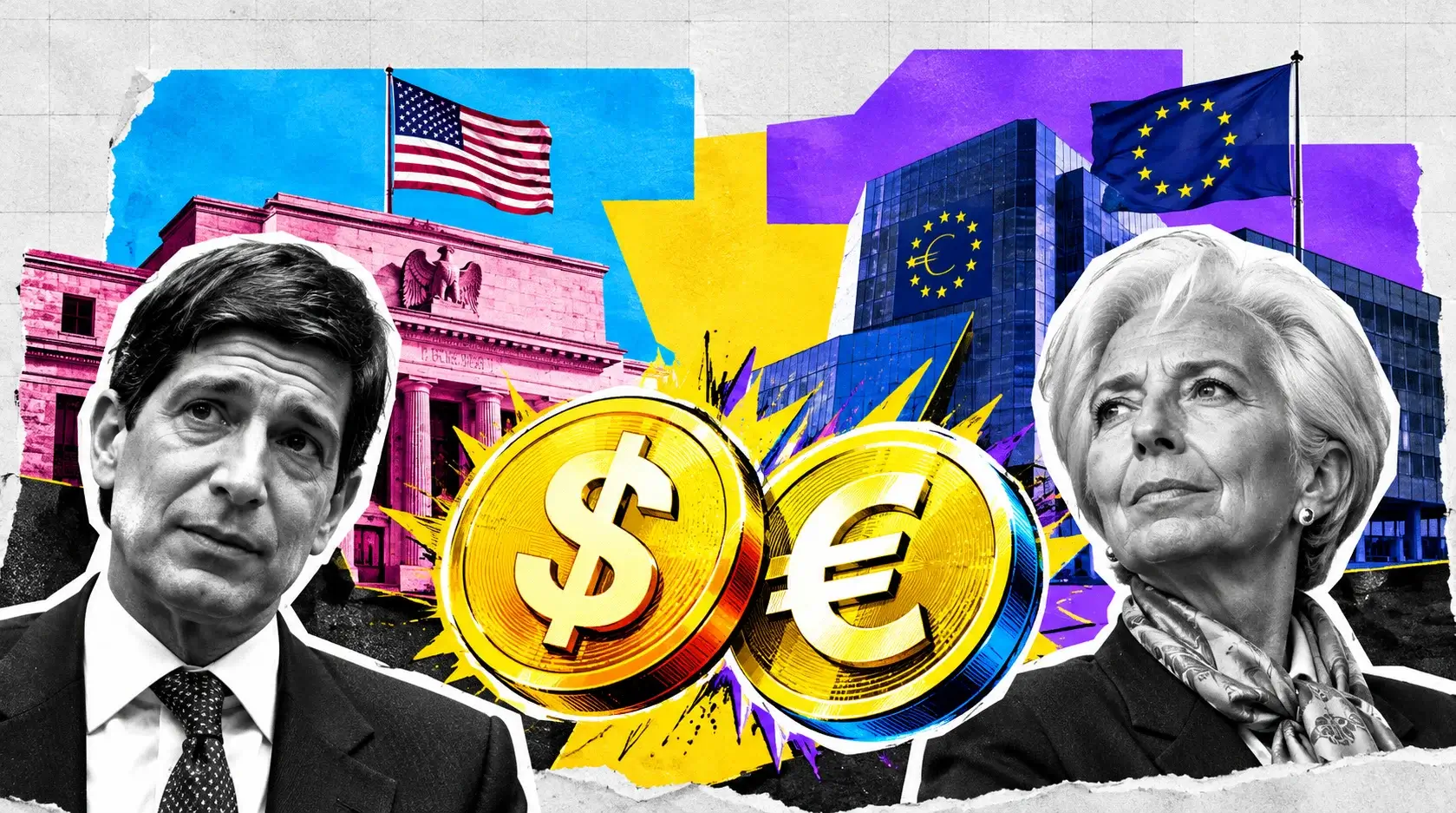
The defining feature of this tape is that both central banks have gone hawkish, and that kills the trade that normally moves the pair. The European Central Bank hiked on June 11 for the first time since 2023, and the Fed signaled hikes rather than cuts at its June 17 meeting. When both sides lean the same way, the rate-divergence engine that typically drives EUR/USD goes quiet, and the pair is, as one currency desk framed it, stuck in the middle rather than poised to break. The euro isn't weak — it is range-bound and sitting toward the softer end.
The geopolitical overhang tilts the balance toward the dollar. A framework agreement between the US and Iran was signed roughly a week ago, but reports that Iran's forces attacked a Singapore-flagged cargo ship in the Strait of Hormuz reignited doubts about its durability. Every flare-up revives the safe-haven bid for the dollar, which acts as a direct headwind for the pair. Oil remains elevated, keeping the inflation-via-energy risk alive and reinforcing the higher-for-longer rate narrative that favors the greenback.
The thesis for this forecast is direct: EUR/USD is range-bound with a downside lean, pinned near 1.1390 by dollar firmness while the hawkish ECB provides a floor underneath. The 1.1320–1.1435 zone is the line that matters — hold it and the pair grinds sideways in its established channel; lose it on a weekly close and 1.1200 opens, while reclaiming 1.1500–1.1514 is needed to ease the bearish tone. Thursday's US jobs report, the ECB's Sintra forum this week, and the July 23 ECB and July 29 Fed decisions ahead make the next stretch decisive. Until then, rallies are sold.
The Price Scoreboard: From 1.2019 To The Lower Third Of The Channel
The pullback from the cycle high frames the whole picture. EUR/USD crossed 1.20 for the first time since mid-2021 on January 28, 2026, touching an intraday peak at 1.2019 on expectations the Fed would keep cutting while the ECB held. The pair entered 2026 at 1.1721 — its strongest year-open since 2021 — riding a dollar that had fallen 9.4% on a Dollar Index basis in 2025, its largest annual decline since the first year of the prior Trump term. From that 1.2019 high, the pair has retreated roughly 5% to the current 1.1390 zone, the weakest since mid-March.
The timeframe reads confirm the soft tape without signaling collapse. The pair fell roughly 0.68% over the past week, declined about 2.29% over the month, and sits down roughly 2.57% over the past year. The 2026 range has been well defined: a high at 1.2019 in January and a low at 1.1435 set on March 15 during the tariff shock, with the recent 1.1324 print marking a fresh test of the lower boundary. The pair has spent the year oscillating inside this band rather than trending, the signature of a market waiting for a catalyst.
The channel structure is the key context. EUR/USD has traded inside a well-defined ascending channel since the September 2022 parity-crisis low at 0.9536, with the lower boundary connecting that low through the 2023 and 2024 higher lows near 1.04 and 1.06, rising toward roughly 1.08–1.09 today. The upper boundary connects the 2023 high near 1.12 through the 2025 high near 1.19 and the January 2026 peak at 1.2019. The pair currently sits between the channel midline and the lower boundary, in the lower third of the structure — a neutral-to-bullish position within the channel framework as long as the lower rail holds.
The level that anchors everything is the 1.14–1.15 zone. This band has absorbed multiple tests already — the March 2026 tariff-shock low and the June 19 intraday low at 1.1435 — and the ascending channel structure remains intact above it. If the zone holds on a weekly closing basis, the breakdown attempts become failed breaks, which would itself flip bullish. Lose it decisively, and the conversation shifts to a deeper retracement toward 1.12 and the lower channel boundary. Every forex desk watching this pair has the 1.13–1.15 band circled as the structure that decides the second half.
The Dollar Wrecking Ball: DXY At A 14-Month High
The dollar is the engine of this move, and it has been relentless. The Dollar Index broke above 100 in June and ran to a peak at 101.80, its highest in just over a year, on track for its strongest monthly performance in nearly a year. The euro carries a 57.6% weight in the index, the dominant component, which means EUR/USD and the DXY are effectively two sides of the same trade — a surging dollar mechanically pushes the pair lower regardless of the euro's own story.
The momentum has been one-directional. The greenback caught its bid the moment the Fed delivered its hawkish hold and signaled possible hikes, and the rally extended as the safe-haven flows from the Middle East tension piled in. The dollar is beginning the week on firm footing, supported by both the rate story and the geopolitical risk premium, and the index's climb above the 100.80–101.00 resistance zone that capped it earlier opened the path toward the highs near 101.80. That breakout confirmed the bullish structure and shifted the near-term bias firmly in the dollar's favor.
The strength is partly speculative inertia. One read of the recent dollar surge frames it as a purely technical, trend-following move — the market trading in line with momentum rather than fresh fundamentals, with the rally feeding on itself as participants buy the dollar on the higher-for-longer narrative. That speculative character is a double-edged sword: it can carry the dollar further on momentum, but inertia-driven rallies are vulnerable to sharp reversals when the underlying catalyst shifts, which is why the upcoming data cluster matters so much.
The dollar's grip is the single biggest factor capping the euro. With the DXY at a 14-month high and the safe-haven bid intact, EUR/USD has no room to run even with the ECB turning hawkish. The pair has struggled to hold above 1.15 all year, and the dollar firmness is the main thing keeping it pinned at the lower end. For EUR/USD to mount a sustained recovery, the dollar has to roll over — and that requires either a dovish repricing of the Fed or a durable de-escalation that drains the safe-haven premium. Neither has arrived. Until the dollar cracks, the euro stays on the back foot.
The Warsh Fed Hike Signal Powers The Greenback
The central force behind the dollar's strength is the new Fed regime's hawkish posture, and the market has taken the signal at face value. The Fed held the federal funds rate at 3.50–3.75% on June 17 but signaled a likely 2026 hike, with nine of eighteen members now projecting tightening — a hawkish shift that erased the rate-cut speculation that had powered EUR/USD's run toward 1.20. The central bank also raised its 2026 PCE inflation projections, hardening the higher-for-longer framework that has lifted the dollar across the board.
The inflation backdrop justifies the hawkish read. US headline PCE accelerated to 4.1% with core at 3.4%, the hottest core reading since 2023 and well above the 2% target. With inflation running north of 4%, the Fed has no room to ease, and the market has repriced accordingly — pricing as many as three hikes this year, with the probability of a September move around 62%. That repricing is the fuel under the dollar: every shift toward tighter US policy widens the appeal of dollar assets and pressures the pairs against it.
The new chair's credibility play reinforces the move. Kevin Warsh, who took office in May 2026, shocked markets with a minimalist, data-dependent stance and has reaffirmed the central bank's commitment to bringing inflation under control, easing concerns he might bow to political pressure to cut early. His resolve in the face of the long-Treasury selloff that drove yields higher earlier this month signaled the Fed won't blink, which is bullish for the dollar and bearish for the euro. The market read the hawkish hold as confirmation the US policy path stays tight.
The tension is that the dollar has rallied despite a fundamentally negative longer-term backdrop for it. The structural picture — twin deficits, the recurring "Sell America" theme, and the dollar's 9.4% decline in 2025 — argues for eventual greenback weakness once the geopolitical and rate-driven support fades. But in the near term, the Warsh Fed's hike signal dominates, and the market is buying the dollar on the higher-for-longer story. The euro's own hawkish turn has been steamrolled by the bigger US rate move, leaving EUR/USD captive to what the Fed does next rather than what the ECB has already done.
The ECB Hiked, And The Euro Still Fell
The euro did something rare this month and got nothing for it. The European Central Bank raised its deposit rate 25 basis points to 2.25% on June 11 — its first hike since 2023 — with the main refinancing rate rising to 2.40% and the marginal lending rate to 2.65%, effective June 17. For a currency, a surprise central-bank hike is normally a powerful bullish catalyst. Instead, EUR/USD fell, a counterintuitive outcome that exposes how completely the dollar is in the driving seat.
The hike was a response to inflation that had already landed in the data. Eurozone headline inflation rose to 3.2% in May, the highest since September 2023, and core inflation climbed to 2.5% — readings well above the ECB's 2% target that forced the Governing Council's hand. The move looked counterintuitive against falling oil, with Brent dropping from above $110 a barrel in April to the low-$90s after the US-Iran ceasefire, but the ECB was reacting to inflation already in the prints rather than the oil price on any given day. Falling crude eases the next leg of inflation but doesn't undo what has already fed through.
The market's indifference to the ECB is the first crack in the dominant narrative. The most common explanation for the dollar's two-week surge is the Fed's hawkish stance, and the market did not even register the ECB's tightening — a striking asymmetry. If the market ignores the ECB's position entirely, it raises the question of whether eurozone news matters at all right now, and the answer for the moment is that it doesn't. The dollar's momentum has overwhelmed the euro's own hawkish turn, leaving the ECB hike priced in and the pair captive to the US side.
The structural support the hike provides is real but capped. The ECB's move gives the euro a floor — a hawkish central bank reduces the odds of a disorderly slide and underpins the 1.14–1.15 zone that has held all year. The ECB's annual Sintra forum opens this week, and any hawkish guidance there could reinforce that floor. But a floor isn't a launchpad. The euro needs the dollar to weaken for any meaningful appreciation, and the ECB hike alone — already in the rate — isn't enough to overcome a greenback at 14-month highs. The euro is firm but capped, supported by relative stability while lacking the catalyst to break higher.
The Compressed Rate Differential Kills The Trade
The mechanism that normally moves EUR/USD has gone quiet, and the reason is mathematical. The rate differential between the Fed and the ECB peaked at roughly 3.25 percentage points in 2023, when the Fed had hiked aggressively while the ECB lagged. That gap has since narrowed dramatically to about 1.50 percentage points today, as the ECB hiked to 4.0% in 2023–24, both banks cut through 2024–25, the Fed stopped cutting first while holding at 3.75%, and the ECB's June hike to 2.25% closed the gap further.
A compressed differential drains the fuel from the pair. EUR/USD trends most powerfully when the two central banks diverge — one tightening while the other eases — because that divergence drives capital toward the higher-yielding currency. With both banks now leaning hawkish and the gap down to 1.50%, neither side is providing the clear rate-divergence signal that typically powers a trend move. The result is a pair that oscillates inside a range rather than breaking, with low yield carry limiting the trade opportunities compared to higher-beta pairs.
The core bull case for the euro rests on that differential compressing further. The thesis is that the remaining 1.50% gap narrows as the Fed eventually cuts while the ECB holds or hikes again, reviving the rate-divergence trade in the euro's favor. That scenario would send EUR/USD back toward the 1.22–1.25 zone that the major banks targeted at the start of the year. But it requires US inflation to cool enough to take the projected Fed hike off the table — a development the current 4.1% PCE print argues against.
The bear case runs the other way. If the Fed delivers its signaled hike while the ECB pauses, the differential could stabilize or even widen back in the dollar's favor, pressing EUR/USD lower toward the 1.08–1.13 range. The most likely path, given both banks holding or moving in small increments, is the base case: a range-bound pair oscillating between 1.13 and 1.21 with no sustained trend absent a clear inflation surprise in either jurisdiction. The compressed differential has turned EUR/USD from a trending pair into a range trade, and that range stays intact until one central bank breaks ranks with the other.
The Iran Wildcard: A Fragile Truce And Safe-Haven Flows
The most binary swing factor for EUR/USD sits in the Middle East, and it currently favors the dollar. A framework agreement between the US and Iran was signed roughly a week ago, and a similar accord between Israel and Lebanon followed on Friday. But the truce is fragile — reports that Iran's Revolutionary Guard attacked a Singapore-flagged cargo ship in the Strait of Hormuz reignited concerns about its durability, and fresh military exchanges over the weekend revived fears of supply disruptions through the passage that carries roughly one-fifth of global oil.
The transmission to EUR/USD runs through the dollar's haven status. Each escalation drives safe-haven demand for the greenback, which acts as a direct headwind for the euro. The dollar's recent strength is partly explained by the suspicion among large players that the conflict will continue in some form, that no durable deal gets signed, and that the Strait stays at least partially blocked — keeping the dollar in demand as a haven. That dynamic has overridden the euro's hawkish turn and reinforced the dollar's momentum through the recent sessions.
The oil channel compounds the pressure. Renewed Hormuz tensions keep crude elevated, which feeds inflation concerns on both sides of the Atlantic and reinforces the higher-for-longer rate narrative. For the euro, elevated oil is doubly negative — the eurozone is a large energy importer, so a sustained oil spike hits its terms of trade and growth outlook harder than it hits the US. The combination of safe-haven dollar demand and oil-driven inflation risk is a potent headwind that has pinned the pair at the lower end of its range.
The de-escalation scenario is the euro's clearest path higher. A durable ceasefire and a Strait of Hormuz reopening would ease oil prices sharply, reducing inflation in both jurisdictions, relieving pressure on both central banks, and potentially reviving the dual-dovish-pivot narrative that supported the earlier 2026 rally toward 1.20. The earlier ceasefire announcement triggered a sharp unwind of safe-haven dollar flows, briefly erasing the dollar's entire 2026 gain — proof of how violently the pair can reverse on genuine de-escalation. The truce is the wildcard: hold it and the euro can rebuild; break it and the dollar's haven bid extends, pressing EUR/USD toward 1.12.
The Technical Structure: Lower Third Of The Channel
The technical picture is a battle between a bearish near-term tape and an intact longer-term channel. On the shorter timeframes, EUR/USD has been trading inside a descending channel, with sellers controlling the market through a series of lower highs and lower lows after repeated rejections from channel resistance. The pair broke below a prior support structure and has been reacting from the 1.1300–1.1350 demand zone, confirming downside continuation in the near term. The bearish structure dominates the daily and intraday charts.
The moving-average backdrop reinforces the caution. Immediate resistance sits at the 1.1440 region, and a break above could lift the pair toward the 100-period SMA at 1.1514 — a move beyond that hurdle is needed to ease the current bearish tone and open the way for a more meaningful correction higher. Until then, the pair remains vulnerable to fresh lows. One model estimates the 50-day SMA sliding toward 1.13 by late July, confirming the downward drift in the trend-following indicators. The metal of the structure points lower until the pair reclaims the mid-1.15s.
The longer-term channel keeps the bears honest. Within the ascending channel that has framed the pair since the 2022 parity low, EUR/USD sits in the lower third — a neutral-to-bullish position as long as the lower boundary near 1.08–1.09 holds. The channel midline has repeatedly served as a dynamic pivot, and the pair tends to find support or resistance along it during consolidation. The 1.14–1.15 zone that has absorbed multiple tests sits as the near-term floor within this structure, and a hold there on a weekly close would turn the recent breakdown attempts into failed breaks.
The standoff resolves at the boundaries. The pair is squeezed between the descending near-term channel pushing it lower and the ascending long-term channel holding it up, with the 1.14–1.15 support and the 1.1514 resistance defining the immediate battlefield. A clean weekly close below 1.1320 would break the long-term lower structure and open a deeper retracement; a reclaim of 1.1514 would crack the near-term bearish channel and open the path back toward 1.1585 and beyond. Until one of those levels gives, the technical bias stays range-bound with a downside lean, and the pair grinds inside its compression.
The Downside Map: 1.1324, Then 1.1200
The support structure beneath the spot is well defined, and the first line is the recent low. The 1.1324 print marks the immediate floor, the level the pair tested before recovering toward 1.1410. Just beneath it sits the broader 1.13 handle and the March 2026 low at 1.1435 — which has now flipped from a swing low into a reference level the pair is trading around. A daily close below 1.1320 would confirm the breakdown from the year-long range and shift the bias decisively bearish, exposing the next leg lower.
Below 1.1320, the targets stack at recognizable intervals. The 1.1300–1.1350 demand zone is the first support the pair has been reacting from, and a clean break of it opens the path toward 1.1200, the level flagged as the next downside objective if 1.1500 support gives way and the dollar recovery extends. One forecasting framework projects the pair dipping toward 1.12 by month-end, clustering the near-term downside risk in the 1.12–1.13 band. The bear case targets the 1.08–1.13 range if the Iran ceasefire collapses and the safe-haven dollar bid extends.
The longer-term structural support sits at the ascending channel's lower boundary. That rail, rising from the 2022 parity low through the 2023 and 2024 higher lows, sits near 1.08–1.09 today and represents the line that separates a correction within the secular uptrend from a genuine trend reversal. The bear scenario in which both economies slow together and the Iran truce fails could drive the pair toward this zone, but it would require a sustained dollar bid and a deterioration in the eurozone outlook that the hawkish ECB is working against.
For the forecast, the downside hinges on 1.1320. As long as that level holds on a closing basis, the pair stays inside its established range and the lower-third position remains neutral-to-bullish within the channel. A confirmed break shifts the framework entirely: the 1.1200 target activates, the failed-breakdown bullish thesis is invalidated, and the deeper retracement toward the channel boundary comes into play. The desk should treat the 1.1320–1.1435 zone as the pivot — the area that determines whether the next move is a range-bound grind or the start of a deeper slide toward 1.12.
The Upside Map: The Reclaim Path To 1.1585
The resistance structure above the spot is dense, and it explains why every bounce has stalled. The first hurdle sits at 1.1440, the immediate resistance flagged for the pair, with the prior week's recovery stalling near this zone. Just above it, the 1.1447 level marks the top of the recent Monday range, and a break beyond would signal buyers stepping in with intent. These are the near-term gates any recovery must clear to gain traction against the dollar's grip.
The cluster that defines the medium-term trend sits higher. The 100-period SMA at 1.1514 is the level the pair needs to reclaim to ease the bearish tone and open the way for a more meaningful correction higher. Above it, the 1.1475–1.1490 supply area has repeatedly rejected rallies, with sellers defending the higher levels aggressively, and the 1.1500 round number adds psychological resistance. A sustained move through this 1.1475–1.1514 band would be the first technical evidence that the near-term bearish channel is breaking.
The path beyond 1.1514 leads to the levels that would confirm a trend change. The 1.1585 zone — near the prior 200-day moving average reference and a potential corrective re-entry level — marks the next resistance, and above it the 1.1805 and 1.1915 levels define the upper boundary of the broader consolidation range. A confirmed close above 1.1805 would indicate buyer dominance and signal a breakout from the range's upper boundary, opening continuation toward the 2026 high near 1.2019. These are a long way up from current spot, which is why the near-term forecast focuses on the 1.1440–1.1585 band.
The mechanism for an upside surprise requires a catalyst. With oscillators flashing oversold and bullish divergences forming, a corrective bounce is plausible — the kind of mean-reversion move that follows an extended decline. But the bounce needs a trigger: a soft US jobs print that takes the Fed hike off the table, hawkish ECB guidance from the Sintra forum, or a durable Iran de-escalation that unwinds the safe-haven dollar bid. Without one, the wall of resistance overhead caps every rally, and the bias stays to fade moves toward 1.1500. The pair stays trapped below the levels it needs to reclaim until the dollar's momentum breaks.
Momentum And Sentiment: Oversold, With Divergences Forming
The oscillator picture shows a pair stretched to the downside with early signs of a potential turn. The CCI indicator has entered oversold territory and has already formed two bullish divergences, warning of a possible end to the downward move — the kind of momentum signal that often precedes a corrective bounce. The five-day average volatility sits around 62 pips, considered average, indicating the selling has been orderly rather than panicked. The market, though, has been ignoring these warning signals, trading the dollar trend on pure momentum.
The trend indicators remain bearish despite the oversold readings. The upper channel of the linear regression has turned downward, indicating a continuation of the downtrend, and the descending-channel structure on the shorter timeframes keeps the lower-highs, lower-lows pattern intact. The MACD histogram has been below zero, reflecting the bearish momentum, though some readings show it narrowing — the kind of tentative improvement that can precede a turn or fade into another leg lower. The momentum complex confirms the selling pressure without yet confirming a reversal.
The dollar-side momentum is the mirror image. The Dollar Index has been following a clean bullish structure, rallying off the 100.80–101.00 breakout toward 101.53 and the 101.80 peak, with the shorter-term moving averages aligned beneath price in a bullish stack. That dollar strength is the direct counterweight to any euro bounce — for EUR/USD to turn higher, the DXY momentum has to break, and so far it hasn't. The dollar's clean uptrend is the single biggest obstacle to the bullish divergences on the euro side playing out.
The signal balance tilts bearish near term, bullish longer term. The near-term technical structure favors the sellers while the pair trades below its key moving averages and inside the descending channel. But the oversold oscillators, the bullish CCI divergences, and the intact long-term ascending channel argue the downside is bounded and a corrective bounce is building. The resolution depends on whether the dollar's momentum breaks — the divergences suggest a bounce is coming, but the dollar trend has to crack first for it to materialize. Until then, the bias stays to fade rallies, and the oversold condition is a setup rather than a signal.
Positioning: Euro Longs Near Record, The Unwind Risk
The positioning backdrop adds a layer of risk that cuts against the euro. Asset managers have held near-record euro long positions even through the selloff, a crowded trade that creates vulnerability if the dollar bid extends and those longs are forced to unwind. When positioning is stretched to one side, every adverse move risks triggering a cascade of stop-losses and liquidations that amplifies the decline — the same dynamic that has caught euro bulls flat-footed during the dollar's recent surge.
The asymmetry matters for the near-term path. With the speculative community already heavily long the euro, the marginal buyer is scarce, and the pair lacks the fresh positioning fuel to mount a sustained rally even on supportive news. The crowded long book means a dollar-positive catalyst — a hot jobs print, a Hormuz escalation — could force a sharper unwind than the fundamentals alone would justify, pressing EUR/USD toward 1.12 faster than the rate story implies. The positioning is a coiled spring on the downside.
The dollar side of the positioning ledger reinforces it. Earlier in the year, a large net-short dollar position had built up, and the safe-haven flows from the Iran conflict triggered a violent unwind of that short, propelling the dollar higher. That short-covering dynamic has been part of the fuel under the DXY's run to 101.80, and while much of it has played out, residual short-covering can extend the dollar's momentum. The positioning on both sides — long euro, formerly short dollar — has been working against EUR/USD through the recent slide.
The constructive read on positioning is the contrarian one. Crowded long-euro positioning that has already absorbed a selloff can mark a washout point, where the weak hands have been shaken out and the pair finds a base. If the dollar momentum breaks and the Iran situation de-escalates, the remaining euro longs become a foundation rather than a liability, and the unwinding pressure reverses. But that requires the catalyst to turn — until the dollar cracks, the near-record euro longs are a vulnerability that keeps the downside risk elevated and the bounce attempts capped.
Read More
-
Yen Stalls at 160 Despite a 3% JGB and Tokyo Core CPI at 2.0% — Intervention Sits at 164, Friday's Payrolls Decide
02.09.2026 · TradingNEWS ArchiveEnergy
-
FDVV ETF ($61.42) Balances Nvidia, Apple and Microsoft Against Rate-Sensitive Income Holdings — $64.54 High in Reach if Yields Ease
19.10.2026 · TradingNEWS ArchiveStocks
-
XRPI ($6.98) and XRPR ($10.61) Trade 56% and 52% Below Their Highs as First-Mover Funds Lose the Fee Battle to 0.19% Spot Products
19.10.2026 · TradingNEWS ArchiveCrypto
-
NG Holds Its $3.00–$3.30 Range as Light Storage Builds Meet Record 112.2 Bcf/d Output — $3.50 Above $3.26
19.10.2026 · TradingNEWS ArchiveCommodities
-
Dollar-Yen (158.43) Stuck in a 1.39-Yen Box as Carry Meets the Intervention Line — 156.65 Below 157.55, Tokyo Waits at 160
19.10.2026 · TradingNEWS ArchiveForex
The Catalyst Cluster: NFP, Sintra, And The July Central-Bank Gauntlet
The calendar loads the next stretch with binary risk, and the sequence starts this week. The US June jobs report lands Thursday — pulled forward from Friday ahead of the July 4 holiday — and it sits as the single most important near-term release for the pair. A strong payroll print would harden the Fed-hike pricing, extend the dollar's rally, and press EUR/USD toward 1.1320 and below. A soft print would revive the rate-cut narrative, weaken the dollar, and hand the euro the catalyst it needs to reclaim 1.1500. The ISM Manufacturing PMI and a slate of US labor indicators round out the week.
The euro side of the calendar is just as dense. The ECB's annual Sintra forum opens this week, where any hawkish guidance on the policy path could reinforce the euro's floor, and eurozone CPI flash data is due — the most important euro release of the stretch, with a hot print cementing the case for further ECB tightening and supporting the pair. The eurozone inflation trajectory is the variable that determines whether the ECB delivers a second hike, which is the euro's clearest path to reviving the rate-divergence trade.
The bigger swing factors sit in July. The next ECB decision lands July 23, and with fresh projections published in June, that meeting matters as much for the guidance as the rate. The Fed follows on July 29, the meeting where the signaled 2026 hike could be delivered or deferred. These two decisions, six days apart, will resolve the central question hanging over the pair: do the two banks diverge in the second half, or move in parallel? The answer dictates whether EUR/USD breaks toward 1.22 or 1.12, and the four-to-six weeks spanning them are decisive for the second-half trajectory.
The data-dependency cuts both ways. A series of dovish US surprises — cooling inflation, a soft jobs print — paired with hawkish ECB guidance would revive the divergence trade and lift the pair toward 1.22–1.25, consistent with the year-end targets the major banks still hold. A run of firm US data paired with an ECB pause would reinforce the dollar and press the pair toward 1.08–1.13. The base case, given both banks holding or moving in small increments, is continued range-bound chop between 1.13 and 1.21. The catalyst cluster is the mechanism that breaks the range — and Thursday's jobs print fires the first shot.
The Verdict: Range-Bound With A Downside Lean, 1.1320 The Line
EUR/USD earns a range-bound-with-downside-bias grade, and the desk should respect the dollar's grip over the euro's hawkish story. The dominant theme is unambiguous — the pair sits near 1.1390 at the soft end of its 2026 range, pinned by a Dollar Index at a 14-month high of 101.80 even though the ECB hiked for the first time since 2023. The driver is the symmetry: both central banks turned hawkish, the rate-divergence trade went quiet, and the pair is stuck in the middle while the Warsh Fed's hike signal and the fragile Iran truce power the greenback.
The constructive elements are real but capped. The hawkish ECB provides a structural floor under the 1.14–1.15 zone that has held all year, the oscillators are oversold with bullish CCI divergences forming, and the long-term ascending channel keeps the pair in a neutral-to-bullish position in its lower third. Germany's €1 trillion infrastructure and defense program offers a medium-term euro tailwind, and the major banks still hold year-end targets clustered at 1.22–1.25. None of it overcomes a dollar at 14-month highs while the safe-haven bid and the Fed-hike pricing hold.
The forecast resolves to one zone. The 1.1320–1.1435 support is the pivot that governs everything: hold it on a closing basis and the pair grinds sideways inside its channel, with the failed-breakdown thesis keeping a bullish tilt; lose it and 1.1200 activates, with the 1.08–1.13 bear case in play if the Iran truce collapses. The 1.1500–1.1514 band is the resistance the pair must reclaim to ease the bearish tone, and it sits below it. Thursday's jobs report, the Sintra forum, and the July 23 ECB and July 29 Fed decisions are the catalysts that break the range. The verdict: range-bound with a downside lean, base case 1.13–1.21, with the dollar in the driving seat until a dovish Fed shift or a durable de-escalation cracks its momentum. Until 1.1320 breaks or 1.1514 reclaims, rallies are sold in a pair the greenback controls.