FDVV ETF Prints a Record at $61.64 — FDVV Wearing an AI Costume, With Nvidia and Apple at the Wheel
ETF delivered a 25.3% one-year return and yields 2.7%, but its 26% technology weighting | That's TradingNEWS
Key Points
- FDVV hits a record $61.64 with a 2.7% yield, 0.15% fee, and a 25.3% one-year return on $9.18B in assets.
- It's a dividend ETF in name only — a 26% tech tilt with Nvidia, Apple, Microsoft, Broadcom over 20% of the fund.
- The hybrid design drove outperformance but adds volatility; today's record rides the same N1X AI rally lifting the Nasdaq.
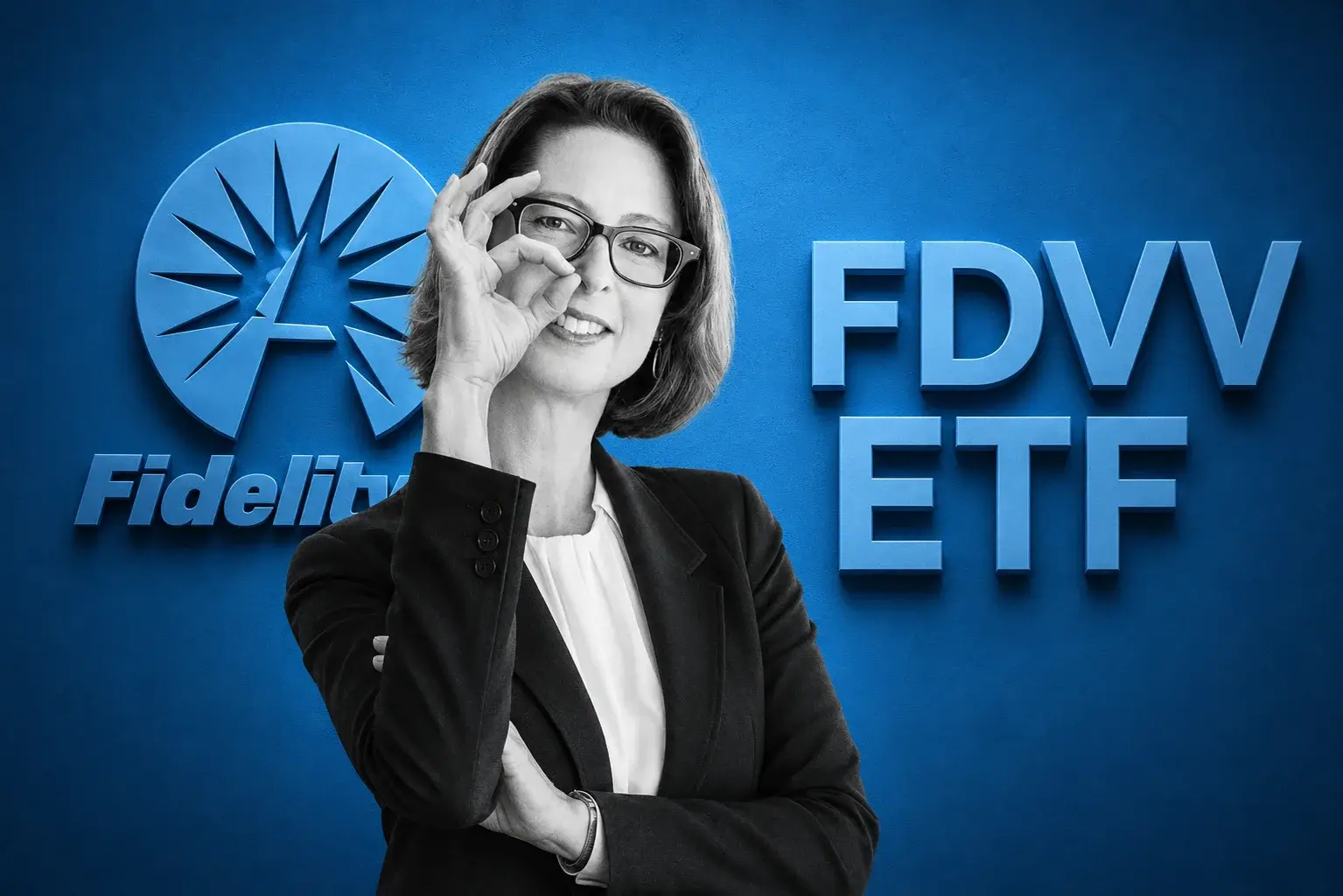
The single most important thing to understand about the Fidelity High Dividend ETF is that its name is misleading, and that misdirection is the entire investment thesis. FDVV is changing hands near $61.64, sitting at a fresh all-time high after touching $61.73 at the top of its 52-week range, and it got there not by behaving like the bond-proxy income vehicle the word "dividend" implies, but by riding the same megacap-tech bid that's powering the Nasdaq to records. A conventional high-dividend ETF anchors itself in utilities, consumer staples, and energy — the slow, defensive payers that act as a substitute for bonds when yields are unattractive. FDVV does the opposite. It leans 26% into technology, holds Nvidia, Apple, Microsoft, and Broadcom as its four largest positions, and lets those AI-driven growth names drive its returns. The result is a fund that pays a 2.7% yield but trades with the volatility and upside of a growth portfolio. That hybrid character is why it just printed a record on the day Nvidia's N1X reveal reignited the AI trade, and it's the lens through which every part of this fund has to be read.
Where FDVV trades right now
The price action is about as strong as a dividend fund gets. FDVV is trading at $61.64, up roughly 0.9% in its most recent session, having pushed to the very top of its 52-week range of $49.97 to $61.73 — a fresh all-time high. The trajectory through 2026 tells the story of a fund firing on the tech tilt: it traded near $54.58 in early April during a session when the broad market sold off, climbed back to $55.49 a few days later, and has since ripped to the $61.64 record, a gain of better than 13% off the spring lows. Assets under management have swelled to $9.18 billion, up from roughly $6.3 billion in late 2025, reflecting both price appreciation and genuine inflows as investors chase the combination of yield and growth. The fund carries a Morningstar large-value classification and a Moderate Buy aggregate rating from the analyst community. A high-dividend ETF sitting at an all-time high while the Nasdaq makes records isn't a coincidence — it's the direct consequence of a portfolio that's stuffed with the AI winners, and the record price is the tech tilt paying off.
The holdings tell the real story
The portfolio is where FDVV reveals what it actually is. The fund holds roughly 110 to 119 stocks, and the top of the book reads like a growth ETF: Nvidia at around 7.18%, Apple at 6.41%, Microsoft at 4.48%, and Broadcom at 3.47%, with those four technology giants together representing more than 20% of the entire fund. The top ten holdings account for roughly 34.5% of assets, a meaningful concentration that means performance is highly sensitive to large-cap tech moves. The irony for income-focused buyers is sharp — these marquee holdings are not substantial dividend payers. Microsoft's forward yield is around 0.90%, Broadcom's about 0.62%, Apple's roughly 0.36%, and Nvidia's is a rounding error. So the fund's largest positions contribute almost nothing to its income stream and everything to its capital appreciation. FDVV blends these low-yielding, high-growth names with genuinely attractive dividend payers like Philip Morris and Exxon Mobil, creating a barbell that captures AI-sector upside on one end and traditional dividend income on the other. The geographic exposure is heavily domestic at roughly 94.7% United States. The holdings make plain that this is a growth-oriented fund that happens to pay dividends, not an income vehicle that happens to own some tech.
The sector tilt is the engine and the risk
The sector allocation is the clearest expression of FDVV's strategy and its single biggest risk factor. Technology sits at roughly 26% of assets, financial services around 17% to 18%, and consumer cyclical near 15% to 16% — a mix that tilts decisively toward the growth-and-cyclical end of the spectrum rather than the defensive corners. Compare that to a traditional high-dividend fund like the iShares Core High Dividend ETF, which puts 24.6% in consumer staples, 21.4% in energy, 16.5% in healthcare, and only 8.2% in technology, and the contrast is stark. FDVV's 26% technology weighting against HDV's 8.2% is the entire difference in how the two funds behave. That tech overweight is the engine behind FDVV's superior returns — it enables direct participation in AI-sector growth and has driven outperformance versus its dividend-ETF peers. But it's also the source of its risk: the same concentration that lifts the fund on AI enthusiasm exposes it to deeper drawdowns when tech rolls over. FDVV has experienced deeper drawdowns than its more defensive peers precisely because it's not built defensively. The tilt is a feature, not a bug, but it's a feature that makes this a higher-beta dividend product.
Why this isn't a bond proxy
Investors reaching for a high-dividend ETF are often seeking a bond substitute — a low-volatility income stream that holds up when rates are unfriendly and equities wobble. FDVV does not fill that role, and mistaking it for one is the most dangerous error an income buyer can make with this fund. A true bond-proxy dividend ETF derives most of its return from the dividend itself and most of its stability from defensive sectors that hold their value in downturns. FDVV derives the bulk of its total return from capital appreciation in growth names and carries equity-market-level volatility because of it. The 2.7% yield is real and competitive, but it's the smaller part of the story — the fund's 25.3% one-year total return came overwhelmingly from price appreciation in Nvidia, Apple, Microsoft, and Broadcom, not from the income stream. In a genuine risk-off environment where rate-sensitive defensive payers shine, FDVV would behave more like the Nasdaq than like a bond ladder, selling off with its tech holdings rather than providing shelter. For an investor who wants income stability, the fund's character cuts the wrong way. The yield is the costume; the growth is the body underneath.
The yield and the cost
On the income and expense metrics, FDVV is competitive without being exceptional. The fund yields roughly 2.7% to 2.88% depending on the calculation window, paid quarterly, with $1.66 to $1.76 per share distributed over the trailing year and the most recent ex-dividend date on March 20. That yield beats a broad-market fund and edges out some pure-income peers — it offers a higher payout than Vanguard's High Dividend Yield ETF at around 2.3% — while sitting below the deeper-yielding defensive funds. The expense ratio is a lean 0.15%, genuinely cheap for an actively-screened dividend strategy, though it's pricier than the rock-bottom 0.04% of some Vanguard alternatives. The fund screens companies on dividend yield, dividend growth rate, and payout ratio, and it has grown its own distributions meaningfully, with cumulative dividend growth of 48% across a recent three-year stretch. So the income case is solid: a competitive yield, a low fee, and a track record of growing the payout. But the yield has to be understood in context — it's a respectable income stream attached to a growth engine, not the primary reason the fund has performed.
The performance record
The total-return numbers are where FDVV makes its strongest case, and they're genuinely impressive for a fund in the dividend category. The ETF delivered a 25.3% to 26.7% total return over the past year including dividends, an 8.6% year-to-date gain, a three-year average annual return around 18.8% to 20.9%, and a five-year average near 13.8%. Since its September 2016 inception, the average annual return has been roughly 13.3% to 13.7%, and over that nearly ten-year span the fund has strongly outperformed traditional high-dividend competitors like the iShares Core High Dividend ETF. That outperformance is the direct dividend, so to speak, of the technology tilt — by owning the AI winners alongside its dividend payers, FDVV captured the megacap-tech bull run that left the defensive dividend funds behind. The Morningstar assessment captures the balance well: the fund rides the line between income and price appreciation, delivering a higher yield than the average large-value fund without sacrificing growth prospects. The record validates the hybrid strategy — for investors willing to accept the tech-driven volatility, FDVV has been the superior way to own dividends over the past decade.
Today's record rides the N1X catalyst
The fund's all-time high today is no accident of timing — it's a direct read-through from the day's dominant market story. FDVV's largest holding is Nvidia at roughly 7.18%, and Nvidia is the stock detonating higher on Jensen Huang's Computex reveal of the N1X PC chip, ripping more than 4% as the AI trade reignites across the entire market. Apple, the fund's second-largest position, drew a reiterated buy from Citi, and Microsoft, its third, surged on its partnership in the N1X and RTX Spark launch. With its three largest holdings all catching strong bids on the same AI catalyst, FDVV mechanically pushed to its record. This is the hybrid nature in real time: a dividend fund hitting an all-time high because the AI infrastructure trade is roaring, not because income-seeking capital is rotating into defensive payers. The fund's fortunes are tethered to the megacap-tech complex, and on a day when that complex leads the market to records, FDVV leads the dividend category to a record of its own. It's the cleanest possible illustration of why this fund trades like the Nasdaq with a yield attached.
Read More
-
Yen Stalls at 160 Despite a 3% JGB and Tokyo Core CPI at 2.0% — Intervention Sits at 164, Friday's Payrolls Decide
02.09.2026 · TradingNEWS ArchiveEnergy
-
CHAT Fund Holds $96.37 as Korean Memory and Chip Exposure Drive a 109.73% Year — Break of $98.02 Opens $105.20
18.09.2026 · TradingNEWS ArchiveStocks
-
First-Generation XRPR and XRPI Ride XRP's Rebound to $1.386 as Spot Funds Post First Outflow — Break of $1.40 Opens $1.54
18.09.2026 · TradingNEWS ArchiveCrypto
-
NG Holds $2.9255 as Storage Surplus Narrows From 5.5% to 3.7% in 3 Weeks — Break of $3.00 Opens $3.15
18.09.2026 · TradingNEWS ArchiveCommodities
-
Dollar Surges to 157.90 as BoJ's Divided Hike Fails to Lift the Yen — Break of 158.87 Opens 159
18.09.2026 · TradingNEWS ArchiveForex
The bull and bear case
The investment case splits cleanly along the same fault line that defines the fund. The bull case is that FDVV offers the best of both worlds — a competitive 2.7% yield, a cheap 0.15% fee, a decade of category-beating total returns, and direct participation in the AI-driven growth that's powering the market, all in a single diversified wrapper. For an investor who wants income but doesn't want to surrender the upside of the megacap-tech bull run, FDVV is a uniquely efficient vehicle, and its record price reflects a strategy that's working. The bear case is the mirror image: the fund's 26% tech tilt and 20%-plus concentration in four AI names mean it carries equity-market volatility and deeper drawdown risk than its name suggests, and an investor buying it for income stability is exposed to a tech-led selloff they didn't sign up for. If the AI trade that's lifting it to records reverses — a Broadcom miss, an Nvidia stumble, a broad megacap de-rating — FDVV would fall harder than a true defensive dividend fund. The fund is excellent for what it actually is and dangerous for what its name implies, and the entire decision rests on which investor is buying it.
Forecast and verdict
The verdict is constructive with a clear caveat about what you're actually buying. FDVV is a buy for the growth-oriented income investor and a mismatch for the bond-proxy seeker, and getting that distinction right is the whole analysis. The fund sits at an all-time high of $61.64 on the strength of a strategy that's genuinely worked — a 25.3% one-year return, a decade of outperformance versus defensive dividend peers, a competitive 2.7% yield, and a lean 0.15% fee, all driven by a deliberate technology tilt that captured the AI bull run. For an investor who wants dividend income but refuses to miss the megacap-tech upside, this is one of the most efficient vehicles available, and its record price is the strategy paying off in real time. The base case from here is continued strength as long as the AI trade holds, with the fund tracking its Nvidia-Apple-Microsoft-Broadcom core higher alongside the Nasdaq. What invalidates the bullish case is precisely what makes the fund work — a reversal in megacap technology, whether from a Broadcom guidance miss this week, an Nvidia stumble, rising Treasury yields compressing growth multiples, or a broad risk-off that hits the AI complex hardest. In that scenario FDVV's 26% tech weighting turns from its greatest asset into its greatest liability, and it would draw down more than its defensive peers. The fund is excellent, but it is not what its name says. Buy it for total return and AI-flavored income, respect that it trades like a growth fund, and never mistake it for the safe-haven income anchor a 2.7% dividend yield might suggest. It's a record-setting dividend ETF wearing an AI costume, and the costume is the reason it's at a record.