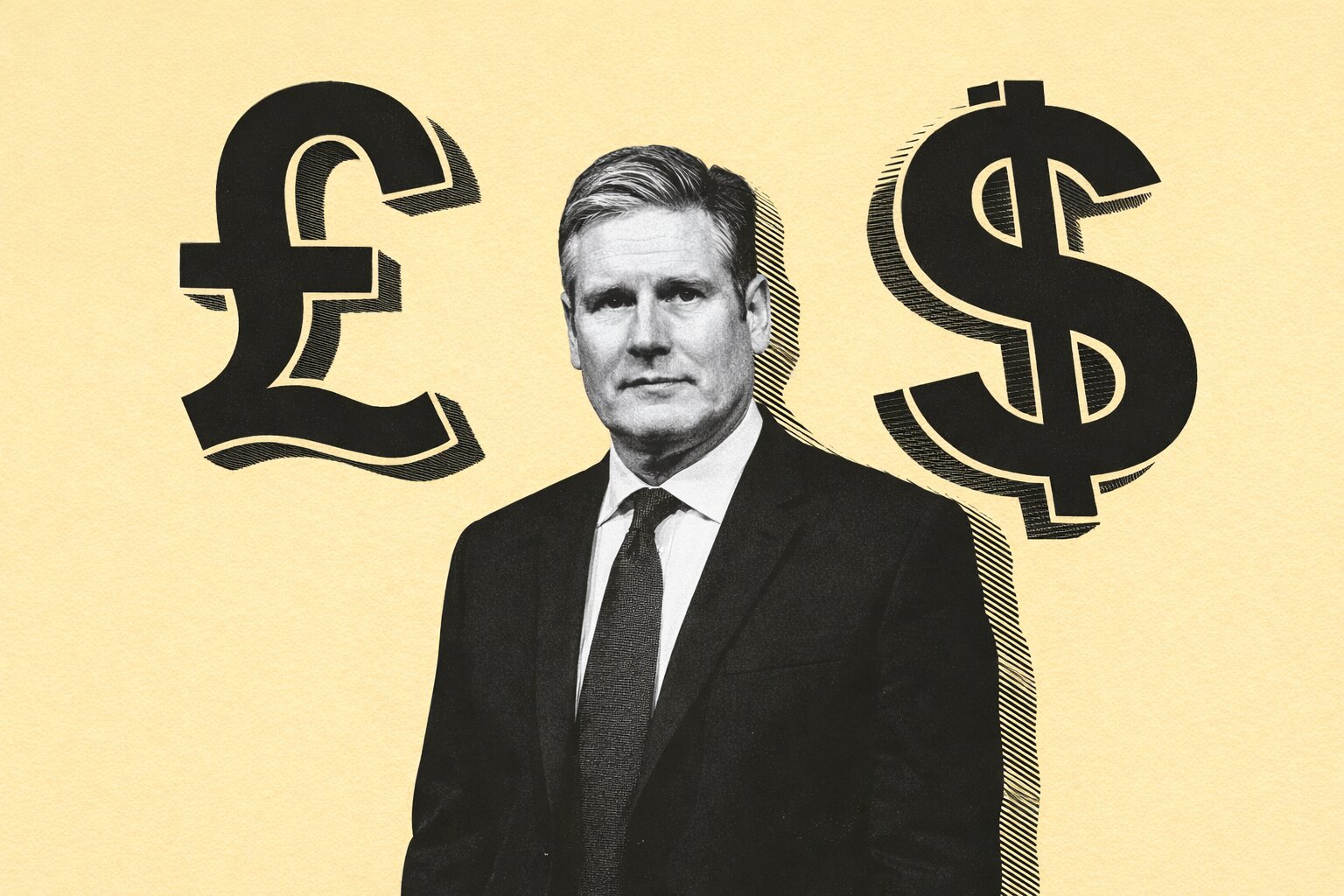
GBP/USD Price Forecast: Sterling Stalls Near 1.36 as Keir Starmer’s Future Is Questioned
The pound’s climb from 1.30 to the 1.38 area is fading, with GBP/USD stuck around 1.36–1.37 as markets price in leadership risk, higher gilt yields and the chance that a post-Starmer government leans more fiscal and less currency-friendly | That's TradingNEWS
GBP/USD – leadership risk forces a 1.35–1.37 repricing
GBP/USD spot move from 1.3870 peak to a 1.3530–1.3700 volatility band
GBP/USD has flipped from a clean four-month uptrend into a choppy, politically driven range. After stretching to a 4½-year high around 1.3870–1.3880 in January, the pair has been forced lower, printing intraday lows near 1.3533 and struggling to reclaim the 1.3700 area. Every push above 1.3680–1.3720 is being sold, which tells you sterling is no longer trading only on rates and data. The market is actively re-pricing a risk premium for UK politics as the Mandelson–Starmer story escalates and leadership speculation intensifies.
GBP/USD and the BoE – 3.75% Bank Rate, weak growth and a labour market that is softening
On the domestic macro side the Bank of England is stuck in a narrow lane. Bank Rate sits at 3.75% after a tight 5–4 vote to cut by 25 bps in December, and the committee is signalling a slow, data-driven path rather than an aggressive easing cycle. Real activity gives them no comfort. Q4 growth is basically flat, and services PMIs show the employment component falling since late 2024, with the latest readings flagging the longest run of job shedding in the sector for roughly sixteen years. Headline CPI around 3.4% year-on-year remains too high for the BoE to relax, but the internal forecast still has inflation sliding toward 2% by spring and hovering near target once regulated tariffs and tax changes wash through. For GBP/USD that mix is awkward. The BoE is not hiking to defend the currency, but it also cannot slash rates to stimulate growth without risking a credibility hit. The policy differential versus the Federal Reserve is no longer moving decisively in sterling’s favour, which caps the upside for the pair above the 1.38–1.39 region even in a benign scenario.
USD leg of GBP/USD – firm services, sticky prices and a Fed that refuses to validate deep cuts
The dollar side of the cross still rests on firm fundamentals. The ISM non-manufacturing index sits around 53.8, clearly in expansion territory and slightly ahead of expectations, while the prices-paid component has climbed into the mid-60s, signalling persistent domestic inflation pressure. ADP private payrolls growth has slowed to roughly 22k jobs in the latest monthly print, down from 37k previously, yet that is not a collapse; weekly initial claims holding just above the 200k mark confirm that the US labour market remains resilient. Fed officials are responding exactly as you would expect. They are pushing back against the idea of large, early cuts and stressing the risk of sticky inflation rather than weakness in employment. As long as that stance holds, the dollar keeps a floor under DXY and prevents GBP/USD from regaining the 1.39–1.40 handle purely on rate-cut hopes.
Mandelson scandal and GBP/USD – how Starmer’s damaged authority became an FX input
The structural change for sterling this week is political, not macro. Newly released Epstein files revealed that Peter Mandelson, appointed as US ambassador in 2024, had shared sensitive information with Jeffrey Epstein and maintained contact even after Epstein’s conviction. That triggered Mandelson’s resignation from Labour and the Lords and opened the door to a criminal investigation into possible misconduct in public office. The crucial point for GBP/USD is that Keir Starmer has now admitted he knew about Mandelson’s ongoing relationship with Epstein when he approved the appointment. That admission enraged Labour MPs, fuelled open talk of betrayal, and immediately put his leadership on a countdown timer. As those headlines crossed, GBP/USD was pushed away from the 1.37 area and forced into the low-1.35s, with a sharp test near 1.3533 as positioning was cut. Gilt yields jumped to their highest levels since late 2025, reflecting investors demanding a higher risk premium to hold UK duration while the future of the government is questioned.
Betting markets, GBP/USD and the timing of a possible Starmer exit in 2026
Pricing in the betting markets now aligns with the FX reaction. Odds on Starmer leaving Downing Street in 2026 have been slashed from levels implying a coin-flip to around 1/3, which is roughly a 70% implied probability of departure this year. More than ninety percent of recent bets flow in the “Starmer gone in 2026” direction. That matters for GBP/USD because it shifts the discussion from a theoretical leadership wobble to a scenario in which the market needs to map concrete successors and assign them fiscal and regulatory profiles. As long as the probability of a 2026 exit hovers at those levels, the currency is going to carry a political discount against peers, particularly when the BoE has limited capacity to counteract that with hawkish surprise.
Read More
-
Yen Stalls at 160 Despite a 3% JGB and Tokyo Core CPI at 2.0% — Intervention Sits at 164, Friday's Payrolls Decide
02.09.2026 · TradingNEWS ArchiveEnergy
-
AMD ($560.68) Rebounds 10% From Its October Low on the Meta Helios Win — November 3 Report Holds the Key to $649
27.10.2026 · TradingNEWS ArchiveStocks
-
Ethereum ($2,312) Lags Bitcoin and AI Stocks as BitMine Nears Its 5% Cap — Break of $2,295 Opens $2,200
27.10.2026 · TradingNEWS ArchiveCrypto
-
Brent ($113.88) Trades a $2.35 Range as Houthi Strikes Meet Saudi-Iran Diplomacy — Break of $117 Unlocks $120
27.10.2026 · TradingNEWS ArchiveCommodities
-
Nasdaq Rips 1.3%, S&P 500 Hits 7,728, Dow Stalls as BA Drops to $171
27.10.2026 · TradingNEWS ArchiveMarkets
-
GBP/USD (1.3310) Can’t Cash In on 5.43% Gilt Yields as Budget Risk Meets a Firm Dollar — Break of 1.3274 Opens 1.3200
27.10.2026 · TradingNEWS ArchiveForex
Successor profiles and GBP/USD – how Rayner, Streeting and others change the fiscal risk premium
The next question for the FX market is simple and brutal. If Starmer falls, who comes next and what does that mean for fiscal policy. Angela Rayner, Wes Streeting, Ed Miliband and external challengers such as Nigel Farage all sit on different points of the fiscal spectrum. A Rayner-led government is perceived as more comfortable pushing for higher public investment and a looser stance on borrowing. That profile, combined with an already fragile gilt market, would force investors to widen the UK risk premium and would argue for a weaker GBP/USD baseline, particularly if global risk sentiment remains shaky. A Streeting-type outcome is read as more continuity with existing fiscal guardrails. He is seen as more likely to preserve the Treasury’s framework, talk directly to markets about discipline and attempt to re-anchor the debate around growth rather than a spending shock. Under that scenario the political discount on sterling could narrow once the succession is settled. Ed Miliband brings strong support from the party base but also a record that the bond market remembers from 2015, while Nigel Farage represents a completely different path, one in which Reform UK converts high polling into seats and re-opens structural questions about the UK’s relationship with Europe and its long-term regulatory model. For GBP/USD the hierarchy is straightforward. A perceived “leftward slide” in leadership, toward Rayner or a similar figure, carries the highest risk for sterling. A technocratic continuity profile such as Streeting’s is less threatening. A chaotic outcome involving early elections and a stronger Reform showing would put “UK exceptional risk” back at the centre of FX pricing and would justify a deeper move below 1.35.
What the big banks have pencilled in for 2026 GBP/USD levels
Before the scandal accelerated, major banks had already sketched a relatively tight trading corridor for the year. JP Morgan projects GBP/USD in a 1.36–1.39 range, with explicit warnings that a decisive shift toward more expansionary leadership could trigger a deeper sell-off. Goldman Sachs sits at roughly 1.36, arguing that weak UK growth caps sterling regardless of marginal political changes. MUFG is more constructive, targeting around 1.40 by mid-2026 on the assumption that the dollar gradually softens as the Fed eases, even if UK politics stays loud. Wells Fargo takes the opposite tack, flagging around 1.34 into year-end on the view that US assets reclaim capital flows as rate cuts prove slower and more limited globally than the market currently wants. Put together those projections define a spine between 1.34 and 1.40. Spot around the mid-1.36 area sits almost exactly in the centre of that band, which confirms what the chart already shows. GBP/USD is not in a clean trend any more. It is trading political and central-bank headlines inside a wide sideways channel, with volatility spikes whenever leadership odds or MPC guidance shift.
Technical structure of GBP/USD – bearish flag under 1.3720 with 1.3550 and 1.3420 as key floors
Technically the pair has carved out a textbook topping sequence. The rally from 1.30 met heavy supply in the 1.3815–1.3880 zone, and the failure above 1.3870 has been followed by a break back below the prior resistance shelf at 1.3720–1.3730. That shelf has now flipped into a first resistance band. Every intraday push into that area is being faded. Above it, the 1.3815–1.3840 zone and the 1.3900–1.3950 band mark the upper edge of the January spike and the point where shorts will be re-loaded aggressively if politics has not stabilised. On the downside the market is defending 1.3615–1.3600 as initial support. Below that, the 20-day moving average near 1.3565 and the 38.2% retracement of the November–January leg around 1.3540 provide a thin cushion before the real floor. The heavy level is 1.3500, where the 50-day and 200-day averages converge with the rising trendline from the 1.3000 base. A clean daily close below 1.3550, followed by sustained trade under 1.3500, would confirm that the uptrend from 1.30 has broken and shift the focus toward 1.3420 and potentially the 1.3350–1.3200 region if gilt yields stay elevated and leadership news deteriorates further. Momentum indicators match that picture. Relative strength has rolled down from overbought territory and is trending lower without yet flashing extreme oversold signals, which leaves room for additional downside before dip buyers can regain control. The pattern on the daily chart is effectively a bearish flag, formed by a sharp drop from 1.3870 to the mid-1.36s and a sideways grind under a falling upper boundary.
GBP/USD price forecast after Starmer’s leadership shock – directional bias, levels and stance
With spot oscillating between roughly 1.3530 and 1.3720, gilt yields at late-2025 highs, the BoE frozen at 3.75%, and the Fed still emphasising inflation risk, the decisive variable for GBP/USD in the next quarter is political. The Mandelson episode has damaged Keir Starmer’s authority, raised the probability of a 2026 resignation toward seventy percent in betting markets and forced investors to assign hard numbers to scenarios in which Angela Rayner, Wes Streeting or another figure sets the fiscal tone. That shift justifies a lower equilibrium for sterling than the one implied when GBP/USD was trading around 1.3870 in January. The tactical bias from here is bearish while leadership uncertainty persists. The working range is 1.34–1.38, with spikes toward 1.3720–1.3800 treated as opportunities to sell rather than chase. On the downside, 1.3550 is the first objective and 1.3420 becomes the next target if the scandal deepens or if polls show increased support for candidates perceived as more fiscally aggressive. Only a sustained daily close above 1.3850, combined with clear evidence that the succession question has been defused or resolved in favour of a fiscally orthodox profile, would invalidate the immediate bearish structure and reopen a path back toward 1.40. Until that happens the position is clear. GBP/USD remains a sell on strength, with the leadership risk around Keir Starmer and the profile of his potential replacement acting as the main catalysts pulling the pair back toward the low-1.35s rather than pushing it back to the 1.39–1.40 highs.