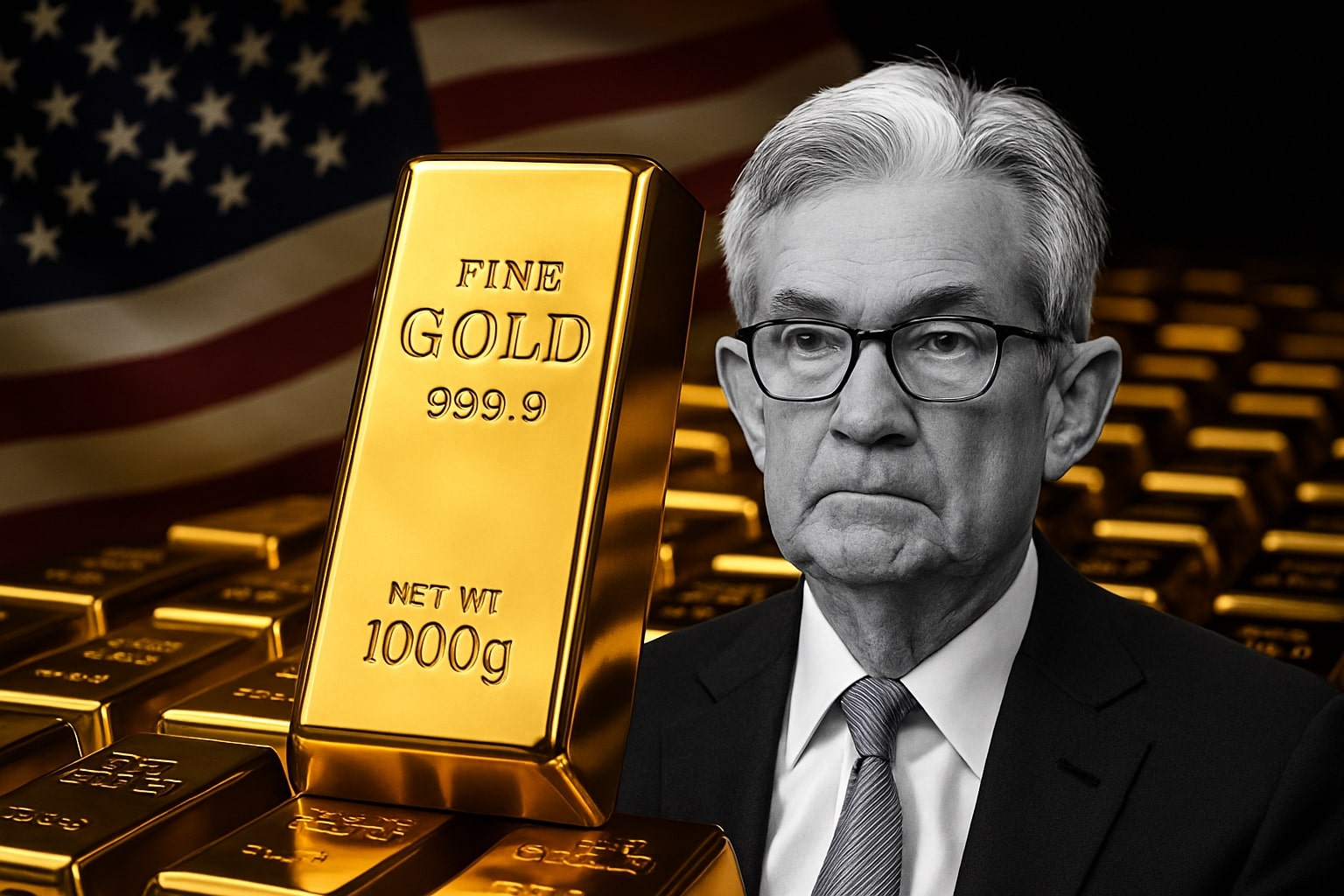
Gold Price Forecast - GOLD (XAU/USD) Steadies Above $4,230 as Analysts Target $4,450–$5,000
XAU/USD consolidates near $4,230 ahead of the Fed’s expected 25 bps cut, with DXY at 98.75 and inflation easing to 2.8% | That's TradingNEWS
Gold Price Forecast - (XAU/USD) Extends Gains Toward $4,230 Amid Fed Pivot and Dollar Weakness
Gold (XAU/USD) is trading around $4,230, maintaining upward momentum as markets price in an 87% probability of a Federal Reserve rate cut at the upcoming policy meeting. The metal remains confined within a narrow range between $4,164 and $4,265, staying comfortably above its 20-day Exponential Moving Average (EMA) at $4,147.96. The RSI near 60 confirms healthy momentum, while the rising EMA structure signals continued bullish bias. As long as gold holds above $4,110, the technical tone stays constructive with upside potential toward the next resistance area near $4,265–$4,300.
Federal Reserve Policy Expectations Reinforce Bullish Outlook
The CME FedWatch Tool indicates an 87% chance of a 25-basis-point cut, which would bring the target rate to 3.50%–3.75%. Soft labor data and easing inflation expectations continue to drive dovish sentiment. A rate cut would reduce real yields and further weaken the U.S. Dollar Index (DXY), now hovering near 98.75 — its lowest level in five weeks. The weaker dollar supports non-yielding assets such as gold, and any confirmation of a longer easing cycle could anchor XAU/USD above the $4,200 level, setting up a base for a move toward $4,400–$4,450.
Labor Market Softness and Inflation Data as Key Drivers
Deteriorating U.S. labor conditions have intensified expectations for monetary easing. Initial jobless claims fell to 191,000 last week, but broader labor indicators, including job openings and payroll additions, continue to show weakness. Inflation remains within the Fed’s comfort zone at 2.8%, keeping the door open for a rate cut. Markets will focus on the delayed U.S. PCE inflation data for confirmation. If the data comes in softer, gold could quickly retest resistance at $4,265 and extend toward the $4,300–$4,450 region.
Technical Setup: Consolidation Within a Rising Channel
Gold remains inside a rising channel originating from the October 28 low of $3,933.90. The lower boundary near $4,110 acts as dynamic support, while the upper range at $4,275 marks near-term resistance. The Fibonacci pivot at $4,191 serves as the equilibrium level of the current structure. A breakout above $4,275 would open the path to $4,381, while a drop below $4,110 would expose the psychological $4,000 zone. The 20-, 50-, 100-, and 200-day EMAs remain positively aligned, confirming an ongoing accumulation phase rather than short-term speculation.
Read More
-
Yen Stalls at 160 Despite a 3% JGB and Tokyo Core CPI at 2.0% — Intervention Sits at 164, Friday's Payrolls Decide
02.09.2026 · TradingNEWS ArchiveEnergy
-
SOFI ($16.71) Posts Its Best Day of the Quarter as Profit Guidance Finally Rises — Holding $15.70 Unlocks $20
27.10.2026 · TradingNEWS ArchiveStocks
-
XRP-USD ($1.30) Defends a $1.27 Double Bottom as Whales Hold 68.5% of Supply — Break of $1.31 Opens $1.35 and $1.40
27.10.2026 · TradingNEWS ArchiveCrypto
-
Brent ($113.88) Trades a $2.35 Range as Houthi Strikes Meet Saudi-Iran Diplomacy — Break of $117 Unlocks $120
27.10.2026 · TradingNEWS ArchiveCommodities
-
Nasdaq Rips 1.3%, S&P 500 Hits 7,728, Dow Stalls as BA Drops to $171
27.10.2026 · TradingNEWS ArchiveMarkets
-
GBP/USD (1.3310) Can’t Cash In on 5.43% Gilt Yields as Budget Risk Meets a Firm Dollar — Break of 1.3274 Opens 1.3200
27.10.2026 · TradingNEWS ArchiveForex
Global Risk, Safe-Haven Demand, and Central Bank Support
Gold continues to attract inflows as geopolitical uncertainty persists, particularly regarding U.S.–Russia tensions and the prolonged Ukraine conflict. Central banks have been a critical pillar of demand, purchasing over 700 metric tons in 2025, significantly above pre-pandemic levels. The World Gold Council (WGC) notes that strong official sector accumulation, alongside elevated ETF holdings, is structurally supporting prices.
2025 Performance and 2026 Outlook
Gold is closing 2025 as one of its best-performing years since the 1970s, rallying over 60% year-to-date and hitting more than 50 record highs. According to the WGC, the yellow metal could follow three distinct paths in 2026 depending on macroeconomic outcomes. In a moderate slowdown scenario, gold could advance 5–15% toward $4,500–$4,650. A deeper global downturn, described as the “doom loop,” could trigger a 15–30% surge above $5,000. In contrast, a reflationary scenario driven by U.S. fiscal strength could push prices down 5–20% toward $3,800–$3,950. Current conditions favor the first two scenarios, supporting a bullish bias with a short-term target near $4,450 and a medium-term projection between $4,800 and $5,000.
Market Positioning and Institutional Flow
Despite multiple tests of the $4,110–$4,150 support zone, sellers have failed to establish a breakdown. Institutional investors continue to accumulate positions as reflected by rising ETF inflows and increased physical deliveries. The absence of liquidation activity signals that gold is undergoing structural revaluation rather than speculative rotation.
Dollar Correlation and Yield Compression
The negative correlation between gold and the U.S. Dollar Index remains firmly in place at -0.85. As DXY trades under 99.00 and Treasury yields stabilize around 4.11%, gold continues to benefit from lower real yields. Global monetary authorities such as the ECB, BoE, and BoC are expected to follow the Fed’s easing path, amplifying global demand for gold as a hedge against currency depreciation.
Projected Price Targets and Market Consensus
Most institutional forecasts place gold’s next breakout zone between $4,450 and $4,500, in line with the ongoing macro and technical setup. If the Federal Reserve reinforces its dovish narrative and global risk sentiment remains elevated, XAU/USD could extend its rally toward $4,800–$5,000 in early 2026. Based on current conditions, the trend remains bullish with a projected price target of $4,450, maintaining a Buy outlook for the near term.