Gold Price Forecast: XAU/USD Rebounds to $4,900 After Historic Margin Selloff
Bullion snaps back 5% from the $4,403 low as central-bank demand, delayed US jobs data and long-term $6,000–$8,000 targets drive the next move above the key $5,000 level | That's TradingNEWS
Gold (XAU/USD) Price Snapshot After The Crash
Gold (XAU/USD) is trading back in the $4,900–$4,950 zone after a violent margin-driven collapse that took spot from the $5,594.82 record high on Jan 29 down toward $4,403.24 in days. U.S. April futures are tracking around $4,945–$4,950, after opening near $4,691 versus Monday’s close at $4,652.60. On a one-week basis gold is still down roughly 7–8%, but over the last month it is up about 7–8%, and versus a year ago it is still ahead by roughly 60–70%, even after a 21%+ peak-to-trough hit. Silver has mirrored the stress, rebounding more than 9% toward $86.7 after its own plunge. The message from the tape: the trend corrected hard, it did not evaporate.
Gold (XAU/USD) What Broke The Rally So Suddenly
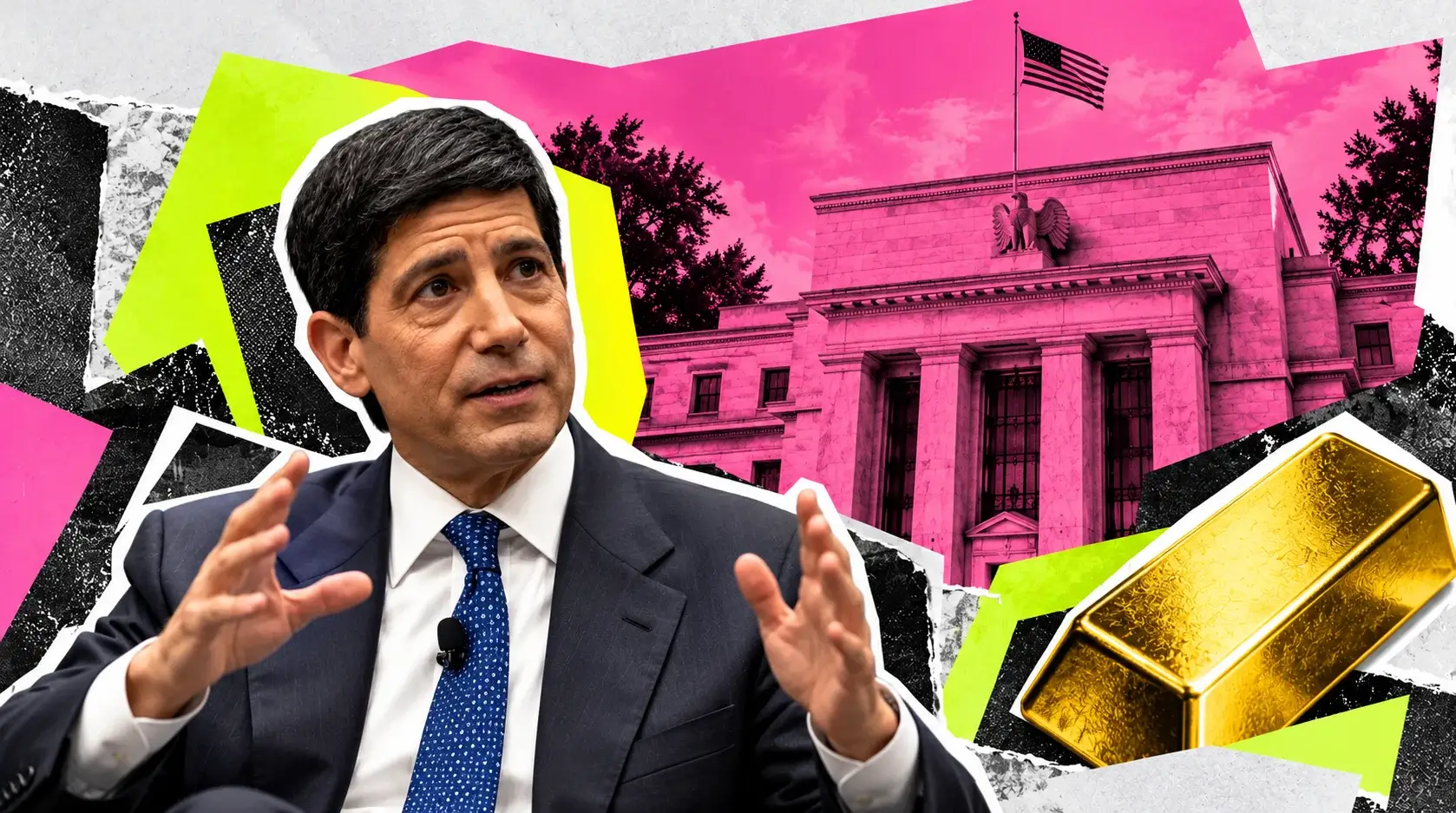
The collapse was triggered by a specific combination of politics and market plumbing. Politically, the nomination of Kevin Warsh as the next Fed chair signaled a tilt toward a more conservative stance on rates at the exact moment gold was stretched above $5,500. Warsh’s prior record as a slow cutter in 2006–2011 raised the probability that real rates stay restrictive for longer, directly attacking a key pillar of the bull case for Gold (XAU/USD). At the same time, CME hiked margin requirements on precious-metal futures just as speculative length was crowded and heavily leveraged. Higher margin means more collateral or forced position reduction. Those who could not post additional capital were forced to sell into a thin tape, which is why spot gold could collapse from near $5,600 to the $4,400s in a cascade instead of drifting lower over weeks. This was a margin and positioning event layered on top of a Fed-path shock, not a slow rejection of gold as an asset.
Gold (XAU/USD) Technical Map After The Oversold Flush
Technically, Gold (XAU/USD) has moved from a parabolic blow-off to a deep but contained reset. The important levels now are clear. The all-time high is around $5,594.82. The recent crash low printed near $4,403.24, with another washout spike toward $4,630.59 on Monday. Current spot in the $4,900–$4,950 region leaves price below the psychological $5,000 handle but well above the panic lows. Short-term support is forming in the $4,600–$4,700 band, where forced liquidations met real demand. The $5,000 area has flipped from a floor into a first layer of overhead resistance, and anything above $5,200–$5,300 will be treated as a test of whether the market can rebuild a sustainable up-move instead of another blow-off. From a structure standpoint Gold (XAU/USD) is no longer overbought, but it is still trading near the top of its historical price distribution. That means volatility remains elevated; the market has room to swing several hundred dollars per ounce in either direction without breaking the bigger picture.
Gold (XAU/USD) Macro Drivers: Real Yields, Fed Chair Risk And Data Gaps
Gold (XAU/USD) always trades against real yields, the dollar and policy expectations. The Warsh nomination matters because it adjusts the expected trajectory of those variables. A chair perceived as more comfortable with higher real rates compresses the relative appeal of a non-yielding asset priced near extremes. The recent 21% drop was the market repricing that probability aggressively. At the same time the partial U.S. government shutdown has delayed the January jobs report, leaving traders without a key data point on the labor market and inflation risk. With no fresh payrolls data to calibrate the Fed path, positioning in XAU/USD is more speculative and more sensitive to headlines than usual. The combination of a perceived hawkish leadership shift, higher margin and missing macro data explains why the move was so violent and why the rebound, while strong, is still not anchored by hard numbers from the real economy.
Gold (XAU/USD) Structural Demand: Central Banks And Institutional Allocation
Behind the noise, the structural bid for Gold (XAU/USD) has not disappeared. Central banks, especially in emerging markets, have been increasing gold reserves for years. Official purchases above 1,000 tonnes in 2024 signaled that policy makers view bullion as a strategic hedge against sanctions risk, reserve concentration and long-term currency debasement, not a short-term trade. On top of that, institutional research has modeled scenarios where global portfolios raise their gold allocation from roughly 3% to around 4.5–4.6%. The supply side cannot respond quickly to that kind of shift. Mine production is slow, capital-intensive and exposed to regulatory constraints. If central bank flows remain elevated and private capital edges allocation higher, the only way to clear the market is through higher prices for XAU/USD over time. The crash wiped out leveraged longs, not central-bank strategies. Those structural buyers tend to view sharp drawdowns as discounted entry points rather than reasons to exit.
Gold (XAU/USD) Tokenization And New Access Channels
Another layer of demand for Gold (XAU/USD) is coming from tokenized instruments. Products like PAX Gold (PAXG) and Tether Gold (XAUT) package claims on vaulted bullion into on-chain tokens that trade 24/7 against stablecoins such as USDT. For many investors, that is the first time they can hold gold exposure without opening a metals account, dealing with physical logistics or interacting with traditional brokers. Spot tokenized gold behaves like unlevered XAU exposure: no yield, direct sensitivity to gold’s price, but low operational friction and fractional sizing. On top of that, futures and derivatives on gold-linked contracts in the crypto space give macro traders another venue to express directional views and hedges. Tokenization does not change the fundamental drivers of Gold (XAU/USD), but it expands the rails capital can travel on. The more accessible gold becomes across different infrastructures, the easier it is for both retail and institutional money to express a structural view in favor of bullion.
Read More
-
Yen Stalls at 160 Despite a 3% JGB and Tokyo Core CPI at 2.0% — Intervention Sits at 164, Friday's Payrolls Decide
02.09.2026 · TradingNEWS ArchiveEnergy
-
AMD ($560.68) Rebounds 10% From Its October Low on the Meta Helios Win — November 3 Report Holds the Key to $649
27.10.2026 · TradingNEWS ArchiveStocks
-
Ethereum ($2,312) Lags Bitcoin and AI Stocks as BitMine Nears Its 5% Cap — Break of $2,295 Opens $2,200
27.10.2026 · TradingNEWS ArchiveCrypto
-
Brent ($113.88) Trades a $2.35 Range as Houthi Strikes Meet Saudi-Iran Diplomacy — Break of $117 Unlocks $120
27.10.2026 · TradingNEWS ArchiveCommodities
-
Nasdaq Rips 1.3%, S&P 500 Hits 7,728, Dow Stalls as BA Drops to $171
27.10.2026 · TradingNEWS ArchiveMarkets
-
GBP/USD (1.3310) Can’t Cash In on 5.43% Gilt Yields as Budget Risk Meets a Firm Dollar — Break of 1.3274 Opens 1.3200
27.10.2026 · TradingNEWS ArchiveForex
Gold (XAU/USD) Long-Term Price Scenarios And Big Targets
Medium- to long-term scenarios for Gold (XAU/USD) are wide but biased upward. One large bank has outlined a path where gold trades toward $8,000 per ounce by 2030, driven by sustained central-bank buying and a moderate increase in private allocations relative to global financial assets. Quantitative models from crypto-data platforms project that from current levels around $4,900, gold could move toward $5,511 by August 2026, with a volatile path that allows for highs near $6,500+ and lows close to $4,059. Those projections are scenario bands, not guarantees, but they underline a key point: even after a crash, Gold (XAU/USD) is still priced inside a strong up-cycle defined by policy risk, debt overhang and reserve diversification. The market has already shown it can slice $1,000 off the price quickly; the same volatility can work in the opposite direction once macro conditions line up with the structural bid.
Gold (XAU/USD) 2026–2031: Bullish, Range, Or Bearish Paths
For Gold (XAU/USD) between now and 2031, three macro paths dominate. In the bullish path, growth slows, central banks pivot to easier policy, real yields compress and fiscal deficits stay elevated. Central bank buying remains strong, private portfolios raise allocations, and tokenized gold keeps on-boarding new capital. In that setup, XAU/USD can hold the $4,600–$4,700 support band, repeatedly challenge $5,000–$5,500, and gradually grind toward the $6,000–$6,500 region, with $8,000 on the table later in the decade if the structural flows persist. In a base-case range-bound path, growth is mediocre, inflation uneven, and the dollar resilient. Gold trades roughly between $4,000 and $5,500, acting more as a stabilizing allocation than an explosive trade. Deep pullbacks attract central banks and long-term investors, while rallies toward the upper band trigger profit-taking. In a bearish path, real yields stay high, the dollar remains strong, growth surprises to the upside and central banks taper their buying. That combination would cap Gold (XAU/USD) rallies, increase the opportunity cost of holding metal and potentially push price back below $4,600, even toward the low-$4,000s, with a long consolidation instead of a new leg higher.
Gold (XAU/USD) Risk Profile At $4,900: Price And Speculation
At current levels around $4,900–$4,950, Gold (XAU/USD) carries two core risks for anyone entering now: price risk and speculation risk. Price risk is straightforward: buyers are stepping into a market that has already rallied nearly 66% year-on-year and only recently came off a high near $5,600. Another policy shock, another margin hike or a surprise upside in real yields could easily drive a retest of $4,600 or even the $4,400 area. Speculation risk is tied to how gold trades. XAU/USD is a pure macro instrument with no cash flow; its price reflects flows, expectations and positioning around inflation, currencies and policy. That makes it extremely sensitive to narrative shifts, leverage and liquidity. Portfolio allocators who use gold as a hedge and size it moderately can absorb those swings. Over-levered traders betting on a one-way move cannot.
Gold (XAU/USD) Positioning: How To Use Spot, Futures And Tokenized Gold
Positioning in Gold (XAU/USD) needs to match the instrument with the objective. Long-term investors who want structural exposure to the macro story should focus on unlevered forms: physical, traditional ETFs, or tokenized spot such as PAXG and XAUT. There the role of gold is to hedge tail risks and currency debasement, not to deliver fast, outsized returns. Position sizes should stay in the low-single-digit percentage range of portfolio value. Active macro traders can use futures and options on Gold (XAU/USD) to express long or short views around data releases, Fed meetings and political events, but leverage should be much lower than what destroyed positions during the recent crash. Crypto-native desks can pair tokenized gold with stablecoins or Bitcoin to build cross-asset trades, for example expressing a view that XAU/USD will outperform or lag BTC in specific regimes. In all cases, the last move proved that margin and liquidation mechanics matter as much as the fundamental thesis.
Gold (XAU/USD) Verdict: Buy, Sell Or Hold After The Crash
With Gold (XAU/USD) sitting below its $5,594.82 high but well above the forced-liquidation low, the balance of evidence points to Buy with high volatility risk rather than a clean Sell or complacent Hold. The structural case is intact: central banks are still diversifying, institutional scenarios still target $6,000–$8,000, and tokenization keeps broadening access. The cyclical risk is obvious: another hawkish shock or another margin squeeze can easily drag XAU/USD back into the $4,400–$4,700 pocket before any march toward $6,000+ resumes. The rational strategy for a serious investor is staged accumulation on weakness inside that lower band, framed as a portfolio hedge, not a leveraged gamble. At these prices Gold (XAU/USD) remains a volatile asset in an up-cycle, and the payoff belongs to those who can tolerate another sharp drawdown without being forced out by their own risk management.