
Gold XAU/USD Surrenders Thursday's $77 Rip to Trade Near $4,466 as Strong Payrolls and a Hawkish Fed Pin Bullion
Gold gave back most of Thursday's 1.74% rally as a blowout 172,000-job May report drove the 10-year yield to 4.54% and firmed the dollar | That's TradingNEWS
Key Points
- Gold trades near $4,466, down about 0.20% on the day and 4.81% on the month, but still up nearly 35% year-over-year.
- A 172,000 May jobs print lifted the 10-year yield to 4.54% and firmed the dollar, the two cleanest headwinds for non-yielding bullion.
- Gold surrendered most of Thursday's $77 (+1.74%) rally to $4,519 as the dollar turned back up; silver fell 1.41% to $72.93.
Gold is caught between two forces pulling in opposite directions, and right now the bearish one has the upper hand. The war-fueled inflation premium that carried bullion through the spring is bleeding out faster than the safe-haven bid can replace it, and into that vacuum stepped a blowout jobs report that lit up Treasury yields, firmed the dollar, and reminded everyone that the Fed is pricing hikes, not cuts. XAU/USD drifted to around $4,466 on June 5, down about 0.20% on the day after surrendering most of a sharp Thursday rally. The metal is now leaning on its 200-day moving average near $4,427 — the line that has held since October 2023 — and that level is the whole ballgame.
Two Forces, One Metal
Strip the noise out and gold's story is a tug-of-war between geopolitics and the rate complex. The bullish leg is the Middle East — every flare-up in the U.S.-Iran conflict pumps a war premium into bullion as physical buyers and macro funds reach for protection. The bearish leg is the Fed and the bond market — every uptick in yields and the dollar raises the cost of holding a metal that pays nothing. For most of the spring the war premium won, and gold ground higher toward record-adjacent levels. This week the rate complex took control, and the metal is paying for it.
The 172,000 May payrolls print was the hinge. A labor market that strong doesn't just kill the rate-cut narrative — it resurrects the rate-hike one, and gold has no defense against rising real yields except a crisis bid big enough to override them. With Middle East headlines tilting toward de-escalation at exactly the moment the jobs data demanded higher yields, both of gold's support beams weakened at once. The metal didn't crash, but it lost its footing, and it's now testing whether the long-term trendline that's held for over two and a half years can take the weight.
Where Gold Trades Now
Put the numbers on the table. Spot gold sits near $4,466 on June 5, off roughly 0.20% on the session and down about 4.81% over the past month as the spring rally has rolled over. Zoom out and the longer trend is still intact — bullion is up nearly 35% from a year ago, with a 52-week range running from roughly $3,248 all the way to $5,595. That's a market that has had a monster run and is now digesting it. Gold futures traded near $4,489 in the premarket, off about 0.35%, with spot and futures both hugging the low-$4,400s to high-$4,400s band.
The intraday range has been tight and heavy, roughly $4,435 to $4,482, with sellers leaning on every rebound. Technical scorecards have flipped to a strong-sell reading, and the price sits below its short- and medium-term moving averages. This is a market that's lost its upside momentum and is trading defense, not offense. The question isn't whether gold can make new highs this week — it's whether it can hold the floor.
The Jobs Print Hit Gold Too
The same report that knocked the Nasdaq down more than a percent did its damage to gold through the bond market. May payrolls came in at 172,000 against forecasts clustered near 80,000 to 85,000, with unemployment holding at 4.3% and prior months revised higher. For equities that was "good news is bad news." For gold it's the same poison delivered through a different vein. A hot labor print drove the 10-year Treasury yield to 4.54% and firmed the dollar, and rising yields plus a strong dollar are the two cleanest headwinds a non-yielding metal can face.
The mechanism is simple and unforgiving. Gold throws off no coupon, so its appeal rises and falls with the opportunity cost of holding it. When Treasuries pay 4.54% and the market is pricing the Fed to stay tight or even hike, every dollar parked in gold is a dollar not earning that yield. The jobs report didn't just trim rate-cut odds — it pushed the conversation toward a possible hike later in 2026, and that repricing flows straight into the gold discount. Bullion sold off on the print because the print made cash and bonds more attractive relative to a metal that does nothing but sit in a vault.
Thursday's $77 Rip
To understand why Friday feels heavy, look at what Thursday gave and Friday took back. Gold ripped $77, a 1.74% surge to around $4,519, on a cascade of Middle East de-escalation headlines — the U.S. House passing a resolution to limit presidential war powers on Iran, and reported progress on an Israel-Lebanon ceasefire framework. Those developments sent the dollar and crude sharply lower and, paradoxically, lifted gold even as the inflation premium that had supported it began to dissolve, because the dollar's drop did the heavy lifting that day. Silver ran even harder, up 3.08% to $75.38, compressing the gold/silver ratio to 60.0, its tightest in weeks.
That rally is now unwinding. Gold has slipped from the $4,519 peak back toward $4,466, and silver got hit for 1.41% to $72.93. The Thursday pop looks increasingly like a one-day event driven by a dollar dip rather than the start of a new leg higher, because the underlying setup never improved — peace headlines remove gold's war bid, and a strong dollar plus high yields cap whatever's left. When the catalyst is a falling dollar and the dollar turns back up the next day, the rally has nothing to stand on. That's what happened.
The War Premium Is Bleeding Out
Gold's geopolitical bid is fading because the conflict picture keeps cutting both ways, and the market is starting to lean toward resolution. President Trump has said peace negotiations are nearing their final phase and signaled reluctance to return to full-scale war with Iran. Each step toward a deal pulls the inflation premium — the fear that a Strait of Hormuz disruption spikes oil and reignites inflation — out of the gold price. The metal climbed for months on that premium. As it dissolves, gold loses its most powerful tailwind.
The catch is that the de-escalation is anything but confirmed. Iran's foreign minister has said there's been no meaningful progress in the talks, and Hezbollah rejected the U.S.-mediated Israel-Lebanon ceasefire proposal, casting doubt on the whole framework. So the war premium isn't gone — it's deflating unevenly, lurching with every contradictory headline. That keeps gold's downside contained, because the moment a deal collapses, the bid roars back. But "contained downside on a fading premium" is not a bull case. It's a market drifting lower with crash-up risk attached, and that's an awkward thing to position around.
A Hawkish Fed Is The Headwind
The Federal Reserve is the immovable object in gold's path. Yields have pushed higher across the curve on the view that negative supply shocks and persistent inflation expectations have boxed the Fed in, and the market has begun pricing a possible hike in late 2026. That's a regime gold hates. The metal thrives on rate cuts and easy money; it struggles when policy stays tight, and it gets crushed when the market thinks the next move is up.
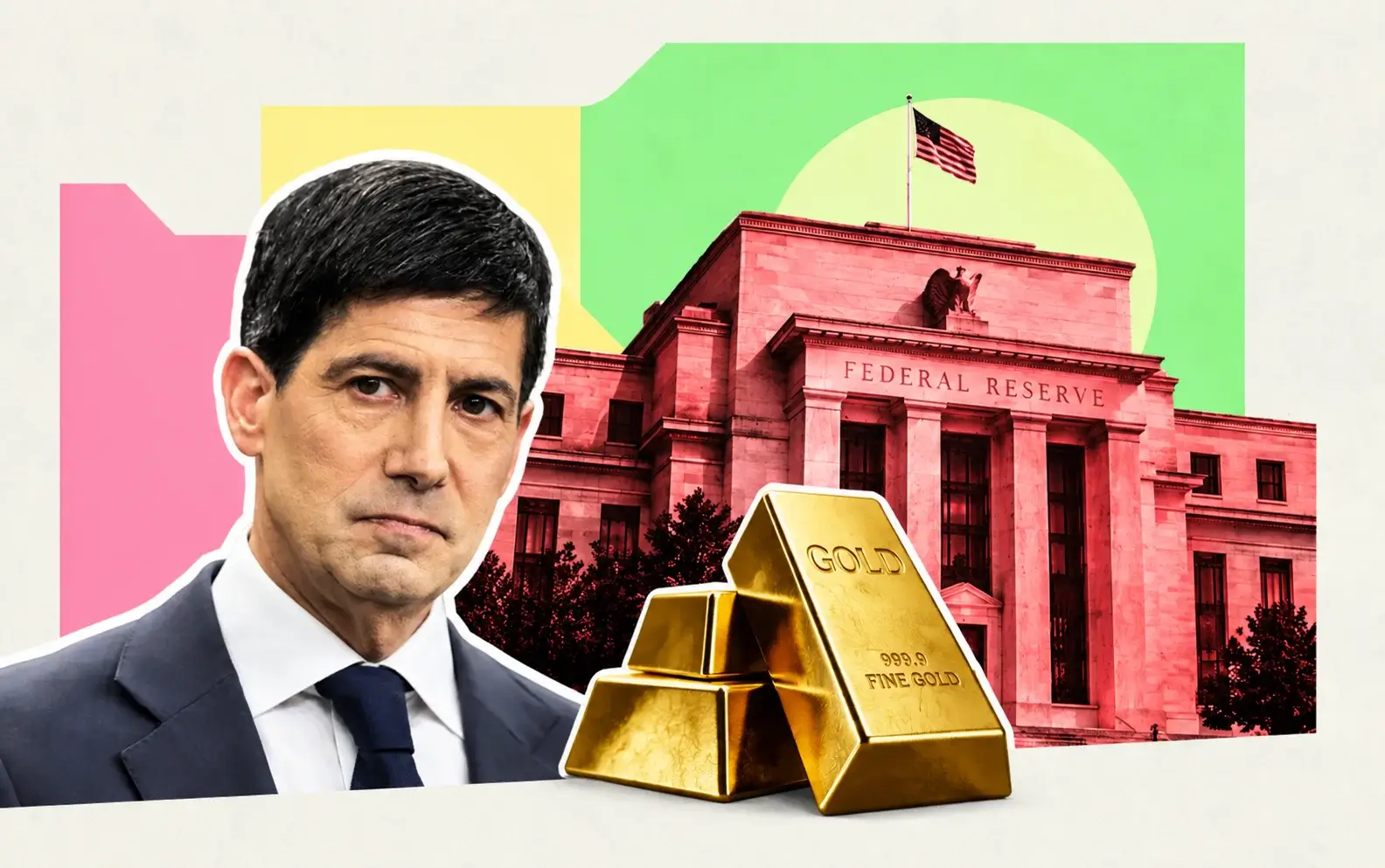
The timing adds an edge. This stretch marks the arrival of new Fed leadership, with Kevin Warsh stepping in as chair ahead of his first policy meeting later this month. The market reads the transition as a hawkish tilt, and a hot jobs report hands the incoming regime every reason to keep the easing bias buried. Until the Fed signals it's done tightening — a softer inflation print, a labor crack, anything that reopens the cut path — the rate backdrop works against bullion. Gold needs the Fed to blink. The jobs report just made that blink less likely.
The Dollar Won't Let Go
Behind the yield story sits the dollar, and it won't let gold breathe. The greenback firmed on the jobs print, and even the equity tape is helping it — the strong momentum in stocks, led by the tech complex earlier in the week, kept the dollar bid in check on the way up but supported it on risk-on days. A firm dollar makes gold more expensive for buyers holding other currencies, which saps international physical demand exactly when the metal needs every buyer it can find.
Thursday proved the point in reverse: gold's $77 rip came specifically because the dollar dropped on peace optimism. Flip the dollar back up, as the jobs report did Friday, and gold gives the gains straight back. The two trade like a seesaw, and right now the dollar end is weighted down by 4.54% yields and Fed-hike pricing. As long as the dollar holds firm, gold's rebounds will keep dying in the same place — somewhere in the $4,500–$4,520 zone where sellers have camped all week.
The Chart: Leaning On The 200-Day
The technical picture is where the stakes get concrete. Gold trades below its 20-day moving average near $4,557 and well under its 100-day near $4,795, which frames the short- and medium-term bias as bearish. The line that matters is the 200-day around $4,427 — the dynamic support that has held since October 2023. Gold has bounced off that trendline repeatedly through this entire bull run, and it's pressing on it again now. Hold it, and the long-term uptrend survives with consolidation and bounce potential. Break it cleanly, and the chart opens the door to a steeper decline.
The momentum indicators sit below their midlines but are losing downside strength, which hints the selling could be tiring even if it hasn't reversed. A recent swing low at $4,366 is the next marker below the 200-day, and below that the air gets thin. The Bollinger band structure caps rebounds — the middle band sits near $4,545 and the upper band near $4,715, so any bounce runs into resistance fast. The setup is a market pinned against long-term support with limited upside room and real downside risk if $4,427 gives. That's a coin-flip chart with asymmetric danger.
Read More
-
Yen Stalls at 160 Despite a 3% JGB and Tokyo Core CPI at 2.0% — Intervention Sits at 164, Friday's Payrolls Decide
02.09.2026 · TradingNEWS ArchiveEnergy
-
T-Rex 2X Inverse MSTR ($4.39) Rips 10.44% as Strategy Pauses Bitcoin Buys for a 2nd Week — $4.63 Close Opens $5.27
15.09.2026 · TradingNEWS ArchiveStocks
-
XRPR ($10.59) and XRPI ($7.04) Open at Highs and Close at Lows After Senate Kills CLARITY Act
15.09.2026 · TradingNEWS ArchiveCrypto
-
NG ($2.908) Holds Above $2.80 Low as LNG Feedgas Hits 18.8 Bcf and TTF Trades 9.2x Henry Hub
15.09.2026 · TradingNEWS ArchiveCommodities
-
USD/JPY (155.09) Faces 275bp Policy Gap as BOJ Prepares 31-Year-High Rate — Close Below 154 Opens 153.40
15.09.2026 · TradingNEWS ArchiveForex
The Levels That Matter
Map it out. On the downside, the first and most important line is the 200-day at $4,427. Lose it on a daily close and $4,366 comes into play immediately, with the $4,200 region as the next demand zone and $4,100 as the deeper floor that bears would target if the breakdown accelerates. Those are the rails of the bearish scenario, and the 200-day is the trigger.
On the upside, gold has to reclaim the $4,500 handle first — the psychological pivot that separates a bearish bias from a neutral one. Above it, the $4,520–$4,545 band is the first real resistance, where the middle Bollinger band and Thursday's rejection cluster, followed by the $4,600–$4,645 zone that some near-term recovery scenarios point to, and the $4,660–$4,715 area as the wider cap. For the month, the demand shelf near $4,500 and the deeper support at $4,200 frame the likely battlefield. The metal is trading the bottom of that range, which is exactly why $4,427 is the level every gold trader is watching into the close.
Silver Took It Worse
Silver amplified gold's move in both directions, as it tends to. After ripping 3.08% to $75.38 on Thursday's risk-on, peace-optimism session, silver got hit harder than gold on Friday, dropping 1.41% to $72.93. The metal's industrial-demand footprint makes it a higher-beta play on the same macro forces — when the inflation-and-crisis trade is on, silver outruns gold; when it reverses, silver falls faster.
The gold/silver ratio tells the story. It compressed to 60.0 at Thursday's peak, its tightest in weeks, as silver's industrial bid amplified the risk-on signal. Friday's reversal will widen it back out as silver underperforms. For traders reading the precious-metals complex, silver's sharper drop is a tell that the Thursday rally was a risk-on, dollar-down event rather than a fear-driven safe-haven bid — because genuine crisis demand favors gold over silver, and this move favored neither once the dollar turned.
The Central Bank Floor
Underneath all the short-term noise sits the one structural force that won't quit: official-sector buying. Central banks resumed adding to reserves in April, picking up 17 tonnes with Poland leading at 14 tonnes, extending a multi-year accumulation trend that has been the bedrock of gold's bull market. This is price-insensitive, strategic demand — central banks buy to diversify away from the dollar and hedge geopolitical risk, not to trade the 200-day moving average. That bid doesn't care about a 4.54% 10-year yield.
That floor is why gold's pullbacks have stayed shallow relative to the violence of the macro headwinds. Every prior dip toward the long-term trendline has been met by structural buyers who view weakness as an opportunity to add reserves at a discount. It doesn't make gold immune to a break of $4,427, but it does mean the metal has a backstop that most risk assets lack. The central-bank bid is the reason the longer-term forecasts skew bullish even as the near-term chart looks heavy — the structural buyer is still there, accumulating into weakness.
The Forecast
The base case is range-bound consolidation with a moderately negative tilt. With the war premium deflating, the dollar firm, and yields at 4.54%, gold lacks the catalyst to retake $4,500 with conviction in the near term, but the central-bank floor and the long-held 200-day at $4,427 argue against a collapse. Expect choppy, high-volatility trade between roughly $4,427 and $4,520, with sellers defending the top of that band and structural buyers defending the bottom. That's the most probable path until the next macro catalyst.
The bear case triggers on a clean daily close below $4,427. That breaks the trendline that's held since October 2023 and opens $4,366, then the $4,200 demand zone, with $4,100 as the deeper target if Fed-hike pricing intensifies and the dollar keeps climbing. The bull case needs two things: a reclaim of $4,500 to flip the bias, and a catalyst — either the Middle East ceasefire collapsing and reigniting the war premium, or a soft inflation print that pulls yields and the dollar back and reopens the rate-cut path. That scenario puts $4,600–$4,645 in play, with the $4,715 cap above. The variables to watch are upcoming inflation data, the Warsh Fed's first meeting later this month, and every Strait of Hormuz headline. Until one of them moves, gold leans on $4,427 and trades heavy, and the rebounds are for selling into resistance, not chasing.