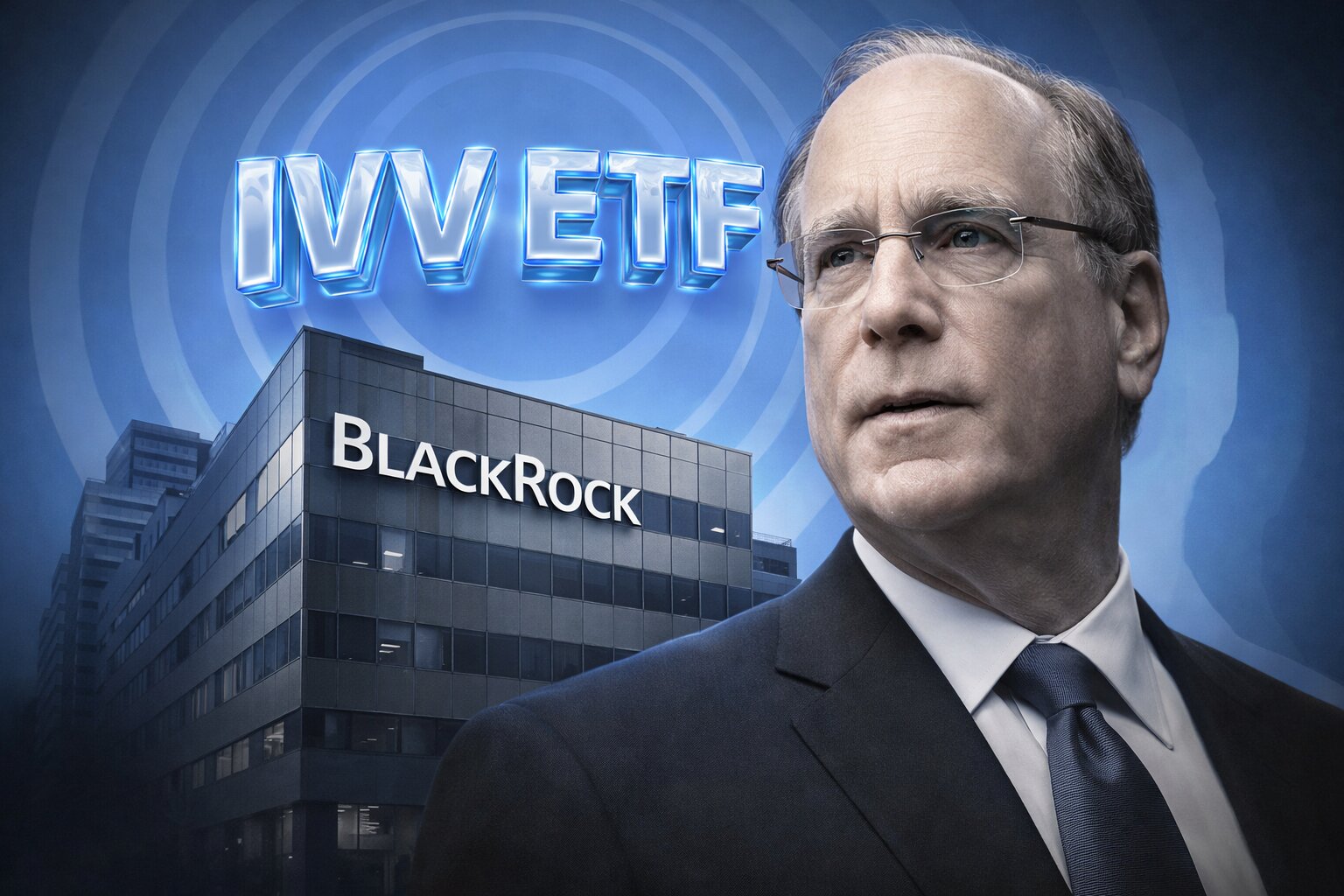
IVV ETF Price Forecast: Is $684 Still Worth Paying For S&P 500 Exposure?
With IVV ETF hovering near record highs, investors balance $684.76 pricing against AI-driven earnings, stretched leverage and passive-flow risk across the S&P 500 | That's TradingNEWS
IVV ETF (NYSEARCA:IVV) – high-altitude S&P 500 exposure in a leveraged, AI-driven cycle
IVV ETF – price, trading range and index exposure right now
IVV ETF (NYSEARCA:IVV) trades around $684.76 after a marginal $0.43 gain on the day, a 0.06% move that looks calm but sits on top of an S&P 500 that is near record territory. The session range ran from $680.55 to $689.35, only a few dollars below the 52-week high of $700.96 and far above the 52-week low of $484.00, locking in a very wide 12-month band that reflects how far the index has already run. The fund carries a market capitalization of roughly $428.11 billion with average daily volume near 1.59 million shares, so liquidity is deep; the real risk is not getting trapped in the ETF itself but being tied to the behaviour of the underlying index when conditions turn. At this level, IVV is a clean, low-cost way to own the full S&P 500, but you are buying into a market priced for sustained productivity gains, AI-driven earnings growth and a benign policy path – and doing it when the tape is already extended.
Leverage and passive flows – why IVV depends on more than just P/E multiples
The usual valuation argument around the S&P 500 – whether the index trades rich or fair on earnings – is only one dimension of the risk profile inside IVV ETF. Two structural forces now matter more for short- and medium-term behaviour: the level of margin leverage in the system and the dominance of passive and algorithmic trading in daily turnover. The FINRA margin balance ratio, which compares customers’ debit balances to currency in circulation, sits around 0.50 – essentially back to levels seen before the dot-com bubble and the 2008 crash. That means roughly fifty cents of margin debt per dollar of U.S. currency, a sign that a large slice of recent equity performance has been funded with borrowed money. At the same time, passive and rules-based strategies now account for over 60% of U.S. equity trading volume. Together, those two facts turn the S&P 500 – and therefore IVV – into a momentum amplifier: when flows chase strength, the ETF grinds higher; when models de-risk, the same structure accelerates moves to the downside regardless of fundamentals.
Margin ratio near historical danger zones – mechanical downside for IVV ETF
The FINRA margin ratio near 0.50 is not just an abstract chart; it is a mechanical risk factor for IVV ETF (NYSEARCA:IVV). A high P/E by itself suggests expensive valuations that can be worked off slowly; a high leverage ratio tells you that any modest index pullback can trigger forced liquidations. When investors are running significant debit balances, a 5–10% drop in the S&P 500 is enough to start margin calls, and brokers do not discriminate between quality and junk when they need collateral – they sell what is liquid. Large, deep ETFs like IVV become prime sources of cash. That means that even if many S&P 500 constituents still have solid earnings and defensible valuations, the ETF can sell off sharply as margin selling hits the entire basket. In this regime, the downside is not just about companies missing estimates; it is about the market structure turning a minor shock into a broad, leveraged unwind.
Passive and algorithmic dominance – how flow regimes shape IVV ETF behaviour
With passive and algorithmic strategies now responsible for the majority of trading volume, IVV ETF is at the centre of modern flow regimes. When asset allocators increase equity exposure or shift from active to index products, they push billions into S&P 500 trackers like IVV, which then buy the underlying constituents in market-cap proportion. That inflow cycle reinforces strength in the largest names and builds a positive feedback loop: gains attract more flows, which create more gains. The reverse mechanism is more brutal. Volatility-targeting funds, risk-parity strategies, CTA models and systematic allocators all reduce equity exposure when realized or implied volatility rises or when their signals flip from risk-on to risk-off. In those moments, they sell index products first – liquid, transparent ETFs like IVV – which then sell the same underlying stocks in size. Because the S&P 500 is more top-heavy than in past cycles, a de-risking wave focused on the biggest constituents can move the entire ETF quickly even if the broader economy has not changed.
Earnings-day volatility – what 10% moves in constituents do to IVV ETF risk
The share of S&P 500 companies moving more than 10% on their earnings day has climbed from roughly just above 10% a decade ago to around 37% recently. This spike in single-stock volatility matters directly for IVV ETF holders because the index is concentrated in a relatively small set of very large companies. A double-digit move in one of the top weights can shift the index by meaningful basis points in a single session. When that volatility interacts with the leverage and passive-flow backdrop, a few high-profile earnings surprises can turn into S&P-wide swings. IVV captures that in real time. The ETF’s intraday path increasingly reflects flow and positioning reactions to earnings headlines rather than slow, fundamental re-rating; investors end up holding an instrument where index-level price stability is far lower than the calm surface of a diversified basket might suggest.
Labour market data and revisions – a supportive present with a fragile past for IVV ETF
The January nonfarm payroll print delivered +130,000 jobs, nearly double the reduced consensus of around 65–70k, with unemployment falling from 4.4% to 4.3% and the participation rate ticking up from 62.4% to 62.5%. Average weekly hours worked rose to 34.3 for the first time since 2019, and wages increased 0.4% month-over-month. That combination is constructive for near-term consumer demand and supports earnings across multiple sectors inside IVV ETF (NYSEARCA:IVV) – from discretionary and industrial names to financials tied to household balance sheets. However, the benchmark revision process stripped away approximately 900,000 jobs from the 2025 totals, leaving average monthly job creation at roughly 15,000. That means what looked like a robust labour market last year was closer to stagnation. For IVV investors, the message is nuanced: the current snapshot of employment supports earnings now, but the underlying trend is fragile and dependent on productivity rather than broad-based hiring, which raises the sensitivity of the index to any future negative shock in job data.
Productivity surge, AI capex and why IVV’s premium is not just hype
The critical offset to that weak hiring backdrop is the surge in productivity. Nonfarm labour productivity is running close to 4.9% year-over-year while hours worked are up only about 0.5%. That gap is the “AI dividend”: companies are generating significantly more output per worker, allowing margins and profits to expand even without aggressive hiring. At the same time, hyperscalers and large platform companies – many of which sit in the top tier of IVV ETF’s holdings – have mapped out an AI-driven capex cycle of roughly $650 billion in the coming year, rising toward $750 billion when additional players like Oracle are included. Bears focus on the hit to free cash flow and the risk of over-build; the more important detail is that these firms collectively hold more than $400 billion in cash and can generate over $580 billion in operating cash flow annually. Data centre shells, power infrastructure and networks have 15–20-year lives; server and GPU layers turn over faster but are plugged into long-term service contracts. For IVV, that means part of the high valuation multiple on the S&P 500 is backed by real, long-duration capital formation that reinforces the competitive moat of its largest constituents, not just speculative enthusiasm.
Rotation beneath the index – what breadth and small caps signal for IVV ETF
Even as the Dow Jones Industrial Average hovers near 50,000 and the S&P 500 trades around the 6,800–6,900 region, equal-weight indices and small caps, represented by products such as IWM, have started to outperform the mega-cap-heavy headline index. That breadth improvement tells you the market is rotating rather than collapsing. More sectors and more individual names are contributing to aggregate earnings growth instead of a narrow group of “Magnificent” leaders. For IVV ETF, which owns the full S&P 500 in cap-weight form, this has two implications. On the positive side, a healthier earnings distribution across the index reduces the risk that one sector’s downturn drives the entire fund. On the negative side, if megacap technology and AI bellwethers consolidate or de-rate after their outsized runs while the rest of the market quietly grinds higher, cap-weighted IVV can lag equal-weight alternatives despite a fundamentally stronger backdrop. The best-case scenario for IVV is continued breadth combined with resumed moderate price appreciation in the top weights; the worst-case is megacap underperformance that cap-weighting cannot fully diversify away.
Inflation, rates and the discount rate implied in IVV ETF pricing
Recent CPI data show headline inflation up 0.2% month-over-month and 2.4% year-over-year, with core CPI up 0.3% month-over-month and 2.5% year-over-year. Energy prices fell about 1.5% in the period, easing one of the most visible cost pressures. That trajectory – inflation drifting toward the Federal Reserve’s 2% goal without a collapse in growth – is exactly the backdrop that justifies a premium multiple on the S&P 500 and, by extension, on IVV ETF (NYSEARCA:IVV). But the same strong January jobs data and persistent wage gains near 3.7–3.8% annualized have pushed expectations for the first rate cuts further out. A March cut is essentially off the table, and odds for June have weakened, with markets leaning toward later in the year for the first easing move. As long as the policy rate remains elevated, the discount rate embedded in IVV’s valuation stays high, which limits how much multiple expansion you can get on top of already strong price performance. The bull case for IVV assumes inflation continues to cool, the Fed eventually delivers cuts and earnings stay resilient; the bear case is a stickier inflation path that forces “higher for longer”, compressing P/E multiples even if profits hold up.
Read More
-
Yen Stalls at 160 Despite a 3% JGB and Tokyo Core CPI at 2.0% — Intervention Sits at 164, Friday's Payrolls Decide
02.09.2026 · TradingNEWS ArchiveEnergy
-
QQQ ETF ($739) Fades From an Early Tech Rally as a 77.9 ISM Prices Index Meets Micron's $61.5B Guide — $760 Record Test Ahead
01.10.2026 · TradingNEWS ArchiveStocks
-
XRPR and XRPI Follow XRP's $1.49 Test as Spot Funds Hold 1.16B XRP and a 1 Billion Token Escrow Release Lands — $1.70 in Play
01.10.2026 · TradingNEWS ArchiveCrypto
-
November NG Slips Below $3 as Decade-High Storage Meets Capped LNG Exports — $2.75 in Sight
01.10.2026 · TradingNEWS ArchiveCommodities
-
Dollar-Yen at 158 Presses Toward 160 as a 363 bp Carry Gap Meets Katayama-Bessent Intervention Risk — 159 in Sight
01.10.2026 · TradingNEWS ArchiveForex
How a margin-call cascade would actually hit IVV ETF holders
To understand the downside tail for IVV ETF (NYSEARCA:IVV), it is useful to map out how a margin-call cascade would propagate. Start with the current setup: FINRA margin balances near historical peaks relative to currency, passive flows dominating turnover and high single-stock volatility on earnings. A 7–10% shock to the S&P 500 – triggered by a negative macro surprise, a geopolitical event or a violent repricing in AI leaders – would immediately push many leveraged accounts through their maintenance thresholds. Brokers respond automatically by selling clients’ holdings. They do not unload illiquid small caps first; they liquidate the largest, most tradable instruments: S&P 500 futures and ETFs like IVV. Those sales push the index down further, triggering more margin calls in a second round and forcing more selling. Systematic strategies that tie risk budgets to realized volatility then cut exposure as volatility spikes, adding to the selling pressure in index products. In such a scenario, IVV can move from “safe, diversified core holding” to “primary de-risking tool” very quickly, even if the underlying economy has not yet deteriorated to recessionary levels.
IVV ETF (NYSEARCA:IVV) – buy, sell or hold at $684–$690?
Putting the pieces together, IVV ETF (NYSEARCA:IVV) at roughly $684.76 represents clean exposure to a U.S. equity market powered by genuine productivity gains, strong AI-linked capex, healthy – if revised – labour data and inflation trending toward target. Corporate earnings are running ahead of the originally expected ~7% growth rate for the current season, closer to double-digit expansion, and breadth is improving as equal-weight indices and small caps catch up. Those factors justify a Buy stance for investors deploying unlevered, long-horizon capital: over a 5–10-year window, owning the S&P 500 through IVV remains a rational core allocation. At the same time, the structural risks – a FINRA margin ratio around 0.50, passive flows exceeding 60% of volume, elevated earnings-day volatility, heavy insider selling and rising job-cut headlines – raise the probability of a sharp, flow-driven drawdown that is not directly tied to a collapse in fundamentals. For that reason, IVV is a Buy only on the assumption that it is held without margin and sized so that a 20–30% drawdown does not force an exit. For short-term traders or leveraged strategies, IVV at these levels is effectively a high-beta bet on both the S&P 500 and the current market structure; in that context, the risk-reward skews much closer to Hold or reduce until leverage in the system normalizes.