Natural Gas Price Breakout: NG=F Soars to $5.50 on Cold U.S. Weather & LNG Export Boom
NG=F clears the $5.00 psychological threshold as U.S. heating demand and surging LNG exports coincide | That's TradingNEWS
Natural Gas (NG=F) Climbs to $5.50 — Record Export Flows and Cold U.S. Weather Drive 9% Weekly Surge
U.S. Natural Gas (NG=F) Extends Breakout as LNG Exports Hit Record Levels
Natural gas prices surged sharply this week, marking one of the strongest rallies of 2025. Futures for Natural Gas (NG=F) jumped 9% for the week, closing Friday near $5.29 per MMBtu, before spiking intraday to $5.50, their highest level since December 2022. This rally was underpinned by record-breaking export flows, intensifying winter demand across the U.S., and a technical breakout that confirmed the long-term reversal above the critical $4.90 resistance level. Data from Capital Economics noted record-high volumes of LNG feedgas flowing into export terminals, reaching approximately 15 billion cubic meters in 2025 — the largest figure on record — signaling that export-driven consumption has become the central force behind U.S. gas pricing.
Cold Weather Shifts Domestic Demand Patterns Across the U.S.
The sharp move higher in NG=F was catalyzed by a sequence of cold fronts sweeping across the Midwest and Northeast. Forecasts from NatGasWeather.com confirmed subfreezing temperatures ranging from -0°F to 30°F across northern U.S. regions, significantly boosting heating demand. The firm projected that the Energy Information Administration (EIA) would report stronger draws from underground storage in its next update, marking the start of the heating season’s first major withdrawal cycle. The most active futures contract climbed 5.8% to $5.354 per MMBtu, as traders priced in tight supply expectations and stronger residential consumption. The weather-induced surge contrasts with the mild autumn period that had depressed gas below $3.00 just weeks earlier, confirming a decisive reversal in sentiment.
Technical Structure Confirms Multi-Month Breakout Momentum
The latest move in NG=F confirmed a textbook long-term breakout structure that had been developing since August. After bottoming at $2.62, natural gas advanced 109.6%, completing a measured move of $2.87 into Friday’s high of $5.50. The rally cleared both the 200% channel extension and the 61.8% Fibonacci retracement at $5.28, with resistance emerging just below the 127.2% Fibonacci extension at $5.52. Technical traders identify the next upside objective at $5.78, representing the 50% retracement of the previous long-term downswing. The 10-day moving average sits at $4.82, providing the first meaningful support in case of consolidation, while the $5.03 daily low defines immediate near-term defense. A break below $4.82 would trigger corrective risk, though the broader structure remains firmly bullish above that line.
European Gas (TTF) Diverges on Mild Weather and Oversupply
In contrast to the U.S. rally, European gas benchmarks, including the Dutch TTF, ended the week with moderate losses. TTF settled at €27.36 per MWh, down more than 5% week-over-week, as above-average temperatures and higher wind generation reduced heating and power demand. Forecast models suggest warmer weather will persist through mid-December, diminishing short-term gas usage for both industrial and residential sectors. European inventories remain 74% full, below the five-year seasonal average of 85%, yet ample LNG imports from Norway and global suppliers have stabilized regional pricing. The divergence between bullish U.S. and stagnant European markets underscores the influence of weather and regional supply dynamics on short-term gas pricing models.
Türkiye’s Spot Gas Market Reflects Localized Volatility and Currency Pressure
Data from the Energy Exchange Istanbul (EXIST) highlighted a 6.9% increase in Türkiye’s daily spot gas trade volume, reaching 9.99 million liras on December 5. Prices averaged 14,696.39 liras per 1,000 cubic meters, translating to approximately $345 per thousand cubic meters at the prevailing exchange rate of 42.53 liras per USD. Total traded volume was around 727,000 cubic meters, while the country imported 238.42 million cubic meters via pipeline, largely from Russia and Azerbaijan. Despite stable physical deliveries, depreciation of the Turkish lira continues to amplify local gas costs. The country’s regasification terminals and expanded storage capacity have supported liquidity, but fiscal constraints and currency volatility remain key risks for Türkiye’s energy import economics.
UK and Continental Benchmarks Maintain Structural Importance in Global Pricing
The UK NBP (National Balancing Point) market remains one of Europe’s foundational pricing hubs, despite losing liquidity to TTF. The NBP benchmark reflects spot-traded gas across the UK’s national transmission system, integrating North Sea output, Norwegian pipelines, continental imports, and LNG cargoes from Qatar and the U.S. Declining North Sea production over the past decade has forced the UK to rely increasingly on LNG imports. Market data shows that within-day and day-ahead contracts are currently trading with significant volatility, reflecting a global repricing of short-term gas logistics. The NBP remains critical for forward-month and seasonal contracts used by industrial consumers and utilities to hedge winter risk exposure, anchoring Europe’s longer-term gas price formation alongside TTF.
Read More
-
Yen Stalls at 160 Despite a 3% JGB and Tokyo Core CPI at 2.0% — Intervention Sits at 164, Friday's Payrolls Decide
02.09.2026 · TradingNEWS ArchiveEnergy
-
SOFI ($16.71) Posts Its Best Day of the Quarter as Profit Guidance Finally Rises — Holding $15.70 Unlocks $20
27.10.2026 · TradingNEWS ArchiveStocks
-
XRP-USD ($1.30) Defends a $1.27 Double Bottom as Whales Hold 68.5% of Supply — Break of $1.31 Opens $1.35 and $1.40
27.10.2026 · TradingNEWS ArchiveCrypto
-
Brent ($113.88) Trades a $2.35 Range as Houthi Strikes Meet Saudi-Iran Diplomacy — Break of $117 Unlocks $120
27.10.2026 · TradingNEWS ArchiveCommodities
-
Nasdaq Rips 1.3%, S&P 500 Hits 7,728, Dow Stalls as BA Drops to $171
27.10.2026 · TradingNEWS ArchiveMarkets
-
GBP/USD (1.3310) Can’t Cash In on 5.43% Gilt Yields as Budget Risk Meets a Firm Dollar — Break of 1.3274 Opens 1.3200
27.10.2026 · TradingNEWS ArchiveForex
Fundamental Strength Supported by LNG Export Expansion
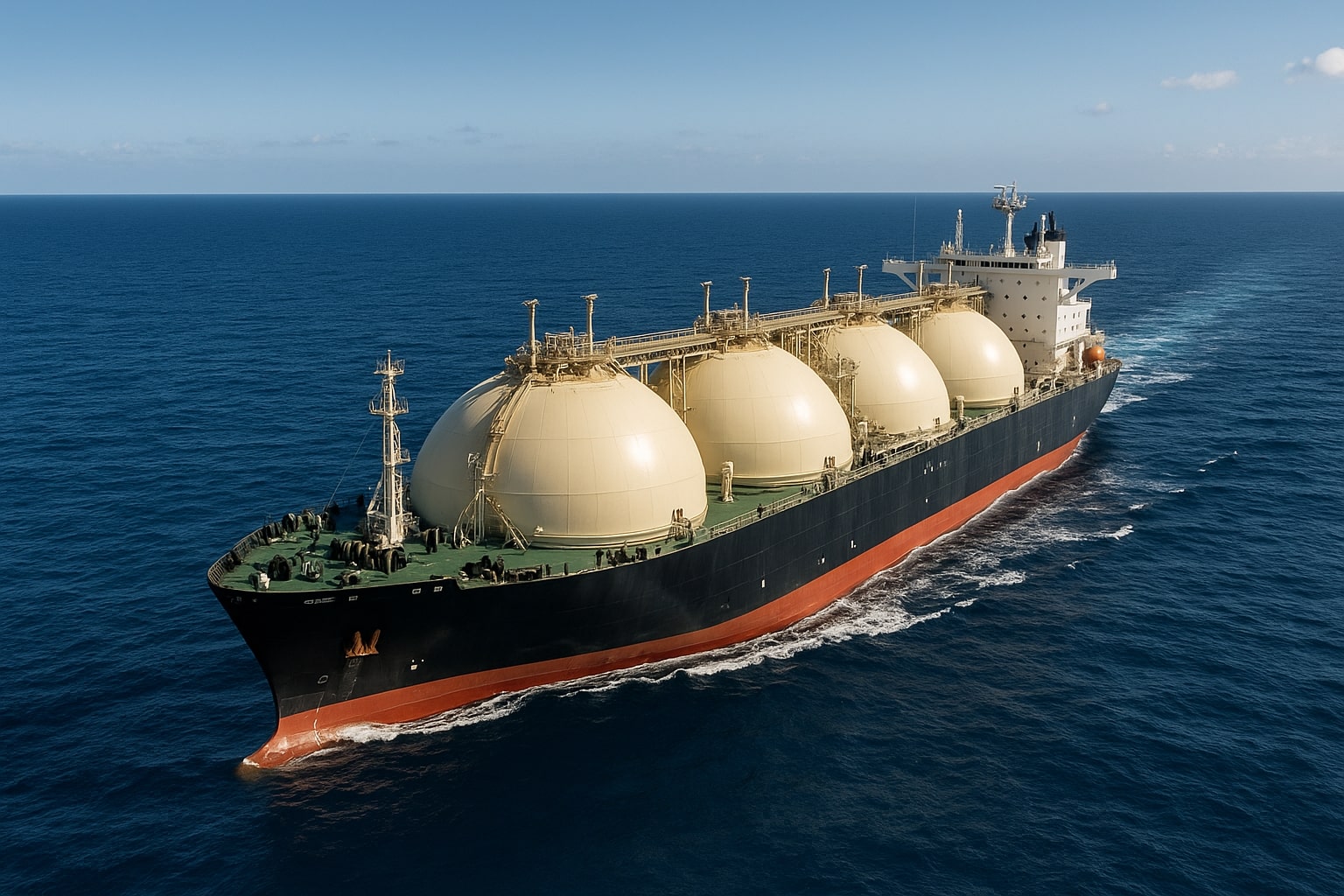
The surge in U.S. LNG exports has redefined natural gas’s global role. With daily feedgas flows exceeding 15 billion cubic meters, the U.S. has firmly cemented its position as the world’s largest LNG exporter, surpassing both Qatar and Australia in monthly delivery volumes. Rising LNG demand from Europe and Asia continues to absorb U.S. supply capacity, particularly as Asian buyers rebuild inventories ahead of potential cold weather shocks in January. The export-driven demand surge has transformed U.S. gas from a domestically balanced commodity into a globally priced asset sensitive to shipping constraints and weather patterns across continents. The strong export correlation with domestic prices marks a structural shift that keeps NG=F highly responsive to international developments.
Volatility Outlook and Key Price Zones for NG=F
Natural gas’s vertical rally has generated overbought technical readings, with price closing above the upper Bollinger Band for multiple sessions — a setup that often precedes short-term consolidation. The 20-day moving average provides a crucial mid-term anchor; maintaining levels above it keeps the bullish structure intact. Failure to hold above $4.82 could signal corrective movement toward $4.60, though strong seasonal demand may limit downside. If momentum extends, the next resistance zone lies between $5.78 and $6.00, while a sustained break above $5.80 could open the path to $6.50, a level not seen since early 2022. The 2025 rally is thus both technically validated and fundamentally reinforced by robust export and domestic heating demand dynamics.
Verdict – Buy Bias: NG=F Maintains Bullish Structure with Export Momentum and Cold-Weather Demand
The natural gas market exhibits powerful structural strength across all dimensions. Record LNG exports, strong heating demand, and confirmed technical breakouts indicate sustained bullish momentum into early 2026. While short-term volatility remains high, the macro and technical backdrop favor continued strength in Natural Gas (NG=F) as long as prices hold above $4.80.