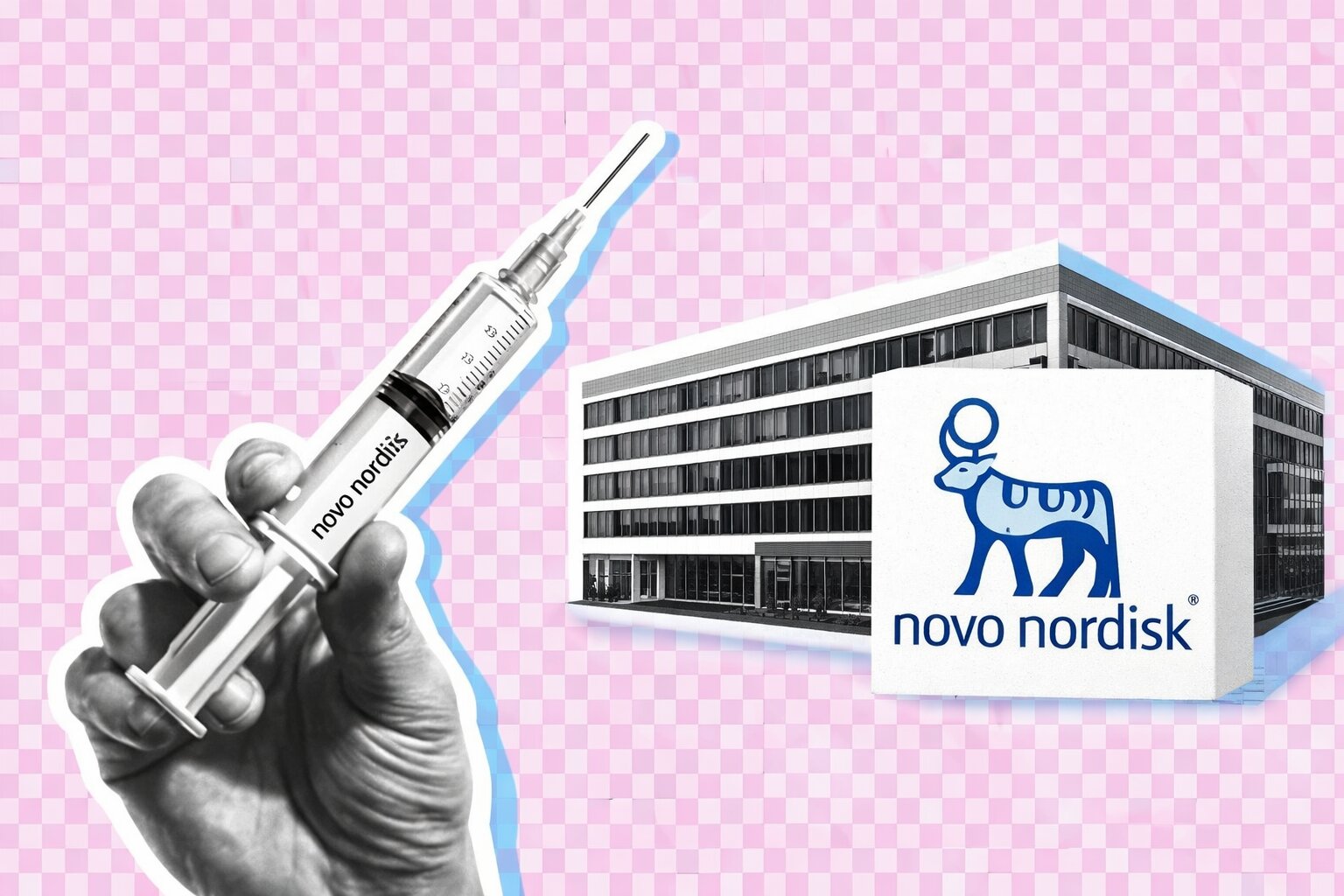
Novo Nordisk Stock Price Forecast - NVO Near $40 After CagriSema Miss: Obesity Moat Under Pressure
CagriSema’s REDEFINE 4 failure, Wegovy pill approvals, TrumpRx cuts, market-share loss and a 10.9x P/E leave GLP-1 heavyweight Novo Nordisk trading like a distressed value play | That's TradingNEWS
Novo Nordisk Stock (NYSE:NVO): GLP-1 Giant Marked Down To Crisis Pricing
Share Price Collapse And What It Signals
Novo Nordisk Stock (NYSE:NVO) is trading near $39.90, after a single-session fall of about -15.9%, with the intraday range at $39.62–$41.09 against a 52-week range of $39.62–$93.80. Market cap is down to roughly $135.5 billion, the stock is on about 10.9x earnings with a dividend yield close to 4.7%. Those metrics say the market now prices this as a low-growth, challenged pharma name rather than the dominant GLP-1 platform that drove the last cycle. The repricing reflects three things at once: a disappointing obesity readout, visible market-share losses to competitors, and a 2026 guidance set deliberately low. The question is whether this is the start of structural decline or a forced reset that creates a value entry point.
CagriSema Trial Miss And Obesity Franchise Shock
The immediate catalyst was the REDEFINE 4 Phase III obesity trial. CagriSema, a fixed-dose combination of cagrilintide 2.4 mg and semaglutide 2.4 mg, was run for 84 weeks in roughly 800 patients with obesity and comorbidities against tirzepatide 15 mg. Under the optimistic full-adherence view, CagriSema achieved about 23.0% average weight loss; tirzepatide delivered 25.5%. Under a more conservative estimand that reflects discontinuations and real-world adherence, CagriSema came in near 20.2%, while tirzepatide still posted around 23.6%. The primary objective was non-inferiority to the category leader. On that metric CagriSema failed. The drug is clearly efficacious, but in this pivotal comparison it neither beats nor matches the benchmark. Management pointed to open-label design and faster titration on the tirzepatide arm as explanations, and noted that not all CagriSema patients reached full dose. Capital markets focus on positioning, not excuses. With sentiment already brittle, the readout was interpreted as a direct hit to the “next-gen obesity defence” narrative, and the stock sold off accordingly.
Competitive Pressure In GLP-1 Diabetes And Obesity
The trial miss lands in a market where competitive pressure is already visible in hard numbers. In the U.S. diabetes market, Novo Nordisk has seen share slip from around 35% in late 2024 to near 31% a year later. In GLP-1 diabetes specifically, share has fallen from roughly 53% to about 46%, as rival products capture volume. The obesity market is even more dramatic. From an effective near-monopoly a few years ago and around 68% share in late 2024, the company now sits close to 51% as of late 2025. The obesity segment itself is accelerating, with market growth around 85%, but Novo Nordisk’s obesity revenue growing about 38% over the same period. That gap is investors’ core concern: the company is still growing, but not as fast as the market it helped create, and CagriSema failed to reassert a clear edge at the high-end of efficacy.
Wegovy Pill, MASH Indication And Franchise Strength
Despite the noise, the current engine of the obesity and cardiometabolic story remains Wegovy. In 2025 Wegovy generated about DKK 79.1 billion in net sales, up 35.9% year-on-year. In Q4 alone, revenue reached roughly DKK 21.86 billion, an increase of 10.1% versus the prior year and 7.4% sequentially, even as Ozempic sales dropped about 6% to DKK 31.8 billion. Momentum is shifting to Wegovy and higher-dose semaglutide formulations. Strategic optionality has expanded sharply. The Wegovy pill received FDA approval in December 2025 for two indications: treatment of obesity and reduction of major cardiovascular events. In parallel, the European Commission approved a 7.2 mg once-weekly maintenance dose for obesity on 17 February, giving the injectable version a higher efficacy ceiling. Wegovy is also currently the only GLP-1 approved for MASH, an asymptomatic liver disease that can progress to cirrhosis or hepatocellular carcinoma. Estimates indicate 9–15 million Americans affected, with prevalence potentially rising 63% by 2030. That is a large additional market where Wegovy faces limited direct GLP-1 competition and mainly contends with a single THR-β agonist, which reported about $321 million in sales over the last year. In that vertical, Novo Nordisk is still on the front foot.
Regulatory Crackdown On Copycat GLP-1 Products
The GLP-1 boom created a peculiar distortion: both Ozempic and Wegovy were placed on the FDA shortage list in 2022, allowing compounders to sell unapproved semaglutide formulations that eroded pricing power and muddied safety oversight. That environment is now turning. U.S. regulators have explicitly targeted mass-marketed compounded GLP-1 products, with cases referred to the Department of Justice for potential violations, and clear warnings that unapproved “copycat” drugs will trigger enforcement. Under that pressure, some telehealth platforms that attempted to launch low-cost compounded Wegovy pills reversed course within days. With patents on Ozempic and Wegovy extending into the next decade in both the U.S. and Europe, the IP position is strong. The regulatory tone has shifted back in favour of the original manufacturers, supporting branded volume and pricing over time and reducing one structural headwind that weighed on the franchise.
Price Cuts, TrumpRx And Margin Compression
At the same time, the economics of GLP-1 therapy are being reset. List prices near $1,000 per month for Ozempic and roughly $1,350 per month for Wegovy are being cut to about $350 when purchased through the TrumpRx platform after agreements with U.S. authorities. That opens access to millions of additional patients, but it mechanically compresses gross margin on each unit. If utilisation ramps faster than capacity, there is also a risk of returning to supply bottlenecks that would again put pressure on the branded franchise. For now, the near-term implication is straightforward: over the next few years, revenue growth will be driven more by volume and indication expansion and less by price, and operating leverage will be lower than during the original boom. Higher demand can offset some of the pricing hit, but profitability metrics will feel the strain.
2025 Results: From Hyper-Growth To An Air Pocket
The most recent full-year numbers show the transition clearly. Revenue increased from about DKK 290.4 billion in 2024 to DKK 309.1 billion in 2025, a 6.4% rise. That is still respectable, but far below the double-digit pace of previous years. Operating profit slipped 0.5% to roughly DKK 127.7 billion. Diluted EPS inched up 1.8% to around DKK 23.03, with adjusted EPS up 5.7% to DKK 26.17. The fourth quarter was weaker again. Net sales fell 7.6% year-on-year to about DKK 79.1 billion, operating profit dropped 13.6% to roughly DKK 31.7 billion, and diluted EPS declined 4.7% to about DKK 6.04. Those figures contrast sharply with a decade when revenue, operating income and earnings per share typically compounded in the low- to mid-teens. The company has moved from hyper-growth with expanding margins to a pause where profit is under pressure.
2026 Guidance: Deliberate Reset With Heavy Capex
Guidance for 2026 underlines a conscious reset. Adjusted sales and adjusted operating profit are expected to fall 5–13% at constant exchange rates. With currency headwinds, reported sales and profit could be 3–5 percentage points weaker again. Management is planning about DKK 55 billion in capital expenditures, focused mainly on GLP-1 and obesity capacity. Free cash flow is guided to just DKK 35–45 billion. On the surface this combination of declining revenue, declining profit and heavy investment is exactly what justifies a lower multiple. The key point is that capex is not a permanent structural step-change; over the last two decades, capital expenditure averaged around 8.8% of revenue, and the current intensity well above that looks like a temporary build-out. Using 2025 operating cash flow near DKK 119.1 billion and a more normalised capex load closer to DKK 27 billion, underlying free cash flow could eventually sit nearer DKK 90 billion once the build-out phase ends. That gap between depressed current FCF and potential normalised FCF is central to the valuation case.
Read More
-
Yen Stalls at 160 Despite a 3% JGB and Tokyo Core CPI at 2.0% — Intervention Sits at 164, Friday's Payrolls Decide
02.09.2026 · TradingNEWS ArchiveEnergy
-
QQQ ETF ($739) Fades From an Early Tech Rally as a 77.9 ISM Prices Index Meets Micron's $61.5B Guide — $760 Record Test Ahead
01.10.2026 · TradingNEWS ArchiveStocks
-
XRPR and XRPI Follow XRP's $1.49 Test as Spot Funds Hold 1.16B XRP and a 1 Billion Token Escrow Release Lands — $1.70 in Play
01.10.2026 · TradingNEWS ArchiveCrypto
-
November NG Slips Below $3 as Decade-High Storage Meets Capped LNG Exports — $2.75 in Sight
01.10.2026 · TradingNEWS ArchiveCommodities
-
Dollar-Yen at 158 Presses Toward 160 as a 363 bp Carry Gap Meets Katayama-Bessent Intervention Risk — 159 in Sight
01.10.2026 · TradingNEWS ArchiveForex
Profitability, Moat And Business Quality
Even in this weaker period, the economic profile is strong enough to justify a premium franchise label. Gross margin remains above 80%. Operating margin is still comfortably above 40% despite price pressure and the cost of expansion. Over the last five years, average return on invested capital has been around 53–54%, a level that is rare across global large-caps and in line with the better compounders in any sector. These metrics are compressing from peak levels, but they still show a business with powerful intangible assets, deep IP, high switching costs and scale advantages in manufacturing and distribution. The share price is now reflecting cyclical setbacks, regulatory concessions and competitive losses. It is not reflecting a collapse in underlying economics, which remain firmly in wide-moat territory.
Pipeline Beyond Semaglutide And Strategic Direction
Strategically, the company is evolving from a pure diabetes specialist to a broader cardiometabolic and obesity-comorbidity platform. Beyond semaglutide itself and combination products such as CagriSema, there are multiple assets in late-stage development. These include anti-inflammatory drugs such as ziltivekimab and metabolic candidates like efruxifermin that target fatty liver and related conditions. The obesity franchise is being extended into indications like MASH and cardiovascular outcomes, building on Wegovy’s approval for both weight management and reduction of major adverse cardiovascular events. The direction of travel is clear: use the installed GLP-1 base, clinical data, and physician familiarity to expand into adjacent diseases where metabolism, obesity and inflammation intersect. That reduces single-product risk over time, although near-term sentiment is still dominated by GLP-1 headlines and the CagriSema miss.
Valuation, Cash Flow Scenarios And Insider Lens
At around $39.90 with a trailing P/E near 10.9x, forward earnings multiple around 13x, dividend yield about 4.7% and enterprise multiples of roughly 10.5x EBITDA and 12.3x EBIT, the stock trades on less than half of its five-year average valuation. Revenue-based metrics tell the same story: EV/Sales around 5x versus historical levels above 10x. Normalised free cash flow in the DKK 90 billion range with long-term FCF growth in the 6–10% band can support intrinsic value estimates between roughly DKK 468 and DKK 600+ per share, comfortably above today’s price region. The market is therefore embedding slow growth, lasting competition and sustained margin pressure. It is not paying for a renewed GLP-1 boom. Monitoring management alignment and capital allocation at these levels is critical. Any significant open-market buying or reduced net insider selling, visible via the Novo Nordisk insider transactions page, would reinforce the case that internal confidence in long-term value remains intact.
Risk Balance, Technical Picture And Final Verdict On NVO
On the risk side, several points are non-trivial. Competition from rival GLP-1s and dual agonists is intense and will stay intense. The CagriSema miss means next-generation obesity products will require more time, higher doses and new trials before they can close the gap to tirzepatide. Regulatory pressure on pricing is structural, not temporary. Capacity build-out must be executed without recreating supply shortages or flooding the market in a way that permanently damages pricing power. There is also the possibility that sentiment stays weak and the stock trades sideways or drifts lower even while fundamentals slowly stabilise. Technically, the drop to the $39–40 area means the price is testing the bottom of the recent range and is far removed from the prior $90+ peaks. At around 11x earnings with nearly 5% yield, strong margins and still-dominant GLP-1 assets, the risk-reward now tilts in favour of accumulation for a patient, long-horizon allocation. The business is transitioning from hyper-growth to more normalised high-single-digit to low-double-digit potential once the current reset is absorbed. On that basis, and at this valuation, Novo Nordisk Stock (NYSE:NVO) at around $40 justifies a clear Buy stance rather than a neutral or bearish view.