Oil Price Forecast - Oil Prices Surge Above $63 as OPEC+ Holds Output and Ukraine Drone Attacks Shake Russian Supply
Brent (BZ=F) climbs 1.6% to $63.46, WTI (CL=F) hits $59.65 as OPEC+ discipline, Venezuela sanctions risk, and fragile demand balance define oil’s volatile rebound | That's TradingNEWS
Crude Oil (CL=F, BZ=F) Rebounds to $59.65 and $63.46 as OPEC+ Holds Output, Ukraine Strikes Fuel Supply Risk
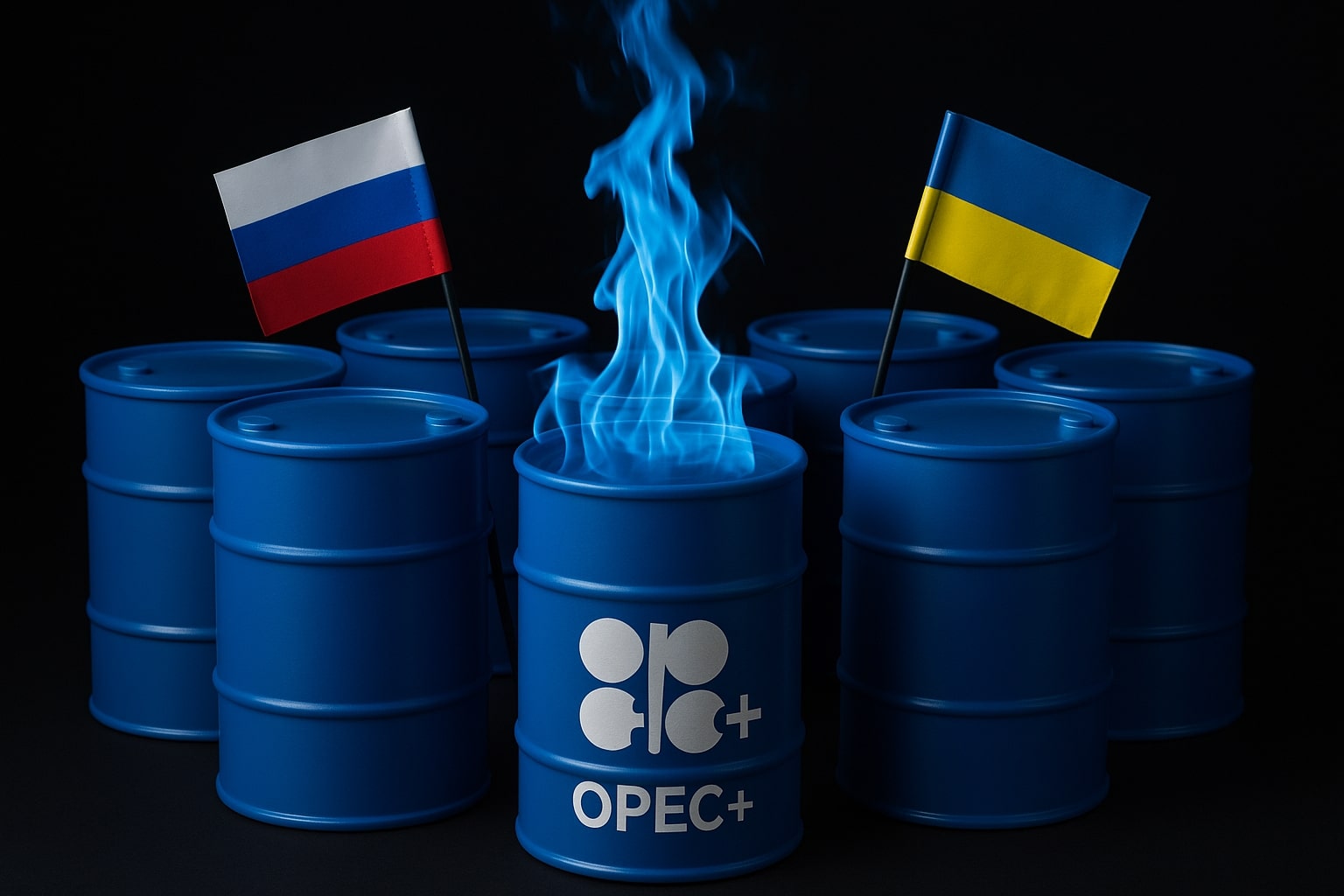
Oil prices are rising again, with West Texas Intermediate (CL=F) climbing 1.9% to $59.65 per barrel and Brent (BZ=F) gaining 1.6% to $63.46, after OPEC+ reaffirmed its commitment to hold production unchanged through Q1 2026. The alliance’s decision signals discipline after months of oversupply pressure, aiming to stabilize prices near the $60 mark. Analysts confirm this as a tactical pause, with OPEC+ keeping flexibility to extend voluntary cuts if market balance remains weak. The commitment arrives amid escalating geopolitical tension — Ukrainian drone strikes on Russian “shadow fleet” tankers in the Black Sea reignited supply concerns, offsetting bearish sentiment from recent oversupply data.
OPEC+ Stays United as Saudi Arabia and Russia Defend the Price Floor
OPEC’s latest session emphasized that current output levels will persist, with major producers Saudi Arabia and Russia reiterating the need for “market stability” and a cautious approach to further supply adjustments. This stance comes after the group already released 2.9 million barrels per day (bpd) back into global markets since April 2025, an action that contributed to oil’s earlier decline of 15% year-to-date. The coalition’s new strategy suggests a priority shift — preserving price levels over expanding market share. Brent’s technical resilience above $63 suggests traders are responding to this renewed coordination. The OPEC basket itself rose to $64.27, gaining 1.68%, reflecting broad support across global grades.
Geopolitical Tensions Add Volatility as Ukraine Attacks Russian Assets
The recent Ukrainian drone assaults on Russian tankers and the Caspian Pipeline Consortium (CPC) terminal, which channels over 1% of global supply, have reinforced fears of logistical disruptions. Though exports continue, the damage underscores how geopolitical risk premiums can rapidly reverse market sentiment. Meanwhile, reports of U.S. sanctions tightening on Venezuela add another layer of uncertainty, with Washington reportedly weighing the closure of Venezuelan airspace. These moves could restrain one of South America’s key export routes, further limiting near-term supply. Analysts at ING warn that “rising risks to Venezuelan oil flows come exactly when the market can least afford more supply shocks.”
Market Structure Shows Fragile Balance Between Weak Demand and Tighter Supply
Despite short-term support from OPEC+, demand fundamentals remain soft. Global crude inventories remain high, and recent data from the International Energy Agency projected a record supply surplus for 2026. Yet, physical market dynamics are tightening — U.S. shale output has plateaued, with Mars US crude slipping 1.35% to $70.36, while Louisiana Light dropped 0.92% to $60.35. In contrast, Murban crude rose 1.66% to $65.35, reflecting stronger Asian demand signals. Gasoline futures surged 2.4% to $1.865, implying potential downstream margin pressure. The current setup points to a bifurcated market: demand weakness meets supply fragility, creating short bursts of volatility rather than sustained trends.
Technical Levels: Resistance at $60 for WTI and $65 for Brent
Technically, WTI (CL=F) remains trapped below its 50-day EMA near $60, a key resistance reinforced by the long-term descending trendline. Attempts to break higher have consistently met selling pressure, with price action forming repetitive shooting star candlesticks — a sign of fading bullish momentum. If the downtrend persists, immediate support lies at $57, followed by deeper technical floors at $55.80 and $53.40. Meanwhile, Brent (BZ=F) faces resistance around $65, and any sustained close above that threshold could shift momentum toward $67.40. For now, fading short-term rallies remains the dominant strategy as global liquidity and demand signals remain weak.
Broader Energy Market Aligns Behind Oil’s Modest Rebound
Other energy commodities are signaling cautious optimism. Natural Gas (NG=F) trades near $4.829, down slightly 0.43%, maintaining its consolidation phase. The OPEC+ output decision also rippled across refined products, where diesel and jet fuel spreads widened, reflecting logistical bottlenecks linked to Middle East supply routes. The U.S. LNG export forecast points to a 40% increase in 2026, led by higher European and Japanese demand, counterbalancing oil’s bearish narrative. However, weak macro data from China and Europe continue to cap broader energy demand growth, keeping overall sentiment defensive.
Corporate and Policy Developments Reshape Energy Landscape
The policy backdrop continues to evolve. India announced a 50% cut in Russian oil imports under U.S. sanctions pressure, reconfiguring Asia’s supply chains. TotalEnergies sold a 40% stake in a Nigerian offshore project to Chevron, reflecting a wider shift among Western majors toward capital-light structures. Meanwhile, Petrobras reduced its 5-year capex plan amid lower oil prices, signaling fiscal caution in Latin America’s largest producer. On the African front, Tullow Oil (LSE:TLW) appointed trader Roald Goethe as its new chair while slimming its board to four members, part of a governance overhaul to streamline costs as it targets refinancing in 2026. These shifts show a global industry repositioning for leaner operations while awaiting price stability.
Macro Pressures and Dollar Dynamics Define Oil’s Short-Term Path
Oil’s recovery faces macroeconomic headwinds as investors digest the implications of U.S. monetary policy. Real yields remain elevated, and the U.S. Dollar Index (DXY) trades near 104.7, tempering the commodity’s momentum. Fed officials have hinted at rate cuts in Q1 2026, which could weaken the dollar and reflate commodity markets. Until such signals firm up, crude’s upside remains capped. The correlation between WTI and the S&P 500 (^GSPC) has tightened again, highlighting how equity sentiment now directly influences energy markets. If risk assets rebound, crude could extend toward $61–$62, but without broader financial easing, rallies may stall quickly.
Read More
-
Yen Stalls at 160 Despite a 3% JGB and Tokyo Core CPI at 2.0% — Intervention Sits at 164, Friday's Payrolls Decide
02.09.2026 · TradingNEWS ArchiveEnergy
-
SOFI ($16.71) Posts Its Best Day of the Quarter as Profit Guidance Finally Rises — Holding $15.70 Unlocks $20
27.10.2026 · TradingNEWS ArchiveStocks
-
XRP-USD ($1.30) Defends a $1.27 Double Bottom as Whales Hold 68.5% of Supply — Break of $1.31 Opens $1.35 and $1.40
27.10.2026 · TradingNEWS ArchiveCrypto
-
Brent ($113.88) Trades a $2.35 Range as Houthi Strikes Meet Saudi-Iran Diplomacy — Break of $117 Unlocks $120
27.10.2026 · TradingNEWS ArchiveCommodities
-
Nasdaq Rips 1.3%, S&P 500 Hits 7,728, Dow Stalls as BA Drops to $171
27.10.2026 · TradingNEWS ArchiveMarkets
-
GBP/USD (1.3310) Can’t Cash In on 5.43% Gilt Yields as Budget Risk Meets a Firm Dollar — Break of 1.3274 Opens 1.3200
27.10.2026 · TradingNEWS ArchiveForex
Short-Term Outlook: Controlled Optimism with Volatile Undercurrents
Oil’s rebound above $59.50 (WTI) and $63.30 (Brent) reflects renewed discipline from OPEC+ and temporary supply fears, yet the broader structure remains fragile. Traders are closely monitoring Venezuela sanctions, Ukrainian conflict escalation, and U.S. inventory data for cues on sustainability. With Brent’s year-to-date decline at 15%, the market is attempting to stabilize, but a definitive reversal requires demand recovery in China and consistent compliance from OPEC+ producers. For now, positioning favors range trading, with upside resistance near $65 and downside protection holding above $57.
Verdict:
WTI and Brent crude remain in a Hold zone, reflecting cautious optimism. The near-term bias leans neutral-bullish, supported by geopolitical risk and OPEC+ discipline but constrained by weak macro demand. If Brent sustains above $65 and WTI breaks $60.20, a shift toward Buy momentum could emerge heading into early 2026.