Stock Market Closed Good Friday as Oil Hits $111 and Wall Street Snaps Its Longest Losing Streak in Months
WTI Crude Posts Its Largest Single-Day Dollar Gain in History, Tesla Sinks 5%, and Traders Brace for a Weekend of Iran War Uncertainty With No Ability to Hedge | That's TradingNEWS
Key Points
- WTI crude surged 11.93% to $111.54 — its biggest daily dollar gain ever — after Trump vowed to hit Iran "extremely hard" for 2–3 more weeks.
- The Nasdaq gained 4.4%, the S&P 500 rose 3.4%, and the Dow climbed 3% for the week, snapping five consecutive weeks of losses across all three indexes.
- Tesla fell 5.4% after delivering 358,023 vehicles in Q1 — down 14% sequentially and below the 368,900 analyst estimate — making it the worst S&P 500 stock Thursday.
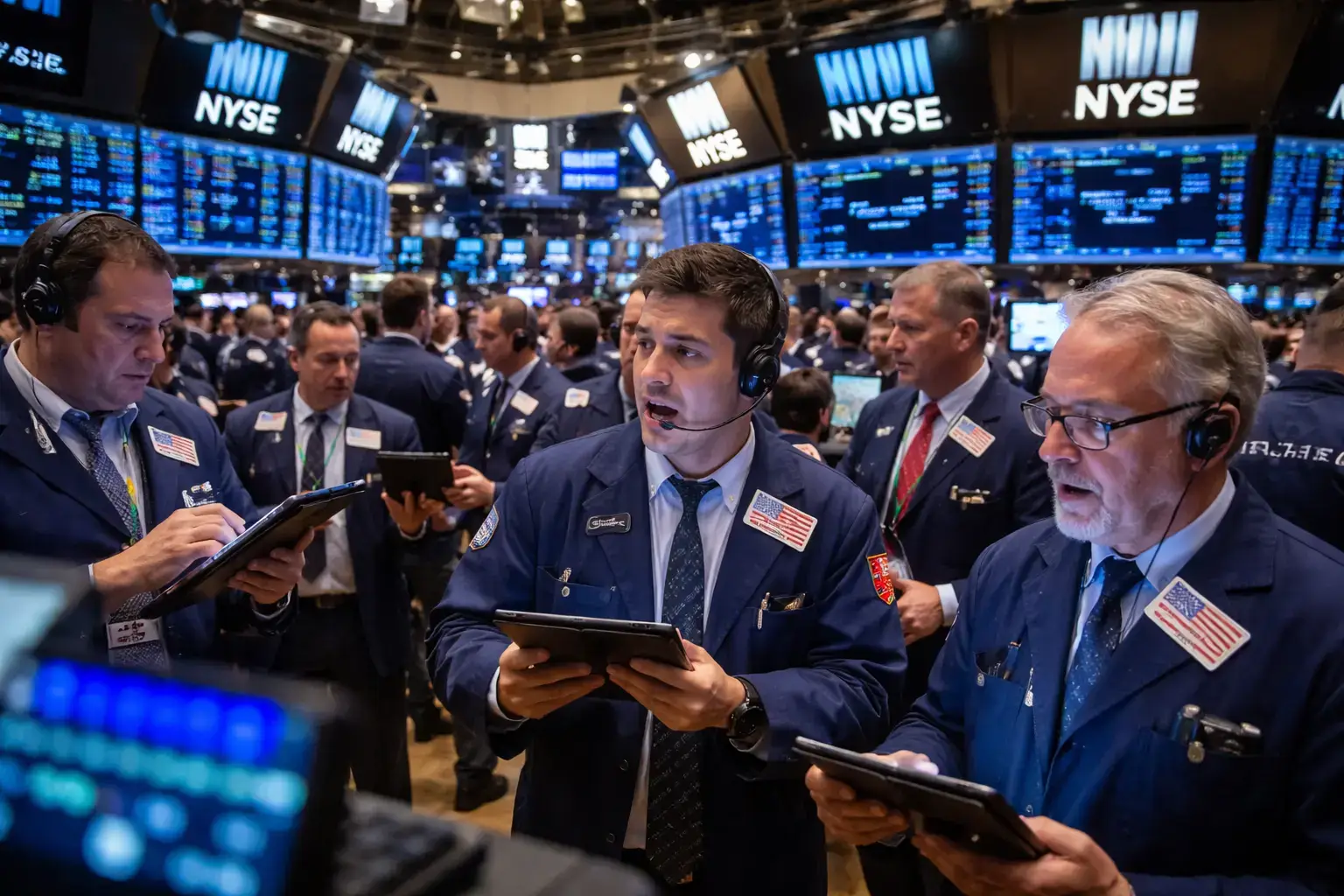
The New York Stock Exchange and the Nasdaq Stock Market are both shut today, April 3, in observance of Good Friday. The bond market closed early at noon ET. Futures markets across the board — the Cboe Futures Exchange, CME Globex, and all over-the-counter platforms — are dark until Sunday evening. Metals futures trading is closed and resumes at 6 p.m. Sunday in New York. The next scheduled trading session is Monday, April 6, when the opening bell rings at its regular 9:30 a.m. Eastern time. The Bureau of Labor Statistics does not observe Good Friday — March's jobs report dropped this morning at 8:30 a.m. ET as scheduled, handing traders a critical data point with no immediate mechanism to react. After today, Wall Street stays open continuously until Memorial Day on Monday, May 25. The next scheduled holiday after that is Juneteenth on Friday, June 19, followed by Independence Day on Friday, July 3. What traders are carrying into this long weekend is a combustible mix unlike anything seen in years — WTI crude above $111 a barrel, a U.S.-Iran war with no credible exit timeline, a stock market that just staged one of its most dramatic weekly reversals since 2025, a Federal Reserve that has explicitly signaled it cannot fight this type of inflation, and a jobs market that is still holding together but showing early cracks from AI-driven displacement. The combination of those forces, festering over a three-day weekend with zero ability to hedge, is exactly the kind of environment that produces gap-down opens on Monday mornings. Every serious market participant knows that. The U.S. has repeatedly escalated operations and issued its most hawkish statements on weekends — the first salvos of the Iran war came late on a Friday night, and Trump's threats to target Iran's energy infrastructure landed on a Saturday. History is not encouraging for those hoping for a quiet weekend.
Trump Posts on Truth Social Friday Morning — Claims Hormuz Can Be "Easily" Opened With Zero Detail
Before traders had even fully processed Thursday's close, President Trump was already posting on Truth Social Friday morning. "With a little more time, we can easily OPEN THE HORMUZ STRAIT, TAKE THE OIL, & MAKE A FORTUNE," the president wrote, in characteristically capital-letter fashion. He gave no timeline, no operational mechanism, no military framework, and no diplomatic pathway explaining how the crucial waterway — which under normal conditions carries roughly 20% of the world's entire oil trade and an even larger share of Persian Gulf LNG exports — would be reopened against Iran's highly effective blockade. The statement, stripped of any actionable substance, did little to calm a market that has been desperately searching for concrete signs of de-escalation. The UN Security Council had been scheduled to vote Friday morning on a draft resolution calling on member states "to use all defensive means necessary and commensurate with the circumstances" to secure transit passage through the Strait for at least six months. That vote was postponed, with no new date announced. French President Emmanuel Macron and South Korean President Lee Jae Myung held a joint press conference in Seoul on Friday, saying their countries would work together to stabilize the Strait situation, but offering no specifics on how that cooperation would actually manifest. Macron has previously stated publicly that forcing the passage open militarily would be unrealistic, which raises serious questions about what any joint French-Korean effort could actually accomplish. The United Arab Emirates has reportedly been the first country to sign onto a plan to reopen the Strait by force, but that coalition remains far too thin to credibly project the kind of power necessary to restore normal tanker transit against Iranian resistance. Goldman Sachs analysts have already published their scenario analysis — if the effective closure of the Strait of Hormuz extends beyond the end of April, Brent crude could rise to approximately $140 a barrel. That is the number every energy trader is carrying into this weekend, with no ability to act on it until Sunday night futures open. The asymmetry of that risk — unlimited upside for crude, devastating downside for equities — is precisely what makes this long weekend genuinely dangerous for anyone holding unhedged equity exposure.
Thursday Was a Battle Between Bulls and Crude That Lasted Six Hours — Here Is Every Move
Thursday, April 2, was not a normal trading day by any measure. The chaos began before the opening bell, with Dow futures already down more than 600 points in premarket as Trump's Wednesday night primetime address reverberated through overnight markets. Asian markets had already absorbed the first wave of selling — South Korea's Kospi dropped 4.47% to 5,234.05, the worst performer across Asia, while the small-cap Kosdaq fell 5.36% to 1,056.34. Both Korean indexes had opened more than 1% higher before the Trump speech landed. Japan's Nikkei 225 fell 2.38% to close at 52,463.27. The Topix declined 1.61% to 3,611.67. Australia's S&P/ASX 200 fell 1.06% to 8,579.5 after starting the day in positive territory. Hong Kong's Hang Seng fell roughly 1% in its final hour. China's CSI 300 lost 1.04% to end at 4,478.91. Indian markets opened sharply lower, with the Nifty 50 down 1.38% and the Sensex falling 1.47%. By the time New York opened, the damage was already global. The Dow Jones Industrial Average (DJIA) opened Thursday down 608 points — 1.3%. The S&P 500 (SPX) shed 1.3% at the open. The Nasdaq Composite (COMP) pulled back 1.7%. At their worst levels of the session, the Dow was down 668.50 points or 1.4%, the S&P 500 was down 1.5%, and the Nasdaq was down 2.2%. Then came the pivot. Iranian state media reported that Iran and Oman were drafting a protocol to monitor traffic in the Strait of Hormuz. The word "monitor" — not "reopen," not "restore," not "normalize" — was enough to send all three indexes ripping back to briefly turn positive. The Dow swung from down 668 points to up approximately 200 at its intraday peak. The S&P 500 recovered from its 1.5% loss to gain 0.4% at its best level. The Nasdaq moved from down 2.2% to up 0.3%. Oil prices, which had been up nearly 10% at $110 a barrel at the session's worst for equities, pulled back modestly on the Hormuz protocol report. But the rally in stocks faded, oil resumed its climb, and the indexes oscillated for the remainder of the afternoon before settling near the flatline. By the close, the Dow had settled at 46,504.67, down just 61.07 points or 0.13%, shattering a three-session winning streak. The S&P 500 closed up 0.11% at 6,582.69. The Nasdaq settled up 0.18% at 21,879.18 — that full intraday reversal from a 2.2% loss to positive territory was the largest for the Nasdaq since April 7, 2025. The Russell 2000 outperformed all three major indexes on the session, closing up 0.70% at 2,530.04 — a notable divergence that suggests some rotation into smaller-cap domestically-focused names that are less directly exposed to international energy pricing. The VIX ended the session at 23.87, down 2.73% on the day, but had touched above 27 at the peak of morning fear before pulling back as stocks recovered. The KBW Nasdaq Bank Index added 0.20% to 156.51, a modest positive signal for the financial sector despite the volatile macro backdrop.
Five Consecutive Weeks of Losses Erased — Best Weekly Performance Since Thanksgiving 2025
Zoom out from Thursday's whipsaw and the weekly picture is dramatically different from the session-level noise. The Nasdaq Composite surged 4.4% across the four-session holiday-shortened week. The S&P 500 advanced 3.4%. The Dow Jones Industrial Average climbed 3.0%. Those are the strongest weekly gains for all three major indexes since the week of Thanksgiving 2025 — and they snapped five consecutive weeks of losses, one of the most sustained downtrends the market has seen since the early months of the Iran war began in late February. At Monday's intraday low earlier in the week, the S&P 500 had been sitting just 9.1% from its January 27 all-time record high — a fraction of a percentage point away from the 10% threshold that officially defines a market correction. The benchmark was also firmly south of its 200-day moving average, a technically critical level that, if combined with a correction breach, would likely have accelerated algorithmic selling and pushed the index materially deeper into the red to close out the first quarter. That line held. A combination of cautious optimism around Iran diplomacy, stronger-than-expected labor market data, and the traditional seasonal tailwinds of April — historically the strongest month of the year for the S&P 500 according to the Stock Trader's Almanac — lifted stocks 3.77% from Monday's close to Thursday's finish. Eight of the 11 GICS sectors closed Wednesday's session in positive territory, led by communication services and industrials, both up 1.65%. Energy dropped 3.89% on Wednesday as the market briefly treated declining oil as a positive for equities, before Thursday's crude explosion reversed that rotation entirely. Consumer staples fell 0.57% Wednesday. The financials sector ended Wednesday's session flat. The weekly gains were not uniformly distributed — the Nasdaq's 4.4% outperformance relative to the Dow's 3.0% reflects continued preference for technology and growth names over the more defensively-oriented blue chips, even in a week defined by energy market volatility and geopolitical uncertainty. That preference for growth in a volatile environment is a bullish signal for the market's underlying risk appetite, even if the macro headwinds remain severe.
WTI Posts the Largest Single-Day Dollar Gain in the Futures Contract's 43-Year History
West Texas Intermediate (WTI) crude futures settled Thursday at $111.54 per barrel — up $11.94 on the session, a gain of 11.93%. That is the highest closing level for WTI since June 28, 2022. Brent crude settled at $109.03, up 7.78% on the day. The $11.42 single-day dollar move in WTI was the largest nominal daily gain ever recorded for that benchmark since the futures contract began trading in 1983 — larger than any move during the Gulf War, the September 11 attacks, the 2008 financial crisis, or the 2022 Russia-Ukraine war. It eclipsed even the April 21, 2020 recovery move as prices climbed back from the historic negative-price territory of the Covid crash. The S&P GSCI Index Spot settled at 771.83, up 4.49% on the session, reflecting the breadth of the commodity complex's reaction to the supply disruption. Since the U.S. and Israel began bombing Iran at the end of February, benchmark WTI futures have now rallied 66% in total. March alone saw crude rise $43.96 a barrel — more than any other single month in the contract's 43-year trading history. The first two sessions of April added another $10.16 a barrel on top of that. Before Trump's Wednesday night speech, WTI was sitting below $100 a barrel. Prices briefly crossed $113 intraday Thursday before settling at $111.54. In dollar terms, prices in March rose more than in any other month since the WTI futures contract began trading in 1983. At current levels, WTI is up approximately 66% since the war began on February 28. The crude oil line in Thursday's market data reads $112.06, up 11.93%. These are not numbers that fit neatly into any conventional market playbook. Ryan Detrick of Carson Group noted Thursday that equity markets appear to be "numbing" to what crude is doing — the correlation between rising oil and falling stocks that defined the early weeks of the war has weakened as the market increasingly looks past the conflict toward an eventual resolution. That decoupling is itself a bullish signal, but it carries enormous risk if the conflict timeline extends materially beyond current expectations.
The Baltic Dirty Tanker Index Has Never Been This High in History — The Physical Oil Market Is Completely Dislocated
The freight market tells a more disturbing story than even the crude futures curve. The Baltic Dirty Tanker Index, which measures the cost of moving crude oil by sea across global tanker routes, spiked to an all-time record high of 3,737 on March 27, 2026 — a level that has never been seen before in the index's history. For perspective, the index was sitting around 1,000 for most of 2025. It began climbing in the fall as geopolitical tensions escalated, surged past 2,000 after the Iran war started in late February, and then exploded to its record 3,737 peak on March 27. It has eased only fractionally since that record. For further context on how extreme this reading is — when Russia invaded Ukraine in February 2022 and global oil markets went into shock, the Baltic Dirty Tanker Index peaked at a level more than 1,000 points below where it sits today. The mechanics driving this record are familiar from past disruptions but more severe in their current application. When shipowners face physical danger — from Iranian naval action, drone strikes, and mine threats in and around the Persian Gulf — and reputational risk from being associated with Persian Gulf oil transit, the effective supply of willing tankers shrinks dramatically even as global demand for crude oil continues. The result is a catastrophic mismatch between available shipping capacity and the volume of oil that needs to move, which drives freight rates to extremes. What makes the current situation uniquely severe compared to 2022 is geography — an enormous volume of oil supply is physically stranded on the wrong side of the Strait of Hormuz, unable to reach global markets via any commercially viable alternative routing without adding thousands of nautical miles and weeks of additional transit time that multiply costs exponentially. The Strait of Hormuz, at its narrowest point, is only 21 miles wide. It controls the exit point for roughly 20 million barrels of oil per day under normal conditions — approximately 20% of global supply. There is no pipeline infrastructure capable of rerouting anything close to that volume. The physical oil market is not just tight — it is structurally dislocated in a way that the futures curve, still pricing crude in the $80s by July, may be materially underestimating.
The Iran War Is Destroying the Fertilizer Supply Chain — A Lost Corn Season Looms
The oil supply disruption is the headline, but the fertilizer crisis developing in its shadow may ultimately cause more lasting economic damage. The closure of the Strait of Hormuz has cut off approximately one third of the world's seaborne fertilizer supply, according to United Nations estimates. With ships blocked from transiting Hormuz for more than a month since the war began, fertilizer prices in the U.S. have already risen nearly 30% according to the Bloomberg Green Markets price index. The timing is catastrophic from an agricultural standpoint — spring planting season in the northern hemisphere is beginning now, and corn in particular requires nitrogen fertilizer inputs that are sourced heavily from the Persian Gulf region. Kathryn Rooney Vera, Chief Market Strategist at StoneX, stated clearly that if the conflict does not end and transit does not reopen allowing fertilizers to pass through, the northern hemisphere faces a lost farming season primarily for corn. A lost season, or even materially reduced yields from inadequate fertilizer application, would translate directly into sharply higher food costs across the U.S. and Europe beginning in the second half of 2026. JD Power's survey of 4,000 Americans conducted in February — when inflation was still at 2.4% year-over-year — already found that more than 85% of consumers had made changes to their daily lives in response to rising prices. Some 45% reduced restaurant visits or takeout orders. Some 42% switched to less expensive food. Some 42% delayed purchases of apparel, home decor, or other discretionary items. Around 34% turned down their thermostats. Some 33% bought less food over the prior 30 days. Approximately 16% postponed or canceled medical care or went without medications. Those numbers were from February, before the full impact of $111 oil, $4-plus national average gasoline, and 30% higher fertilizer prices hit household budgets. The second-order inflationary effects of this war are only beginning to register in consumer behavior data.
The Federal Reserve Is Watching But Cannot Act — Powell Faces a Supply-Side Inflation Trap
The Federal Reserve's conventional monetary policy toolkit is essentially powerless against the specific type of inflation the U.S.-Iran war is generating. This is supply-side inflation — driven not by excess demand or loose monetary conditions, but by the physical destruction of supply chains and the dramatic increase in energy costs that flows through into virtually every category of goods and services. Fed Chair Jerome Powell has explicitly acknowledged this dynamic. If Fed officials view their policy tools as ineffective against the current wave of inflation — which is the accurate assessment — they are far more likely to hold the federal funds rate steady in coming months even as PCE inflation potentially rises significantly above target. Bank of America economists are now projecting PCE inflation to hit nearly 4% year-over-year in Q2, up from their pre-war estimate of 3% annual inflation. The Atlanta Fed's GDPNow model for first-quarter growth has slid since the war started but remains positive at 1.6% — meaning the economy is slowing but not yet contracting. The 10-year Treasury yield settled Thursday at 4.347%, down from last Friday's close near 4.44% — its highest closing level since last July. Two-year yields fell 20 basis points over the course of the week. The bond market's behavior has meaningfully shifted — J.P. Morgan's fixed income strategy team, led by Jay Barry, noted that markets have refocused from pricing inflation risk to pricing growth risk. That is a critical distinction. Treasury prices reversing higher even as oil surges means the bond market is beginning to price in the possibility that $111 crude eventually breaks economic activity enough to matter more than its inflationary impulse. That is the scenario where the Fed cuts rates — not because inflation is under control, but because growth has deteriorated enough to override the inflation mandate. Rate cuts would be back on the table if the economy continues to weaken materially. Until then, the Federal Reserve is effectively a spectator.
Trump's Pharmaceutical Tariffs Hit 100% — Pfizer (PFE) Hits 52-Week High, Lilly (LLY) and J&J (JNJ) Navigate the Minefield
The Trump administration announced Thursday it would impose tariffs of up to 100% on branded patented pharmaceuticals from companies that have not signed deals with the administration or committed to build U.S. manufacturing facilities. The 100% rate applies specifically to patented imported drugs from companies that haven't entered "most favored nation" pricing agreements matching their U.S. prices to the lowest prices they charge in other developed countries. Generic drugs and orphan drugs are carved out of the tariff structure entirely. More than a dozen major drugmakers — including Eli Lilly (LLY), Pfizer (PFE), and Johnson & Johnson (JNJ) — have already signed deals exempting themselves from the levies, effectively securing immunity from the 100% rate in exchange for pricing commitments and manufacturing investment pledges. The market's verdict on this dynamic was unambiguous. Pfizer (PFE) hit a 52-week high Thursday, trading at levels not seen since October 2024 — the market is directly rewarding companies that moved early to secure exemptions. For those that haven't signed deals, the 100% tariff represents a potentially existential cost structure change for any drug sold in the U.S. market. The pharmaceutical tariff announcement layers additional complexity onto a sector already navigating the Iran war's supply chain disruptions, an inflationary macro environment, and a Federal Reserve that cannot cut rates to provide relief. The companies with exemptions — LLY, PFE, JNJ — are in a structurally advantaged position relative to peers who have not yet reached accommodation with the administration. This bifurcation within the pharma sector is likely to persist and widen.
Steel, Aluminum, and Copper Tariff Restructuring Creates a Hidden Cost Surge for Industrials
The administration announced Thursday a reshaping of tariffs on steel, aluminum, and copper products, altering how duties are assessed on finished metal goods in a way that will effectively raise costs for many importers even where the headline tariff rate appears lower than before. The critical structural change is that duties are now being assessed on the full value of imported finished products rather than just on their steel or aluminum content. This means a product that previously had a tariff calculated only on the raw material portion of its value now has that same rate applied to the entire finished product value — a dramatically higher actual dollar cost even if the stated percentage looks unchanged or lower. For manufacturers importing finished steel or aluminum components, the effective tariff burden increases substantially. The industries most directly affected include construction — already reeling from housing stocks hitting multi-year lows — as well as capital equipment, automotive parts, and industrial machinery. Lennar (LEN) is already trading at its lowest level since December 2022. Builders FirstSource (BLDR) is at February 2023 lows. Home Depot (HD) hit December 2023 lows Thursday. The metal tariff restructuring is not the primary driver of those moves, but it adds incremental cost pressure to sectors already fighting elevated input costs from oil-driven energy and transportation expense inflation. The net effect is an across-the-board squeeze on industrial margins that has no obvious near-term relief valve.
Tesla (TSLA) Is the Worst Stock in Both the S&P 500 and Nasdaq — Down 20% in 2026
Tesla (TSLA) closed Thursday down 5.42% at $360.59, making it the single worst performer in both the S&P 500 and the Nasdaq Composite on the session. The triggering event was the company's first-quarter delivery report, which came in at 358,023 vehicles — up 6% from the 336,681 units delivered a year ago, but down 14% sequentially from Q4 2025, and meaningfully short of the 368,900 analyst consensus from Visible Alpha. Production came in at 408,386 vehicles, also well below the 446,060 estimate. The sequential decline in deliveries — 14% from the prior quarter — is the number that stings most, because it demonstrates that demand weakness is not merely a year-over-year comparison artifact but a genuine quarter-over-quarter deterioration in the pace of vehicle sales. Tesla deliberately shut down Model S and X production at its Fremont, California facility to redirect those factory lines toward building Optimus humanoid robots — a calculated strategic pivot toward AI and robotics that management has telegraphed repeatedly but which carries a significant near-term cost in delivery volume and revenue. Wedbush analyst Dan Ives called the numbers "quite underwhelming" but "not a shock" given the current EV backdrop across geographies and the company's deliberate shift toward its AI strategy. The Q1 earnings call on April 22 is the next critical inflection point, where management will need to provide detailed updates on Optimus production targets, Full Self-Driving monetization timelines, and first-quarter margin data. Shares have lost nearly 20% since January 1, 2026. After hours Thursday, Tesla ticked back up 0.19% to $361.26, suggesting the market is not in full capitulation mode on the name. The AI and robotics narrative remains the long-term thesis and is genuinely compelling if Optimus scales as advertised. But the delivery shortfall makes this a firm hold — not a buy — until April 22 provides hard data on the AI pivot's actual production progress and margin implications. A miss on April 22 against already-lowered expectations could push the stock toward the $300 level.
Globalstar (GSAT) Explodes 13% on Amazon (AMZN) Acquisition Talks — Deal Estimated at $9 Billion
Globalstar (GSAT) was one of Thursday's most dramatic movers, surging 13% after the Financial Times reported that Amazon (AMZN) is in active talks to acquire the satellite communications company in a transaction estimated to be worth approximately $9 billion. With Thursday's move, GSAT has now climbed more than 20% since the start of 2026. The deal is ongoing but faces complications, the most significant of which is the relationship with Apple (AAPL), which acquired a 20% stake in Globalstar in 2024. Any acquisition by Amazon would need to navigate those existing contractual and equity relationships carefully — Apple's stake gives it meaningful leverage over any change of control transaction. Amazon declined to comment on the report, and Globalstar did not immediately respond to requests for comment. The strategic rationale for Amazon's interest is unambiguous. The company's Project Kuiper satellite internet initiative needs ground-based satellite infrastructure and spectrum assets to compete credibly with SpaceX's Starlink, which has established a commanding market position. Building that infrastructure organically would take years and billions of dollars in capital expenditure. Acquiring Globalstar's existing network, spectrum licenses, and operational infrastructure represents a dramatically faster and potentially cheaper path to scale. The $9 billion deal value, if confirmed, would represent a substantial premium to where the stock was trading before the report landed. The timing is also notable — SpaceX filed confidential IPO paperwork this week targeting a $40 billion to $80 billion raise, which would give Musk's company a massive public market currency advantage in the satellite race. Amazon acquiring Globalstar would be a direct strategic response to that competitive threat. This is a speculative buy on the acquisition premium, with the clear caveat that talks remain unconfirmed and early-stage, and that Apple's blocking position introduces real deal uncertainty.
SBA Communications (SBAC) Leads the Entire S&P 500 With a 14% Surge on Potential Sale to Infrastructure Funds
SBA Communications (SBAC) delivered the single best performance in the entire S&P 500 on Thursday, jumping 14% in the final hour of trading after Bloomberg reported the tower operator is exploring a potential sale following preliminary takeover interest from large infrastructure funds. Bloomberg reported that deliberations are at an early stage and that the company is weighing various options including a full sale. The 14% gain pushed SBAC into positive territory for 2026 after a difficult start to the year. Tower operators represent exactly the class of asset that infrastructure funds are aggressively targeting in the current environment — long-duration lease contracts with creditworthy tenants, mission-critical physical infrastructure with high barriers to replication, and highly predictable recurring revenue streams that behave like investment-grade bonds but with inflation-linked escalators built into most lease agreements. In a world where WTI is at $111 and inflation is re-accelerating, those inflation-escalation clauses in tower lease agreements are particularly attractive to institutional capital. The market's 14% single-session reaction reflects genuine premium expectation from sophisticated participants who follow the infrastructure M&A space closely. Large infrastructure funds — including those affiliated with Brookfield, Blackstone, and similar platform managers — have been aggressively accumulating communications infrastructure assets globally. SBAC is a buy on the infrastructure takeout thesis, with a tight stop if the early-stage talks collapse without a transaction materializing.
Eleven S&P 500 Stocks Hit New 52-Week Lows — Housing, Payments, and Consumer Names Shattered
While the headline indexes closed near flat on Thursday, the market's internal damage was substantial and tells a much grimmer story than the index levels suggest. Eleven S&P 500 constituents hit new 52-week lows during Thursday's session, spanning housing, retail, payments, and consumer staples. Lennar (LEN) traded at its lowest level since December 2022 — nearly three and a half years of gains wiped out in a homebuilder sector hammered by elevated mortgage rates and now rising construction material costs from metal tariff restructuring. Alexandria Real Estate (ARE) plunged to lows not seen since August 2009 — a 17-year low for a real estate investment trust that has been systematically repriced as the rate environment shifted. Builders FirstSource (BLDR) hit its weakest level since February 2023. Home Depot (HD) touched lows last seen in December 2023, with the home improvement giant caught in the crossfire between higher lumber, steel, and aluminum costs and a housing market that is showing severe stress. Pool Corp. (POOL) dropped to April 2020 levels — back to Covid-crash territory for a company that had been a massive pandemic beneficiary. Tractor Supply (TSCO) hit January 2024 lows. Global Payments (GPN) crashed to a level not seen since March 2016 — a decade of value destroyed in the payments processor. Fidelity National Information (FIS) traded at lows unseen since October 2013 — going back thirteen years. McCormick (MKC) fell to November 2017 levels. Nike (NKE) — already down more than 15% the prior session to lead the S&P 500 and Dow decliners — sank further Thursday to levels not seen since October 2014, a staggering twelve-year low for a brand that once traded at a massive premium multiple. Insulet (PODD) hit its weakest level since September 2024. Simultaneously, five S&P 500 stocks hit 52-week or all-time highs, all concentrated in utilities, energy infrastructure, and healthcare. Pfizer (PFE) hit levels not seen since October 2024. Sempra (SRE) reached an all-time high going back to its 1998 creation through the merger of Pacific Enterprises and Enova. Entergy (ETR) traded at all-time high levels going back to when it began trading on the NYSE in 1949 — 77 years of highs. Corteva (CTVA) hit an all-time high since its May 2019 IPO. Equinix (EQIX) reached all-time highs since its August 2000 IPO. The divergence between these two lists — utilities and energy infrastructure hitting generational highs while housing, payments, and consumer brands collapse to multi-year lows — is the clearest possible expression of where the market thinks the economy is heading under sustained $110-plus oil and the tariff regime.
Airlines Crushed — DAL, UAL, AAL, LUV All Under Pressure — United Raises Bag Fees as Cost Pass-Through Begins
The airline complex absorbed some of Thursday's most severe damage, and the pressure extends well beyond Thursday's session. Delta Air Lines (DAL) and United Airlines (UAL) both closed lower, having fallen roughly 4% at the premarket open before recovering partially through the session. American Airlines (AAL), Southwest Airlines (LUV), and Alaska Air all fell approximately 4% before the bell as well. The arithmetic is devastating and simple — fuel costs for U.S. carriers have roughly doubled since the Iran war began in late February, and with WTI now above $111 a barrel, there is no visibility on when relief arrives. Jet fuel is the single largest expense for carriers outside of labor, and with no hedging program capable of absorbing a 66% rise in crude over six weeks without ultimately flowing through to the income statement, airlines are facing the most hostile fuel cost environment since 2022. The pass-through is already happening. United Airlines (UAL) compounded Thursday's session pain by announcing a $10 increase on first and second checked bag fees for travel across the U.S., Mexico, Canada, and Latin America, effective for tickets purchased from Friday. Third checked bag fees are rising $50. This is United's first increase on checked baggage fees in two years, and it is an explicit acknowledgment that fuel costs are no longer absorbable within existing pricing structures. International fares have already been raised materially — routes that require more fuel are pricing in the cost surge fastest. Delta's Q1 earnings call, scheduled for Wednesday, April 8 before the opening bell, will be the first major window into how severely these cost dynamics are hitting carrier margins. Management's commentary on forward fuel hedging positions, fare pricing power, capacity planning, and revenue outlook will set the tone for the entire travel sector heading into the critical summer travel season. DAL closed lower Thursday and is a sell heading into the print unless oil shows meaningful retreat before Wednesday's report.
Cruise Lines Follow Airlines Lower — CCL, RCL, NCLH All Drop as Fuel Cost Fears Reignite
The cruise sector mirrored the airline selloff with equal intensity. Carnival Corporation (CCL), Royal Caribbean Cruises (RCL), and Norwegian Cruise Line Holdings (NCLH) all fell roughly 3.5% to 4% on Thursday, as Trump's two-to-three week war extension timeline reset expectations for a fuel cost recovery and reignited fears of broader demand destruction. Cruise operators are uniquely exposed to the current environment — they face both the direct fuel cost impact and the secondary demand risk from consumers who are increasingly pulling back on discretionary spending as inflation erodes household budgets. JD Power's survey data showing that 45% of Americans have already reduced restaurant visits and 42% have switched to cheaper food suggests that higher-cost discretionary travel spending is the next category to come under pressure as the oil shock fully transmits into consumer price levels. The cruise sector's summer booking season is the highest-stakes period of the year, and any deterioration in forward bookings data — which won't be visible to the market until Q1 earnings calls in late April and early May — could catalyze another leg lower for these names. CCL, RCL, and NCLH are all sells until there is a credible de-escalation path for the Strait of Hormuz.
European Banks Caught in the Bond Selloff — UniCredit, Deutsche Bank, Santander All Fall
The Iran war is not just an American equity story. European financial institutions face their own distinct set of pressures from the conflict's impact on bond markets. UniCredit (IT:UCG), Deutsche Bank (XE:DB), and Santander (ES:SAN) all fell Thursday as European government bonds sold off. The mechanism is straightforward but painful — European banks carry enormous portfolios of government debt securities, and when bond prices fall as yields rise, those portfolios generate mark-to-market losses that hit capital ratios and earnings. The inflationary impact of $109 Brent crude on European economies — which are even more energy import-dependent than the United States — is forcing European central bank officials to reassess their rate-cutting trajectories, keeping bond yields elevated and maintaining the pressure on bank balance sheets. The correlation between sustained high oil prices and European bank stress is well-established from the 2022 Russia-Ukraine episode, and the current disruption is larger in magnitude by nearly every measurable metric.
Coinbase (COIN) Clears Major Federal Regulatory Hurdle — A Landmark Moment for Crypto Infrastructure
Coinbase (COIN) received conditional approval from the U.S. Office of the Comptroller of the Currency to operate as a federal trust bank — one of the most significant regulatory milestones in the company's history and a watershed moment for the broader crypto industry's ambitions to integrate with traditional financial infrastructure. If the approval is finalized, Coinbase will be able to operate payment products in addition to its existing custody business under direct federal supervision. Chief Legal Officer Paul Grewal told CNBC the trust charter opens the door to offering not just custody products but broader payment infrastructure products — potentially positioning Coinbase to move, hold, and settle money with the legal authority, banking infrastructure access, and regulatory credibility of a federally chartered institution. The company was explicit that it will not become a commercial bank, will not take retail deposits, and will not engage in fractional reserve banking. The trust charter model is narrower than a full banking license but provides Coinbase with the institutional plumbing to compete more directly with PayPal and Square in the payments infrastructure space — a market that dwarfs the crypto trading volumes that have historically defined the company's revenue base. Coinbase shares fell more than 1% on Thursday amid the broader market pullback driven by Iran war uncertainty — the regulatory milestone was entirely overshadowed by macro noise in the session's tape. But the long-term implication of this approval is significantly and unambiguously bullish for Coinbase's business model and addressable market. Bitcoin ended Thursday's session near $66,949, down just 0.04%, after briefly touching $68,600 in the overnight session. The Bitcoin line in Thursday's market data shows $66,963.54, down $9.58 on the day.
Read More
-
Yen Stalls at 160 Despite a 3% JGB and Tokyo Core CPI at 2.0% — Intervention Sits at 164, Friday's Payrolls Decide
02.09.2026 · TradingNEWS ArchiveEnergy
-
QQQ ETF ($706.22) Slides 7.4% Below Its High as the Market Reprices the AI Capex Bill — $686.57 Target if $700 Breaks
22.10.2026 · TradingNEWS ArchiveStocks
-
XRPI ($7.00) and XRPR ($10.74) Slide Toward 52-Week Lows as Spot XRP ETF Flows Stall at $708,510
22.10.2026 · TradingNEWS ArchiveCrypto
-
NG ($2.775) Decoupled From Europe’s €88 Gas Crisis as LNG Feedgas Hits 18.9 Bcf/d — $3.30 Upside on Cold Weather
22.10.2026 · TradingNEWS ArchiveCommodities
-
Dollar-Yen (157.35) Loses 157.65 as the Yen Rallies on Haven Demand — 155 Target if 156 Breaks
22.10.2026 · TradingNEWS ArchiveForex
Blue Owl (OWL) Falls 7% as Private Credit Redemption Crisis Reaches a Dangerous New Phase
Blue Owl Capital (OWL) was one of Thursday's worst performers among asset managers, falling nearly 7% after the firm was forced to cap private credit redemptions at 5% — down dramatically from a prior 15% limit — following an unprecedented flood of withdrawal requests across its two flagship funds. Blue Owl's OCIC fund — its largest — received redemption requests equal to 21.9% of shares outstanding during the first quarter alone. Its tech-focused OTIC fund received requests representing a staggering 40.7% of shares outstanding in Q1. The redemption cap at 5% means that investors requesting withdrawals will be able to receive only a small fraction of what they are seeking to exit, with the remainder queued in a redemption backlog of indefinite duration. AI disruption fears that surfaced in January and February drove massive outflows from technology-exposed private credit funds, and those fear-driven redemption requests have now triggered the gates that private credit fund structures include precisely for situations like this. Blue Owl stock has now lost more than 40% of its value since the start of 2026 — a staggering decline for an asset manager in a business that, until recently, was considered one of the growth engines of alternative investment management. Apollo Global Management (APO), Ares Management (ARES), and BlackRock (BLK) have all made similar moves in recent weeks, limiting redemptions as requests accelerated across the $3 trillion private credit market. Private credit experts note that redemption gates do not necessarily indicate structural insolvency or fundamental impairment of the underlying loan portfolios — the gates are a liquidity management mechanism, not a default event. But the mass withdrawal dynamic is effectively a stress test of the private credit market's liquidity assumptions, and the results of that test are not reassuring. The sector's retail investor base, which expanded dramatically in 2023 and 2024 as yield-hungry individual investors poured money into non-publicly-traded credit funds, is now discovering that the liquidity they thought they had is conditional and subject to managerial override. That realization is unlikely to be limited to Blue Owl — the redemption pressure across the entire private credit ecosystem will remain elevated until the macro environment stabilizes and investor confidence in the asset class returns. OWL is a sell.
Acuity Brands (AYI) Drops 6% on Lighting Outlook Cut — Down 25% in 2026
Acuity Brands (AYI) fell nearly 6% Thursday after the Atlanta-based industrial technology company reported fiscal second-quarter 2026 net sales of $1.06 billion — up 5% year-over-year but below the Visible Alpha consensus expectation of $1.08 billion. Adjusted earnings per share of $4.14 beat the $4.04 estimate, but the earnings beat was entirely irrelevant in the face of the guidance revision that management delivered on the earnings call. CEO Neil Ashe told analysts that given the company's year-to-date performance and expectations for the lighting market for the remainder of the fiscal year, Acuity now expects full-year Acuity Brands Lighting sales to come in flat to down low-single digits year-over-year — a direct downgrade from prior guidance that had called for up low-single digits growth. Ashe noted that ABL is running approximately 1% below year-ago levels in the first half of the fiscal year and faces extremely difficult year-over-year comparisons from the second half of fiscal 2025, when the prior year benefited from massive order pull-forward activity ahead of expected tariff increases. The combination of a soft lighting market, a guidance cut on the largest business segment, and tough upcoming comps is a triple negative that the stock had no choice but to reflect. Including Thursday's decline, AYI has now lost approximately 25% of its value since January 1, 2026 — one of the worst performances among industrial names in what has already been a brutal year for the sector. The stock is a sell until the macro environment provides a meaningful tailwind for construction and renovation activity, and until the lighting market shows evidence of demand recovery.
Jobless Claims Print at 202,000 — The Labor Market Remains Remarkably Resilient Despite the Oil Shock
The labor market data released Thursday morning was one of the genuine positive surprises of the session. Initial jobless claims for the week ended March 28 came in at a seasonally adjusted 202,000 — down 9,000 from the prior week's upwardly revised 211,000, and well below the 212,000 Dow Jones consensus estimate. This is a remarkably low number for an economy absorbing a 66% rise in crude oil over six weeks, a 100% tariff threat on pharmaceuticals, escalating metal tariffs, and the general uncertainty of an active military conflict in a region that controls a fifth of global oil supply. Continuing claims fell 25,000 to 1.841 million. The four-week moving average for continuing claims dropped to 1.838 million — its lowest level since September 28, 2024 — suggesting the low-claims trend is not a one-week statistical anomaly but a persistent structural reality of the current labor market. Apollo's chief economist Torsten Slok stated Thursday that AI has not yet created the broad structural labor market disruption many had anticipated, noting that while unemployment rates for young adults have risen, they are not dramatically out of line with broader trends. However, Oracle recently began cutting thousands of jobs with AI explicitly cited as a primary driver, and Challenger, Gray & Christmas reported separately that March corporate layoffs totaled 60,260 — up 25% from February but down 78% from the same month a year ago. Of those 60,260 cuts, 15,341 — roughly one quarter of all reductions — were directly attributed to AI. Hiring plans spiked 157% month-over-month to 32,826. Year-to-date hirings are off 6%. The labor market picture is complex — aggregate layoffs remain at historically manageable levels, but the quality and composition of those layoffs is shifting in ways that AI attribution data begins to capture. Friday's March jobs report is now in the market, and with no trading today, the full reaction awaits Monday's open.
Trade Deficit Narrows Dramatically — Down 54.8% From a Year Ago, Better Than Expected in February
The U.S. trade deficit for February came in at $57.3 billion — up 4.9% from January's reading but meaningfully below the Dow Jones consensus estimate of $62 billion. More significant than the monthly number is the two-month cumulative picture — the combined January-February trade deficit is down 54.8% from the same period a year ago, representing a $136.1 billion reduction. Compared to full-year 2024, February's deficit fell 16%. The sharp year-over-year compression is largely a mechanical artifact of the extraordinary import front-loading that took place in early 2025, when U.S. companies were aggressively stockpiling imports ahead of Trump's anticipated tariff announcement — creating an artificially inflated 2025 baseline that makes 2026 comparisons look dramatically favorable even if the underlying trade dynamics haven't structurally improved. The better-than-expected February print removes one negative catalyst from Friday's data slate and provides a modest positive backdrop for the dollar, which closed Thursday with the Dollar Index at 96.86, up 0.09% on the day.
Gold Snaps a Four-Week Losing Streak — Up 50% From a Year Ago Despite March's Sharpest Decline in Two Years
Gold futures closed the week 3.5% higher to snap a four-week losing streak, despite pulling back 2.29% on Thursday to settle at $4,702.70. The market data line for gold shows $4,702.70, down 2.29%. At Thursday's close of $4,651.50 per troy ounce, gold futures remain up 7.5% year-to-date and are up a remarkable 50% from a year ago — even after last month's sharpest single-month decline in the precious metal's two-year surge. The pull back was the steepest yet in gold's extraordinary run, but the weekly and annual performance context makes clear it was a correction within a bull market rather than a trend reversal. Metals futures trading is closed today for Good Friday and resumes at 6 p.m. Sunday in New York. The 10-year Treasury note yield settled Thursday at 4.347%, with the note down 3/32. Treasury prices reversed to the upside over the course of the week in a significant market dynamics shift — 10-year yields fell 11 basis points across the week, while two-year yields dropped 20 basis points. Both moves are substantial. The two-year yield, the maturity most sensitive to anticipated Federal Reserve moves, falling 20 basis points in a single week while oil is simultaneously spiking to a six-year high is a striking and somewhat contradictory signal — the bond market is saying it believes the oil shock will ultimately hurt growth more than it stokes durable inflation, and that the Fed's next move is more likely to be a cut than a hike. That is a meaningful shift from where bond market expectations were sitting just a week ago.
SpaceX Filed Confidentially for an IPO That Could Shatter Every Record in History
SpaceX filed confidential paperwork with the Securities and Exchange Commission this week for a public market debut that is targeting a capital raise of $40 billion to $80 billion — a figure that would obliterate Saudi Aramco's record $29 billion IPO from 2020 by a factor of nearly three at the top of the range. If SpaceX lists by its July 2026 target, it would be the first of three potential mega-IPOs this year, alongside OpenAI and Anthropic — a concentration of landmark technology listings that the market has not seen in a single year since the dot-com era. The IPO process typically takes between six months and one year from the confidential filing stage to shares actually trading publicly — meaning SpaceX's July target requires flawless execution with no regulatory delays. SpaceX's Starlink satellite internet business is the crown jewel of the offering, generating recurring subscription revenue from millions of global subscribers with a defensible competitive position built on launch cost advantages that no competitor has yet come close to replicating. The Globalstar-Amazon deal talks, if they result in a completed transaction, would represent the most credible competitive response to Starlink that has yet materialized — giving Amazon the spectrum assets and ground infrastructure to meaningfully accelerate Project Kuiper's buildout. The IPO would represent one of the most consequential capital markets events of the decade regardless of when it ultimately prices.
Earnings Next Week: Delta Air Lines (DAL) Is the Most Critical Print — Levi Strauss and Constellation Brands Also Report
Next week's earnings calendar is sparse by volume but dense with market-moving potential. Levi Strauss (LEVI) reports Tuesday after the closing bell — a consumer discretionary bellwether whose forward guidance on apparel demand and pricing power will be closely watched given the inflation data showing 42% of consumers are delaying apparel purchases. Delta Air Lines (DAL) reports Wednesday before the opening bell — the most consequential earnings print of the week by a wide margin, given the airline sector's direct and severe exposure to the jet fuel cost spiral that has defined markets since the Iran war began. Delta's Q1 call will be the first major airline reporting under the new fuel cost reality, and management's commentary on forward hedging positions, international fare pricing, domestic demand trends, capacity discipline, and full-year earnings outlook will set the tone for the entire travel sector heading into the summer. Constellation Brands (STZ) follows Wednesday after the close, providing a read on premium beverage alcohol demand in an environment where consumer discretionary spending is under meaningful pressure. DAL closed lower Thursday and is a sell heading into Wednesday's print unless crude shows a credible retreat before the report drops. A negative fuel guidance update from Delta could catalyze another leg lower for the entire airline complex — UAL, AAL, LUV, and NCLH would all move on Delta's numbers regardless of their own reporting dates.
The Only Variable That Matters Going Into This Weekend — And Why the Next 72 Hours Are Critical
The entire market's directional trajectory from here collapses into one variable: the Strait of Hormuz. WTI futures contracts are pricing crude in the $80s by July and drifting toward the $70s for the back half of 2026 — a futures curve that embeds an assumption of conflict resolution and Strait reopening within the next several weeks. Every day that assumption fails to materialize, the gap between the futures curve's optimism and the physical market's reality grows larger, and the eventual repricing — if the conflict extends materially — becomes more violent. Goldman Sachs has quantified that scenario: Brent at $140 a barrel if the Strait stays closed past April. WTI at those levels would represent another 25% increase from Thursday's already record-high close. The equity market, which managed to snap five weekly losing streaks this week on hopes of near-term resolution, would not absorb $140 oil without a severe and sustained correction that would likely take the S&P 500 through the 10% correction threshold it narrowly avoided at Monday's low. The S&P 500 futures market is forward-looking and pricing in an end to the war. The crude futures market, at $111 and rising, is not pricing in that same resolution. One of them is wrong by a wide margin. The resolution of that contradiction — whenever it comes and in whichever direction — will define the next major directional move for every asset class across every geography. What this weekend holds is unknowable. What is knowable is that the U.S. has a pattern of escalating on weekends, that markets reopen Monday with no ability to have reacted to whatever develops over Saturday and Sunday, that Goldman's $140 Brent scenario is not a tail risk but a base case under an extended closure, and that the jobs report dropped this morning into a void with no price discovery possible until Monday morning. The asymmetry of risk — where the upside from a peace deal is meaningful but the downside from extended conflict is potentially catastrophic — argues for caution in sizing positions into a weekend that history suggests will not be quiet.