Stock Market News - Nasdaq Drops to 23,195 as AVGO Stock Crashes 11% and S&P 500 Slides to 6,827
Dow ends at 48,458 as yields jump to ~4.19%; AI margins and capex delays hit tech while gold tags $4,381 and Bitcoin hovers near $90K | That's TradingNEWS
Stock Market News: Nasdaq Drops To 23,195 As AVGO Crashes 11% And Gold Hits $4,381
Global Close: The Rally Hit A Profitability Wall, Not A Liquidity Wall
Friday’s tape looked like a classic late-cycle rotation day: risk appetite stayed alive, but leadership cracked. The trigger was not “rates shock” or “macro panic.” It was a valuation reality check inside the AI complex—specifically, whether the next leg of AI spending converts into earnings leverage fast enough to justify 2025’s pricing. That single doubt was enough to flip a record-heavy U.S. market into a sharp pullback, while Asia kept rallying earlier in the session and Europe faded once Wall Street’s tone spread.
U.S. Index Scorecard: Nasdaq Took The Hit, Dow Held The Line
The U.S. close showed a clean split between tech concentration and broader cyclicality. The S&P 500 finished at 6,827.41 (-1.07%) after recently clearing 6,900 for the first time. The Nasdaq Composite closed at 23,195.17 (-1.69%), the clear pressure point as investors sold duration and crowded AI exposure. The Dow Jones Industrial Average ended at 48,458.05 (-0.51%)—down on the day, but still the index that won the week, up roughly +1%, while the Nasdaq and S&P 500 both ended the week down about -1.6% and -1.0%, respectively. That weekly divergence matters: it signals investors did not abandon equities; they re-priced which equities deserve premium multiples into year-end.
The AI Trade Repriced: Margin Math Replaced “FOMO”
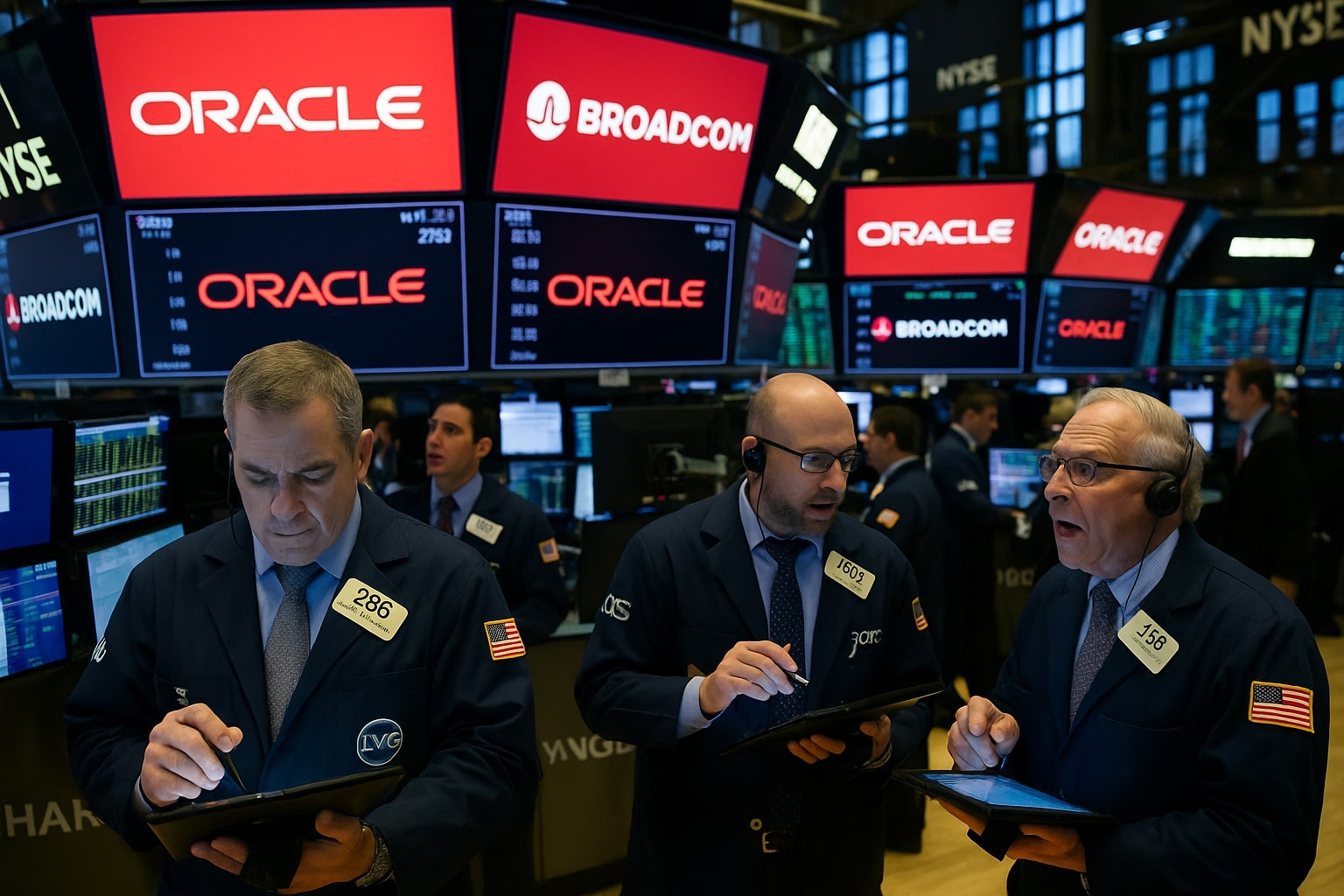
The market didn’t sell “AI demand.” It sold the assumption that AI demand automatically equals AI profit. Two datapoints dominated positioning. First, Broadcom (AVGO) dropped -11.43% to $359.93, even after a quarterly beat, because forward margin optics deteriorated: guidance pointed to 76.9% gross margin for the current quarter versus 79% a year ago (and below the prior quarter prints). Second, Oracle (ORCL) stayed in the blast radius after its earlier slide, then got hit again by reports of data-center timeline slippage tied to OpenAI—pushing some completion targets to 2028 from 2027 due to labor and material constraints. Oracle was cited as roughly 45% below its September intraday high of $345.72.
That combination—capex intensity plus margin compression—reopened the “AI bubble” framing. The key change is nuance: this isn’t 2023’s debate about whether AI is real. It’s 2025’s debate about payback periods and whether the AI supply chain is drifting back toward more commodity-like economics where pricing power fades.
Single-Stock Tape: Winners Were Idiosyncratic, Losers Were Crowded
Friday’s action separated event-driven moves from factor-driven pain. Lululemon (LULU) surged +9.60% to $204.97 after an earnings beat and improved outlook: EPS $2.59 versus $2.22 expected, revenue $2.6B versus $2.47B expected, with international sales +18% (comparable) while Americas comp sales -5%. Guidance for Q4 revenue $3.5B–$3.58B tracked the $3.56B consensus, and full-year revenue guidance $10.96B–$11.0B implied about 4% growth, with full-year EPS guided $12.92–$13.02. Management also flagged a leadership transition: CEO Calvin McDonald to exit end of January, with interim co-CEOs and an advisory transition into March. That is how you get a stock up big on a down tape—numbers plus a narrative reset.
On the tech side, downside was factor-linked: Nvidia (NVDA) was cited as down about -1.3% on the day and about -4% on the week, while other mega-cap tech names were broadly lower (several flagged for weekly declines in the 3%–4% range). Semis and AI infrastructure names were treated as a single crowded trade—weakness fed on itself.
Rates And The Discount Rate: The 10-Year Quietly Did The Damage
The index move makes more sense once you look at the curve. The U.S. 10-year yield pushed up to about 4.18%–4.194%, and the 30-year yield moved above 4.85%. That is the exact setup that pressures “long-duration” growth exposure: higher real yields raise the discount rate applied to distant cash flows, and the Nasdaq is basically a discount-rate instrument in weeks like this. Importantly, this happened right after the Fed’s policy pivot, which is why the market felt schizophrenic: the Fed is easing, but the long end can still rise when growth and issuance dynamics dominate.
Policy Backdrop: A Fed Cut, A Potential Pause, And A Chair Succession Overhang
The Fed cut by 25 bps to a 3.50%–3.75% target range. The messaging emphasized uncertainty and risk balance, but the market immediately shifted to the next argument: how many cuts follow in 2026, and how fast. Adding tension, at least two Fed officials publicly explained dissenting votes—arguing for waiting for more inflation data before cutting again—while broader market chatter moved toward the possibility of a January pause.
Then the political overlay hit: commentary circulated that President Trump views Kevin Hassett as a frontrunner for the next Fed chair when Jerome Powell’s term ends in May, with Kevin Warsh also in contention. That matters because the “rates path” is now trading not only on CPI and jobs, but also on perceived future reaction functions.
Europe: Smaller Tech Weight Helped, But It Still Slipped
Europe initially opened firmer, then faded as U.S. tech weakness infected risk sentiment. The STOXX 600 ended 578.24 (-0.53%). The FTSE 100 closed 9,649.03 (-0.56%), DAX 24,186.49 (-0.45%), and CAC 40 8,068.62 (-0.21%). Europe’s relative insulation from mega-cap tech concentration cushioned the decline, but AI- and chip-exposed names still dragged enough to pull the region lower. Next week’s focal point is central-bank divergence, with the ECB’s final decision of the year set up as a macro catalyst for European risk pricing into 2026.
Asia: Japan Printed A Record While The BoJ Tightening Clock Ticked
Asia looked stronger earlier in the cycle, led by Japan. The Nikkei 225 closed 50,836.55 (+1.37%), with Japan described as record-setting on the rally. The constructive read is straightforward: global investors are still willing to buy equities when the story is growth and momentum, especially outside the most crowded U.S. AI pockets. The risk is also straightforward: markets were described as nearly fully pricing a BoJ hike to 0.75% from 0.5% at the Dec. 18–19 meeting, and the only question is how hawkish the guidance sounds about the pace beyond that.
China and Hong Kong participated on policy expectations. Hang Seng closed 25,976.79 (+1.75%), and the Shanghai Composite 3,889.35 (+0.41%), while Australia’s All Ordinaries ended 8,983.30 (+1.19%). The common thread was anticipation of additional support measures after Beijing’s pro-growth signals.
FX: The Divergence Trade Stayed Alive
Currencies reflected the same theme: easing in the U.S. versus potentially firmer stances elsewhere. The Dollar Index was around 98.44 (up on the day, down on the week). EUR/USD traded about $1.1735. USD/JPY hovered near 155.93 into the BoJ window. GBP/USD sat around $1.3375 after the UK economy reportedly shrank 0.1% over the three months to October. One widely watched call projected the dollar index could soften another 2%–3% in 2026 if Fed easing persists.
Commodities And Crypto: Gold Kept Winning, Oil Stayed Soft, Bitcoin Slipped With Risk
Gold behaved exactly like a market pricing easier policy: Gold futures (GC=F) touched an intraday record around $4,381/oz, then ended the session up about +0.3% near $4,300.10/oz. The metal was also framed as on pace for its best year since 1979, and the repeated record prints in 2025 underline how aggressively the market has repriced real rates and hedging demand.
Oil stayed heavy despite a Friday bounce. Brent was cited around $61.71 and WTI around $58.03 during the move, with the broader week still characterized as weak.
Bitcoin traded like a risk asset, not a safe haven. BTC-USD slipped toward ~$90,000, failing to clear $94,000 in recent weeks. A key level mentioned was the approximate cost basis for newer holders at ~$103,000, reinforcing why sub-$100k is psychologically and mechanically important into year-end.
Copper remained the “AI meets real economy” story even after volatility: prices were described as nearing $12,000 per metric ton, with projected deficits of about 124,000 tons (2025) and 150,000 tons (2026)—a tightness narrative driven by electrification and data-center demand colliding with supply limits.
Flows: Equity Demand Didn’t Break—It Rotated
The under-the-hood flow data didn’t confirm a broad de-risk. Global equity funds reportedly took in about $12.9B in the week to Dec. 10, the largest weekly inflow in five weeks. Europe led with $6.4B of inflows, and the U.S. and Asia also saw net additions. That combination—money still coming in while AI leadership cracks—supports the “rotation, not liquidation” framing, at least for now.
The Private-Market Shockwave: “Invitation Only” Is A Macro Story Now
The market narrative expanded beyond daily price action into structural access. A major private share sale cited as $40B for OpenAI—available to fewer than 50 handpicked investors—was used as a symbol of a widening gap between private-market upside and what public investors can access. The key datapoint: the number of U.S. public companies was described as roughly half its late-1990s peak, while the median age of companies going public moved from about 6 years (2000) to 14 years today.
This isn’t just social commentary; it changes how public-market multiples behave. If the most explosive growth gets harvested privately, public indexes can skew older, larger, and more sensitive to rates—while wealth creation concentrates in private clubs, SPVs, and secondary platforms with layered fees and fraud risk. Regulatory debate is now central: the SEC’s Paul Atkins is positioned as a leading advocate for expanding access with guardrails, while critics want higher disclosure standards for private issuers instead. The fraud and fee-layering risk was illustrated by SPV stacking and a high-profile platform failure narrative.
Read More
-
Yen Stalls at 160 Despite a 3% JGB and Tokyo Core CPI at 2.0% — Intervention Sits at 164, Friday's Payrolls Decide
02.09.2026 · TradingNEWS ArchiveEnergy
-
SPY Stalls Below Its Record As A 4.63% Earnings Yield Loses To A 4.74% Treasury
03.09.2026 · TradingNEWS ArchiveStocks
-
Bitwise Holds 286.8M XRP At A $480M Cost And $393M Of Value — The Category Bought Every Dip And Is Still Underwater
03.09.2026 · TradingNEWS ArchiveCrypto
-
Natural Gas Stalls Under $3 As Record 111.5 Bcf/d Production Absorbs Every Bullish Signal
03.09.2026 · TradingNEWS ArchiveCommodities
-
Dow 53,461, S&P 500 7,702 And Nasdaq 26,392 Climb On Waller's Dovish Turn — HOOD Explodes 14.9%
03.09.2026 · TradingNEWS ArchiveMarkets
-
Yen Rips Four Yen In A Session As Japan Takes Control Of The Dollar — Brent At $97.62 Could Not Stop It
03.09.2026 · TradingNEWS ArchiveForex
Cannabis, Autos, And Other Friday Extremes: Risk-On Still Exists, But It’s Selective
A separate speculative pocket lit up on policy headlines: cannabis stocks surged on reports of potential U.S. reclassification easing restrictions. Tilray (TLRY) +35%, Canopy Growth (CGC) +25%, Aurora Cannabis (ACB) +23%, Cronos (CRON) +13% were cited in premarket action. That move matters because it proves liquidity is still willing to chase catalysts; it’s just less willing to pay any price for AI hardware margins.
In autos/tech, Rivian (RIVN) jumped +17% after highlighting a $2,500 self-driving upgrade and an AI chip push, with one analyst price target lifted to $23 from $14.
India Single-Name Event: TARIL Rebounded On Debar Relief And Order Flow (Converted To USD)
Transformers and Rectifiers (India) Ltd (NSE: TARIL) was described as rebounding sharply, trading near ₹280–₹281 (about $3.37–$3.39 using ₹83 per $1, approximate) and up roughly 17% on heavier volume after an update tied to World Bank debar status process timing (deadline extended to Jan. 12, 2026). The move also referenced order wins: a GETCO contract ₹389.97 crore (about $47.0M, approximate) and a Power Grid HVDC converter transformer order ₹53.33 crore (about $6.43M, approximate). The cited 52-week range of ₹230–₹650 translates to roughly $2.77–$7.83 on the same conversion basis. The market read was “procedural relief, not final resolution,” which is exactly why the stock can rip while uncertainty remains.
Valuation Stress Test: The CAPE Signal Is Flashing Where It Only Flashed In 2000
One valuation marker was highlighted as a rare warning: the S&P 500 Shiller CAPE ratio reaching about 39, a level seen only twice over roughly 153 years—in 2000 and now. Even if you stay constructive on growth and liquidity, that metric argues for narrower forward returns and higher drawdown risk if the earnings path disappoints. This is where the AI-margin debate becomes existential: at CAPE-like extremes, the market has less tolerance for “trust us, returns later.”
Next Week: Data Dumps, Central Banks, And A Practical Earnings Calendar
Macro catalysts stack immediately. The U.S. calendar was framed around a delayed-release backlog with a November jobs report Tuesday and CPI Thursday. Central banks are the second pillar: BoE expected to cut, ECB expected to hold with 2026 rhetoric in focus, and BoJ expected to hike with guidance on tightening pace.
On the company calendar, UK/Europe-facing watchlists flagged results and trading statements week commencing 15 Dec 2025: Hollywood Bowl Group (16-Dec) full-year results, WH Smith (16-Dec) full-year results, Bunzl (17-Dec) full-year trading statement, IntegraFin Holdings (17-Dec) full-year results, Currys (18-Dec) half-year results, and Carnival (19-Dec) fourth quarter results. Carnival’s setup was framed around guidance momentum: EBITDA guidance at $7.05B, more than 15% higher than last year, with demand/booking strength contrasted against tougher comparisons and potential cracks in leisure travel demand into 2026—while lower oil is a tailwind.
Trading News Verdict: Buy/Sell/Hold By Index Based On Friday’s Data
Nasdaq Composite (23,195.17, -1.69%) — HOLD / Bearish Near-Term Bias. The index is still being priced as an AI profit machine, yet the tape just repriced the margin structure of key AI suppliers (AVGO -11.43%) and the capex timeline risk inside the ecosystem (data-center delays tied to OpenAI). With the 10-year ~4.19% and the 30-year >4.85%, the discount-rate headwind remains active. Until yields cool or AI margins stabilize, upside is fragile and pullbacks can accelerate in thin year-end liquidity.
S&P 500 (6,827.41, -1.07%) — HOLD. Broader than Nasdaq, but still hostage to mega-cap tech leadership. The flow data ($12.9B into global equity funds; $6.4B to Europe) argues against a broad risk-off unwind, yet valuation stress (CAPE near 39) limits the “just buy the dip” argument unless earnings delivery improves.
Dow Jones (48,458.05, -0.51%) — BUY / Bullish Relative Call. It underperformed intraday versus its own record narrative, but it outperformed on the week (~+1%) precisely because it carries less of the crowded AI-duration factor. In a rotation regime, relative strength is the edge.
STOXX 600 (578.24, -0.53%) — HOLD. Europe is less tech-heavy, but it is trading the ECB narrative next week and can’t fully decouple from U.S. risk sentiment.
Nikkei 225 (50,836.55, +1.37%) — BUY With A BoJ Risk Flag. Momentum is strong and the region benefited from earlier-cycle optimism, but the near-fully priced BoJ hike to 0.75% is a real event risk for rates-sensitive positioning.