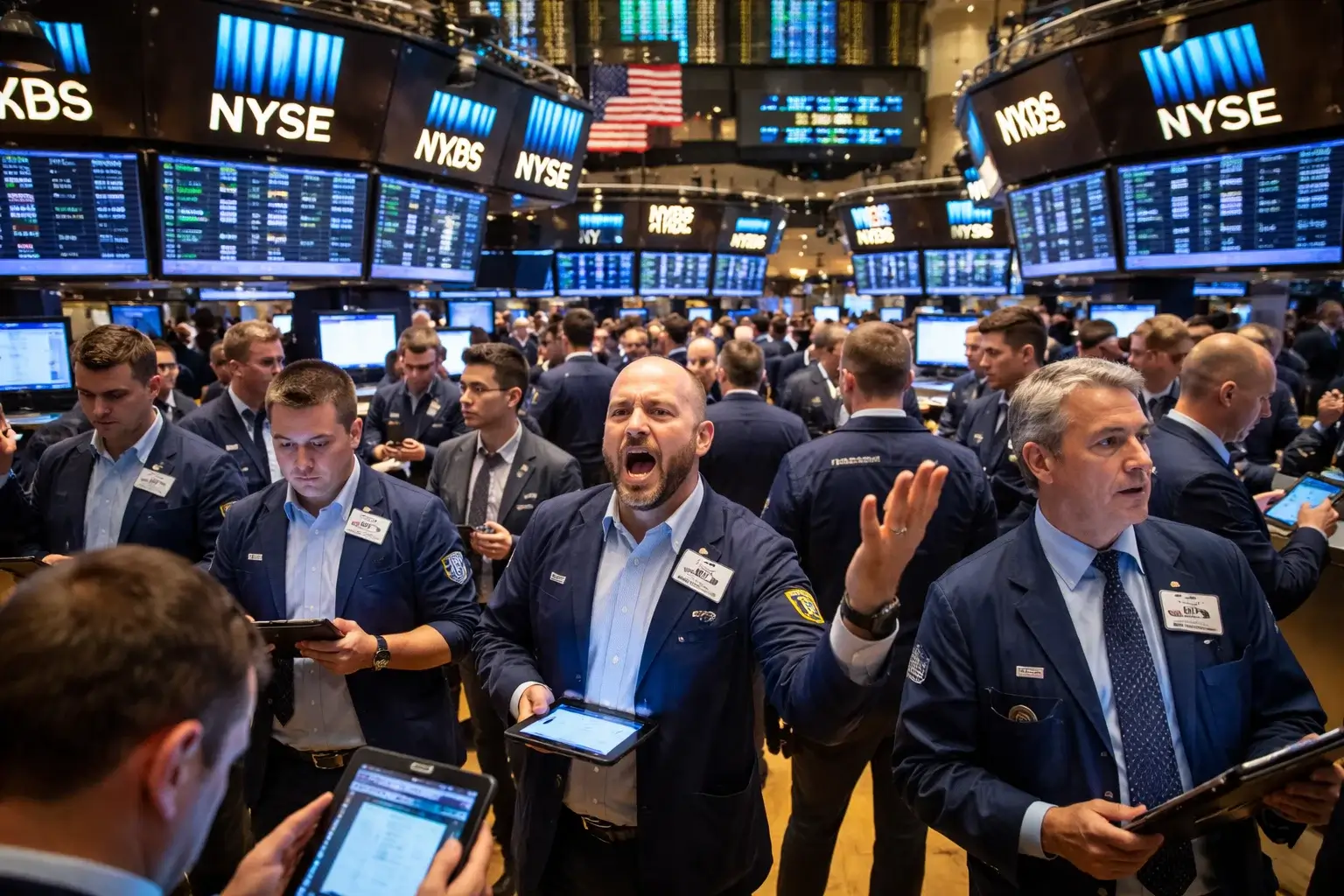
Stock Market Today - S&P 500 Holds Full Iran War Recovery, Dow Adds 225 Points as Nasdaq Chases Historic 10-Day Winning Streak
Oil Drops 5% to $94 on Peace Talk Optimism, Bloom Energy (BE) Surges 22% on Oracle Deal, PPI Prints at Half the Expected Level | That's TradingNEWS
Key Points
- The S&P 500 (^GSPC) held at 6,936 Tuesday, fully erasing Iran war losses, as the Dow (^DJI) added 225 points and the Nasdaq (^IXIC) surged 1.2% toward a historic 10th straight win.
- Oil dropped 5% to $94 a barrel as Pakistan brokered new U.S.-Iran talks, while March PPI rose just 0.5% — less than half the 1.1% economists had forecast ahead of the report.
- Bloom Energy (BE) exploded 22% on an expanded Oracle power deal, Bitcoin topped $75,000, JPMorgan profits jumped 13% to $16.5B, and Oracle (ORCL) extended its two-day rally past 19%.
The S&P 500 (^GSPC) is trading at 6,936.71, up 0.73% Tuesday morning, and that number carries more weight than a routine intraday gain — it represents the complete erasure of every loss the index accumulated since the Iran war began in late February. The Nasdaq Composite (^IXIC) is outperforming the broader market with a 1.21% advance, pushing toward its 10th consecutive positive session and crossing back into positive territory for 2026 in the process. The Dow Jones Industrial Average (^DJI) is adding 225 points, or 0.47%, while the Russell 2000 is quietly leading all major benchmarks with a 1.34% gain — a detail worth examining carefully because small-cap leadership doesn't materialize unless confidence in domestic economic conditions is genuinely recovering rather than simply performing.
The VIX is down 3.56% to 18.44. Six weeks ago it was threatening levels that historically correspond to institutional panic. Options market participants are now actively pricing out tail risk around the conflict, and when the fear gauge compresses this decisively during an active geopolitical war, the signal demands respect rather than skepticism. Sixty-five percent of all U.S. equity issues were advancing mid-morning, led by small caps and technology — this is not a narrow, fragile rally driven by a handful of mega-cap names manipulating index performance. This is broad-based risk appetite with genuine breadth underneath it.
Oil's 5% Collapse Is the Single Most Important Macro Variable Today
West Texas Intermediate crude (CL=F) is down 5.12% to $94.01 per barrel. Brent (BZ=F) is retreating approximately 3% to the $95-96 range. Both benchmarks are now decisively below the $100 threshold — a level that, when broken to the upside, triggers recession modeling at every major strategy desk on Wall Street. The retreat is being driven by two simultaneous catalysts: Pakistan is attempting to broker a second round of U.S.-Iran negotiations following last weekend's collapse in Islamabad, and the International Energy Agency released its monthly report warning that "demand destruction will spread as scarcity and higher prices persist." When the IEA signals demand collapse risk, energy traders front-run the downside without hesitation.
The Strait of Hormuz remains the most consequential physical choke point in global commodity markets. The U.S. Navy blockade of Iranian ports entered its second full day Tuesday. Reuters reported that three Iran-linked tankers moved through the strait Monday, though none were heading to Iranian ports and therefore fell outside the blockade's legal parameters. The geopolitical premium still embedded in crude is real — $94 a barrel is not a historically cheap barrel — but every dollar of decline translates directly into relief for inflation expectations, consumer spending power, and corporate margin pressure across industrials, airlines, and consumer discretionary sectors.
Citadel CEO Ken Griffin delivered the morning's most direct macro statement at the Semafor World Economy Summit in Washington: if the Strait remains shut for six to twelve months, "the world's going to end up in a recession — there's no way to avoid that." Griffin simultaneously argued the military campaign would have been far costlier had it been delayed while Iran's capabilities continued developing. Both positions are coherent. The more actionable read from Griffin is that his firm has been a net buyer through the volatility rather than a seller, which tells you everything about his actual conviction level separate from the public commentary.
Producer Prices Print at Half the Expected Level — The Fed Calculus Shifts
March Producer Price Index data showed headline PPI rising 0.5% month-over-month — less than half the 1.1% consensus from Dow Jones economists. Core PPI, stripping food and energy, came in at 0.1% against a 0.4% forecast. On a year-over-year basis, headline PPI hit 4.0% versus the 4.6% expectation, while core year-over-year held at 3.8% — matching the prior month but arriving well below the 4.1% consensus estimate.
The composition inside the number explains the full story. Energy within PPI surged 8.5% for the month — the largest single-month spike since June 2022 — with gasoline alone jumping 15.7% month-over-month. Diesel, jet fuel, and home heating oil all contributed meaningfully. Yet food costs fell 0.3%, scrap iron prices declined, and natural gas prices dropped. The war is delivering a severe energy shock, but the pass-through into broader goods and services is running far weaker than the Street feared. That is a significant disinflationary signal outside the energy complex and it directly affects the Federal Reserve's policy path.
Goldman Sachs economists George Cole and William Marshall noted Tuesday that the conflict has now pushed six G10 central banks toward expected rate hikes in 2026, up from three prior to the war's outbreak. The Fed remains the lone major central bank still anticipated to cut rates this year — though the timeline has been pushed back meaningfully. Their core argument is that the inflationary dimension of the commodity shock is dominating growth concerns in rate markets, and that the repricing in front-end yields will stay "sticky even as front-end yields sit higher than most baseline forecasts." The 10-year Treasury yield is essentially unchanged at 4.279%. Gold futures are up 1.0% to $4,817 per ounce — the hard asset bid holding even as equities advance, reflecting lingering uncertainty about the durability of the ceasefire.
JPMorgan Delivers a Standout Quarter Then Guides NII Lower — and That's the Only Number That Matters
JPMorgan Chase (JPM) posted first-quarter EPS of $5.94 against a $5.43-$5.45 consensus, on net revenue of $49.8 billion — a 10% year-over-year increase from $45.3 billion. Net profit rose 13% to $16.5 billion. Investment banking fees surged 28%. Trading revenue climbed 20% to $11.6 billion. By every standard measure this was an outstanding quarter with no ambiguity.
The stock is lower anyway, and that reaction is not irrational — it reflects sophisticated institutional reading of the guidance. JPMorgan cut its full-year net interest income outlook, and NII is the metric that defines the bank's recurring earnings power beyond the cyclical volatility of trading desks. CEO Jamie Dimon's language was careful: "The U.S. economy remained resilient in the quarter, with consumers still earning and spending and businesses still healthy." He then enumerated "geopolitical tensions and wars, energy price volatility, trade uncertainty, large global fiscal deficits and elevated asset prices" as significant risks. Dimon's measured caution combined with the NII guidance reduction is enough to keep the stock under pressure even on a clean beat. Hold — the fundamentals are intact but the NII headwind and macro uncertainty cap the near-term upside.
Wells Fargo Misses on Every Metric That Institutional Investors Track
Wells Fargo (WFC) is the worst-performing major bank Tuesday, down more than 4.5-5%, and the numbers justify the severity of the reaction precisely. Reported EPS was $1.60, but adjusted earnings stripping out a tax benefit came in at $1.56 per share against a $1.58 consensus. Net revenue of $21.45 billion came in just below analyst forecasts. Net interest income disappointed. Margin compression is the central structural problem: WFC is more heavily dependent on spread income than JPMorgan, whose diversified trading and advisory businesses provide a natural hedge when loan-based income compresses. In an environment of elevated short rates and weakening loan demand driven by war-related uncertainty, Wells Fargo's model is under pressure from multiple directions simultaneously. Sell — there is no near-term catalyst for spread income recovery, and the bank lacks the trading and fee income diversification that its peers are using to compensate.
Citigroup Proves Fee Income and Trading Desks Are the Best Business on Wall Street Right Now
Citigroup (C) beat on every line that matters and is up 1.38% to $128.02 as a direct result. The bank earned $3.06 per share against a $2.65 estimate, on revenue of $24.63 billion versus a $23.55 billion forecast. Revenue rose 14% year-over-year. Net income grew 42%. CEO Jane Fraser called it "an exceptionally strong start to 2026" — and that characterization is defensible. Bond trading, equities, and overall revenue all beat simultaneously, which is the kind of across-the-board outperformance that reflects management execution rather than fortunate market conditions. The gap between Citigroup and Wells Fargo today perfectly illustrates the valuation difference between institutions that can generate fee income across market cycles and those structurally dependent on loan spreads. Buy — the stock is pricing in too much institutional pessimism relative to the quality of execution this quarter.
BlackRock and Johnson & Johnson Deliver Two Clean Beats the Market Is Under-Appreciating
BlackRock (BLK) posted adjusted EPS of $12.53 against Wall Street expectations, on revenue of $6.7 billion — both lines above forecasts. Assets under management continue expanding, and in a risk-on environment with equities recovering, crypto surging, and bond markets stabilizing, BlackRock's fee income base strengthens mechanically as flows accelerate. Buy — if the Iran peace process advances and risk appetite broadens further, flows into BlackRock's funds will accelerate and drive meaningful upside from current levels.
Johnson & Johnson (JNJ) reported first-quarter EPS of $2.70 against a $2.67 estimate, on revenue of $24.1 billion — up roughly 10% year-over-year from a $23.6 billion consensus estimate. The company immediately raised full-year guidance: sales are now projected in the $100.3-$101.3 billion range with a midpoint of $100.8 billion, up from a prior midpoint of $100.5 billion, while adjusted EPS guidance was lifted to a $11.45-$11.65 range with a midpoint of $11.55 versus the prior $11.53. A company that raises guidance during an active geopolitical war and an oil shock is a company with genuine forward earnings visibility. Buy — the guidance raise during a period of maximum macro uncertainty is the most bullish signal management can deliver.
Oracle Is Rapidly Becoming the Most Important AI Infrastructure Equity in the Large-Cap Universe
Oracle (ORCL) is up another 7% Tuesday after surging more than 12% on Monday, and the catalyst this time is a newly announced agreement with Bloom Energy (BE) to purchase up to 2.8 gigawatts of fuel cell power for Oracle's data center buildout. This expands upon 1.2 gigawatts already under contract and currently being deployed. Bloom's modular fuel cell systems can be delivered and operational in 55 days — a timeline that matters enormously for a hyperscaler competing to bring AI inference capacity online faster than Microsoft, Amazon, and Google. Oracle has now staged one of the most powerful two-day moves of any mega-cap name in the market, up more than 19% across Monday and Tuesday combined. Buy — the Bloom deal confirms Oracle is attacking the AI infrastructure constraint of power availability with a solution that is faster and more capital-efficient than traditional grid connection alternatives. The multiple expansion is justified by the earnings power being built.
Bloom Energy Surges 22% and This Is Not a Speculative Momentum Trade
Bloom Energy (BE) is advancing 22.02%, adding $38.91 to trade at $215.58 with a market capitalization of $60.9 billion and a 52-week gain of 864.88%. The Oracle deal is the immediate catalyst but the investment thesis is structurally broader: data center power availability is the binding constraint on AI infrastructure expansion across every hyperscaler globally, and Bloom's on-site fuel cell generation — deployable in weeks rather than the years required for new grid connections or nuclear plant construction — is a genuine technological solution to a genuine physical problem. The 22% single-session move creates an inevitable near-term consolidation setup. Buy on any pullback — the fundamental demand for rapid, on-site, reliable power generation is not cyclical and will not diminish regardless of how the Iran conflict resolves.
Credo Technology Acquires DustPhotonics and the Market Immediately Validates the Capital Allocation
Credo Technology (CRDO) is surging 16.55% to $156.68 after announcing the acquisition of DustPhotonics for $750 million in cash plus approximately 920,000 shares of Credo stock. DustPhotonics brings Silicon Photonics PIC technology in-house, directly accelerating Credo's optical interconnect roadmap and expanding its total addressable market across the global optical industry. The stock has gained 242.93% over the past 52 weeks — and yet the market is aggressively rewarding this acquisition on announcement day, which signals that institutional holders believe management is deploying capital into growth at a price that creates value rather than destroying it. The iShares Semiconductor ETF (SOXX) simultaneously hit a new all-time intraday high Tuesday, advancing 0.69%, with Credo and Marvell Technology pacing the fund. Buy — the optical interconnect market is expanding faster than consensus models are capturing, and the DustPhotonics acquisition is a genuine accelerant to Credo's competitive positioning within it.
Read More
-
Yen Stalls at 160 Despite a 3% JGB and Tokyo Core CPI at 2.0% — Intervention Sits at 164, Friday's Payrolls Decide
02.09.2026 · TradingNEWS ArchiveEnergy
-
CHAT Fund Holds $96.37 as Korean Memory and Chip Exposure Drive a 109.73% Year — Break of $98.02 Opens $105.20
18.09.2026 · TradingNEWS ArchiveStocks
-
First-Generation XRPR and XRPI Ride XRP's Rebound to $1.386 as Spot Funds Post First Outflow — Break of $1.40 Opens $1.54
18.09.2026 · TradingNEWS ArchiveCrypto
-
NG Holds $2.9255 as Storage Surplus Narrows From 5.5% to 3.7% in 3 Weeks — Break of $3.00 Opens $3.15
18.09.2026 · TradingNEWS ArchiveCommodities
-
Dollar Surges to 157.90 as BoJ's Divided Hike Fails to Lift the Yen — Break of 158.87 Opens 159
18.09.2026 · TradingNEWS ArchiveForex
Bitcoin Breaks $75,000 and the Entire Crypto Equity Complex Is Repricing
Bitcoin (BTC-USD) is trading at $74,775, up 3.90% from yesterday's close and recovering from overnight lows around $73,100 to intraday highs above $75,100. The move was partially catalyzed by a $200 million-plus short squeeze. Ethereum is up 5% to approximately $2,300-$2,355, with more than $114 million in ETH short positions forcibly liquidated. Monday's session actually saw bitcoin ETFs post their largest single-day net outflow — $291 million — since March 6, while ether ETFs took in $9.4 million, suggesting institutional rotation within the crypto asset class rather than broad-based selling.
The equity proxies are amplifying the underlying asset moves, as they reliably do on high-conviction risk-on days. Robinhood (HOOD) is the top-performing stock in the entire S&P 500 on Tuesday, up 9.25% to $78.30 with a 62.59% 52-week gain. Coinbase (COIN) is up 6.5%, sitting as the second-best performer in the index. Strategy (MSTR) is advancing 3-6%. MARA Holdings (MARA) is 4.5% higher. Bitdeer Technologies (BTDR) is up 7.96%. IREN Limited (IREN) is gaining 8.36%. Buy the bitcoin proxy complex — the short squeeze dynamic indicates positioning was heavily short coming into this week, and the technical unwind has further to run if peace negotiations produce any concrete progress before the April 21 ceasefire expiration.
The United-American Airline Merger Speculation Is the Boldest M&A Story in the Market
American Airlines (AAL) is up 8.15% to $12.15. United Airlines (UAL) is advancing 3.38%. Bloomberg reported that United CEO Scott Kirby personally pitched the concept of United acquiring American to White House officials, with Reuters subsequently confirming the pitch occurred during a late-February meeting with President Trump directly. A combined United-American entity would become the largest airline on earth by annual revenue — exceeding $110 billion — versus the current largest, Delta Air Lines (DAL), at $63 billion in 2025 revenue. The antitrust barriers are real and substantial under any regulatory framework, but the Trump administration's posture toward consolidation is categorically different from the Biden era, and the political context of pitching directly to the President rather than through regulatory channels tells you Kirby believes the political pathway exists even if the legal pathway is uncertain. JetBlue (JBLU) is surging 11.78% on the speculation — presumably reflecting the possibility that a major carrier merger creates strategic value for smaller assets as the competitive landscape consolidates. Speculative buy on AAL — even absent a deal, the stock has been so severely discounted by fuel costs and competitive pressure that any credible strategic interest establishes a floor.
Amazon Acquires Globalstar for $11.57 Billion to Challenge Musk's Starlink Directly
Amazon (AMZN) is up 3.13% after announcing the acquisition of satellite operator Globalstar (GSAT) for approximately $11.57 billion. Globalstar is gaining 10.18% to $80.38 on volume of 8.3 million shares against a 3-month average of 832,000 — ten times normal turnover. The strategic rationale is straightforward: Amazon's low-earth-orbit satellite network, Amazon Leo, needs existing orbital infrastructure and spectrum assets to compete credibly with Elon Musk's Starlink, which currently has more than 10 million active subscribers, roughly 10,000 satellites already in orbit, and is projected to generate over $9 billion in revenue this year alone. Building that infrastructure from scratch would take years and tens of billions of dollars. Acquiring Globalstar is a shortcut that dramatically compresses the timeline. Buy Amazon — the Globalstar deal adds a satellite commerce and connectivity dimension to the cloud and logistics thesis that the current multiple is not pricing, and AMZN's ability to deploy capital at this scale without straining its balance sheet is a structural competitive advantage.
Novo Nordisk Partners With OpenAI and the Valuation Dislocation Is Getting Harder to Justify
Novo Nordisk (NVO) is up 2.25-2.26% to $38.84 after announcing a comprehensive AI collaboration with OpenAI covering drug discovery, manufacturing, and commercial operations. The Danish drugmaker entered Tuesday down 25% year-to-date and more than 40% over the past 12 months — a collapse driven entirely by Eli Lilly's competitive gains in the obesity drug market, including U.S. FDA approval of its oral weight-loss pill Foundayo after Novo launched oral Wegovy in January of this year. The OpenAI partnership will not reverse competitive dynamics overnight, but the ability to analyze datasets at a scale described by CEO Mike Doustdar as "previously impossible" — identifying drug candidates faster, compressing timelines from research to patient — is the kind of structural productivity gain that compounds over multiple development cycles. Analysts project annual GLP-1 and weight-loss drug revenues exceeding $100 billion within the next decade. Novo is not exiting this market; it is retooling for the next phase of it with the most capable AI partner available. Buy — the 40% decline over 12 months has created a valuation entry point that does not appropriately reflect the long-term market trajectory or the company's pipeline depth.
The Magnificent Seven Reclaim Market Leadership With Force
The Roundhill Magnificent Seven ETF (MAGS) is up approximately 2.15% Tuesday, outpacing both the S&P 500 and the Nasdaq Composite by a meaningful margin. The sector heat map confirms the leadership rotation: Technology (XLK), Consumer Discretionary (XLY), and Communication Services (XLC) are the three leaders in the large-cap universe today. Energy (XLE) and Consumer Staples (XLP) are the two laggards — XLE is down nearly 10% over the last 10 trading sessions since the March 30 low, precisely inverse to the peace deal optimism driving everything else higher. Apple (AAPL) is the only Magnificent Seven name in negative territory at -0.57%. Nvidia (NVDA) is up 2.05%. Tesla (TSLA) is advancing 2.73%. Alphabet (GOOGL) is gaining 2.66%. Palantir Technologies (PLTR) is extending its recent climb for the fourth consecutive session.
Morgan Stanley Chief Investment Officer Mike Wilson was unambiguous on CNBC Tuesday morning: "The lows are in." His reasoning points to rotation back into pro-cyclical market segments as the definitive confirming signal. He is correct. When rotation is broad — 65% of U.S. issues advancing, small caps leading, technology extending gains, semiconductors hitting new all-time highs — the internal market structure is healthy rather than artificially narrow.
Quantum Computing Names Are Amplifying the Bull Case at the Speculative End of the Market
The highest-beta names in the U.S. equity market are using today's risk-on environment as a launching pad. IonQ (IONQ) is up 17.98% to $35.11. D-Wave Quantum (QBTS) is advancing 15.32% to $16.90. Rigetti Computing (RGTI) is up 12.10% to $16.96. Applied Digital (APLD) — the AI data center infrastructure play — is gaining 10.25% to $30.43 against a 52-week appreciation of 702.33%. Xanadu Quantum Technologies (XNDU) is surging 32.08% on volume of 2.1 million shares against a 3-month average of 809,000. Their collective performance Tuesday is functioning as a real-time market-implied probability gauge on the peace deal timeline. If the Strait of Hormuz reopens and U.S.-Iran negotiations produce a durable framework before the ceasefire expires April 21, these names are among the largest relative beneficiaries of the sentiment re-rating that would follow. Speculative buy on the quantum basket for those with appropriate risk tolerance — but these instruments move 15-30% on single headlines and position sizing is non-negotiable.
Travere Therapeutics Explodes 34.66% on FDA Approval and the Royalty Chain Moves With It
Travere Therapeutics (TVTX) is the top-performing stock in the entire U.S. equity market Tuesday, up 34.66% to $41.34 on volume of 9.1 million shares — six times the 3-month average of 1.52 million. This is a highly anticipated FDA approval landing on a day when the broader market is already constructive, which amplifies the move beyond what the approval alone would have generated. Ligand Pharmaceuticals (LGND) — which holds a royalty interest in Travere's commercialization — is up 8.52% in direct sympathy, reflecting the royalty economics that will flow through Ligand's income statement as the drug ramps. Buy both names through the commercialization ramp — FDA approvals of this significance create multi-quarter earnings visibility that the market will continue to price in over subsequent sessions.
ASML Positions for a Potential Record High After Wednesday's Earnings Report
ASML (ASML) reports earnings Wednesday morning with the options market pricing a move of approximately 6% in either direction by end of week. A 6% upside move from Monday's close would push shares to roughly $1,590 — a new all-time record. ASML has already gained 40% year-to-date on the back of surging demand for EUV lithography equipment driven by the global AI chip investment cycle. The company holds an absolute monopoly position in extreme ultraviolet lithography, which means every major chip foundry on earth — TSMC, Samsung, Intel — depends on ASML's tools to manufacture advanced semiconductors. There is no substitute, no alternative, and no competitor within a decade of producing viable competition. The setup going into earnings is strongly constructive. Buy — the options market's 6% implied move is likely conservative given the 40% YTD run, the positive semiconductor sentiment evidenced by SOXX hitting a new all-time high, and the monopoly pricing power that sits beneath every forward earnings model.
Viking Cruise Lines Gets a Valuation Upgrade That Makes Strategic Sense
Viking (VIK) is gaining roughly 3% Tuesday following an upgrade to Buy from Rothschild & Co., which cited secular demand drivers, best-in-class revenue visibility, and strong cash generation as the core thesis. The firm's normalized free cash flow analysis shows Viking trading at less than a 30% premium to Norwegian Cruise Line (NCLH) and Carnival (CCL), and at a 25% discount to Royal Caribbean (RCL) — a valuation gap that does not reflect Viking's superior capacity growth trajectory relative to all three of those peers. The macro backdrop for cruise is complicated by sustained elevated fuel costs and war-related consumer confidence pressure, but Viking's customer demographic — affluent, older travelers with high income resilience — exhibits substantially lower cyclical sensitivity than mass-market cruise competitors' customer base. The stock is already up more than 12% year-to-date. Buy — the Rothschild upgrade is identifying a legitimate value dislocation in a high-quality name that the broader travel sector selloff has incorrectly grouped with more vulnerable peers.
The IMF Cuts Global Growth and Points to the Most Vulnerable Economies
The International Monetary Fund cut its 2026 global growth forecast to 3.1% — down from the 3.3% steady-state trajectory it was tracking before the Iran conflict. Global inflation is now projected to hit 4.4%, described by the IMF as "a sharp departure from the previous trend." IMF Chief Economist Pierre-Olivier Gourinchas specifically identified commodity-importing low-income economies and emerging markets as the most exposed, facing simultaneously higher energy and food prices, persistent wage and price pressures, and deteriorating confidence. The IMF's downside scenario encompasses further escalation, new trade tensions, or a reassessment of AI investment profitability. The upside scenario requires a swift resolution of the conflict. Harvard Kennedy School professor Linda Bilmes has separately estimated the total cost of the Iran war to U.S. taxpayers will reach $1 trillion, noting that the first six days of the joint U.S.-Israel operation that began February 28 alone cost $11.3 billion according to the Pentagon's own Congressional briefing.
China Is Outperforming the World — But the Earnings Picture Is Deteriorating Beneath the Surface
The CSI 300 has declined just 1.4% since late February. The MSCI Asia benchmark is down nearly 6% over the same period. Chinese equities have been sheltered by the country's accelerating progress toward energy independence and consistent gains in dividend-yielding domestic stocks. However, Bloomberg Intelligence data shows MSCI China earnings estimates have been trimmed more than 2% from a late-February peak, with Q4 results delivering an 11% negative surprise — the worst since Bloomberg Intelligence began tracking the metric in 2022. Consumer-facing sectors including healthcare, staples, and real estate led the disappointments while energy, materials, and utilities beat expectations. Bloomberg Intelligence strategist Marvin Chen's assessment is direct: "The bar for earnings recovery this year remains high." The relative resilience in Chinese equities is real but it is narrowing, and the earnings revision cycle has turned negative in the sectors that matter most for domestic consumption.
The KBW Bank Index Is the Most Overlooked Value Setup in U.S. Equities
The KBW Nasdaq Bank Index fell 6% in the first quarter of 2026 — its worst quarterly performance since 2023. That decline was driven entirely by macro fears surrounding the Iran conflict, inflation trajectory, and private credit risk. It was not driven by any deterioration in actual bank balance sheets, credit quality, or earnings power. Tuesday's Q1 results proved that: JPMorgan posted a 13% profit increase to $16.5 billion, Citigroup grew net income 42% on revenue of $24.63 billion, and BlackRock beat cleanly on both lines. The one genuine miss — Wells Fargo — was measured in basis points of net interest income, not in any credit quality collapse or reserve building that would signal systemic stress. The Financial Select Sector SPDR (XLF) is up nearly 7% from its March 30 low — a solid rebound, but still below where it should trade relative to the quality of the Q1 earnings results now hitting the tape. Buy the sector via XLF with deliberate overweight in Citigroup and deliberate underweight in Wells Fargo until the NII environment clarifies.
Circle Internet Group Emerges as a Structural Beneficiary of the Digital Asset Expansion
Circle Internet Group (CRCL) is advancing 7.23% to $105.81 on volume of 10.6 million shares against a 3-month average of 16.6 million — approximately two-thirds of normal daily volume already transacted by mid-morning, suggesting institutional accumulation rather than retail speculation. The stablecoin issuer benefits directly and mechanically from the same risk-on crypto environment lifting Bitcoin and Ethereum: USDC issuance expands when digital asset transaction volumes increase, and Circle collects yield on the reserve assets backing every unit of USDC in circulation. The regulatory framework around stablecoins under the current administration has been trending unambiguously in Circle's favor. Buy — the fundamental business model generates significant income from reserve asset yields in the current rate environment, and the stock is not yet pricing the full upside of favorable stablecoin legislation that appears increasingly likely to pass before year-end.
The Dollar Retreating 0.3% Adds One More Constructive Layer to the Risk Asset Setup
The U.S. Dollar Index (DXY) is down 0.3% to 98.06. Dollar weakness in a risk-on, peace-optimism environment is historically constructive for emerging market assets, dollar-priced commodities excluding oil, and multinationals with substantial international revenue exposure. The concurrent pattern of declining oil, rising gold to $4,817, falling dollar, and advancing equities is a coherent and internally consistent macro signal: the market is assigning materially higher probability to a negotiated resolution of the Iran conflict, which removes the energy-security safe-haven premium that has been supporting the dollar since late February. The 10-year Treasury yield at 4.279% is providing no resistance to equities at this level, and the spread between the implied Fed path and actual inflation expectations is narrowing in a direction that supports risk assets through at least mid-year if the ceasefire holds.
The Ceasefire Expiration on April 21 Is the Singular Risk Underneath This Entire Rally
What the full sweep of Tuesday's market data collectively reveals is an equity market that has moved from treating the Iran conflict as a potential systemic catastrophe to treating it as a solvable geopolitical problem with a clear resolution pathway. The S&P 500 has erased every loss accumulated since February 28. The Nasdaq is positive for 2026. The VIX is below 19. Bitcoin is above $74,000. Gold is at $4,817. The yield curve is not blowing out. PPI printed at less than half the expected level. JPMorgan, Citigroup, BlackRock, and Johnson & Johnson all beat estimates. Oracle is up 19% in two days. SOXX hit a new all-time high. The breadth is broad and improving.
The risk sitting directly underneath all of this is precisely dated: the fragile truce announced April 7 expires one week from today, on April 21. Pakistan is attempting to arrange a second negotiating round. U.S. officials are considering locations for a follow-up in-person meeting. Iran's foreign minister communicated to his French counterpart that progress had been made on "several issues." President Trump told reporters "the right people, the appropriate people" in Iran had reached out and "they want to work a deal." These are genuine constructive signals, not manufactured optimism. The market is currently pricing approximately a 60-70% probability of successful framework negotiations before the ceasefire lapses — that's the implied read from where oil trades, where equities trade, and where credit spreads sit. If that probability is correct, the rally has further room to run and the rotation back into pro-cyclical assets Wilson described will continue. If negotiations collapse again and U.S. forces escalate enforcement of the blockade in response, WTI breaks back above $100 and every risk asset in the portfolio reprices sharply and immediately lower. April 21 is the date that defines whether this is a sustained recovery or the most expensive head-fake of 2026.