Stock Market Today: Dow (DJI) Falls 160, S&P 500 (SPX) and Nasdaq (IXIC) Slip as QCOM Soars 13%, DPZ Crashes 9%
S&P500 slip and Nasdaq -0.32% as Brent tops $102, MSFT eds OpenAI deal, INTC clears 26-year peak | That's TradingNEWS
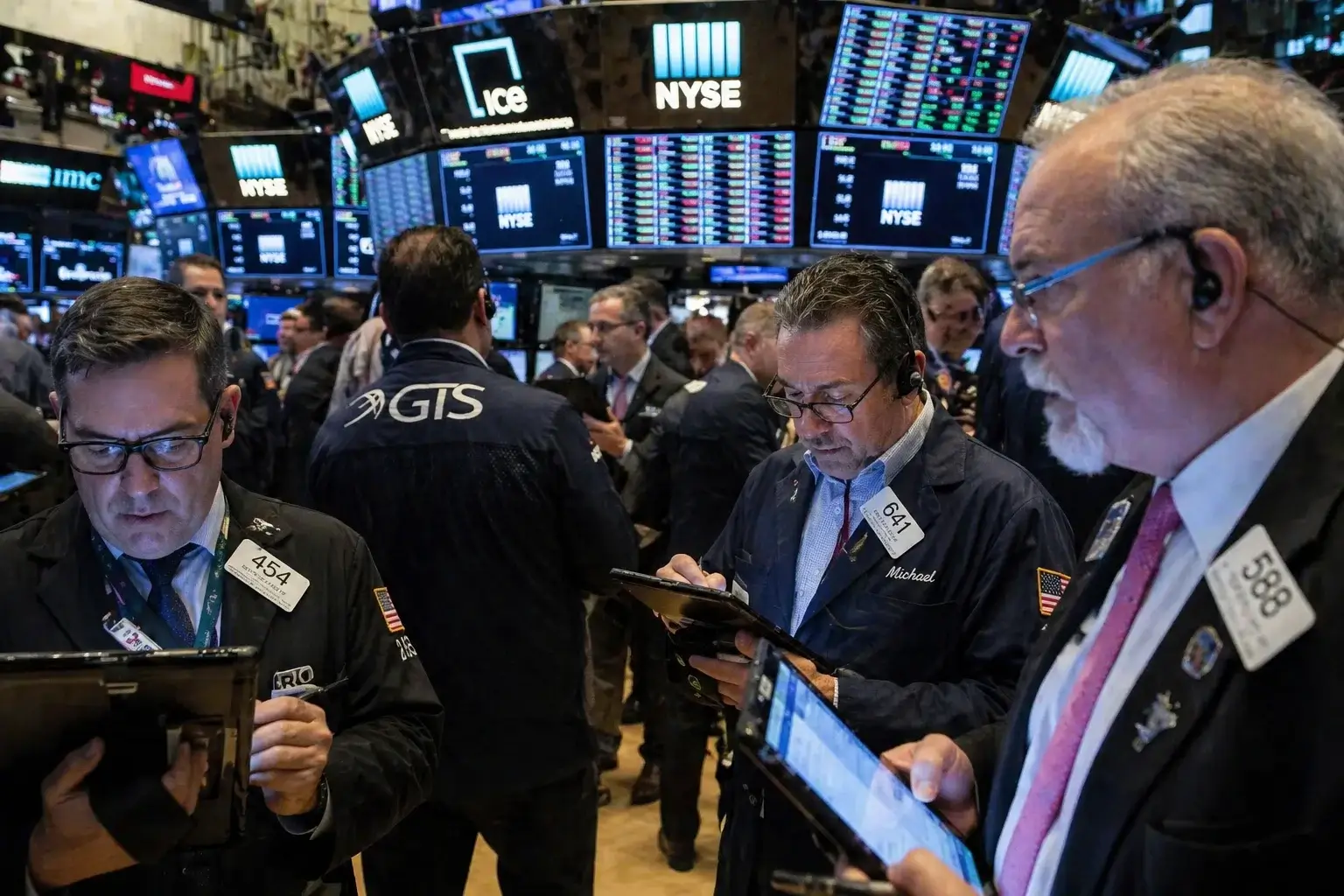
The opening session of what may be the most consequential trading week of the second quarter began with US equity benchmarks giving back ground from Friday's record close, as a collapsed envoy mission to Pakistan dragged the Strait of Hormuz back to the front of every trading desk's risk dashboard. The Dow Jones Industrial Average shed roughly 160 points, falling 0.33% to trade near the 49,070 mark, while the S&P 500 leaked 0.17% to hover around 7,152.37 and the Nasdaq Composite slipped 0.32% to 24,756. The small-cap Russell 2000 was effectively unchanged at 2,786.55, declining a fractional 0.02%, and the VIX ticked higher by 0.27% to 18.76—a remarkably contained volatility print given that Brent crude has now punched decisively above the $100-a-barrel threshold. That single juxtaposition—stretched index valuations, an active oil shock, and a sub-19 fear gauge—is the entire setup for the trading week ahead, and it telegraphs that institutional positioning is far more exposed than the surface tape would suggest.
Crude's New Floor: WTI at $97, Brent Through $102, Goldman Pushes Forecasts Higher Again
West Texas Intermediate jumped 2.93% to $97.17 a barrel, while the most actively traded May Brent contract climbed roughly 3% to print north of $102. The S&P GSCI Index Spot, the broadest commodity gauge available to institutional allocators, climbed 1.71% to 741.14, confirming that the energy bid is broadening across the complex rather than remaining a one-barrel story. The catalyst was the weekend decision out of the White House to scrap the planned trip by special envoy Steve Witkoff and Jared Kushner to Islamabad—a mission that had been positioned as the decisive next step in dragging Tehran back to the negotiating table. The president's stated rationale, citing "infighting and confusion" inside Iran's leadership and a Truth Social broadside arguing Washington holds "all the cards," instantly evaporated the ceasefire premium that had quietly built up across the prior trading week.
Iran's Foreign Ministry spokesperson Esmaeil Baqaei confirmed that no US-Iran meeting is currently scheduled, and Foreign Minister Abbas Araghchi has reportedly departed Islamabad for Moscow after a brief return to Pakistan over the weekend. Tehran did float, via an Axios report citing a US official and two sources with direct knowledge, a counter-proposal under which Iran would extend the current ceasefire and reopen Hormuz in exchange for deferring discussion of its nuclear program—a non-starter for the White House, which is demanding near-total dismantlement of enrichment capacity and surrender of existing nuclear material stockpiles. Adam Crisafulli of Vital Knowledge characterized the development as a "modest negative" while still framing the broader trajectory as one of de-escalation, but Bloomberg's oil strategists confirmed Hormuz traffic remained near zero through Monday morning, which is the operational data point that actually matters for pricing.
Goldman Sachs took the tape at face value and lifted forecasts again. Brent is now seen averaging $90 a barrel in the fourth quarter versus the $80 prior, with WTI moving to $83 from $75. Daan Struyven's team estimated that 14.5 million barrels per day of Persian Gulf production are sidelined, with global inventories drawing at an unprecedented 11–12 million b/d pace through April—a rate the bank itself flags as unsustainable, meaning either supply normalizes or demand destruction has to do the work. Citigroup followed with a parallel upward revision, and the bank's strategists explicitly cited the "Hormuz shock" as the binding variable. The trade is straightforward: integrated majors and US shale beneficiaries remain a clean buy on any pullback, refining margins should stay structurally fat as long as product shortages persist, and energy as a sector remains the single most defensible long position in the market right now. Gold, paradoxically, fell 1.12% to $4,688—a counterintuitive print that reveals positioning was already extended long the safe-haven trade and is now being trimmed to fund the energy bid.
Qualcomm Detonates 13% on OpenAI Smartphone Tie-Up, Apple Caught in the Crossfire
Qualcomm (QCOM) was the single largest individual story of Monday's tape, ripping more than 12–13% in premarket trading after TF International Securities analyst Ming-Chi Kuo flagged supply-chain checks indicating the San Diego chip designer is co-developing smartphone processors with OpenAI. Taiwanese semiconductor group MediaTek is reportedly part of the same workstream, providing a secondary supply chain alongside the lead Qualcomm relationship. The strategic implication is heavy: OpenAI is moving from pure software into a vertically integrated hardware stack, and Qualcomm—not Apple's in-house silicon team—captures the design win on what will likely be a multi-tens-of-millions-of-units annual run rate by 2027 if the device launches as the leak suggests.
That mechanical read-through is precisely why Apple (AAPL) sagged roughly 1.5% in premarket trading despite no negative news on its own fundamentals. Apple still holds a six-handle gain on the month heading into Thursday's print, but the prospect of a credible OpenAI-branded handset, riding Qualcomm modems and application processors, is exactly the kind of structural threat that compresses iPhone gross margins on a multi-year horizon. Qualcomm becomes a fundamental re-rate candidate—buy on the architecture lock-in, with the recognition that smartphone royalty economics on an OpenAI-branded device will likely command premium pricing relative to commodity Android. Apple becomes a hold into earnings; the bull case requires a Services beat large enough to neutralize the hardware-disruption narrative, and the buyback authorization will almost certainly be increased to defend the share price.
Microsoft–OpenAI Divorce: Exclusivity Out, Revenue-Share Out, Azure Growth Now Carries the Whole Bag
Microsoft (MSFT) traded down roughly 0.6% as the company confirmed the end of its exclusive license to OpenAI's models and the wind-down of the revenue-sharing arrangement that has anchored the relationship since the 2019 initial investment. Strategically this is a genuine double-edged sword. Microsoft loses preferential access on the frontier model side, which means enterprise customers can now route to Anthropic, Google, or open-source alternatives within Azure without friction—a marginal negative for product differentiation. On the other hand, Redmond stops feeding a percentage of Azure-OpenAI revenue back to a partner that is increasingly its competitor on agents, hardware, and enterprise tooling—a clear positive for the operating margin line.
Stack this announcement against the Qualcomm-OpenAI hardware leak and the picture sharpens considerably: Sam Altman's company is now visibly building a stack designed to operate outside Redmond's gravitational pull, from silicon up through the device. Microsoft is a hold into Wednesday's print—the single number that matters is Azure ex-OpenAI growth, because that figure now has to do all the work of justifying the multiple. If management can demonstrate Azure ex-OpenAI is accelerating, the stock holds and grinds higher; if the underlying cloud growth is decelerating and only the OpenAI tailwind has been driving the headline, the multiple compression risk is severe.
Beijing Pulls the Plug on Meta–Manus, Geopolitical Tax on M&A
Meta Platforms (META) traded essentially flat at $674.54, lower by less than a tenth of a percent, after China's National Development and Reform Commission ordered the unwinding of Meta's roughly $2 to $2.5 billion acquisition of Singapore-based agentic AI startup Manus on national-security grounds. The transaction was largely complete; forcing a rescission this late in the integration cycle is an unusually aggressive move, and it lands just weeks before a high-profile Trump-Xi summit. The signal to every multinational watching is unambiguous: any AI deal that touches Chinese-origin technology now carries embedded political risk that does not show up in any discounted cash flow model.
The NDRC statement was deliberately brief—a one-line notice asserting the decision was made "in accordance with laws and regulations"—and that brevity itself is the message. Beijing is not interested in technical justifications because the action is political. Meta itself takes a relatively contained financial hit given the deal size relative to its cash position, but the read-across for the broader China-tech complex is materially negative: any Western acquirer eyeing a Chinese-origin AI asset now has to model a non-zero probability of deal collapse at the regulatory finish line. META is a hold heading into Wednesday's earnings, but the headline matters more for the structural M&A environment than for the company's own quarterly print.
Domino's Cracks 9%—The Consumer Tape Just Got Demonstrably Worse
Domino's Pizza (DPZ) was the single ugliest move on the board, collapsing 9.22% to $333.90 after management cut full-year US same-store sales guidance to roughly 0.9% growth versus the 2.3% Street consensus tracked by StreetAccount. Executives explicitly flagged that US consumer sentiment has retraced to levels last seen at the height of the Covid-19 pandemic, with March identified as a particular weak spot and lower-income households leading the pullback. The fundamental issue is that Domino's value proposition is supposed to be most resilient precisely when households trade down, and the fact that the chain is missing on guidance during a stagflationary pulse suggests the trade-down dynamic is being overwhelmed by absolute discretionary income compression.
Stack that against a $97 WTI print and what investors actually have on their hands is a stagflation pulse showing up in the discretionary tape—the textbook macro setup that pins central bankers to the wall. DPZ is a sell on fundamentals until management can demonstrate the March weakness was promotional and not structural; the read-across to Yum Brands (YUM), Wingstop (WING), Restaurant Brands (QSR), and the broader QSR cohort is unambiguously negative. Watch Chipotle (CMG) and McDonald's (MCD) closely on their next prints—if even the value end of fast-casual is rolling over, the consumer staples versus discretionary trade has further to run.
Intel's 26-Year Round Trip: A Warning Embedded in a Headline Win
Intel (INTC) printed $83.56, gaining 1.19%, finally clearing its August 2000 dot-com peak after a quarter-century in the wilderness. Deutsche Bank's research desk framed the milestone as "a potent lesson," noting that Intel was the second-largest stock by market value at its 2000 peak. The brutal opportunity cost was the real story embedded in the celebration: over the same stretch, the S&P 500 returned roughly 370% on a price basis and over 650% on a total-return basis with reinvested dividends. Intel's investors, holding through the round trip, captured zero capital appreciation while the broader market multiplied many times over.
The cohort of dot-com semiconductors that needed similar timeframes to break free is instructive. Cisco (CSCO) only just reclaimed its March 2000 high earlier this year and trades roughly 9% above that level. Rambus (RMBS), Amkor Technology (AMKR), Photronics (PLAB), and AXT (AXTI) each required a generation to recover. Names like Tower Semiconductor (TSEM), Veeco Instruments (VECO), Vishay Intertechnology (VSH), STMicroelectronics (STM), and Cohu (COHU) still sit underwater two and a half decades on. And that list carries survivorship bias—it leaves out the dozens of dot-com semiconductor names that disappeared, merged into oblivion, or lost relevance so completely that the tickers no longer trade.
The implication for anyone running an AI book today is uncomfortable. The technology was real in 2000; the internet was real, semiconductors were real, broadband was real. What killed returns was the entry price. INTC at current levels is a hold—the foundry turn under Pat Gelsinger's successor is real, the government CHIPS Act backstop is real, the AI accelerator roadmap with Gaudi has measurable traction—but at this multiple, the easy money has been made and risk-reward favors trimming into strength rather than chasing the breakout.
Micron's Melius Upgrade, Nvidia Cools Off the All-Time High
Micron Technology (MU) jumped as much as 6% to an intraday record of $517 after Melius Research initiated coverage with a two-year price target of $700, implying 35% upside from current levels. The HBM cycle—high-bandwidth memory used in AI accelerators—is structurally tight through at least 2027 based on hyperscaler capex commitments, DRAM pricing has firmed materially through the first half of 2026, and Micron's leverage to AI server build-outs is increasing as the bit-density roadmap scales. MU is a buy with a clear two-year horizon.
Nvidia (NVDA), which set an all-time high Friday, eased modestly as the broader chip complex looked set to snap an 18-session win streak heading into Monday's session. The rally has run hot enough that an 18-day uninterrupted advance isn't a setup—it's a warning. The right approach is to trim NVDA into Wednesday's hyperscaler capex commentary while holding the core position; the structural AI capex cycle is intact, but tactical positioning is overheated and any guidance disappointment from Alphabet, Amazon, or Meta on capex pacing will see Nvidia sell off harder than the underlying news warrants.
Auto Credit Quality Surprises to the Upside—Ally, JPMorgan, Capital One
Buried under the geopolitical noise was a genuinely positive credit print across the auto-lending complex. Ally Financial (ALLY) reported that the share of consumer auto loans more than 30 days delinquent fell to 3.69% in the first quarter from 4.24% in the fourth quarter, with net charge-offs—a measure of how many loans are considered uncollectable—also declining. JPMorgan Chase (JPM) and Capital One Financial (COF) reported parallel improvements; Capital One's 30-day auto delinquency rate dropped more than a full percentage point to 4.21%. The KBW Nasdaq Bank Index ticked higher by 0.67% to 168.37, quietly outperforming the broader tape on Monday.
The improvement in auto credit metrics matters out of proportion to the headline because auto loans were widely flagged through 2024 and 2025 as the canary in the consumer credit coal mine. If the cohort that was supposed to break is instead normalizing, then the credit cycle thesis that has been driving regional bank underperformance loses a key plank. ALLY is a buy on the credit-normalization thesis, JPM remains a core hold given its dominant deposit franchise, and the auto-lender cohort broadly looks like one of the cleanest setups in financials right now. Watch the next round of regional bank earnings—if the auto improvement is showing up across the Fifth Thirds and Huntingtons of the world, the entire regional banking complex re-rates higher.
Airline Tape: United-American Merger Dies on the Runway, Frontier Lobbies Washington
United Airlines (UAL) CEO Scott Kirby went public Monday confirming he had pitched American Airlines (AAL) on a merger and was rebuffed. UAL traded $91.70, down 1.40%, while AAL pushed slightly higher on the news that it had successfully fended off the approach. American CEO Robert Isom characterized the proposed combination as "anti-competitive"—which it almost certainly is, but Kirby's "big bold vision" framing was a clear attempt to test the regulatory waters under a White House that has signaled openness to industrial concentration. Without a willing dance partner, the deal is dead, and Kirby's public statement was as much about putting the question to bed as anything else.
Frontier Group Holdings (ULCC) ticked up about 2.5% in premarket as a coalition of budget airlines pitched the Trump administration on a $2.5 billion relief package, citing jet fuel costs that have moved in lockstep with crude. JetBlue (JBLU), Republic Airways, Frontier, and Allegiant Travel (ALGT) are all reporting this week, and the data points investors actually need are fuel hedge ratios, unit revenue traction, and capacity discipline going into the summer travel peak. Legacy carriers including United, Delta Air Lines (DAL), and American are watching closely to see whether budget-carrier capacity discipline holds—if the discounters cut capacity to defend yields, the legacies benefit; if they hold capacity to grab share, the entire industry's revenue per available seat mile gets compressed. Airlines as a sector are a sell while crude is bid above $95—operating leverage cuts both ways and right now it is cutting hard against the entire complex.
Intellia's 87% Print: Gene Editing Just Cleared a Real Clinical Bar
Intellia Therapeutics (NTLA) traded sharply higher in early Monday action after reporting that a single infusion of its experimental in-vivo gene-editing therapy reduced swelling attacks by 87% in patients with hereditary angioedema, a rare and potentially fatal condition that causes severe swelling in the face, throat, abdomen, and limbs. An 87% reduction from a single dose in a chronic condition is not an incremental result; it is a platform validation event for the entire in-vivo CRISPR space.
The therapeutic implication is that gene editing has now demonstrated durable efficacy from a single intervention, which fundamentally changes the economic model for chronic disease treatment. NTLA is a buy for risk-tolerant biotech allocations, with positive read-through for the broader CRISPR cohort including Beam Therapeutics (BEAM), Verve Therapeutics (VERV), and CRISPR Therapeutics (CRSP). The XBI biotech ETF should benefit at the index level as the platform-validation argument lifts the entire gene-editing complex out of the post-2021 funding winter that has characterized the space.
Read More
-
Yen Stalls at 160 Despite a 3% JGB and Tokyo Core CPI at 2.0% — Intervention Sits at 164, Friday's Payrolls Decide
02.09.2026 · TradingNEWS ArchiveEnergy
-
QQQ ETF ($739) Fades From an Early Tech Rally as a 77.9 ISM Prices Index Meets Micron's $61.5B Guide — $760 Record Test Ahead
01.10.2026 · TradingNEWS ArchiveStocks
-
XRPR and XRPI Follow XRP's $1.49 Test as Spot Funds Hold 1.16B XRP and a 1 Billion Token Escrow Release Lands — $1.70 in Play
01.10.2026 · TradingNEWS ArchiveCrypto
-
November NG Slips Below $3 as Decade-High Storage Meets Capped LNG Exports — $2.75 in Sight
01.10.2026 · TradingNEWS ArchiveCommodities
-
Dollar-Yen at 158 Presses Toward 160 as a 363 bp Carry Gap Meets Katayama-Bessent Intervention Risk — 159 in Sight
01.10.2026 · TradingNEWS ArchiveForex
Hormuz Stalemate Reignites the Crude Bid as Wall Street Braces for Mag 7 Earnings Deluge
The opening session of what may be the most consequential trading week of the second quarter began with US equity benchmarks giving back ground from Friday's record close, as a collapsed envoy mission to Pakistan dragged the Strait of Hormuz back to the front of every trading desk's risk dashboard. The Dow Jones Industrial Average shed roughly 160 points, falling 0.33% to trade near the 49,070 mark, while the S&P 500 leaked 0.17% to hover around 7,152.37 and the Nasdaq Composite slipped 0.32% to 24,756. The small-cap Russell 2000 was effectively unchanged at 2,786.55, declining a fractional 0.02%, and the VIX ticked higher by 0.27% to 18.76—a remarkably contained volatility print given that Brent crude has now punched decisively above the $100-a-barrel threshold. That single juxtaposition—stretched index valuations, an active oil shock, and a sub-19 fear gauge—is the entire setup for the trading week ahead, and it telegraphs that institutional positioning is far more exposed than the surface tape would suggest.
Crude's New Floor: WTI at $97, Brent Through $102, Goldman Pushes Forecasts Higher Again
West Texas Intermediate jumped 2.93% to $97.17 a barrel, while the most actively traded May Brent contract climbed roughly 3% to print north of $102. The S&P GSCI Index Spot, the broadest commodity gauge available to institutional allocators, climbed 1.71% to 741.14, confirming that the energy bid is broadening across the complex rather than remaining a one-barrel story. The catalyst was the weekend decision out of the White House to scrap the planned trip by special envoy Steve Witkoff and Jared Kushner to Islamabad—a mission that had been positioned as the decisive next step in dragging Tehran back to the negotiating table. The president's stated rationale, citing "infighting and confusion" inside Iran's leadership and a Truth Social broadside arguing Washington holds "all the cards," instantly evaporated the ceasefire premium that had quietly built up across the prior trading week.
Iran's Foreign Ministry spokesperson Esmaeil Baqaei confirmed that no US-Iran meeting is currently scheduled, and Foreign Minister Abbas Araghchi has reportedly departed Islamabad for Moscow after a brief return to Pakistan over the weekend. Tehran did float, via an Axios report citing a US official and two sources with direct knowledge, a counter-proposal under which Iran would extend the current ceasefire and reopen Hormuz in exchange for deferring discussion of its nuclear program—a non-starter for the White House, which is demanding near-total dismantlement of enrichment capacity and surrender of existing nuclear material stockpiles. Adam Crisafulli of Vital Knowledge characterized the development as a "modest negative" while still framing the broader trajectory as one of de-escalation, but Bloomberg's oil strategists confirmed Hormuz traffic remained near zero through Monday morning, which is the operational data point that actually matters for pricing.
Goldman Sachs took the tape at face value and lifted forecasts again. Brent is now seen averaging $90 a barrel in the fourth quarter versus the $80 prior, with WTI moving to $83 from $75. Daan Struyven's team estimated that 14.5 million barrels per day of Persian Gulf production are sidelined, with global inventories drawing at an unprecedented 11–12 million b/d pace through April—a rate the bank itself flags as unsustainable, meaning either supply normalizes or demand destruction has to do the work. Citigroup followed with a parallel upward revision, and the bank's strategists explicitly cited the "Hormuz shock" as the binding variable. The trade is straightforward: integrated majors and US shale beneficiaries remain a clean buy on any pullback, refining margins should stay structurally fat as long as product shortages persist, and energy as a sector remains the single most defensible long position in the market right now. Gold, paradoxically, fell 1.12% to $4,688—a counterintuitive print that reveals positioning was already extended long the safe-haven trade and is now being trimmed to fund the energy bid.
Qualcomm Detonates 13% on OpenAI Smartphone Tie-Up, Apple Caught in the Crossfire
Qualcomm (QCOM) was the single largest individual story of Monday's tape, ripping more than 12–13% in premarket trading after TF International Securities analyst Ming-Chi Kuo flagged supply-chain checks indicating the San Diego chip designer is co-developing smartphone processors with OpenAI. Taiwanese semiconductor group MediaTek is reportedly part of the same workstream, providing a secondary supply chain alongside the lead Qualcomm relationship. The strategic implication is heavy: OpenAI is moving from pure software into a vertically integrated hardware stack, and Qualcomm—not Apple's in-house silicon team—captures the design win on what will likely be a multi-tens-of-millions-of-units annual run rate by 2027 if the device launches as the leak suggests.
That mechanical read-through is precisely why Apple (AAPL) sagged roughly 1.5% in premarket trading despite no negative news on its own fundamentals. Apple still holds a six-handle gain on the month heading into Thursday's print, but the prospect of a credible OpenAI-branded handset, riding Qualcomm modems and application processors, is exactly the kind of structural threat that compresses iPhone gross margins on a multi-year horizon. Qualcomm becomes a fundamental re-rate candidate—buy on the architecture lock-in, with the recognition that smartphone royalty economics on an OpenAI-branded device will likely command premium pricing relative to commodity Android. Apple becomes a hold into earnings; the bull case requires a Services beat large enough to neutralize the hardware-disruption narrative, and the buyback authorization will almost certainly be increased to defend the share price.
Microsoft–OpenAI Divorce: Exclusivity Out, Revenue-Share Out, Azure Growth Now Carries the Whole Bag
Microsoft (MSFT) traded down roughly 0.6% as the company confirmed the end of its exclusive license to OpenAI's models and the wind-down of the revenue-sharing arrangement that has anchored the relationship since the 2019 initial investment. Strategically this is a genuine double-edged sword. Microsoft loses preferential access on the frontier model side, which means enterprise customers can now route to Anthropic, Google, or open-source alternatives within Azure without friction—a marginal negative for product differentiation. On the other hand, Redmond stops feeding a percentage of Azure-OpenAI revenue back to a partner that is increasingly its competitor on agents, hardware, and enterprise tooling—a clear positive for the operating margin line.
Stack this announcement against the Qualcomm-OpenAI hardware leak and the picture sharpens considerably: Sam Altman's company is now visibly building a stack designed to operate outside Redmond's gravitational pull, from silicon up through the device. Microsoft is a hold into Wednesday's print—the single number that matters is Azure ex-OpenAI growth, because that figure now has to do all the work of justifying the multiple. If management can demonstrate Azure ex-OpenAI is accelerating, the stock holds and grinds higher; if the underlying cloud growth is decelerating and only the OpenAI tailwind has been driving the headline, the multiple compression risk is severe.
Beijing Pulls the Plug on Meta–Manus, Geopolitical Tax on M&A
Meta Platforms (META) traded essentially flat at $674.54, lower by less than a tenth of a percent, after China's National Development and Reform Commission ordered the unwinding of Meta's roughly $2 to $2.5 billion acquisition of Singapore-based agentic AI startup Manus on national-security grounds. The transaction was largely complete; forcing a rescission this late in the integration cycle is an unusually aggressive move, and it lands just weeks before a high-profile Trump-Xi summit. The signal to every multinational watching is unambiguous: any AI deal that touches Chinese-origin technology now carries embedded political risk that does not show up in any discounted cash flow model.
The NDRC statement was deliberately brief—a one-line notice asserting the decision was made "in accordance with laws and regulations"—and that brevity itself is the message. Beijing is not interested in technical justifications because the action is political. Meta itself takes a relatively contained financial hit given the deal size relative to its cash position, but the read-across for the broader China-tech complex is materially negative: any Western acquirer eyeing a Chinese-origin AI asset now has to model a non-zero probability of deal collapse at the regulatory finish line. META is a hold heading into Wednesday's earnings, but the headline matters more for the structural M&A environment than for the company's own quarterly print.
Domino's Cracks 9%—The Consumer Tape Just Got Demonstrably Worse
Domino's Pizza (DPZ) was the single ugliest move on the board, collapsing 9.22% to $333.90 after management cut full-year US same-store sales guidance to roughly 0.9% growth versus the 2.3% Street consensus tracked by StreetAccount. Executives explicitly flagged that US consumer sentiment has retraced to levels last seen at the height of the Covid-19 pandemic, with March identified as a particular weak spot and lower-income households leading the pullback. The fundamental issue is that Domino's value proposition is supposed to be most resilient precisely when households trade down, and the fact that the chain is missing on guidance during a stagflationary pulse suggests the trade-down dynamic is being overwhelmed by absolute discretionary income compression.
Stack that against a $97 WTI print and what investors actually have on their hands is a stagflation pulse showing up in the discretionary tape—the textbook macro setup that pins central bankers to the wall. DPZ is a sell on fundamentals until management can demonstrate the March weakness was promotional and not structural; the read-across to Yum Brands (YUM), Wingstop (WING), Restaurant Brands (QSR), and the broader QSR cohort is unambiguously negative. Watch Chipotle (CMG) and McDonald's (MCD) closely on their next prints—if even the value end of fast-casual is rolling over, the consumer staples versus discretionary trade has further to run.
Intel's 26-Year Round Trip: A Warning Embedded in a Headline Win
Intel (INTC) printed $83.56, gaining 1.19%, finally clearing its August 2000 dot-com peak after a quarter-century in the wilderness. Deutsche Bank's research desk framed the milestone as "a potent lesson," noting that Intel was the second-largest stock by market value at its 2000 peak. The brutal opportunity cost was the real story embedded in the celebration: over the same stretch, the S&P 500 returned roughly 370% on a price basis and over 650% on a total-return basis with reinvested dividends. Intel's investors, holding through the round trip, captured zero capital appreciation while the broader market multiplied many times over.
The cohort of dot-com semiconductors that needed similar timeframes to break free is instructive. Cisco (CSCO) only just reclaimed its March 2000 high earlier this year and trades roughly 9% above that level. Rambus (RMBS), Amkor Technology (AMKR), Photronics (PLAB), and AXT (AXTI) each required a generation to recover. Names like Tower Semiconductor (TSEM), Veeco Instruments (VECO), Vishay Intertechnology (VSH), STMicroelectronics (STM), and Cohu (COHU) still sit underwater two and a half decades on. And that list carries survivorship bias—it leaves out the dozens of dot-com semiconductor names that disappeared, merged into oblivion, or lost relevance so completely that the tickers no longer trade.
The implication for anyone running an AI book today is uncomfortable. The technology was real in 2000; the internet was real, semiconductors were real, broadband was real. What killed returns was the entry price. INTC at current levels is a hold—the foundry turn under Pat Gelsinger's successor is real, the government CHIPS Act backstop is real, the AI accelerator roadmap with Gaudi has measurable traction—but at this multiple, the easy money has been made and risk-reward favors trimming into strength rather than chasing the breakout.
Micron's Melius Upgrade, Nvidia Cools Off the All-Time High
Micron Technology (MU) jumped as much as 6% to an intraday record of $517 after Melius Research initiated coverage with a two-year price target of $700, implying 35% upside from current levels. The HBM cycle—high-bandwidth memory used in AI accelerators—is structurally tight through at least 2027 based on hyperscaler capex commitments, DRAM pricing has firmed materially through the first half of 2026, and Micron's leverage to AI server build-outs is increasing as the bit-density roadmap scales. MU is a buy with a clear two-year horizon.
Nvidia (NVDA), which set an all-time high Friday, eased modestly as the broader chip complex looked set to snap an 18-session win streak heading into Monday's session. The rally has run hot enough that an 18-day uninterrupted advance isn't a setup—it's a warning. The right approach is to trim NVDA into Wednesday's hyperscaler capex commentary while holding the core position; the structural AI capex cycle is intact, but tactical positioning is overheated and any guidance disappointment from Alphabet, Amazon, or Meta on capex pacing will see Nvidia sell off harder than the underlying news warrants.
Auto Credit Quality Surprises to the Upside—Ally, JPMorgan, Capital One
Buried under the geopolitical noise was a genuinely positive credit print across the auto-lending complex. Ally Financial (ALLY) reported that the share of consumer auto loans more than 30 days delinquent fell to 3.69% in the first quarter from 4.24% in the fourth quarter, with net charge-offs—a measure of how many loans are considered uncollectable—also declining. JPMorgan Chase (JPM) and Capital One Financial (COF) reported parallel improvements; Capital One's 30-day auto delinquency rate dropped more than a full percentage point to 4.21%. The KBW Nasdaq Bank Index ticked higher by 0.67% to 168.37, quietly outperforming the broader tape on Monday.
The improvement in auto credit metrics matters out of proportion to the headline because auto loans were widely flagged through 2024 and 2025 as the canary in the consumer credit coal mine. If the cohort that was supposed to break is instead normalizing, then the credit cycle thesis that has been driving regional bank underperformance loses a key plank. ALLY is a buy on the credit-normalization thesis, JPM remains a core hold given its dominant deposit franchise, and the auto-lender cohort broadly looks like one of the cleanest setups in financials right now. Watch the next round of regional bank earnings—if the auto improvement is showing up across the Fifth Thirds and Huntingtons of the world, the entire regional banking complex re-rates higher.
Airline Tape: United-American Merger Dies on the Runway, Frontier Lobbies Washington
United Airlines (UAL) CEO Scott Kirby went public Monday confirming he had pitched American Airlines (AAL) on a merger and was rebuffed. UAL traded $91.70, down 1.40%, while AAL pushed slightly higher on the news that it had successfully fended off the approach. American CEO Robert Isom characterized the proposed combination as "anti-competitive"—which it almost certainly is, but Kirby's "big bold vision" framing was a clear attempt to test the regulatory waters under a White House that has signaled openness to industrial concentration. Without a willing dance partner, the deal is dead, and Kirby's public statement was as much about putting the question to bed as anything else.
Frontier Group Holdings (ULCC) ticked up about 2.5% in premarket as a coalition of budget airlines pitched the Trump administration on a $2.5 billion relief package, citing jet fuel costs that have moved in lockstep with crude. JetBlue (JBLU), Republic Airways, Frontier, and Allegiant Travel (ALGT) are all reporting this week, and the data points investors actually need are fuel hedge ratios, unit revenue traction, and capacity discipline going into the summer travel peak. Legacy carriers including United, Delta Air Lines (DAL), and American are watching closely to see whether budget-carrier capacity discipline holds—if the discounters cut capacity to defend yields, the legacies benefit; if they hold capacity to grab share, the entire industry's revenue per available seat mile gets compressed. Airlines as a sector are a sell while crude is bid above $95—operating leverage cuts both ways and right now it is cutting hard against the entire complex.
Intellia's 87% Print: Gene Editing Just Cleared a Real Clinical Bar
Intellia Therapeutics (NTLA) traded sharply higher in early Monday action after reporting that a single infusion of its experimental in-vivo gene-editing therapy reduced swelling attacks by 87% in patients with hereditary angioedema, a rare and potentially fatal condition that causes severe swelling in the face, throat, abdomen, and limbs. An 87% reduction from a single dose in a chronic condition is not an incremental result; it is a platform validation event for the entire in-vivo CRISPR space.
The therapeutic implication is that gene editing has now demonstrated durable efficacy from a single intervention, which fundamentally changes the economic model for chronic disease treatment. NTLA is a buy for risk-tolerant biotech allocations, with positive read-through for the broader CRISPR cohort including Beam Therapeutics (BEAM), Verve Therapeutics (VERV), and CRISPR Therapeutics (CRSP). The XBI biotech ETF should benefit at the index level as the platform-validation argument lifts the entire gene-editing complex out of the post-2021 funding winter that has characterized the space.
Campbell's Cut, Adobe Cut, DoorDash Re-Rated Higher
Bernstein analyst Alexia Howard waved the white flag on Campbell's Company (CPB), pulling its outperform rating to market-perform with a $21 price target, barely 2% above Friday's $20.49 close. The note flagged that CPB's forward EV/EBITDA multiple has compressed from 10.4x to 8.0x since the May 2024 upgrade thesis, with the discount to US food peers widening from roughly 13% to 21% and the discount to the S&P 500 expanding from 26% to 45%. The chip business is losing share to PepsiCo (PEP) and Utz Brands (UTZ), and pretzel comps are negative. CPB is a sell—the fundamental erosion is structural, not cyclical, and the cheap valuation is cheap for measurable reasons.
Adobe (ADBE) lost more than 1% after Mizuho downgraded the stock to neutral from outperform, citing rising substitutes and the risk of margin pressure from defensive M&A. ADBE remains a hold at current levels but the pricing-power narrative is officially under threat—every generative-AI native creative tool in the market, from Midjourney to Runway to Figma's expanding suite, is taking direct aim at the Creative Cloud bundle. The Firefly response from Adobe's own AI development effort has been competent but not differentiated enough to lock in pricing, and the next two earnings prints will determine whether the multiple can hold above 25x forward.
DoorDash (DASH) caught a tailwind as TD Cowen analyst John Blackledge initiated coverage with a buy rating and a $225 price target, implying 27.3% upside from Friday's close. The thesis is coherent: US category leadership in food delivery, expanding international footprint particularly in Europe and Latin America, growing grocery and retail mix that diversifies the revenue base away from pure restaurant delivery, plus a nascent but rapidly scaling ads and commerce business. DASH is a buy, with the international expansion the single most underappreciated lever in the equity story.
The Fed Is Boxed In: 100% Hold Priced, Powell's Penultimate Meeting
The two-day FOMC meeting kicks off Tuesday and CME FedWatch has the probability of a hold pegged at exactly 100%, with futures pricing essentially no policy move for the remainder of 2026. The probability of a hike by year-end stands at just 8%. With WTI at $97 and supply constraints driving inflation expectations higher, Chair Powell has effectively zero operational room to cut even if growth indicators weaken—precisely the stagflation signal Domino's just delivered to the broader macro tape. The 10-year Treasury yield at 4.339%, with a marginal three-thirty-seconds move, is far too sanguine given the inflation pulse coming through crude.
Former Cleveland Federal Reserve President Loretta Mester and former Kansas City Federal Reserve President Esther George have both publicly pointed at second-half inflation pass-through as the binding constraint on policy. Mester explicitly noted that oil prices remain "well above where they were before the war started" and that the impact on the economy will eventually materialize. George flagged that the ripple effects will likely be felt through summer and into fall, keeping oil prices elevated and impacting supply chains across multiple industries.
This is the second-to-last meeting Powell will chair before the leadership handoff to Kevin Warsh, whose confirmation hearing has already advanced through the Senate Banking Committee. Trump's nominee for Fed Chair faces a critical floor vote in the coming weeks, and the rates curve is currently pricing political and policy continuity that may not materialize given Warsh's hawkish historical posture and the president's well-documented preference for rate cuts. Duration is a sell here—the 10-year yield has more upside than downside on a 90-day horizon given the combined inflation and political risk.
Wednesday Is the Cliff: Alphabet, Amazon, Meta, Microsoft All Print on the Same Night
Four members of the Magnificent Seven report Wednesday—Alphabet (GOOGL), Amazon (AMZN), Meta Platforms, and Microsoft—with Apple following on Thursday. Each of the Wednesday quartet is up more than 10% on the month into the print, and Apple has gained over 6% over the same period. That is the textbook definition of an asymmetric setup: the bar is high, positioning is heavy, and any guidance miss on AI capex monetization will be punished disproportionately relative to the headline number.
Hyperscaler capex commentary—particularly the slope of capex growth into 2027—is the single most important data point for Nvidia, Broadcom (AVGO), Micron, and the broader semiconductor capital equipment complex. If Alphabet, Amazon, and Meta each guide capex higher for 2027 versus current Street models, the entire AI infrastructure trade re-accelerates and Nvidia punches through to fresh records. If even one of the three signals capex moderation, the positioning unwind in semis will be vicious. Wedbush's Dan Ives, who has been about as constructive on the AI capex cycle as any voice on the Street, has framed the week as a "monster" for big tech, but the burden of proof has shifted from spending to revenue. Each of these companies needs to demonstrate that the AI capex they are deploying is generating measurable revenue—not just future-tense optionality, but actual dollars on the income statement this quarter.
Alphabet specifically faces an interesting dual narrative around Gemini monetization and the Anthropic investment expansion. Alphabet has reportedly increased its commitment to Anthropic alongside the OpenAI-Microsoft restructuring, which both validates the multi-model thesis and suggests Google is hedging its own internal AI roadmap. GOOGL is a hold into the print with upside skew if cloud revenue accelerates.
Asia Hits Records, Europe Treads Water, Wind Names Lead
Outside the United States, Japan's Nikkei 225 closed up 1.38% at a record 60,537.36, and South Korea's Kospi ripped 2.15% to a fresh peak of 6,615.03—a clean sign that the Iran headlines are not driving global de-risking, just US-specific repositioning into earnings. Australia's S&P/ASX 200 slipped 0.23% to 8,766.4, Hong Kong's Hang Seng eased 0.24% in late trade, and mainland China's CSI 300 closed essentially flat at 4,770.95 after March industrial profits accelerated to 15.8% year-over-year from 15.2% in the first two months of 2026—a measurable acceleration that argues against the bear case on Chinese domestic demand.
In Europe, the pan-regional Stoxx 600 added 0.1% to 608.61 after oscillating around the flat line through the morning session. Oil and gas led at +0.9%, retail rose 0.6%, and banks gained 0.5%. Germany's DAX slipped 0.21% to 24,079.22, the FTSE 100 lost 0.50% to 10,326.86, France's CAC 40 fell 0.27% to 8,135.72, Italy's FTSE MIB was effectively unchanged at 47,647.37 with a 0.02% decline, and Spain's IBEX 35 ticked higher by 0.01% to 17,692.90. Germany's Nordex led the regional tape, surging 11.8% on a strong first-quarter print, dragging Denmark's Ørsted up 3.9% and Vestas Wind Systems up 3%—a clear signal that the offshore-wind capex cycle is reaccelerating after the 2024-2025 cost-overrun shakeout.
Crypto and the Dollar: Risk-Off Around the Edges, Not the Core
Bitcoin slipped 1.83% to $76,826.32, and the Dollar Index eased 0.15% to 95.31. Neither move qualifies as a regime change, but the combination of softer dollar, softer crypto, firmer crude, and softer gold is consistent with positioning unwinds rather than fresh hedging activity—exactly what would be expected on a Monday morning where the Hormuz tape is bid but no allocator wants to add risk ahead of Wednesday's earnings cliff and the FOMC decision. Crypto is a hold; the long-term thesis is intact but tactical positioning is too crowded for fresh entry at these levels. The dollar at 95.31 is mildly oversold but lacks an obvious near-term catalyst for a reversal absent a hawkish Fed surprise on Wednesday.
Verizon Earnings: Subscriber Beat Saves a Light Revenue Print
Verizon Communications (VZ) reported earnings before the open with a beat on the bottom line and a slightly light revenue print, but the standout data point was net postpaid phone subscriber additions that surprised meaningfully to the upside under the new CEO. Postpaid phone subscribers are the highest-margin customer cohort in the wireless business, and any acceleration in net adds materially changes the outlook for service revenue and average revenue per user. VZ is a buy on the subscriber re-acceleration; the dividend yield remains attractive at current levels and the new management team is demonstrating measurable traction on the core operational metric that drives the equity story.
Re/Max Surges on Real Estate Tech Sale, AbbVie Faces Biotech Threat
Re/Max Holdings (RMAX) shares surged on news of a sale to a real estate technology firm—the kind of strategic exit that tends to mark cyclical bottoms in housing-adjacent equities. The transaction validates the thesis that traditional real estate brokerage assets, which have been compressed by the post-NAR-settlement commission environment and the slowest existing home sales market in three decades, retain underlying value to acquirers willing to integrate them with proprietary technology stacks.
Separately, Oruka Therapeutics generated headlines for a clinical readout that has rattled AbbVie's (ABBV) $18 billion immunology franchise. Specific details on the readout will matter for sizing the threat, but the headline alone is enough to put AbbVie into a hold posture pending fuller disclosure—the immunology franchise is the single most important driver of AbbVie's earnings power post-Humira biosimilar erosion, and any credible threat to Skyrizi or Rinvoq cash flows is a material equity event.
The Trade: Where to Be Long, Where to Be Short, Where to Wait
Long energy beneficiaries broadly—integrated majors led by Exxon Mobil (XOM) and Chevron (CVX), US shale producers, and refiners that benefit from elevated crack spreads. Long Qualcomm on the OpenAI hardware partnership, long Micron on the Melius initiation and the structural HBM tightness, and long Intellia on the platform-validation gene-editing readout. Long Ally Financial and the auto-lender complex on the credit normalization print. Long DoorDash on the TD Cowen initiation and the international growth thesis. Long Verizon on the postpaid subscriber re-acceleration.
Short or trim duration—the 10-year Treasury at 4.339% is mispriced for the inflation pulse coming through crude and the political risk around the Warsh confirmation. Short or sell Domino's Pizza and the broader QSR cohort on consumer rollover. Sell Campbell's on the structural fundamental erosion documented by Bernstein. Reduce airline exposure across United, American, Delta, JetBlue, and the budget carriers while jet fuel tracks $97 WTI. Trim Apple into Thursday's print on the Qualcomm-OpenAI hardware competitive threat.
Hold and wait for Wednesday—Microsoft, Alphabet, Amazon, Meta, and Nvidia. Positioning is too heavy and the bar is too high to be adding ahead of the prints, but the structural AI capex cycle is intact enough that wholesale exits would be a strategic mistake. Hold Intel after the dot-com peak retake, hold AbbVie pending fuller disclosure on the Oruka readout, and hold the broader regional bank complex pending confirmation that the auto credit improvement extends across the cohort.
The single most important question for the next five trading sessions is whether Magnificent Seven earnings deliver enough revenue confirmation to justify the 10%-plus monthly moves into the prints. If they do, the S&P 500 punches through 7,200 with conviction, the Hormuz premium gets faded, and the small-cap and credit-sensitive sectors join the rally with a lag. If they don't, the 7,000 level on the index becomes the next real test, the VIX at 18.76 looks mispriced by a clean five handles, and the rotation out of mega-cap tech that has been telegraphed for two quarters finally arrives in size. The setup is binary, the positioning is extended, and the catalyst calendar is dense enough that conviction trades need to be sized for volatility rather than for direction.