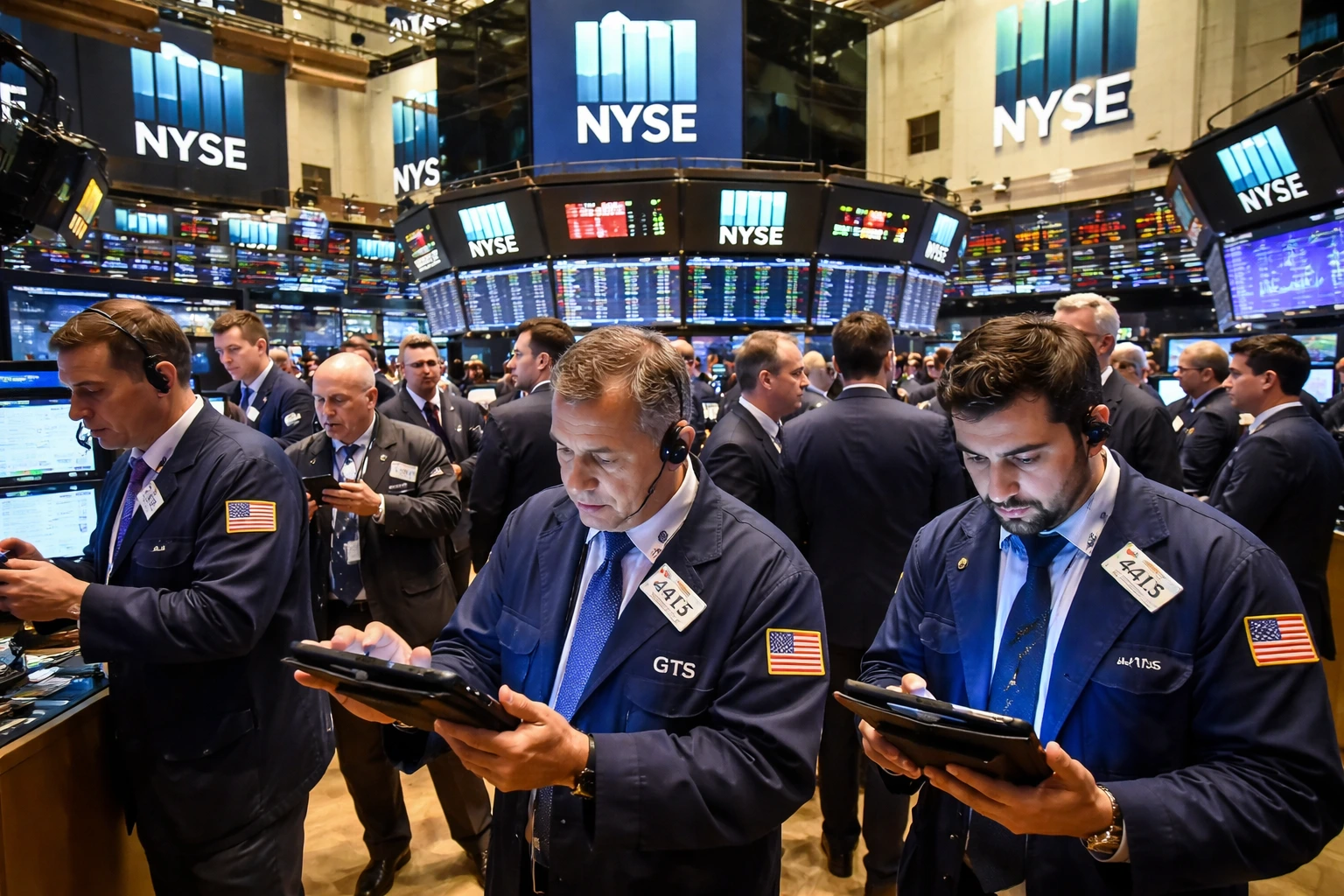
Stock Market Today: Dow Jones (^DJI) Recovers 158 Points, S&P 500 (^GSPC) Near Flat, Nasdaq (^IXIC) Drops 0.30% as Brent Crude (BZ=F) Reclaims $103
S&P 500 (^GSPC) Holds 6,586 While Russell 2000 Outperforms All Major Indices | That's TradingNEWS
Key Points
- 1. Oil Rules, Tech Bleeds — Brent hit $103, WTI reclaimed $91, dragging Nasdaq (^IXIC) down 0.30% as Palantir (PLTR) fell 4%, Salesforce (CRM) dropped 4%, and Microsoft (MSFT) shed 2.47% on Anthropic AI fears. Dow (^DJI) recovered to 46,366, up 158 points, as energy names offset tech losses.
- 2. Private Credit Cracks, One Bank Wins — Apollo (APO) dropped 5% capping withdrawals at 45 cents on the dollar while KKR and Blackstone (BX) both lost over 3% after Moody's junked FSK. Jefferies (JEF) bucked the trend surging 7% on Sumitomo takeover speculation.
- 3. Bitcoin Repeating a Dangerous Pattern — Bitcoin (BTC) trades at $70,000, forming the exact same descending wedge that triggered the crash from $126,000 in October 2025 and the February wipeout to $59,000. Bears are targeting $52,000 with the extreme case at $35,000 while the 50-day EMA caps every rally at $72,000.
Tuesday's session on Wall Street opened with a gut punch and spent the rest of the morning trying to recover from it. The optimism that lit up Monday's tape — driven by President Trump's Truth Social post claiming "very good and productive conversations" with Tehran — evaporated fast once Iranian state media flatly denied any direct negotiations had taken place. What followed was a session defined entirely by crude prices, geopolitical whiplash, and a market that has now fully surrendered its direction to a single variable: whether the Strait of Hormuz reopens or stays shut. The Dow Jones Industrial Average (^DJI) clawed its way back from a 400-point morning deficit to trade up 158 points, or 0.34%, settling at 46,366. The S&P 500 (^GSPC) finished near flat, adding a thin 0.09% to 6,586. The Nasdaq Composite (^IXIC) couldn't hold on, sliding 0.30% to 21,881 as software names and high-multiple tech stocks absorbed sustained selling pressure throughout the session. The Russell 2000 was the day's outperformer, advancing 0.37% to 2,503 — a continuation of a trend that has quietly made small-cap equities the only major U.S. index in positive territory for 2026, up roughly 1% year-to-date while the S&P 500 sits down over 3% and the Nasdaq has fared even worse. The VIX closed at 26.1, still well above the 20-point threshold that historically signals elevated volatility, and there is no near-term catalyst on the horizon capable of pushing it meaningfully lower while Brent crude is trading north of $100 and the Strait of Hormuz remains effectively closed.
Crude Oil's Violent Reversal: Brent Back Above $103, Goldman Targeting $115 in April, Citi's Bull Case Sits at $150
Monday's 11% collapse in oil prices — which briefly dragged Brent crude down to $99 a barrel — lasted exactly one trading session. By Tuesday morning, the fundamental reality of the conflict had reasserted itself with force. Iranian Deputy Speaker Ali Nikzad told the semi-official Fars news agency that the Strait of Hormuz would not be returned to its previous state and there would be no negotiations with Washington under any circumstances. Fresh Iranian strikes against Gulf neighbors compounded the message. Perhaps most alarming for energy traders, reports emerged that Saudi Crown Prince Mohammed bin Salman is now close to a decision to formally join coalition forces in the fight against Tehran — a development that, if confirmed, would represent a dramatic escalation of an already catastrophic regional conflict. Brent crude futures (BZ=F) surged 3.1% back to $103 per barrel. West Texas Intermediate (CL=F) reclaimed $91.25, gaining 3.6% on the session. Gold futures, meanwhile, traded near flat around $4,410 an ounce after an early decline of nearly 2%, with the precious metal now down nearly 12% on the week and in the grip of what would be — if Tuesday's session closes lower — the longest losing streak in recorded history for bullion. Silver held near $70 an ounce.
Since the war began, Brent futures have gained roughly 40% and WTI is up more than 30% — numbers that would have been dismissed as alarmist hypotheticals just weeks ago. BP chief economist Gareth Ramsay, speaking at CERAWeek by S&P Global on Tuesday, was unequivocal: "I don't think you really compare this with any disruption in the past. There's been no disruption of this scale." He identified the Strait of Hormuz closure as the event that every analyst had modeled as a worst-case scenario but never genuinely expected to materialize. The Strait is currently choking off 15 to 16 million barrels per day of global oil supply. Ramsay made clear that the global market cannot respond quickly enough with new production, given timelines of weeks or months to bring new supply online. The country most capable of rapidly increasing output — Saudi Arabia — sits on the wrong side of Hormuz. A 10% rise in oil prices, he noted, might shave 0.1% to 0.2% off global GDP growth. The market is now absorbing a 30% to 40% rise in prices, which, by Ramsay's own calculation, could cut a full 1% off global economic growth — representing a "significant global slowdown" that has yet to be fully priced into risk assets.
Goldman Sachs, in a note published late Monday, reiterated its expectation that oil flows through the Strait of Hormuz will remain disrupted through at least April 10. The bank simultaneously lifted its oil price forecasts, with Brent now targeted at $115 a barrel in April. Goldman acknowledged that signs of diplomatic progress have allowed investors to price out the most severe tail scenarios, but flagged the need to replenish oil stockpiles that nations are currently drawing down at record pace as a structural support for prices. Oxford Economics went further, projecting energy market disruptions to persist for the remainder of 2026, stating flatly that Trump's five-day strike postponement "does not materially change that assumption, though it does shift risks to the downside." Oxford sees the Strait of Hormuz remaining effectively impassable until May, at which point volumes could potentially recover to just half of pre-conflict levels. Citi's analysis is the most aggressive on the street: the bank's strategists called for Brent to rally to "at least" $120 per barrel over the coming month in their base case, while their bull case — which they explicitly reiterated on Tuesday — pegs crude at $150 per barrel if neither military action nor diplomacy resolves the Hormuz disruption and damage to regional energy infrastructure extends into the middle of the year or beyond. The bank stated directly that markets need to get accustomed to oil above $100 as a baseline.
Insurance costs for ships navigating the Persian Gulf have spiraled to levels not seen in decades. Insurers are now quoting 5% to 10% of a ship's total value to cover war risk — many times the typical peacetime rate of 0.25%. J.P. Morgan analysts noted that the conflict is now impacting 2% to 3% of global sea freight volumes and approximately 15% of global air freight capacity. Air cargo capacity tightening has been the sharper disruption, with Persian Gulf airports and the Strait of Hormuz both experiencing operational paralysis now entering week four.
The $760 Million Mystery: Suspicious Oil Trading Before Trump's Post Draws Regulatory Scrutiny
Before the market even opened Monday, something unusual happened that traders are still talking about Tuesday. According to Dow Jones Market Data, a concentrated burst of activity in oil and stock-index futures materialized in a two-minute window between 6:49 AM and 6:51 AM ET on Monday — roughly 15 minutes before Trump's Truth Social post triggered a massive collapse in oil prices and a simultaneous surge in equities. During that two-minute period, approximately 7,200 contracts in Brent and West Texas Intermediate oil futures changed hands, representing a notional value of more than $760 million. There was no news, no economic data release, no public announcement of any kind that preceded or explained the surge in activity. About 15 minutes later, Trump's post dropped, and the market moved dramatically in precisely the direction that the pre-announcement positioning favored. Regulators and traders are now scrutinizing whether the timing was coincidental or whether someone had advance knowledge of the presidential announcement before it was made public. The episode has added another layer of unease to a market already stretched thin by geopolitical stress.
PMI Data Confirms Economic Deceleration: Stagflation Risks Are No Longer Theoretical
The economic data released Tuesday morning did nothing to calm nerves. S&P Global's preliminary U.S. composite PMI — which combines manufacturing and services activity — fell to 51.4 in March from 51.9 in February. That is its weakest reading since April 2025, when Liberation Day tariffs were rattling U.S. business confidence. The number sits technically above 50, the dividing line between growth and contraction, but the directional trend is what matters, and the direction is down. Europe and Asia printed even weaker PMI data on Tuesday, with surveys of global businesses showing growth slowing across both regions simultaneously. The common thread is energy-price inflation feeding into input costs, compressing margins, and dampening business investment. Analysts have started using the word "stagflation" with growing frequency — an environment of slowing growth and rising prices that historically forces the Federal Reserve into an impossible position. Fed Chair Jerome Powell, speaking last week, acknowledged the dilemma directly: "It'll come down to how long the current situation lasts, and then what are the effects on prices, and then how do consumers react. The economic effects could be bigger. They could be smaller. They could be much smaller or much bigger. We just don't know." The Fed's conventional framework calls for looking through energy shocks, but that framework was designed for an era of well-anchored inflation expectations — which is not the world the Fed currently inhabits, with inflation above the 2% target for five consecutive years. The 10-year Treasury yield climbed to 4.37% from 4.35% at Monday's close, hovering near its highest level since July 2025. The U.S. Dollar Index rose 0.4% to 99.35, reflecting the dual pull of safe-haven demand and oil-driven inflationary pressure.
America's gross federal debt recently crossed $39 trillion, and some analysts warn that the cost of this war — in terms of oil subsidies, defense spending, and interest rate pressure — could blow through official projections at a pace the bond market may ultimately struggle to absorb. The next round number in federal debt could arrive faster than any previous milestone, and the bond market's perceived invincibility may be tested once the geopolitical fog eventually clears.
Russell 2000 Outperforms: Why Small Caps Are Winning a War Nobody Expected Them to Win
The Russell 2000's 0.37% gain Tuesday may look modest in isolation, but zoom out and the picture becomes striking. The small-cap index is up roughly 1% year-to-date while the S&P 500 is down over 3%. On Monday, when all 11 GICS sectors finished higher — led by consumer discretionary at 2.46%, followed by materials at 1.49% and information technology at 1.46% — the Russell 2000 added more than 2%, outpacing the S&P 500's 1.2% gain by a wide margin. Bank of America analysts, in a note earlier this month, told clients that small-cap stocks are "better positioned for elevated volatility" than large-caps, and that value stocks are likely to outperform growth stocks in a sustained risk-off environment. The logic is straightforward: small-cap companies tend to have less international revenue exposure, making them less vulnerable to the kind of global supply chain and currency disruptions that a Middle East war generates. They also carry lower valuation multiples, which means they have less air to let out when discount rates rise. The relative outperformance is not a fluke — it reflects a genuine shift in the risk-reward calculus for portfolio managers who are underweight domestic-oriented value names and overweight the Magnificent Seven.
The Magnificent Seven as a group has declined 10% year-to-date, snapping three straight sessions of losses on Monday before mixed performance resumed Tuesday. The divergence between mega-cap tech and everything else is now one of the defining structural features of the 2026 market, and there is no obvious catalyst to close that gap until either oil prices normalize or the AI monetization narrative finds firmer footing in actual earnings.
TSLA: One Month of Green in Europe Doesn't Fix the Bigger Story
Tesla (TSLA) edged up roughly 1% Tuesday after leading Monday's Magnificent Seven bounce with a 3.5% gain. The driver was European registration data from the European Automobile Manufacturers' Association showing 17,664 new Tesla vehicle registrations across the EU, UK, Iceland, Liechtenstein, Norway, and Switzerland in February — an 11.8% year-over-year increase. That ended a losing streak stretching back to December 2024, with January having printed a 17% year-over-year decline. The headline number reads positively until you put it in context: the year-over-year comparison was against a February 2025 when European Tesla sales collapsed 27%, making the base comparison unusually favorable. Meanwhile, BYD registered nearly 18,000 vehicles across the same geography in February — still outselling Tesla in a region Tesla once dominated — and did so with year-over-year growth of more than 160%. Total EV registrations in greater Europe rose 15.8% in February, with overall auto registrations up just 1.7%, confirming that EV demand is growing robustly. Tesla's problem isn't the category — it's that the category is growing around it while its own share erodes. The Elon Musk political overhang in European markets has not gone away, and Chinese automakers BYD and Li Auto are flooding the continent with competitively priced vehicles that European consumers are actively choosing over Tesla's lineup.
Hold — the European registration number is a single month of data against a historically weak comparable period. It is a data point, not a trend reversal. Sustained share recovery over multiple quarters would be required to justify adding to positions at current levels. The macro environment — oil above $90, consumer confidence under pressure — is not favorable for high-ticket discretionary purchases regardless of brand.
JEF: Takeover Speculation Creates One of the Cleaner Risk/Reward Setups in the Market
Jefferies Financial Group (JEF) was the most actionable individual stock story Tuesday. Shares surged between 4% and 7% throughout the session following a Financial Times report that Japan's second-largest lender, Sumitomo Mitsui Financial Group (SMFG), is actively developing plans for a potential takeover of the U.S. investment bank. SMFG's banking subsidiary, Sumitomo Mitsui Banking Corporation, already holds a minority stake in Jefferies, providing the acquirer with a meaningful baseline of familiarity with the target's operations, culture, and balance sheet. Per the FT, SMFG has assembled a small internal team tasked specifically with ensuring the bank is positioned to move quickly if Jefferies' continued share price decline presents a compelling acquisition opportunity. Entering Tuesday, Jefferies had lost 36% of its value since January 1 — a drawdown driven almost entirely by macro and sector headwinds rather than any fundamental deterioration specific to the firm. The company is scheduled to report first-quarter earnings after the Wednesday close, which means management will almost certainly be pressed for comment on the takeover speculation during any associated call or media appearances.
Buy — the setup here is asymmetric in the most favorable sense. A 36% year-to-date drawdown for an investment bank with a strategic acquirer actively sizing up the opportunity represents a structurally attractive entry. Either the deal advances at a meaningful premium to current price levels, in which case shareholders benefit directly, or Wednesday's earnings report provides an independent fundamental floor for the stock. Risk-adjusted, this is one of the cleaner long setups in the current market environment.
Read More
-
Yen Stalls at 160 Despite a 3% JGB and Tokyo Core CPI at 2.0% — Intervention Sits at 164, Friday's Payrolls Decide
02.09.2026 · TradingNEWS ArchiveEnergy
-
QQQ ETF ($739) Fades From an Early Tech Rally as a 77.9 ISM Prices Index Meets Micron's $61.5B Guide — $760 Record Test Ahead
01.10.2026 · TradingNEWS ArchiveStocks
-
XRPR and XRPI Follow XRP's $1.49 Test as Spot Funds Hold 1.16B XRP and a 1 Billion Token Escrow Release Lands — $1.70 in Play
01.10.2026 · TradingNEWS ArchiveCrypto
-
November NG Slips Below $3 as Decade-High Storage Meets Capped LNG Exports — $2.75 in Sight
01.10.2026 · TradingNEWS ArchiveCommodities
-
Dollar-Yen at 158 Presses Toward 160 as a 363 bp Carry Gap Meets Katayama-Bessent Intervention Risk — 159 in Sight
01.10.2026 · TradingNEWS ArchiveForex
APO, BX, KKR, ARES: The Private Credit Redemption Crisis Just Became Impossible to Dismiss
The most structurally significant story in Tuesday's market had nothing to do with oil, Iran, or central banks. It concerns private credit — a $21 trillion industry that has expanded aggressively over the past five years while operating largely out of public view. The cracks that have been forming for months are now visible to everyone. Apollo Global Management (APO) disclosed that its $15 billion private credit fund received redemption requests totaling 11.2% of shares outstanding in the first quarter — more than twice the fund's stated 5% quarterly cap. Apollo will distribute roughly 45 cents on the dollar to investors who submitted withdrawal requests, enforcing the cap strictly and describing the decision as a mechanism to preserve value for remaining investors. Shares of APO dropped roughly 5% on the news and are now down nearly 24% year-to-date.
Ares Management filed separately with the SEC to disclose that its $21.5 billion "semiliquid" business development company received redemption requests for 11.6% of shares for the quarter ending March 20. The fund will limit payouts to 5%. Ares noted that the majority of repurchase requests came from a small number of family offices and smaller institutions representing less than 1% of total BDC shareholders — which actually makes the redemption pressure more alarming, not less, because it suggests concentrated institutional actors are losing confidence rather than retail investors acting on noise. Blackstone and KKR also saw their shares slide more than 3% in sympathy. Blue Owl Capital, which has been at the center of private credit industry concerns for months, slipped 1% and is now down approximately 40% year-to-date — a number that underscores just how far sentiment in the space has deteriorated. Adding to the pressure, Moody's on Monday downgraded FS KKR Capital Corp (FSK) — a private credit fund run by KKR and Future Standard — by one notch to Ba1 from Baa3, pushing it into junk territory. Moody's cited worsening asset quality, with non-accrual loans — borrowers who have stopped making payments — rising to 5.5% of total investments at year-end 2025, described as one of the highest rates among rated BDCs. FSK shares dropped 4% on the news and have plunged more than 30% in 2026.
Sell APO, Sell FSK — the redemption dynamics here are not a one-quarter anomaly. When multiple funds across multiple managers simultaneously hit their withdrawal caps, it reflects a structural shift in institutional confidence, not idiosyncratic noise. The private credit industry expanded during a zero-interest-rate environment that rewarded illiquidity premiums. That environment is gone. Energy-driven inflation, slowing growth, rising non-accruals, and now a wave of redemption requests that funds can only partially honor create a feedback loop that is difficult to break. The sector deserves to trade at a discount until redemption trends stabilize across multiple consecutive quarters.
SFD: Smithfield Foods Delivers a Record Year and Raises Its Dividend — the Quiet Outperformer of 2026
While financial markets were consumed by geopolitical drama, Smithfield Foods (SFD) quietly posted one of the strongest earnings reports of the quarter. Shares jumped nearly 5% on Tuesday after the pork giant — which spun off from Chinese majority owner WH Group in January 2025 — reported fourth-quarter adjusted earnings per share of $0.83 against analyst consensus expectations of $0.68, a beat of approximately 22%. Consolidated quarterly sales reached $4.23 billion, up 7% year-over-year, against consensus estimates of $4.11 billion. CEO Shane Smith acknowledged "significant market headwinds" in fiscal 2025 but delivered record full-year results nonetheless. Overall operating profit of $1.29 billion represented a second consecutive annual record. The Packaged Meats segment — the company's crown jewel — posted its fourth straight year with operating profit above $1 billion, coming in at $1.08 billion. For fiscal 2026, Smithfield guided Packaged Meats segment adjusted operating profit of between $1.10 billion and $1.20 billion, representing continued growth from the record 2025 base. The company also raised its quarterly dividend by 25%, to 31.25 cents from 25 cents, a signal of management's confidence in sustained free cash flow generation. Smithfield shares have now gained 23% since their IPO price of $20 last year, including more than 10% in 2026 alone — making SFD one of the standout performers in an equity market that has otherwise struggled.
Buy — Smithfield is a defensive cash-flow machine in an environment where investors are desperately searching for earnings visibility. The dividend raise signals balance sheet strength. The Packaged Meats segment provides a durable revenue base with pricing power. In a market dominated by oil volatility and geopolitical uncertainty, SFD's business model is largely insulated from the primary risk factors currently punishing growth stocks.
EL and Puig: A Merger Conversation That Raises More Questions Than It Answers
Estée Lauder (EL) confirmed Tuesday that it is in active discussions with Barcelona-based fragrance and beauty group Puig regarding a potential combination. The discussions were first reported by the Wall Street Journal, and both companies subsequently issued statements acknowledging the talks while noting that no final decision has been made and no agreement has been reached. The structure being discussed involves a mix of cash and stock. Puig, which went public in 2024, carries a market value of approximately $10 billion and operates brands including Charlotte Tilbury and Carolina Herrera. Puig's Frankfurt-listed shares rose 8% on the news. Estée Lauder, however, fell sharply — down nearly 8.5% on the session to $72.57 — as investors questioned the strategic rationale and timing of a major acquisition at a moment when the company is already navigating significant operational challenges. EL shares have been under sustained pressure, and the market's reaction to merger confirmation suggests skepticism rather than enthusiasm about the deal's terms and value creation potential.
Sell EL — the market is telling you something when an acquirer drops 8.5% on confirmation of deal talks. Estée Lauder does not need to be paying a premium for a $10 billion fragrance company right now. The stock is already down sharply on a year-to-date basis, the luxury beauty market is facing headwinds from consumer spending pressure, and the timing of a complex cross-border transaction in the middle of a geopolitical and inflationary crisis is difficult to justify. Until the deal terms are made public and a clearer strategic thesis is articulated, the risk-reward favors the exit.
FROG, ECL, GILD: Upgrades and Acquisitions Providing Selective Long Opportunities
Software company JFrog (FROG) received a notable upgrade from UBS Tuesday, moving from neutral to buy with a reiterated price target of $60 — implying 37% upside from Monday's close. The stock has fallen 31% since January on fears that artificial intelligence tools will disrupt software development workflows and commoditize some of JFrog's core functionality. UBS analyst Radi Sultan called the current risk-reward ratio "attractive" and identified multiple near-term AI tailwinds that could actually benefit JFrog's platform rather than threaten it. The analyst argued that upward estimate revisions would be the key catalyst to shift the market narrative. Buy FROG — the AI disruption fear has been priced in aggressively, the stock has lost nearly a third of its value on a forward-looking thesis that is still largely speculative, and the UBS upgrade provides institutional cover for a contrarian position.
Ecolab (ECL) received an upgrade from JPMorgan to overweight with a price target of $295, implying nearly 13% upside. JPMorgan analyst Jeffrey Zekauskas argued that the stock has been unfairly punished by fears of margin compression from rising raw material costs tied to the Iran war, and that Ecolab will likely neutralize those pressures by implementing surcharges in April. The analyst also highlighted Ecolab's recent acquisition of CoolIT, which sells direct-to-chip cooling technology for data centers — a product category with significant long-term growth potential given escalating AI infrastructure spending. Ecolab shares edged 1% higher in premarket trading. Buy ECL — the surcharge mechanism provides a near-term earnings protection floor, and the CoolIT acquisition gives the company an increasingly relevant data center growth vector at a time when AI infrastructure spending is one of the few secular trends with genuine visibility.
Gilead Sciences (GILD) edged higher after announcing an agreement to acquire privately held biotech Ouro Medicines. Specific deal terms were not immediately disclosed, but the transaction signals continued Gilead management intent to deploy capital into pipeline expansion via M&A — a strategy that has historically been both the company's greatest strength and greatest risk. Hold GILD — the acquisition is incrementally positive but lacks sufficient detail to move the conviction needle in either direction.
IGV, PLTR, CRM: Anthropic's New AI Capability Hits Software Stocks Hard
The iShares Expanded Tech-Software Sector ETF (IGV) declined 3.5% on Tuesday, led by a 5% drop in Palantir (PLTR) and a 4% slide in Salesforce (CRM). The trigger was Anthropic's announcement of expanded capabilities for Claude Cowork and Claude Code, allowing the AI system to control computers and execute increasingly complex agentic tasks with minimal human oversight. The announcement reignited fears that AI agents will systematically erode the user bases and pricing power of traditional SaaS platforms. Oracle (ORCL), Palo Alto Networks (PANW), Snowflake (SNOW), Shopify (SHOP), Intuit (INTU), and ServiceNow (NOW) were all under pressure. The HALO trade — heavy assets, low obsolescence — continues to capture relative outperformance in the AI infrastructure space. Memory and storage companies including Sandisk (SNDK), Western Digital (WDC), and Seagate Technology (STX) remain among the S&P 500's top performers year-to-date, even with recent declines, as AI data center spending creates what analysts at Tortoise Capital describe as "insatiable demand" for memory and storage components. These stocks now carry meaningful pricing power, which is forcing a reconsideration of the old cyclical framework that historically governed the memory industry.
Sell PLTR, Sell CRM — the AI disruption trade is not a sentiment story anymore. It is a revenue model story. SaaS companies are increasingly being asked to prove why their platform remains indispensable in a world where AI agents can replicate an expanding share of their core functionality. Until that proof materializes in the form of accelerating growth metrics, the sector deserves to trade at a discount. Buy SNDK, Buy WDC — AI infrastructure is the one area of the technology complex with verifiable, contracted demand. The memory trade remains structurally sound even after this year's volatility.
FDX: Same-Day Delivery Entry Creates a New Competitive Front
FedEx (FDX) announced Tuesday a new same-day delivery service through a partnership with last-mile delivery provider OneRail. The service will offer retail customers two-hour and same-day delivery windows, leveraging OneRail's driver network of more than 1,000 operators with coverage across approximately 98.5% of the U.S. population. FedEx shares have added close to 25% in value year-to-date, making the stock one of the stronger performers in the industrials sector. The same-day launch puts FedEx directly in competition with Amazon (AMZN) and Walmart (WMT) on last-mile speed, an area where both retailers have invested heavily over the past three years. Hold FDX — the partnership is strategically logical and extends FedEx's addressable market, but execution risk on last-mile delivery at scale is real, and the stock's 25% year-to-date gain already prices in considerable operational improvement.
NYSE Tokenization, Amazon AWS Disruption, and the Data Center Overhang
The New York Stock Exchange announced Tuesday a partnership with Securitize to develop a tokenized securities platform, under which stocks and ETFs would trade as digital tokens on a blockchain with 24/7 availability and instant settlement. Investors would also be able to fund trades using stablecoins pegged to the U.S. dollar. The announcement represents the most significant step yet by a major traditional exchange toward integrating blockchain infrastructure into core equity market operations, and it comes at a moment when Bitcoin (BTC) is trading around $70,000 — down 0.7% on the session — after touching a session high near $71,400 earlier in the day. Ethereum also moved higher. The tokenization initiative is a long-term structural development rather than a near-term catalyst, but its significance for the competitive landscape of financial infrastructure should not be underestimated.
On the data center front, Amazon Web Services disclosed Tuesday that its Bahrain region has been "disrupted" due to drone activity related to the Iran war — the second such incident this month, following earlier Iranian attacks on AWS facilities in the UAE. The disruption is already forcing major technology companies to reassess regional expansion plans. As Constellation Energy CEO Joe Dominguez put it at CERAWeek: "One month ago, we would have said there's going to be a fairly significant data center build-out in the Middle East. Today, we wake up, and there's a question mark as to whether more critical infrastructure is going to be built in that region of the world." That uncertainty is directionally positive for domestic data center investment and power infrastructure companies, but it adds another layer of cost and complexity for hyperscalers like Amazon (AMZN), Microsoft (MSFT), and Alphabet (GOOGL) that were counting on Middle Eastern capacity to meet near-term AI compute demand.
The Contrarian Trade: When Crowded Positioning Becomes Its Own Risk
Goldman Sachs data shows that active portfolio managers have "sharply decreased" their allocation to U.S. equities over the past several weeks, while asset managers have simultaneously raised their hedging positions through VIX options. That's the textbook setup for a crowded trade unwind, and Monday's price action offered a preview of what that can look like: oil fell, U.S. large-cap stocks rose, and the dollar gave back gains — the exact opposite of what worked over the prior several weeks. The lesson from Monday is that consensus positioning in this market has become its own source of risk. Consumers are already absorbing approximately 33% higher gasoline costs compared to pre-war levels, with food prices also under upward pressure. The State Street SPDR S&P 500 ETF Trust (SPY) and Vanguard Total Stock Market Index Fund ETF (VTI) have both been under sustained pressure, hitting retirement savers and 401(k) balances heading into a period of heightened economic uncertainty. Four consecutive weeks of equity market losses preceded Monday's relief rally, and the structural underpinnings of that relief remain fragile at best. The rental market is providing some marginal inflation relief — analysts at Yardi Matrix see rent prices remaining sluggish through spring 2026 — but that single deflationary input is insufficient to offset the inflationary impulse coming from energy prices at $91 for WTI and $103 for Brent. The market DoubleLine's Gundlach described as "going nowhere" is not a resting market — it is a market caught between forces powerful enough to prevent either a sustained rally or a clean breakdown, and that kind of trendless, volatile environment is historically the most punishing for leveraged positions and high-multiple growth assets.