Stock Market Today: Dow Jones, S&P 500, and Nasdaq Bounce — But GDP Collapses to 0.7% and Adobe Crashes 8% on CEO Shock
Q4 growth revised down from 1.4% to 0.7%, core PCE rises to 3.1%, Adobe CEO Shantanu Narayen steps down after 18 years sending $ADBE to its lowest level of 2026, while CF Industries surges to all-time highs | That's TradingNEWS
Markets Brace for a Third Straight Weekly Loss as Iran War Reshapes Every Trade on the Board
The Dow, S&P 500, and Nasdaq Are Bouncing — But the Weekly Damage Is Already Done
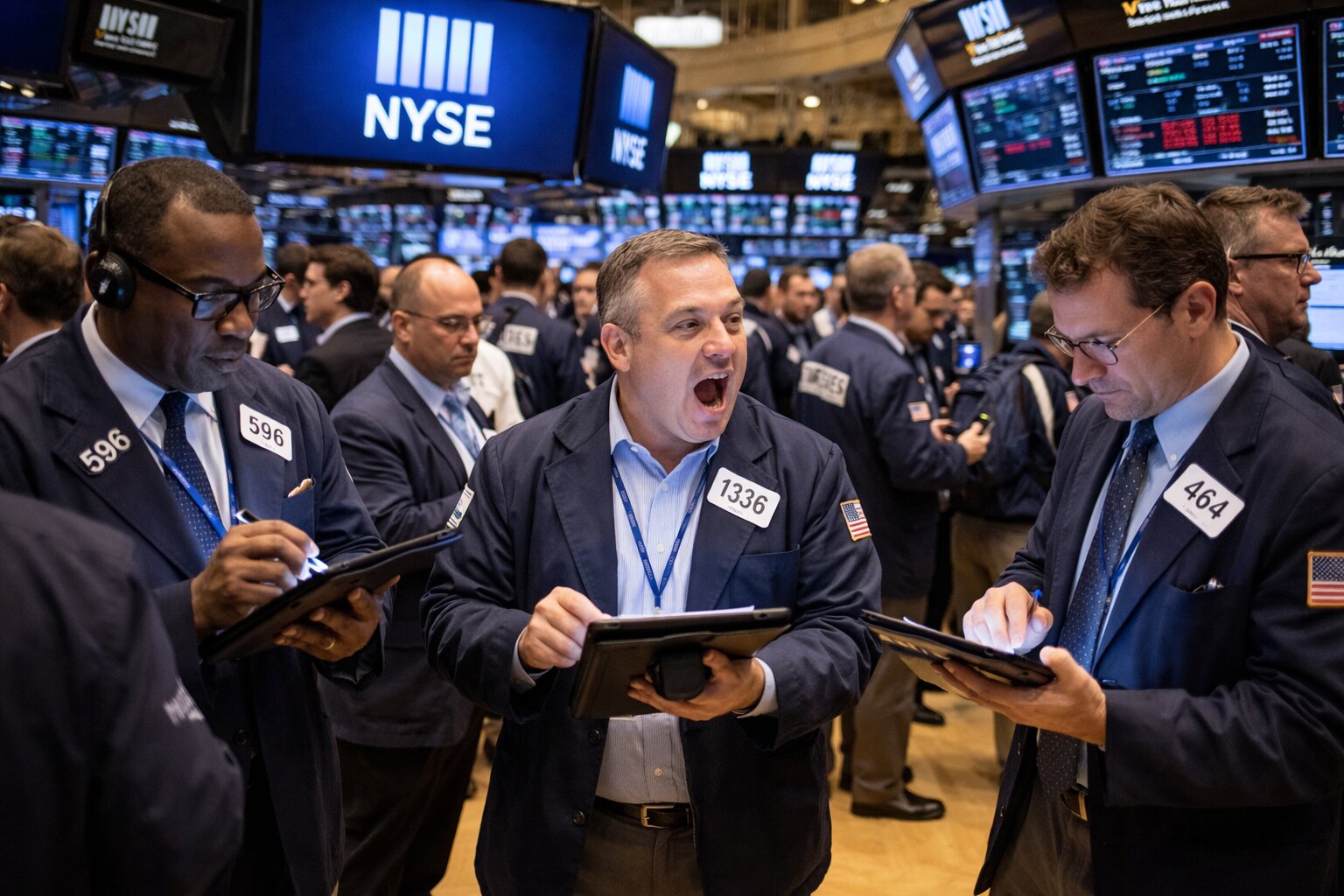
Friday's session opened with a relief rally that frankly the market needed, but relief is not the same as recovery. The Dow Jones Industrial Average (DJIA) added 331 points, or 0.7%, clawing back a fraction of Thursday's 739-point wipeout. The S&P 500 gained 0.8%, and the Nasdaq Composite climbed 0.8% as well. Those intraday gains feel constructive until you zoom out to the weekly scorecard: the S&P 500 is tracking a 0.3% weekly loss, which puts it on pace for its first three-consecutive-week losing streak in roughly a year. The Dow is staring at a 1.1% weekly slide, and the Nasdaq, the relative outperformer this week at +0.4%, is navigating a macro backdrop that would have seemed unthinkable three months ago. Every single one of these indexes finished lower the prior two weeks as well, and Thursday alone saw all three sink at least 1.5% each. The session before that was a 700-point Dow demolition that closed the index at a fresh 2026 low below 47,000. The Russell 2000 was up 1.17% Friday, adding 29.74 points to 2,518.15, making small-caps the relative bright spot in an otherwise battered landscape. The VIX, the market's real-time fear reading, stood at 24.89 — down 8.79% Friday but still in territory that signals active institutional hedging and risk reduction. A VIX above 20 is not a market looking to build new long exposure; it is a market managing downside. That is the environment right now.
Oil Pulls Back From $100, But the Math on the Strait Still Doesn't Work
West Texas Intermediate crude futures (WTI) dropped nearly 2% Friday to approximately $94 per barrel — a number that reads like relief until you recall that oil sat near $67 a barrel before the U.S. and Israel launched coordinated strikes on Iran on February 28. That is a 40% surge in crude in under two weeks. Brent crude, the global benchmark, retreated roughly 1% to around $99.50 a barrel after closing above $100 for the first time since August 2022 on Thursday. The Strait of Hormuz — a 21-mile-wide passageway that in normal times handles 20 million barrels per day — is now processing fewer than 1 million barrels per day, mostly on Chinese- and Russian-controlled tankers. To put that in plain terms, roughly 95% of normal Hormuz throughput has been wiped out. Treasury Secretary Scott Bessent authorized countries to temporarily purchase sanctioned Russian oil already at sea through April 11, and approximately 124 million barrels of Russian crude are currently floating globally. That sounds large until you divide it by 20 million barrels per day: it buys roughly six days of supply buffer against an indefinite closure. The International Energy Agency simultaneously authorized a record 400 million barrels of strategic reserve releases — the largest in the history of the global oil market by their own characterization — but energy analysts are uniform in their view that existing spare capacity is insufficient to bridge a prolonged Strait shutdown. Defense Secretary Pete Hegseth told a Pentagon press briefing Friday that the U.S. has "been dealing with it, and don't need to worry about it," a statement that was more reassuring in tone than in operational specificity. Russia's UK ambassador, Andrey Kelin, separately told CNBC that the U.S.-Israel campaign is a "misadventure" with no clear exit strategy — language that does not suggest a near-term resolution. Iran's new Supreme Leader Mojtaba Khamenei, in his first media statement, vowed to continue blocking the Strait as a "tool to pressure the enemy." That is the geopolitical container in which every trade is being made right now, and it is not one that resolves cleanly over a weekend.
GDP Revised to 0.7%: The Growth Cliff That Stagflation Fears Are Built On
Buried beneath the oil drama Friday morning was one of the more alarming single data points in recent quarters. Fourth-quarter 2025 GDP growth was revised sharply lower to a seasonally adjusted annual rate of just 0.7% — cut almost exactly in half from the prior estimate of 1.4% and well below the Dow Jones consensus forecast of 1.5%. For broader context, the third quarter of 2025 posted 4.4% GDP growth. That is not a deceleration; that is a hard stop. The BEA's Bureau of Economic Analysis confirmed the revision, and the market's initial reaction was measured — equity futures actually ticked higher afterward as traders repriced rate cut odds — but the medium-term read on this number is deeply uncomfortable. An economy growing at 0.7% annually while core inflation is running at 3.1% sits in the uncomfortable neighborhood of stagflation, a combination that offers the Federal Reserve no clean policy path. Cutting rates into 0.7% growth would be normal central bank behavior; cutting rates while core PCE is above 3% and energy prices are surging toward fresh highs is not. The 10-year Treasury yield settled at approximately 4.24%, retreating slightly from Thursday's close of around 4.27% — its highest settlement since February 4 — as the GDP revision pulled some growth expectations out of the long end of the curve. That modest yield compression offered a thin cushion to rate-sensitive equities Friday, but it does not resolve the structural contradiction between slowing growth and persistent inflation.
PCE Inflation Stayed Hot in January — And That Was Before the Oil Spike
The Bureau of Economic Analysis released the delayed January Personal Consumption Expenditures index Friday, the Federal Reserve's preferred inflation gauge, and the numbers confirmed what most traders already suspected: inflation was sticky before the war, and it is about to get worse. Headline PCE rose 2.8% year-over-year in January, a marginal slowdown from December's 2.9% reading and just below the Dow Jones economist poll consensus of 2.9%. Month-over-month, prices increased 0.3%, down from 0.4% in December, matching estimates. Core PCE — which strips out volatile food and energy prices — rose 3.1% year-over-year, up from 3.0% in December and matching forecaster expectations. That 3.1% core reading is a fresh high since early 2024. The critical analytical point that cannot be overstated: this entire dataset is January data, predating the Iran war and the subsequent 40% surge in crude prices. February and March PCE prints will carry the full weight of oil near or above $100 a barrel, gas prices north of $5 per gallon in parts of California, and supply-chain repricing across industries exposed to Hormuz-dependent commodities. Whatever discomfort core PCE at 3.1% creates for the Fed's rate path today, the next two monthly reads will almost certainly push that number higher.
Read More
-
Yen Stalls at 160 Despite a 3% JGB and Tokyo Core CPI at 2.0% — Intervention Sits at 164, Friday's Payrolls Decide
02.09.2026 · TradingNEWS ArchiveEnergy
-
QQQ ETF ($739) Fades From an Early Tech Rally as a 77.9 ISM Prices Index Meets Micron's $61.5B Guide — $760 Record Test Ahead
01.10.2026 · TradingNEWS ArchiveStocks
-
XRPR and XRPI Follow XRP's $1.49 Test as Spot Funds Hold 1.16B XRP and a 1 Billion Token Escrow Release Lands — $1.70 in Play
01.10.2026 · TradingNEWS ArchiveCrypto
-
November NG Slips Below $3 as Decade-High Storage Meets Capped LNG Exports — $2.75 in Sight
01.10.2026 · TradingNEWS ArchiveCommodities
-
Dollar-Yen at 158 Presses Toward 160 as a 363 bp Carry Gap Meets Katayama-Bessent Intervention Risk — 159 in Sight
01.10.2026 · TradingNEWS ArchiveForex
The Federal Reserve Is Caught in a Box, and Rate Cut Odds Are Getting Repriced in Real Time
The Federal Open Market Committee meets next week and is unanimously expected to hold rates steady. That is not where the interesting rate-cut debate is happening. The real question is how many cuts — if any — materialize in 2026, and the market's answer has changed dramatically in the last two weeks. According to the CME FedWatch Tool Friday morning, the most likely outcome through December is a single quarter-point cut, sitting at 40.8% probability — up from 38.3% on Thursday, a jump driven specifically by the GDP downward revision. Odds of a half-point in total 2026 cuts rose to 19.4% from 12.4%. Bets on three-quarters of a point in cuts more than doubled to 5.3% from 2.2%. But the bigger picture on the rate timeline is sobering: fed funds futures markets had taken even a September cut off the table entirely before Friday's data, and no additional easing beyond December is being priced in until well into 2027 or even early 2028. That timeline shift has crushed hopes for a return to accommodative monetary policy in the near term. President Trump, responding to Friday's data on Truth Social, demanded that Fed Chair Jerome Powell cut rates "IMMEDIATELY, not waiting for the next meeting" — even with Brent crude sitting near $100. Powell leaves the Fed chair position in May, succeeded by presumptive nominee Kevin Warsh, who was selected in part for his perceived willingness to ease aggressively. But no Chair can cut rates credibly into accelerating inflation, and the energy-driven PCE trajectory makes a dovish pivot in 2026 a low-probability event regardless of who sits in the chair.
Adobe (ADBE): A Record Revenue Quarter Completely Overshadowed by a CEO Exit
Adobe (ADBE) delivered what should have been a solid fiscal first quarter: adjusted EPS of $6.06 on revenue of $6.40 billion, a 12% year-over-year revenue jump that set a company record and cleared analyst estimates compiled by Visible Alpha on both the top and bottom lines. Under normal circumstances, that combination — record revenue, earnings beat — holds a stock or lifts it. Instead ADBE cratered approximately 6.5% to 8% in extended trading and premarket, sitting around $254.51 as of Friday morning. The stock has now lost 23% in 2026 and 29% over the past 12 months. The driver of that collapse: CEO Shantanu Narayen, who has led Adobe since 2007 — 18 years — announced he will step down as soon as a successor is identified. He will remain as board chair, but his operational tenure is ending. Barclays analyst Saket Kalia immediately downgraded ADBE from overweight to equal weight, cutting his price target to $275 — implying just 2% upside from current levels. His reasoning is analytically tight: with an annual recurring revenue base exceeding $25 billion, any incoming CEO will require substantial time to understand the portfolio, assess competitive positioning, and implement strategy. Leadership transitions at software companies of this scale are measured in years, not quarters. The deeper structural problem is that Adobe's own AI innovation is beginning to erode its traditional revenue streams. Adobe Firefly — the company's generative AI image tool — is pulling customers away from Adobe Stock, because text-to-image generation is replacing the need to license stock photos. Net new annual recurring revenue came in below Kalia's estimate for the quarter. Meanwhile, faster growth in freemium users across Firefly and Adobe Express is compressing average revenue per user metrics. Adobe built one of the most durable software franchises in history with Acrobat Reader's freemium model — but Firefly and Express scaling at the expense of paid conversions is a pattern worth monitoring with deep scrutiny. ADBE is a hold at best with a credible bear case toward $220 if the CEO search extends and AI margin compression accelerates.
Ulta Beauty (ULTA): Revenue Beat Means Nothing When Guidance Disappoints
Ulta Beauty (ULTA) dropped 7% to 8% Thursday evening and extended those losses into Friday's premarket after reporting fourth-quarter results that split the market in the wrong direction. The top-line beat was real: revenue of $3.90 billion cleared the $3.80 billion LSEG consensus. But earnings per share of $8.01 missed the $8.03 estimate — a two-cent shortfall that, in isolation, is immaterial. What broke the stock was the forward guidance: full-year 2026 profit and comparable sales forecasts came in soft, and in a consumer environment where energy costs are rising sharply and household budgets are beginning to absorb $5-per-gallon gas, a beauty retailer telling the market to expect slower growth is not a story that attracts buyers. The consumer discretionary sector is one of the most direct transmission mechanisms for oil price increases to corporate earnings — fuel costs, shipping, consumer wallet stress — and ULTA sits squarely in that crosshair. ULTA is a sell near-term until the 2026 guidance framework gets revised or until energy prices show sustained normalization.
Fertilizer Stocks: CF Industries (CF), Mosaic (MOS), Nutrien (NTR) Are the Trade of the War
While virtually every other sector is absorbing the damage from Hormuz disruption, nitrogen and potash fertilizer producers are posting numbers that would be exceptional in any environment. CF Industries (CF) has surged 76% year-to-date to an all-time high, adding another 2.5% in Friday premarket. Mosaic (MOS) is up 30% year-to-date, and Nutrien (NTR) has gained 36%. Both MOS and NTR added over 2% in premarket Friday, while Intrepid Potash (IPI) also climbed 2%. CF Industries (CF) added less than 1%. The thesis here is straightforward and durable as long as the Hormuz closure persists: Middle Eastern fertilizer production — particularly out of Qatar and Saudi Arabia — is blocked from reaching global agricultural markets. North American producers with access to comparatively cheap domestic natural gas have a rare and potentially sustained window to capture global market share at structurally elevated price points. This is not a speculative trade — it is a direct supply-displacement play backed by measurable Hormuz throughput data and global food security demand that does not wait for geopolitical resolution. CF is a buy with a clearly defined exit thesis tied to Strait reopening timelines. Mosaic and Nutrien are holds with bullish bias.
Bitcoin Pushes Through $73,000, Lifting Coinbase (COIN) and Strategy (MSTR)
Bitcoin (BTC) climbed above $73,000 Friday for the first time in over a week, recovering from overnight lows near $70,000 and trading around $73,492 with a gain exceeding 4%. A Trump post on social media has been cited as a partial catalyst for the overnight momentum push through the $70,000 level. Whatever the trigger, crypto is trading with its own momentum independent of the broader equity de-risking cycle — an unusual decoupling worth noting in a week where the U.S. Dollar Index rose to 100.03, up 0.3%, typically a headwind for risk assets and hard assets alike. Strategy (formerly MicroStrategy) shares jumped 5% early Friday, its Bitcoin treasury model amplifying BTC's gains with characteristic leverage. Coinbase Global (COIN) was up nearly 3%, benefiting from the increase in on-chain activity and trading volume that tends to accompany sharp directional Bitcoin moves. Dubai's Token2049 — billed as the world's largest crypto conference and scheduled for late April — has been canceled due to the Iran war, a blow to the region's positioning as a digital asset hub. But that cancellation does not appear to be weighing on BTC price action in any measurable way. Coinbase is a speculative buy on momentum. Strategy remains a leveraged BTC proxy — high reward, high volatility, appropriate only for defined-risk positioning.
Nvidia (NVDA) Gets a Lift From ByteDance's Malaysia Chip Build
Nvidia (NVDA) shares rose 1% Friday morning after a report that TikTok parent ByteDance is assembling a significant compute infrastructure stack in Malaysia using approximately 36,000 Nvidia B200 Blackwell chips across roughly 500 computing systems. The build is designed to fuel ByteDance's ambitions in competing directly with Google, OpenAI, and other major U.S. AI players — outside China's regulatory perimeter. That demand signal matters for NVDA because it confirms that Blackwell adoption at the enterprise and hyperscaler tier is extending beyond the established U.S. cloud giants into international AI development hubs. The AI buildout thesis — which was the dominant equity market narrative before the Iran war hijacked the conversation — has not gone away. It has simply been temporarily overwhelmed by a more urgent macro story. Among the Magnificent Seven more broadly, Meta Platforms (META) led Friday's declines, falling 3%, and all seven finished Thursday's session in negative territory. The Magnificent Seven is not immune to the macro environment, but within that group, NVDA retains the clearest fundamental demand driver in the form of accelerating global AI infrastructure spending. NVDA remains a buy on any meaningful pullback.
Rivian (RIVN): The R2 Launch Didn't Save the Stock
Rivian (RIVN) debuted the R2 at SXSW in Austin Thursday — a smaller, more affordable SUV starting at $59,485 for the Performance trim, targeting the mass-market buyer that the $76,990 R1S has always priced out. First deliveries go to existing R1 owners this spring, with cheaper trims arriving no earlier than 2027. The existential framing around the R2 is accurate: for a company burning through billions in cash with a stock price that has fallen 22% year-to-date, this launch is not optional. It is the entire turnaround thesis. The market's immediate verdict was unambiguous — shares fell 8% Thursday even as the R2 reveal was generating media attention at SXSW. A product launch announcement is not the same as demonstrated unit economics, positive gross margins, or evidence that Rivian can scale the R2 profitably. Until those numbers materialize in actual production ramp data, the market is treating each piece of news as a reason to sell, not buy. RIVN is a hold with a sell bias until production economics on the R2 are demonstrably improving.
Once Upon a Farm (OFRM): IPO Honeymoon Is Over After One Quarter
Once Upon a Farm (OFRM), the organic baby food company co-founded by actress Jennifer Garner, dropped 15% Friday — one session after reporting its first quarterly earnings following its February 6 IPO. The stock has lost approximately 18% of its value since the listing, and the fundamental driver of Friday's selloff is straightforward: growth is decelerating sharply. Full-year 2025 revenue surged 53.5% to $240.7 million — an extraordinary growth rate. The company's 2026 net sales guidance of $302 million to $310 million implies growth of just 25% to 29%. For a company that went public on a high-growth narrative, a near-halving of the revenue growth rate in the first visible guidance window is a serious confidence hit. Adjusted EBITDA guidance of $2 million to $4 million puts the bottom of the range below 2025's $2.1 million result, meaning the company is guiding to a scenario where earnings do not grow at all. The post-IPO deceleration narrative is one of the most reliably punished patterns in small-cap growth investing. OFRM is a sell. The valuation was built on the prior growth trajectory, and the new guidance profile doesn't support it.
Global Markets Reflect the Same Pressures, But U.S. Equities Are Holding Better
The pain is not confined to Wall Street. Japan's Nikkei 225 dropped 2% Thursday night, with the broader Topix falling 1.4%. South Korea's Kospi slumped nearly 3% while the Kosdaq shed almost 2%, making Korean equities among the worst performing in the Asia-Pacific session. Australia's S&P/ASX 200 fell 0.3%. In Europe, Germany's DAX dropped 1.1% at the Friday open as Siemens Energy lost 3.1%. France's CAC 40 fell 1% as banks and luxury stocks — the index's twin pillars — moved lower. The Spanish IBEX 35 dropped 1.3% with Santander down 2%. The FTSE 100 fell 0.75% weighed by miners on falling precious metals prices. The Italian FTSE MIB slipped 1.1%. The lone standout in European trade: BE Semiconductor on the Dutch AEX leapt over 10% on takeover reports. By the time European markets improved into the afternoon on the back of Friday's oil retreat and U.S. open strength, the DAX was up 0.70%, the CAC 40 gained 0.38%, and the FTSE 100 added 0.56%. The dollar's strength — up 0.5% against the euro and 0.6% against the British pound — reflects capital flow toward U.S. assets even amid domestic growth concerns, with the WSJ Dollar Index posting gains for two consecutive weeks. The yen sits near 159.4 per dollar, on pace for its weakest close since July 2024 when Japan conducted large-scale currency interventions — a level that will keep Tokyo policymakers extremely alert heading into next week.