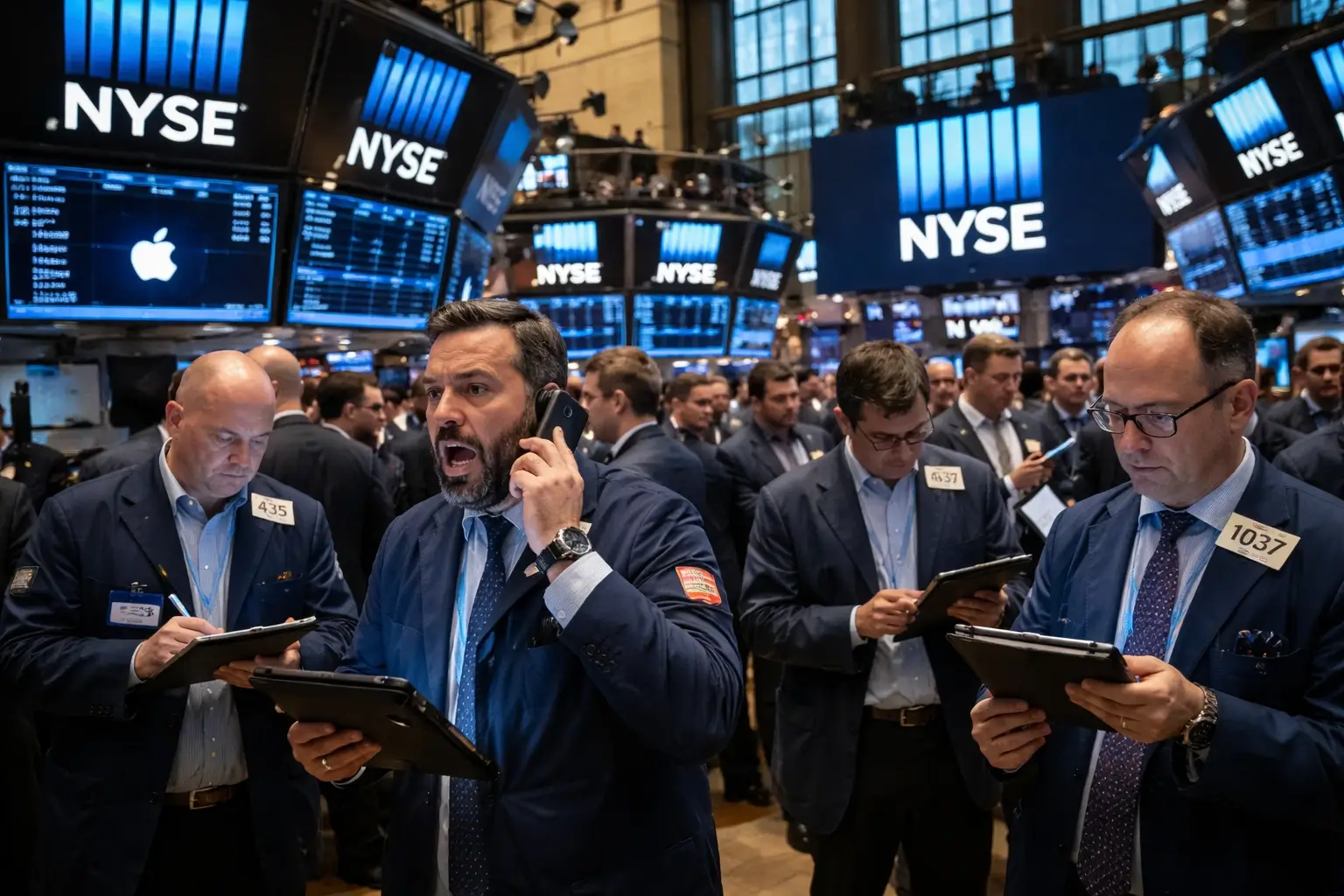
Stock Market Today - Dow Jones, S&P 500, and Nasdaq Erase 600-Point; WTI Hits $110, CF Surges 5%, OWL Collapses 7%
Trump's vow to hit Iran "extremely hard" sent WTI above $110 and hammered tech and airline stocks | That's TradingNEWS
Key Points
- The Dow Jones (^DJI) crashed 600 points before fully recovering after Iran and Oman signaled a Hormuz protocol, with WTI (CL=F) surging 11% above $113 and Brent (BZ=F) jumping 8% to $109
- CF Industries surged 5%, APA gained 4.3%, and OXY, DVN, COP, XOM, and CVX all added 3% while NVDA, MU, TSLA, and INTC dropped 2-3% on energy and helium supply fears
- Bank of America cut 2026 US GDP to 2.3%, raised inflation to 3.6%, and projected $100 oil all year
Thursday, April 2nd opened as a full-scale market emergency. The Dow Jones Industrial Average (^DJI) plunged more than 600 points, or 1.3%, within the first minutes of the session. The S&P 500 (^GSPC) dropped 1.2% at the open. The Nasdaq Composite (^IXIC) — the most vulnerable of the three major indexes given its concentration in high-multiple technology names — collapsed 2.2%, its sharpest opening selloff in weeks. Dow futures had already been signaling the carnage hours earlier, with contracts falling 686 points or 1.5% in overnight trading, S&P 500 futures shedding 1.7%, and Nasdaq 100 contracts (NQ=F) sinking 2.2% before a single share changed hands in New York. Then, just as the bears appeared fully in control of the tape, Iranian state media agency IRNA reported that Iran and Oman were actively drafting a protocol to monitor and manage maritime traffic through the Strait of Hormuz. The reaction was instantaneous and extreme. The Dow erased its entire 600-point deficit within minutes. The S&P 500 briefly crossed into positive territory. The Nasdaq clawed back the majority of its morning losses in what became one of the sharpest intraday reversals of the year. By 11 a.m. Eastern, the Dow sat at 46,457 — down just 108 points or 0.23%. The S&P 500 traded at 6,565, off 0.17%. The Nasdaq held at approximately 21,794, down 0.28%. The Russell 2000 (^RUT), showing the small-cap resilience that has periodically emerged when large-cap tech is under maximum pressure, actually managed a slim gain of 0.26%, sitting at 2,519. These mid-morning numbers mask the full violence of what played out across global markets from the moment Trump finished speaking Wednesday night to the moment the Hormuz headline hit Thursday morning — and they do not capture the deeply unsettled fundamental picture that remains underneath the surface recovery.
What Trump Actually Said Wednesday Night — And Why the Market Was Completely Unprepared
The setup coming into Trump's Wednesday night primetime address was genuinely optimistic by any reasonable measure. The president had told reporters at the White House on Tuesday afternoon that he expected US military forces to leave Iran within two to three weeks. Iran's president had floated a ceasefire offer. Trump had publicly acknowledged he would "consider" the proposal — with the condition that the Strait of Hormuz be "open, free, and clear" first. Institutional investors had responded accordingly. The S&P 500 was tracking toward its best weekly gain since November 28, carrying a 2.4% advance for the week even after Thursday's losses, according to Dow Jones Market Data. The Dow had jumped 200 points on April 1st alone as traders bet the conflict was approaching resolution. The Nasdaq was on pace for its strongest weekly performance of the year. That carefully constructed optimism walked directly into a speech that delivered almost exactly the opposite of what the market had priced in.
Trump told the American public that US forces would hit Iran "extremely hard" over the next two to three weeks, explicitly vowing to send the country "back to the stone ages." He acknowledged the US was "getting very close" to completing its military goals but refused to anchor any commitment to a firm withdrawal date. He offered no diplomatic framework for reopening the Strait of Hormuz — the world's single most critical energy chokepoint, through which approximately 20% of global oil supply transits. In perhaps the most damaging line for energy markets, Trump implied that reopening the strait was not America's problem to solve, telling nations that depend on Persian Gulf oil to "take it, protect it, use it for yourselves." That framing destroyed the market's working assumption that the US would actively manage a Hormuz reopening as part of any exit strategy. Deutsche Bank strategists wrote Thursday morning that markets had reversed the continued positive momentum they had seen the prior day, as rising hopes for an imminent end to the conflict evaporated. The Cboe Volatility Index, Wall Street's fear gauge known as the VIX, jumped 2.7 points to just above 27 in early trading — implying that options markets are now pricing average daily S&P 500 moves of approximately 1.7% over the next 30 days. It was not bad news that broke the tape. It was the total absence of any plan.
WTI Surges Above $110, Brent Above $109, Diesel Jumps 11% — And a Historic Pricing Inversion Signals Something Deeper
The oil market's reaction to Trump's address was immediate, ferocious, and historically significant in ways that go beyond the headline price move. West Texas Intermediate crude futures (CL=F) surged as much as 11%, printing above $113 per barrel in the pre-market session before pulling back to approximately $109 by mid-morning — still carrying a gain of roughly 8.8% on the day. June futures for international benchmark Brent crude (BZ=F) jumped 8% to $109.25 per barrel at the session's peak, before retreating to around $106, still up more than 5%, following the Hormuz protocol headline from Iran and Oman. The cumulative rally in Brent crude since the war began in late February now stands at approximately 50%. That is not a speculative spike driven by positioning. That is a fundamental repricing of the global energy complex driven by the effective near-closure of the world's most important oil shipping corridor. Brent has now traded above $106 per barrel for multiple consecutive sessions, and WTI above $108, establishing a new price floor that BofA economists are projecting will hold at or above $100 per barrel for the remainder of 2026 even under optimistic conflict resolution assumptions.
The most technically significant development in Thursday's oil market was the inversion of WTI's traditional discount to Brent crude. Under normal market conditions, WTI trades at a discount to Brent because Brent prices globally traded seaborne crude while WTI is priced at Cushing, Oklahoma, and carries domestic logistical constraints that cap its premium. When WTI trades above comparable Brent contracts — as it did briefly Thursday, marking the second such inversion since the war began — it signals a supply dislocation so severe that the fundamental pricing relationship between the two benchmarks breaks down entirely. The near-closure of the Strait of Hormuz has created exactly that scenario: a massive shortfall in globally available seaborne crude that is mechanically repricing WTI above its historical relationship with Brent. This is not noise. This is the market telling you that the supply picture is structurally broken in ways that will not self-correct without genuine diplomatic resolution of the strait access question.
Diesel futures told an even more alarming story than crude, jumping 11% on Thursday. Diesel is the fuel that powers trucking, freight networks, agricultural equipment, construction machinery, and industrial logistics. An 11% single-day spike in diesel prices will flow directly into transportation costs within weeks, and from transportation costs into the prices of goods on grocery shelves, building materials, and agricultural produce. The pass-through from diesel to CPI readings is not theoretical — it is a matter of timing and magnitude. European natural gas added further pressure to the global energy picture, with Dutch TTF futures rising nearly 6% to 50.33 euros per megawatt-hour. The combined move across crude oil, diesel, and natural gas on a single trading day is precisely what BofA economists mean when they characterize this as an energy shock rather than simply an oil shock.
The Hormuz Protocol Headline That Briefly Reversed Everything — And Why Skepticism Is Warranted
At approximately 10:30 a.m. Eastern, IRNA — Iranian state media — reported that Iran and Oman were drafting a protocol to monitor and manage ship traffic through the Strait of Hormuz. The market's reaction was among the most dramatic single-headline responses of the entire war period. The Dow erased more than 600 points of losses within minutes. The S&P 500 briefly flipped positive. The Nasdaq recovered the majority of its morning decline. WTI crude, which had been up as much as 10-11%, pulled back sharply from its highs. The thinking was straightforward: any movement toward restored Hormuz access, even partial or procedural, removes some of the worst-case energy disruption premium that has been baked into oil prices and the war discount baked into equities.
Todd Schoenberger, CIO at CrossCheck Management, added a dimension to the Hormuz conversation that most market commentary has missed entirely. He pointed out that for the United States specifically, the most pressing supply chain concern tied to Hormuz may not be crude oil — it is helium. Helium is used to cool the cryogenic processing equipment that fabricates semiconductors. There is no viable substitute for it in that application. A sustained closure of the Strait of Hormuz creates critical helium supply constraints that directly threaten US semiconductor manufacturing capacity in ways that have not yet fully appeared in earnings guidance or supply chain disclosures. Schoenberger explicitly flagged expectations for continued sharp volatility heading into the Good Friday long weekend, citing the combination of unresolved geopolitical uncertainty and thin holiday trading conditions as a setup for outsized moves in either direction.
The critical question for this headline is whether it represents genuine diplomatic progress or a tactical communication designed to temporarily relieve pressure on oil prices and provide Iran with some negotiating room. Trump's simultaneous rhetoric about hitting Iran "extremely hard" over the next two to three weeks is fundamentally inconsistent with a fully open and functioning strait within any near-term timeframe. The partial reversal of the initial positive market reaction by mid-morning on Thursday suggests that traders reached the same conclusion. This is a news-flow driven market, and every Hormuz headline — positive or negative — will continue to generate violent swings in both directions until there is verified, boots-on-the-ground evidence of restored shipping access.
Energy Stocks Are the Clearest Winning Trade in This Market: CF, APA, OXY, DVN, COP, XOM, CVX All Surge
The energy sector's outperformance on Thursday is not ambiguous and it is not a coincidence. CF Industries Holdings (CF) was the single largest premarket gainer among named stocks on the day, surging 5% before the opening bell. CF is an American manufacturer and distributor of agricultural fertilizers, and its exposure to Persian Gulf supply chain disruption is direct and measurable. Fertilizer production is heavily dependent on natural gas inputs and Persian Gulf distribution routes — both of which are materially disrupted by the current conflict. With Trump explicitly declining to commit to a Hormuz resolution and BofA projecting the energy shock will persist through year-end even under optimistic scenarios, the supply concerns driving CF's 5% move are firmly grounded in fundamental reality. APA Corporation (APA) gained 4.3% in premarket trading. Devon Energy (DVN), Occidental Petroleum (OXY), Diamondback Energy (FANG), ConocoPhillips (COP), Exxon Mobil (XOM), and Chevron (CVX) all added approximately 3% before the bell. Permian Resources (PR) and Antero Resources (AR) each gained roughly 3% as well. The GICS energy sector ended Wednesday down 3.89%, its worst session of the week, which in retrospect looks like the institutional selling that created Thursday's entry point — buyers who accumulated energy stocks on that Wednesday dip are sitting on significant single-day gains.
Citi analyst Alastair Syme published a note Thursday making the more durable long-term argument for energy equities beyond the near-term commodity spike. Syme argued that calling the short-term trajectory of oil prices in the current environment is nearly impossible, but that the more lasting consequence of the war will be a structural re-engagement of the broader institutional investment community with oil and gas equities — a cohort that spent the better part of the past decade systematically underweighting the sector in favor of technology and ESG-aligned alternatives. The energy sector is a buy with conviction. The fundamental tailwind from $100-plus oil, constrained Hormuz supply, BofA's $100-per-barrel baseline projection for the remainder of 2026, and the structural institutional re-engagement thesis from Citi create a multi-quarter earnings tailwind that current energy stock prices have not fully discounted.
Technology Gets Hit From Every Direction: NVDA, TSLA, MU, GOOG, INTC All Fall 2-3%, Chip Stocks Face a War-Specific Supply Chain Threat
Nvidia (NVDA), Alphabet (GOOG, GOOGL), Micron Technology (MU), Tesla (TSLA), and Intel (INTC) all declined between 2% and 3% in premarket trading Thursday and carried those losses into the session open. Broadcom (AVGO) was specifically identified alongside Nvidia as particularly hard-hit in the chip selloff. The semiconductor sector is absorbing a genuinely multidimensional compression from this conflict that goes well beyond the standard risk-off rotation out of high-multiple growth equities. On the demand side, institutional risk-off flows mechanically exit the highest-multiple names first, and there is no sector in the S&P 500 carrying higher multiples than large-cap semiconductors. On the cost side, rising energy prices directly increase the energy-intensive manufacturing costs throughout the chip fabrication supply chain. On the supply side — and this is the dimension the market has not yet fully priced — the Strait of Hormuz disruption directly threatens helium supply, which is irreplaceable as a cooling medium in semiconductor processing equipment. That supply chain vulnerability is specific to the chip sector in ways that do not apply to most other industries and adds a layer of fundamental risk to the standard geopolitical selloff narrative.
Intel (INTC), already deep in a multi-year competitive battle against Nvidia and AMD, has the thinnest margin cushion to absorb energy cost increases of any major chip name. Tesla (TSLA) faces a more complex dynamic: higher crude oil prices theoretically create demand tailwinds for electric vehicles by making gasoline-powered alternatives more expensive to operate, but the broader risk-off consumer environment and Tesla's specific exposure to discretionary high-income spending create net negative near-term pressure that outweighs the fuel economy argument. Micron (MU) is facing its own demand cycle pressures on top of the macro headwinds. Large-cap technology as a sector is a tactical sell for any investor with a three-to-six month horizon. The combination of energy cost headwinds, a frozen Federal Reserve that cannot provide rate cut relief, elevated multiples, and the emerging helium supply chain risk creates a fundamentally difficult setup through at least mid-year.
Airlines Are in Freefall and Delta's April 8th Earnings Print Is Now a Major Risk Event
Delta Air Lines (DAL) and United Airlines (UAL) each fell more than 3% in premarket trading Thursday. Southwest Airlines (LUV) and Alaska Air (ALK) declined roughly 4% before the bell. The financial arithmetic for airlines in this environment is straightforward and brutal. Jet fuel is derived directly from crude oil and is typically the single largest line item on an airline's income statement, representing 20-25% of total operating costs in normal market conditions. With WTI crude now sitting above $108 per barrel — up approximately 50% from pre-war levels in late February — the fuel cost shock flowing through to airline economics is severe, sustained, and showing no sign of abating under the current geopolitical trajectory. Delta reports earnings on Wednesday, April 8th before the opening bell, making Thursday's session a critical pricing setup for what is now shaping up as a genuinely difficult print. Delta will almost certainly revise fuel cost assumptions sharply higher for full-year 2026 guidance. The critical question for investors is whether Delta's capacity management, yield optimization, and any existing fuel hedge positions can materially offset the cost increase — or whether the margin compression is too large to absorb through revenue management alone. The answer, given the magnitude of the crude rally, is almost certainly the latter. Delta is a sell ahead of April 8th. United Airlines faces identical structural pressure. The asymmetric risk into Delta's earnings report is decisively to the downside, and the stock's Thursday premarket decline is likely a preview rather than a full repricing.
Carnival Corporation (CCL), Royal Caribbean (RCL), and Norwegian Cruise Line (NCLH) fell roughly 4% each in premarket. Cruise operators are being hit through two channels simultaneously: direct fuel cost increases that compress operating margins, and the forward consumer demand softness that begins to appear when household energy costs — gasoline, home heating, electricity — rise significantly and crowd out discretionary travel spending. Cruise bookings have a six-to-twelve month lead time, meaning the demand destruction from elevated energy prices will show up in forward booking data before it appears in reported revenue. All three cruise operators are sells until oil price trajectory stabilizes.
Read More
-
Yen Stalls at 160 Despite a 3% JGB and Tokyo Core CPI at 2.0% — Intervention Sits at 164, Friday's Payrolls Decide
02.09.2026 · TradingNEWS ArchiveEnergy
-
QQQ ETF ($706.22) Slides 7.4% Below Its High as the Market Reprices the AI Capex Bill — $686.57 Target if $700 Breaks
22.10.2026 · TradingNEWS ArchiveStocks
-
XRPI ($7.00) and XRPR ($10.74) Slide Toward 52-Week Lows as Spot XRP ETF Flows Stall at $708,510
22.10.2026 · TradingNEWS ArchiveCrypto
-
NG ($2.775) Decoupled From Europe’s €88 Gas Crisis as LNG Feedgas Hits 18.9 Bcf/d — $3.30 Upside on Cold Weather
22.10.2026 · TradingNEWS ArchiveCommodities
-
Dollar-Yen (157.35) Loses 157.65 as the Yen Rallies on Haven Demand — 155 Target if 156 Breaks
22.10.2026 · TradingNEWS ArchiveForex
Bed Bath & Beyond Drops 6% After Announcing $150 Million Container Store Acquisition: BBBY Is a Sell
Bed Bath & Beyond (BBBY) stock fell 6.12% to $4.375 on Thursday after announcing a $150 million acquisition of The Container Store, along with the Elfa and Closet Works home storage brands. CEO Marcus Lemonis framed the deal in a shareholder letter as a "critical step" in rebuilding the company's home essentials platform, citing Container Store's brand equity, its physical retail footprint, and its customer-focused employee culture. Lemonis explicitly signaled this is not the company's final acquisition, writing that Bed Bath & Beyond is "actively working on additional acquisitions across each of our pillars" and promising further announcements as those opportunities progress. The strategic logic — filling gaps in retail and home services, broadening the product and service platform, acquiring physical store infrastructure — is coherent on paper. The financial execution risk is enormous in practice. Both Bed Bath & Beyond and The Container Store emerged from bankruptcy proceedings within the past three years. A company that has spent three years rebuilding from bankruptcy is now deploying $150 million to acquire another recently bankrupt company while telegraphing a pipeline of additional deals to come. This is not how post-bankruptcy companies rebuild credibility and financial strength — it is how they introduce a new category of balance sheet and integration risk before proving that the core business is self-sustaining. The market's 6% negative reaction on deal announcement day is telling. In deal-making history, a 6% acquirer selloff on announcement day frequently marks the beginning of a longer de-rating rather than the end of one, particularly when the acquirer's own financial foundation is as fragile as BBBY's. This is a sell.
Blue Owl Capital Forces a 5% Redemption Cap as Investors Flee at Historic Rates: OWL Drops Nearly 7%
Blue Owl Capital (OWL) fell nearly 7% Thursday in what was one of the most structurally alarming individual stock stories of the session — and it had nothing to do with Iran. The alternative asset manager disclosed it was capping redemptions at 5% across its major private credit funds after experiencing withdrawal requests that would be considered extraordinary under any market conditions in any era. Blue Owl's OTIC fund, an AI disruption-focused private credit vehicle, received redemption requests totaling 40.7% of assets during the first quarter of 2026 alone. Its largest and most prominent fund, OCIC, saw requests come in at 21.9% of assets. These are not numbers that reflect mild investor discomfort or routine portfolio rebalancing. A 40.7% redemption request at a flagship fund in a single quarter represents a fundamental loss of institutional confidence in both the fund's strategy and its near-term return prospects. The AI disruption fears that have dominated market conversation in 2026 drove sustained institutional outflows from technology-adjacent private credit strategies, and Blue Owl's AI-focused vehicles were directly in the path of that rotation.
Forcing a 5% redemption cap protects the fund's remaining asset base from a potentially disorderly forced liquidation of illiquid private credit positions. But it simultaneously traps investors who have already decided they want out, signals to the broader market that Blue Owl is managing a liquidity situation that is not fully under control, and creates an overhang of deferred redemption pressure that will weigh on the stock for multiple quarters. Forced redemption caps are rarely a one-quarter resolution story. The institutional dynamics that produce a 40.7% withdrawal request in 90 days do not reverse in the following 90 days. OWL is a sell with conviction. The stock's nearly 7% single-day decline is the beginning of a repricing process, not the end of it.
Gold Crashes More Than 2% Despite War Escalation — The Dollar Is Winning the Safe-Haven Battle
Gold futures (GC=F) dropped 2.14% to $4,708 per ounce on Thursday, with spot gold tumbling as much as 4.3% at the session's worst moment, breaking a four-day winning streak and reversing sharply from what had been an extraordinary run toward historic highs. Silver fell in sympathy. The selloff appears deeply counterintuitive at first glance. A war escalation with no defined endpoint should theoretically be unambiguously bullish for the classic geopolitical safe-haven metal. But the dynamics playing out Thursday were more nuanced than a simple risk-on/risk-off framework captures. Trump's address simultaneously suggested military goals were nearly complete and promised the hardest strikes yet over the next two to three weeks. That contradictory framing disrupted gold's clean narrative as a pure war premium hedge. Traders who had been accumulating long gold positions as geopolitical insurance used the muddled outlook to take profits, particularly given the extraordinary 4,700-plus level gold had reached. The more important mechanical factor was the US dollar. The greenback strengthened broadly on Thursday, with the dollar index sitting near 99.93 — functioning as a competing safe-haven trade in a way that creates direct downward pressure on dollar-denominated commodity prices. Evelyn Partners chief investment strategist Daniel Casali specifically noted in a Thursday research note that maintaining dollar exposure "has become increasingly valuable" as a portfolio protection tool during periods of geopolitical stress and elevated US interest rate expectations. When the dollar wins the safe-haven competition, gold loses mechanically, and that is what happened Thursday.
Copper (HG=F) and aluminum (ALI=F) also declined on Thursday, with aluminum pulling back after closing at its highest level in four years on Wednesday. Despite Thursday's sharp correction, gold remains a structural buy for any investor with a medium-to-long term horizon. BofA's revised forecast of 3.6% US headline inflation for 2026 — up from a prior estimate of 2.8% — provides durable fundamental support for hard assets that will reassert itself once the near-term geopolitical noise and profit-taking pressure clear. Thursday's decline is a correction within an uptrend, not a trend reversal.
Bitcoin Falls to $66,000, Ethereum Hits $2,000, Solana Drops 5%: Crypto Tracks the Risk-Off Tape With Precision
Bitcoin (BTC-USD) fell 2.49% to approximately $66,870 on Thursday, having earlier tested as low as $66,172 — a level that matches the year's lows and represents a technically critical support zone. Ethereum (ETH-USD) declined roughly 4% to hover near the psychologically important $2,000 level. Solana fell as much as 5.1%. Across the board, the crypto selloff tracked the equity market's risk-off opening with near-perfect correlation, triggered directly by the renewed fears of sustained Middle East conflict following Trump's speech. The risk-asset relationship was the dominant driver, overriding any crypto-specific narrative for the session. Caroline Mauron, co-founder of Orbit Markets, offered a nuanced observation that deserves attention beyond the headline decline numbers: despite the daily volatility, Bitcoin has been showing reduced sensitivity to both positive and negative geopolitical developments over the past several weeks compared to earlier in the conflict. Analysts at Saxo reinforced that read, noting that Bitcoin's direction continues to depend primarily on macroeconomic risk appetite and overall market confidence, but that the reduced beta to individual war headlines may reflect a gradual maturation in how the asset class processes geopolitical risk.
The $66,000 level is the line that matters most for Bitcoin's near-term technical picture. A sustained break and close below $66,000 opens the door to a retest of year-to-date lows and would likely accelerate downside momentum as technical stop-loss levels trigger. A hold above that zone heading into the Good Friday long weekend keeps the recovery thesis alive and gives buyers a foothold. Bitcoin is a neutral at current levels with a cautious lean — holding existing positions, but not adding until oil stabilizes and the broader macro picture shows any sign of settling. The long weekend creates additional gap risk given thin liquidity conditions.
BofA Delivers a Stagflation Warning With Specific Numbers: 2.3% US Growth, 3.6% Inflation, $100 Oil Through Year-End
Bank of America's economics team, led by Claudio Irigoyen, published a research note on Wednesday that landed with full force in Thursday's market conversation. The team's verdict on the Iran war's economic consequences is precise and unsparing. What is happening right now is "mild stagflation" — the toxic combination of slowing growth and rising inflation that central banks are structurally ill-equipped to address because every policy tool that fights inflation simultaneously accelerates the growth slowdown, and every tool that supports growth simultaneously worsens inflation. BofA's specific revised forecasts are the numbers every portfolio manager should be running through their models. US GDP growth for 2026 is now projected at 2.3%, representing a 50 basis point reduction from prior estimates. US headline inflation is forecast to reach 3.6% for the full year, up from a prior forecast of 2.8%. Globally, BofA revised 2026 GDP down to 3.1% and lifted global inflation expectations to 3.3%. On oil specifically, the firm is projecting $100 per barrel as the baseline price floor for the remainder of 2026 — and that projection assumes the conflict ends in the relatively near term. A prolonged war pushes that baseline materially higher.
The most important intellectual contribution in Irigoyen's note is the reframe that this crisis is not an oil shock but a full-spectrum energy shock. The global economy has meaningfully reduced its direct crude oil dependence over the past two decades through fuel efficiency improvements, electrification of transportation, and industrial process optimization. But it has simultaneously become far more sensitive to natural gas — which is the primary feedstock for power generation, industrial heating, and the fertilizer production process — and to fertilizers themselves, which are produced primarily from natural gas through the Haber-Bosch chemical process. The Strait of Hormuz disruption hits both of those channels directly and severely, creating compound exposure that the headline crude price figure does not capture. BofA specifically flagged Europe and developing economies as the most vulnerable to this broader energy shock transmission, noting that the natural gas channel represents a major risk that is distinct from and additional to the crude oil impact. For US investors, the stagflation framing has direct and actionable portfolio implications: duration assets and high-multiple growth equities historically perform poorly in stagflationary environments, while commodity producers, real assets, inflation-protected securities, and value-oriented cyclicals with pricing power tend to outperform.
The Federal Reserve Is Completely Boxed In — No Rate Cuts Are Coming
Kevin Mahn, CIO of Hennion & Walsh, stated the Federal Reserve's predicament plainly on CNBC's Squawk Box Thursday morning: he does not expect the Fed to move on rates in the near future, and markets will have to wait for an actual resolution to the conflict to see any relief from elevated oil prices and the inflation they are driving. This is the most important structural constraint in the current market environment, and it is the reason why every equity rally built on Hormuz optimism is inherently fragile. The Fed cannot cut rates to support an economy slowing under the weight of an energy shock — doing so with headline inflation running toward 3.6% would be deeply irresponsible and would further weaken the dollar, which would push oil prices even higher in a self-reinforcing inflationary loop. But the Fed also cannot raise rates to fight energy-driven inflation without compressing an already slowing growth trajectory and delivering additional pain to consumers and businesses already absorbing the energy cost shock. The result is a central bank that is effectively paralyzed, waiting for geopolitical resolution to do the work that monetary policy tools are not designed to do. This dynamic creates a particularly punishing environment for equity valuations, which are anchored to discount rate assumptions — and a Fed that cannot cut means those discount rates stay elevated precisely when forward earnings estimates are being revised lower to reflect rising energy costs. The combination is the definition of multiple compression.
Labor Market Refuses to Break: Weekly Claims Drop to 202,000, Crushing the 212,000 Estimate
Buried beneath the geopolitical noise on Thursday morning was a meaningfully constructive US labor market data point that deserves more attention than it received. The Labor Department reported initial jobless claims for the week ending March 28 came in at 202,000, falling 9,000 from the prior week's upwardly revised level of 211,000 and handily beating the Dow Jones consensus estimate of 212,000 by a wide margin. Continuing claims, which run a week behind the initial reading, fell 25,000 to 1.841 million for the week ending March 21. The four-week moving average for continuing claims declined to 1.838 million — its lowest level since September 28, 2024. These are not numbers that describe a labor market cracking under the weight of an energy shock. These are numbers that describe a labor market that is, at this moment, remarkably resilient. The significance for the broader stagflation thesis is material. Stagflation becomes genuinely destructive — the 1970s scenario that haunts every economist's reference library — when unemployment rises alongside elevated inflation, creating a spiral of declining consumer purchasing power, collapsing demand, and structural economic damage. So far, the US labor market is not cooperating with that narrative. Layoffs remain at historically contained levels, claims are tracking near generational lows, and the four-week moving average on continuing claims is declining rather than building. Thursday's full March jobs report will be released Friday morning, with markets closed for Good Friday, meaning the data will sit undigested until Monday's open — setting