Stock Market Today: Dow Sinks 715 Points — NVDA Falls, Dell and Block Surge 18%, Netflix Rallies 9%
January PPI jumps 0.5% as core wholesale prices double forecasts; 10-year Treasury yield drops below 4% for first time since November | That's TradingNEWS
Wall Street Crumbles on Scorching Inflation Print as AI Anxiety Deepens — Dow Drops 700+ Points to Close February on a Sour Note
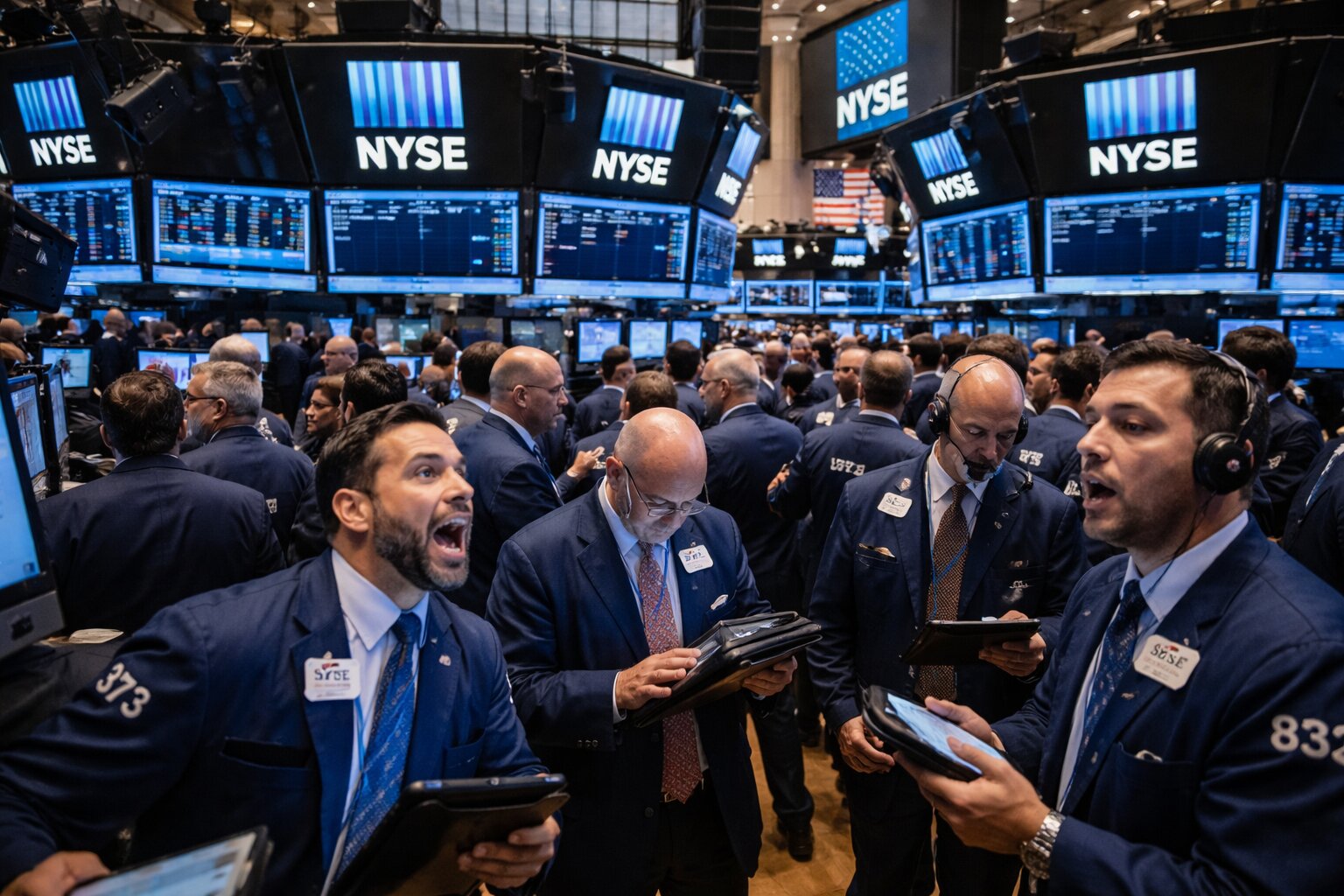
Friday's session delivered a brutal end to what had already been a painful month for risk assets. A wholesale price report that nobody wanted to see, combined with mounting fears over artificial intelligence's disruptive footprint on the U.S. labor market, hammered equities across the board. The Dow Jones Industrial Average (DJIA) cratered 715 points, or 1.63%, settling at 48,694.51. The S&P 500 (SPX) shed 0.94% to land at 6,844.25, and the Nasdaq Composite (COMP) surrendered 1.08%, closing at 22,632.30. Small-caps fared even worse — the Russell 2000 (RUT) tumbled 1.46% to 2,638.11, underscoring that risk aversion swept through every corner of the market.
Wholesale Prices Deliver an Unwelcome Surprise
The January producer price index came in scorching hot and derailed any remaining hope of a smooth glide path toward Federal Reserve rate cuts. Headline PPI surged 0.5% month-over-month — well above the 0.3% economists had penciled in — and accelerated from December's already-warm 0.4% gain. But the real gut punch arrived from core PPI, which strips out volatile food and energy components: it spiked 0.8%, more than doubling the 0.3% consensus forecast. On a twelve-month basis, wholesale prices rose 2.9%, marginally lower than the prior reading only because elevated January 2025 figures rolled out of the trailing window.
This kind of upstream price pressure directly threatens the Fed's timeline. If pipeline costs keep accelerating at this pace, the central bank has virtually no justification to ease policy anytime soon, and the futures market reflected that reality within minutes. The disconnect between stubborn producer-level inflation and a slowing consumer economy creates a stagflationary undercurrent that makes portfolio positioning exceptionally difficult. The verdict here is clear: the inflation fight is far from over, and any assumption of imminent rate relief is premature. Bearish for rate-sensitive sectors heading into March.
Treasury Yields Break Below 4% — A Flight to Safety, Not a Victory Lap
In a seemingly paradoxical move, the 10-year Treasury yield (TNX) fell below the psychologically important 4% threshold for the first time since November, settling at 3.978% — down more than 3 basis points from Thursday's 4.01% close. Normally, hotter inflation would push yields higher. But this decline signals something more troubling: a massive flight to safety as institutional capital rotates out of equities and into government debt. Yields have been trending lower throughout February, driven by demand for haven assets amid stock market volatility. When bond traders are more worried about growth collapsing than prices rising, that tells you everything about where sentiment stands.
NVDA Extends Its Post-Earnings Slide — Is the AI Trade Breaking?
Nvidia (NVDA) — the bellwether of the entire artificial intelligence investment thesis — dropped another 2.5% on Friday after an already-devastating 5.5% plunge Thursday. That two-day rout erased billions in market capitalization despite objectively stellar fiscal fourth-quarter numbers. The world's most valuable company delivered blowout results Wednesday evening, yet the stock responded by becoming the worst performer in both the Nasdaq and S&P 500 on Thursday, and continued bleeding into the weekend.
CEO Jensen Huang pushed back on the selloff during a CNBC interview, arguing that the market is fundamentally underestimating the total addressable opportunity for computing. His exact message: the scope of computing industry growth is far larger than most participants appreciate, and Nvidia sits at the epicenter of that expansion. He's probably right on the long-term trajectory — but right now, the market doesn't care about five-year TAMs. Traders are questioning whether hyperscaler capital expenditure budgets are sustainable, whether the Nvidia-OpenAI investment relationship introduces conflicts of interest, and whether AI monetization timelines keep getting pushed further out. The stock is now negative for 2026, which given the strength of the underlying business is a striking signal of how damaged sentiment has become. Hold — the fundamentals are exceptional, but near-term technical and sentiment damage needs to heal before adding exposure.
OpenAI's $110 Billion Mega-Round Shakes the Magnificent Seven
Before Friday's bell, privately held OpenAI — the parent of ChatGPT — disclosed a staggering $110 billion capital raise at a pre-money valuation of $730 billion, a massive leap from the $500 billion secondary valuation recorded in October. Amazon (AMZN) committed $50 billion, while both Nvidia and SoftBank contributed $30 billion each. A strategic partnership between Amazon and OpenAI will develop customized models to power Amazon's consumer-facing products, and Nvidia secured next-generation inference compute arrangements.
Earlier in this cycle, announcements of this magnitude would have launched Big Tech shares into orbit. Instead, Amazon dropped roughly 1%, Microsoft (MSFT) slid over 2%, and Meta Platforms (META) lost more than 1%. Every single Magnificent Seven member finished in the red. The muted-to-negative reaction reveals something important about market psychology: participants are no longer rewarding massive AI spending. They want to see returns on all these hundreds of billions being deployed. Until revenue attribution catches up with capital commitment, expect these names to face continued headwinds. Neutral-to-Bearish near-term for mega-cap tech.
Block (XYZ) Rockets 18% on Radical AI-Driven Restructuring
Block (XYZ), the parent company of Square and Cash App, surged 18% and was the session's standout gainer after co-founder and CEO Jack Dorsey announced the most dramatic corporate restructuring in recent memory: a 40% workforce reduction, slashing headcount from over 10,000 to just under 6,000 — meaning more than 4,000 employees are being shown the door. In a shareholder letter accompanying earnings results, Dorsey attributed the decision squarely to advancements in "intelligence tools," making the layoffs explicitly an AI-replacement story rather than a traditional cost-cutting exercise.
Wall Street loved the operating leverage implications — the stock posted its best single-session performance in over four years. But this announcement sent shockwaves beyond Block's own equity. Financial sector stocks and broader market segments pulled back as participants absorbed the implication: if a prominent technology-enabled company can eliminate nearly half its workforce because AI is good enough, what does that mean for every other employer in America? This is no longer a theoretical discussion. Dorsey explicitly told employees at other companies to brace for similar large-scale cuts. Bullish on XYZ — the operational transformation is aggressive but positions the company for dramatically higher margins, and at current valuations the risk-reward skews favorably.
Dell Technologies (DELL) Surges 18% on AI Infrastructure Dominance
Dell Technologies (DELL) delivered one of the cleanest earnings beats of the quarter and shares exploded 18% higher. Fiscal 2026 fourth-quarter adjusted earnings came in at $3.89 per share on revenue of $33.38 billion — handily topping analyst expectations of $3.53 and $31.72 billion, respectively. Revenue soared 39% year-over-year, driven overwhelmingly by the company's AI-optimized server business.
COO and Vice Chairman Jeff Clarke laid out the numbers that matter: Dell closed over $64 billion in AI-optimized server orders during fiscal 2026, shipped more than $25 billion throughout the year, and enters fiscal 2027 with a record backlog of $43 billion. Those are not incremental numbers — that is a fundamental transformation of the business. Forward guidance for revenue, AI server revenue, and adjusted earnings per share all came in well above consensus. On top of that, Dell announced a $10 billion expansion of its share repurchase program and a 20% dividend increase. The stock moved into positive territory for 2026 on the back of this report. Buy — Dell is one of the clearest AI infrastructure beneficiaries with tangible revenue proof, a massive and growing backlog, and shareholder-friendly capital return. The valuation still has room to re-rate higher.
Netflix (NFLX) Jumps 9% After Walking Away From Warner Bros. Discovery
Netflix (NFLX) shares soared roughly 9% after the streaming giant confirmed it would not match Paramount Skydance's revised all-cash bid of $31 per share to acquire the entirety of Warner Bros. Discovery (WBD). Co-CEOs Ted Sarandos and Greg Peters framed the abandoned deal as a "nice to have at the right price, not a must have at any price" — a disciplined capital allocation stance that the market rewarded immediately.
The deal dynamics evolved rapidly this week. Warner Bros. Discovery's board determined Paramount's sweetened offer — raised from $30 to $31 per share — constituted a "Company Superior Proposal" to Netflix's December deal for WBD's film studios, television operations, and HBO Max streaming service. Netflix had four business days to counter but elected to step aside. Paramount Skydance (PSKY) shares popped 7-9% on the victory, while WBD itself dipped roughly 2% — a signal that the market believes Paramount may be overpaying.
Analysts overwhelmingly view Netflix's withdrawal as a positive, arguing it removes a significant overhang and refocuses the investment thesis on core organic growth rather than integration risk from a massive acquisition. Bullish on NFLX — walking away from a bidding war demonstrates the kind of financial discipline that separates great companies from good ones.
Software Carnage Continues — The IGV Meltdown
The damage to enterprise software names deepened on the final trading day of February. Salesforce (CRM) tumbled more than 4%, Microsoft (MSFT) fell about 2%, and cybersecurity firm Zscaler (ZS) cratered 11% after fiscal second-quarter deferred revenue and billings disappointed expectations. CoreWeave (CRWV) — the AI cloud infrastructure play — collapsed 16-19% on guidance that failed to meet already lofty expectations. FanDuel parent Flutter Entertainment (FLUT) sank 16% in post-earnings trading.
The iShares Expanded Tech-Software ETF (IGV) captures the breadth of this destruction: down 10% for February alone, bringing year-to-date losses to a staggering 23%. The AI disruption narrative is cutting both ways — while companies that build AI infrastructure like Dell are thriving, traditional software businesses face existential questions about whether their products can survive in a world where AI agents handle tasks previously requiring licensed software suites. This is a sector to avoid until the selling capitulates.
The Trade Desk (TTD) Stumbles on Forward Guidance Weakness
The Trade Desk (TTD) closed Thursday at $23.95, down 4.81%, on massive volume — 52.5 million shares traded hands, roughly 264% above its three-month average of 14.4 million. After opening down 16% following Wednesday's earnings, the stock clawed back throughout the session but still finished materially lower. Fourth-quarter revenue growth of 14% and flat adjusted net income beat expectations, but the forward outlook disappointed: management guided for Q1 revenue growth of just 10% alongside a projected 6% decline in adjusted EBITDA. That margin compression suggests weakening pricing power in programmatic advertising, which is concerning for a company that has historically commanded premium multiples. The stock is now trading near its lowest-ever valuation since its 2016 IPO. Hold — the AI-powered Kokai platform needs to demonstrate it can reaccelerate growth before conviction can return.
UBS Downgrades American Equities as Foreign Markets Trounce the U.S.
UBS head of global equity strategy Andrew Garthwaite cut U.S. stocks to "benchmark" weighting in a fully invested global portfolio, citing a weakening dollar, stretched valuations, and political turbulence from Washington. The dollar risk is central to the thesis: UBS forecasts the euro reaching $1.22 by the end of Q1 2026 and identifies "asymmetric structural downside risks" for the greenback. Historical analysis shows that when the dollar's trade-weighted index drops 10%, U.S. equities underperform by roughly 4% on an unhedged basis.
The numbers tell the story clearly. The MSCI World ex-US index has gained approximately 8% in 2026, while the S&P 500 sits essentially flat. The U.S. dollar index was near 94.74 on Friday — a far cry from where it stood just months ago. Capital is rotating overseas to cheaper valuations and a tailwind from currency appreciation. This is a trend worth respecting. International diversification has rarely looked more attractive.
Investor Sentiment Deteriorating Rapidly
The American Association of Individual Investors weekly survey paints a picture of evaporating confidence. Bullish sentiment dropped for a fourth consecutive week to 33.2%, down from 34.5% the prior week, 38.5% two weeks ago, and a recent peak of 44.4% just a month earlier on January 28th. The reading stood at nearly 50% as recently as January 14th — the highest since November 2024. That kind of rapid sentiment unwind typically precedes either capitulation or a counter-trend rally. Contrarian indicators are approaching levels where buying opportunities historically emerge, but the macro backdrop — hot inflation, AI-driven labor disruption, and geopolitical risk — makes this a particularly treacherous setup for mean-reversion trades.
VIX Spikes Above 20 — Fear Returns to Wall Street
The CBOE Volatility Index (VIX) jumped 12.83% to 21.02, reclaiming the 20 handle and signaling that options markets are pricing in significantly elevated uncertainty. A VIX above 20 historically corresponds to periods of active de-risking, and the move confirms that Friday's selloff was accompanied by genuine hedging demand, not just passive selling. With month-end rebalancing flows also in play, volatility is likely to remain elevated heading into the first week of March.
Commodities Diverge — Gold Shines, Oil Surges on Iran Tensions
The commodity complex offered a stark contrast to equity weakness. Gold futures climbed roughly 1% to approximately $5,234-5,245 per ounce, continuing their role as the premier safe-haven asset. Silver futures ripped 6% higher to $92.70 an ounce — an outsized move suggesting industrial and speculative demand are converging. West Texas Intermediate crude oil futures surged nearly 4% to $67.70 a barrel after the latest round of U.S.-Iran nuclear negotiations concluded without an agreement, raising the risk of further supply disruptions. Brent crude rose 2.91% to $72.90.
The oil move deserves attention. A failed diplomatic outcome with Iran combined with an upcoming OPEC+ meeting creates a supply-side catalyst that could push crude higher in coming weeks. Energy equities — which have largely lagged technology this cycle — may offer relative value if geopolitical tensions persist. Bullish on crude and energy names near-term.
Bitcoin Falters as Risk-Off Sentiment Spreads to Crypto
Bitcoin fell to roughly $65,900, surrendering overnight gains that had pushed it above $68,200 earlier. The 2.24% decline tracks almost perfectly with the risk-off rotation in equities, reinforcing that Bitcoin is behaving as a correlated risk asset rather than a hedge. Until macro conditions stabilize, crypto is likely to trade as a leveraged equity proxy. Neutral — the long-term structural thesis remains intact but the near-term correlation to tech makes it vulnerable to further drawdowns.
Mortgage Stress Rising — A Macro Warning Signal
A VantageScore report revealed that the number of homeowners one to two months behind on mortgage payments surged 30.9% year-over-year in January. While the overall delinquency rate remains modest at 1.14% of borrowers, this is the highest reading since the pandemic and a clear leading indicator of consumer financial stress. The sustained burden of elevated living costs — from groceries to veterinary bills — is eroding household balance sheets even as headline inflation moderates. VantageScore's chief data officer warned that sustained cost pressures and interest rates may leave consumers "increasingly exposed to future economic shocks." This data point reinforces the stagflationary concern: inflation running hot at the producer level while consumers are increasingly unable to keep up with existing obligations.
Read More
-
Yen Stalls at 160 Despite a 3% JGB and Tokyo Core CPI at 2.0% — Intervention Sits at 164, Friday's Payrolls Decide
02.09.2026 · TradingNEWS ArchiveEnergy
-
T-Rex 2X Inverse MSTR ($4.39) Rips 10.44% as Strategy Pauses Bitcoin Buys for a 2nd Week — $4.63 Close Opens $5.27
15.09.2026 · TradingNEWS ArchiveStocks
-
XRPR ($10.59) and XRPI ($7.04) Open at Highs and Close at Lows After Senate Kills CLARITY Act
15.09.2026 · TradingNEWS ArchiveCrypto
-
NG ($2.908) Holds Above $2.80 Low as LNG Feedgas Hits 18.8 Bcf and TTF Trades 9.2x Henry Hub
15.09.2026 · TradingNEWS ArchiveCommodities
-
USD/JPY (155.09) Faces 275bp Policy Gap as BOJ Prepares 31-Year-High Rate — Close Below 154 Opens 153.40
15.09.2026 · TradingNEWS ArchiveForex
Trump Unveils Retirement Accounts for Workers Without 401(k) Access
During Thursday's State of the Union address, President Trump announced a new initiative to provide retirement accounts to the approximately half of American workers who lack access to employer-sponsored 401(k) plans. The program, modeled after the federal government's Thrift Savings Plan, will launch next year and include government matching contributions of up to $1,000 annually. While the policy's long-term market impact depends on implementation details and funding mechanisms, it represents a potentially significant inflow of new capital into retirement investment products if successfully scaled. Asset managers and brokerage firms could see incremental benefit from expanded account enrollment.
Live Nation (LYV) Gets a Boost from Rothschild Upgrade
Live Nation (LYV) shares rose about 1% after Rothschild & Co. Redburn upgraded the stock to buy from neutral and raised its price target to $193 from $166 — implying 22.2% upside from Thursday's close. Analyst Ed Vyvyan noted that key risks he flagged when downgrading just five months ago — including FTC regulatory action and a soft third-quarter 2025 concert segment — have already materialized and been absorbed through a share price de-rating. With regulatory concerns fading and Q4 results showing resilient demand, the setup has improved. Buy on the dip — live entertainment demand remains structurally strong.
Dollar Tree (DLTR) Downgraded as Valuation Catches Up
Citi cut Dollar Tree (DLTR) to neutral from buy, sending shares down nearly 2% in premarket trading. The analyst team acknowledged the company's multi-price strategy is showing signs of success but noted that the stock has already doubled from its post-tariff announcement lows in April 2025 and sits within 3% of Citi's price target. Risk-reward at current levels is balanced. Agreed — the easy money in DLTR has been made. Hold.
February Scoreboard — A Month to Forget for Growth
As the final bell rang on the shortest month, the damage was widespread but uneven. The Nasdaq Composite dropped more than 3% in February — its worst monthly showing since March 2025. The S&P 500 lost more than 1% for the month. The Dow Jones Industrial Average, buoyed by its more defensive composition, eked out a roughly 0.2% advance and remained on track for its 10th consecutive monthly gain — a remarkable streak of relative strength. The divergence between the Dow and the Nasdaq perfectly captures the current market regime: money is flowing away from high-multiple growth and toward value, quality, and yield.
The MSCI World ex-US index's 8% year-to-date gain versus a flat S&P 500 is perhaps the most underappreciated dynamic right now. International equities are outperforming at a rate not seen in years, and a weakening dollar amplifies those returns for U.S.-based allocators. Portfolio rebalancing toward non-U.S. exposure deserves serious consideration.
Bottom Line — Where Does This Leave Positioning?
February 2026 exposed the fragility beneath what had appeared to be an unstoppable bull market. Producer-level inflation is reaccelerating, the Fed's hands are tied, AI is simultaneously creating enormous wealth for infrastructure providers and destroying employment across traditional enterprises, and the American consumer is starting to crack under cumulative cost pressure. Magnificent Seven names are no longer automatic buys on every dip — the OpenAI mega-round proved that massive spending announcements now trigger skepticism rather than euphoria.
The actionable takeaways: Dell (DELL) remains a buy as the cleanest AI hardware play with proven revenue and a $43 billion backlog. Block (XYZ) is a buy on the operational transformation thesis. Netflix (NFLX) earns a bullish nod for capital discipline. Nvidia (NVDA) is a hold until sentiment stabilizes — the fundamentals are unimpeachable but technical damage is real. Software names broadly remain an avoid. Crude oil and energy offer near-term relative value given Iran tensions. And perhaps most importantly, non-U.S. equities deserve a significantly larger allocation than most portfolios currently maintain. The era of unquestioned American exceptionalism in markets is being tested in real time