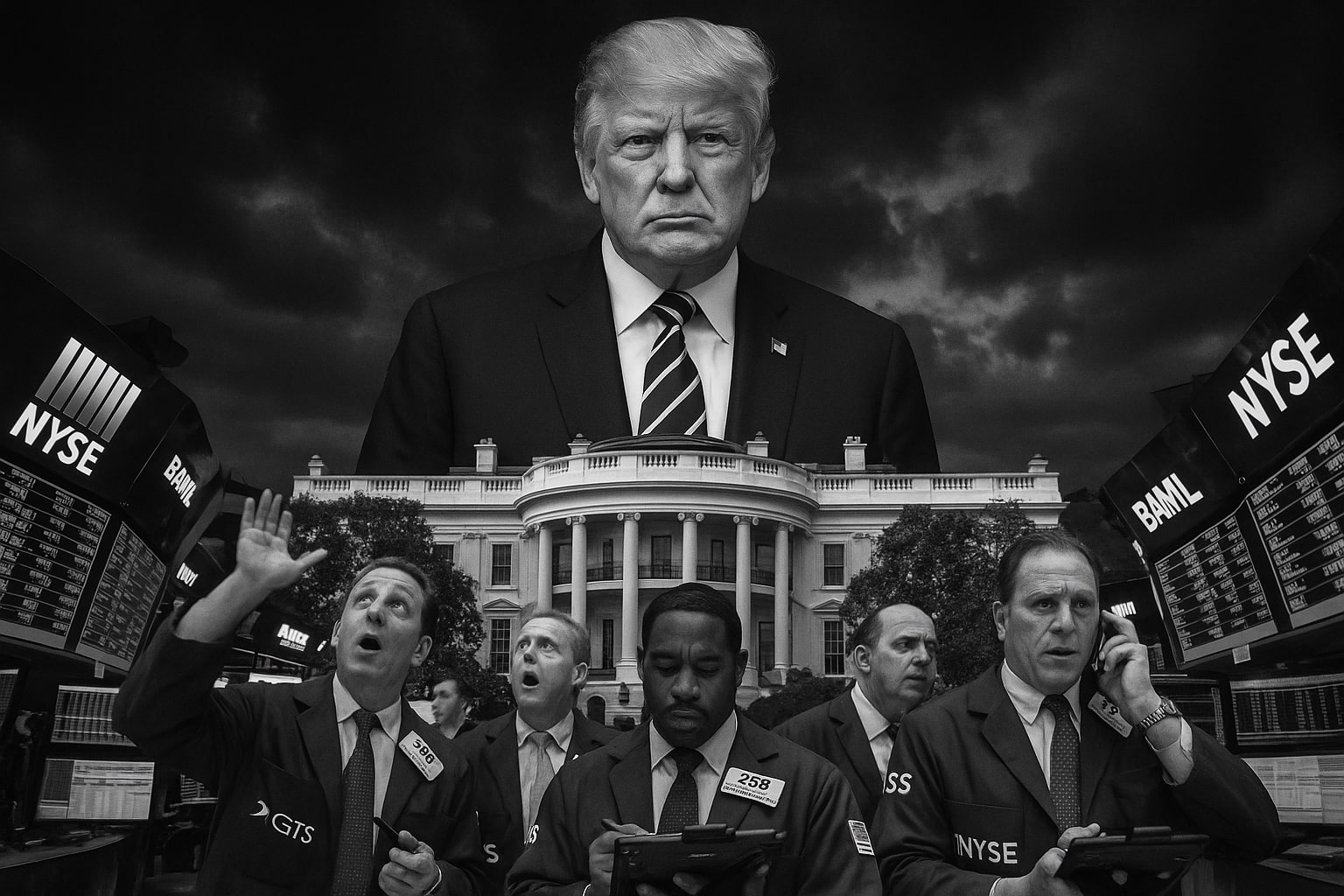
Stock Market Today - Dow, S&P 500 and Nasdaq Futures Climb as Gold and Tsla Stock Jumps and Wall Street Awaits Jobs Data
Tech jitters ease while TSLA and NVDA rebound, IRBT sinks on bankruptcy, BTC-USD slips near $86,900 and markets price more 2026 Fed cuts ahead of key payrolls and CPI | That's TradingNEWS
Stock Market Today: Dow (^DJI) 48,400, S&P 500 (^GSPC), Nasdaq (^IXIC) Futures Rise
Wall Street Opens Higher, Then Loses Grip As Tech Selling Returns
US equities started Monday with a rebound, but the rally faded as the session developed and the technology unwind reasserted itself. The Dow Jones Industrial Average (^DJI) traded around 48,380–48,410, down roughly 0.1%–0.2%. The S&P 500 (^GSPC) hovered near 6,810–6,813, off about 0.2%, while the Nasdaq Composite (^IXIC) slid roughly 0.5%–0.6% toward 23,060–23,080. The Russell 2000 (^RUT) sat near 2,545, down about 0.25%, still lagging but holding far better than at the worst points of last week.
Futures had pointed to a stronger tone earlier in the day. Dow futures were up about 0.5%, with S&P 500 and Nasdaq-100 contracts also gaining roughly 0.5% each before the opening bell, reflecting dip-buying after Friday’s AI-driven selloff. That early optimism faded once cash trading got underway and investors sold rallies in the mega-cap growth complex again.
The volatility shows up clearly in risk gauges. The VIX traded near 16.9, up roughly 7% on the day, a moderate stress signal but still far from panic levels. Overall, Monday is shaping up as a reset session: a market that wants to stay near record highs but has to digest frothy AI valuations, a very aggressive rate-cut narrative for 2026, and a crowded positioning in the same handful of leaders.
Dow, S&P 500 And Nasdaq: Record Highs Last Week, Choppy Start To The Final Stretch
Last week’s performance frames Monday’s trading. The S&P 500 slipped about 0.6%, while the Nasdaq Composite fell roughly 1.7% as a sharp reversal in artificial-intelligence leaders hit sentiment. In contrast, the Dow rose about 1.1%, highlighting how its lower exposure to high-multiple tech buffered the damage.
On Monday, that divergence persists. The Nasdaq remains the weakest of the three major US indices, giving back more ground as investors reassess how much they are willing to pay for AI stories. The S&P 500 trades modestly lower but is still only a small step away from last week’s record close near 6,830–6,840. The Dow is hovering just shy of its all-time highs around 48,400–48,500, reflecting support from value, financials and select industrials rather than pure AI momentum.
The message from price action is simple: the AI-heavy Nasdaq is underperforming, the Dow is quietly outperforming, and the S&P 500 is being pulled between those two poles. For allocation decisions, that means the era of simply owning the “Magnificent 7” and ignoring the rest of the market is losing its grip.
AI Rotation: Oracle And Broadcom Lead A Repricing Of Tech Valuations
The current phase started with a brutal repricing in some of the AI-infrastructure leaders. Oracle (ORCL) plunged roughly 12%–15% over the final two sessions of last week after its earnings report and guidance failed to justify the prior run-up. Broadcom (AVGO) dropped around 7.8%–11% over the same window, its steepest weekly slide since April, despite trading at record highs just days earlier.
Those moves triggered a broader rethink of AI valuations. The S&P 500 information technology sector fell about 2.3% for the week, dragging the Nasdaq sharply lower. Monday’s premarket saw a partial stabilisation: Broadcom was up around 0.7%–0.8%, and high-beta chip names such as Nvidia (NVDA), Micron Technology (MU) and Advanced Micro Devices (AMD) each added around 1%–1.5% in early trading after sharp losses last week.
However, intraday action remains fragile. The Nasdaq’s intraday reversal back into negative territory shows that the market is not yet ready to declare the AI shake-out over. The key point: the AI theme is not dead, but the market is shifting from pure story-driven multiple expansion into a more demanding phase where earnings, margins and capital discipline will matter more than headlines.
Banks, Value And Cyclicals Start To Outperform As Leadership Broadens
As AI-linked names cool, money is rotating into areas that were left behind earlier in the year. Large US banks are a clear beneficiary. On Monday, Goldman Sachs (GS) and Morgan Stanley (MS) both gained more than 1%, and the KBW Nasdaq Bank Index traded near 165.8, up about 0.6% on the day. That relative strength matches the broader pattern: financials and cyclicals held up while AI leaders deflated last week.
Small caps also illustrate the shift. The Russell 2000 remains down about 0.25% on Monday, but that mild decline is a far cry from the deep underperformance seen earlier in 2025. Strategists now argue that some volatility and a pause in the AI trade are necessary pre-conditions for value and small caps to outperform in 2026. That view is consistent with a Fed that is already cutting rates and with a GDP profile that remains positive.
Consumer-facing cyclicals are participating as well. Dollar General (DG) rose about 3% after an upgrade to overweight and a price target increase to $166 from $128, implying roughly 16% upside from current levels. In travel and leisure, Las Vegas Sands (LVS) climbed close to 3% and Marriott International (MAR) advanced about 1.5% on new buy ratings, backed by robust demand from higher-income consumers and a strong Macau recovery theme. The rotation is not uniform, but the signal is clear: breadth is improving, and investors are no longer willing to pay any price for AI exposure when more reasonably valued cyclicals and financials are finally delivering.
Gold And Silver: Haven Trade Pushes Bullion Back Toward Record Territory
While equities churn, precious metals are acting as the clean outperformers. COMEX Gold Feb 2026 futures (GC=F) trade around $4,350–$4,355 per ounce, up roughly 0.5%–0.6% on the day and within about $40–$50 of the all-time closing high near $4,398 set in October. Intraday, prices earlier pushed toward $4,373–$4,385, effectively revisiting record territory. Silver is even stronger in percentage terms, with front-month contracts near $63.6, up around 2.6%.
This is the fifth consecutive daily gain for gold and marks the longest winning streak since the run-up to the October peak. The drivers are straightforward. First, the Federal Reserve delivered a third straight 25-basis-point rate cut last week and signalled a willingness to continue easing in 2026 if the labour market softens. Lower real yields are historically supportive for non-yielding assets such as gold and silver.
Second, the renewed volatility in AI stocks is rekindling the safe-haven bid. As investors question whether AI valuations have run ahead of fundamentals, some capital is recycling into hard assets rather than staying exclusively in equities or long-duration growth names. Gold-linked equities are responding: Newmont (NEM) is among the notable movers on the day as traders reposition around higher bullion prices and better margin prospects at miners.
For now, the tape is telling you that gold and silver are outperforming US equities, and that the combination of easier policy, geopolitical noise and tech-sector fragility is a powerful cocktail for precious metals.
Rates, Dollar And Tariffs: Macro Setup Behind The Index Moves
The 10-year US Treasury yield sits near 4.16%, down a few basis points from around 4.19% at Friday’s close and below the three-month high of roughly 4.21% touched last Wednesday before the latest Fed cut. The gradual drift lower in yields is consistent with a market that expects more easing than the Fed’s own projections for 2026, even as growth remains resilient.
The US dollar index trades around 98.1–98.2, down roughly 0.2%–0.3% and under its recent low near 98.35 from mid-October. A softer dollar, together with lower real yields, helps explain the strength in gold, silver and several non-US risk assets. The Japanese yen has strengthened versus the dollar ahead of this week’s Bank of Japan meeting, where investors will parse any hint of a shift away from ultra-loose policy. Central banks in Europe are also in focus, with decisions due in the final weeks of the year.
On the fiscal and trade front, tariffs have not derailed US growth. Real GDP printed one of its strongest quarterly gains in nearly two years in Q2 2025, and Q3 is tracking close behind. The main reasons: a powerful AI-capex cycle, a risk-asset rally that boosts wealth effects, and the fact that several headline tariffs have been delayed, watered down or applied at effective rates below the headline schedule. That said, tariffs still bite at the micro level.
The iRobot (IRBT) bankruptcy filing is a case study. The company generated roughly $682 million in revenue in 2024 but faced intense competition from lower-priced Chinese rivals such as Ecovacs, while also absorbing a 46% levy on vacuum cleaner imports from Vietnam into the US. Those tariffs added about $23 million in extra costs in 2025, squeezing margins on top of price cuts and heavy R&D spending. IRBT now trades near $1.19, down more than 70% on the day and over 80% from prior levels, with roughly $190 million in debt as it heads into restructuring. That is a reminder that policy risk can destroy equity value even in a generally strong macro backdrop.
Bitcoin And Crypto Treasuries: From Hero To Stress Test
Bitcoin (BTC-USD) is another underperformer in this cross-asset mix. The token trades around $86,700–$86,900, down roughly 2.1%–2.3% on the day and struggling to reclaim the $90,000 level after a sharp October decline. That slide has pushed many corporates who aped the corporate-treasury-as-Bitcoin-fund model into uncomfortable territory.
Roughly 180 public companies now hold some form of crypto on their balance sheet, and about 100 of them follow a variant of the strategy pioneered in 2020 by MicroStrategy (MSTR)—funding large BTC purchases with debt and equity issuance. Of those 100 names with a measurable cost basis, around 65 bought Bitcoin above current prices, leaving them with unrealized losses after the recent drawdown. MicroStrategy itself trades near $165.5, down more than 6% on the day, but analyst commentary still suggests the firm can survive this “crypto winter” thanks to its scale and access to capital. Smaller copycats may not be as fortunate and could remain stuck at discounts to net asset value without a credible path to refinancing.
The takeaway for equity investors: crypto-heavy balance sheets magnify volatility and can become a valuation drag when token prices roll over. In the current phase, Bitcoin is underperforming gold, silver, banks, and even the broader indices, reinforcing its status as a high-beta risk asset rather than a consistent hedge.
Single-Stock Movers: iRobot Collapses, Zillow Slumps, Tesla And Tilray Rally
The strongest signals about where money is flowing come from the day’s biggest movers. On the downside, iRobot (IRBT) is effectively being repriced as an option on a successful restructuring rather than a growth stock. After the Chapter 11 filing and planned sale to Picea Robotics, the stock trades below $1.20, with a one-day collapse of roughly 72% and an 80%+ drawdown versus prior levels. Given the revenue base of $682 million in 2024 and the $190 million debt load, equity investors are signalling minimal residual value until the new owner proves it can restore margins in the face of tariffs and cheaper rivals.
Zillow Group (Z) is the other high-profile casualty. Shares are down roughly 12.8% to around $65.1–$65.2 after reports that Google (GOOG) is testing a new real-estate ad format that could compete directly with Zillow’s core business. The stock is now down more than 9% year-to-date despite a volatile 2025, and the move underscores how platform risk—dependence on larger tech ecosystems—remains a key multiple limiter.
On the upside, Tesla (TSLA) is regaining momentum. The stock trades near $473, up slightly more than 3% intraday after disclosure that the board has earned over $3 billion collectively through stock awards, a figure that dwarfs grants at many other US technology groups. For now, investors are treating the compensation story as confirmation of Tesla’s long-term equity value creation rather than an overhang.
In healthcare tech, Doximity (DOCS) is bouncing. The stock is up roughly 2.5%–4% around $45 after a Morgan Stanley upgrade to overweight and a price target increase to $65, implying approximately 48% upside from current levels. The bank argues that the roughly 30% correction since early November has reset expectations enough to offer an attractive entry point.
Other notable movers include ServiceNow (NOW) near $778, down about 10% as investors digest reports of an advanced $7 billion bid for cybersecurity firm Armis, which would be the company’s largest acquisition to date. Texas Instruments (TXN) is off roughly 2% following a downgrade to Sell and a price-target cut to $156 from $200, reflecting concern about cyclical headwinds and capital intensity. Teradyne (TER) is up about 4% after a 5% drop on Friday, highlighting how traders are selectively bottom-fishing in semiconductor equipment after last week’s washout.
In cannabis, Tilray (TLRY) adds around 3%, building on last week’s rally following news that US authorities plan to shift cannabis to a Schedule III classification from Schedule I, a change that could materially improve industry economics. And in consumer staples, Hershey (HSY) received a meaningful vote of confidence: a rating move to overweight and a price target increase to $211 from $195, signalling roughly 16% potential upside as cocoa-related cost pressures recede and earnings growth is expected to reaccelerate.
Global And Niche Stories: Juventus, Momentus, XPO And The AI Corporate Spending Wave
Outside the core US benchmarks, there are several notable cross-currents. In Italy, Juventus Football Club surged about 16% in Milan trading after holding company Exor rejected an all-cash takeover proposal from stablecoin issuer Tether. Tether had proposed buying the Agnelli family’s stake—over 65% of Juventus’ share capital—and then launching a tender for the remainder, backed by a planned €1 billion investment into the club. Exor’s refusal keeps Juventus public and underscores the premium value placed on elite sports franchises even in a choppy macro environment.
In US small-cap space, Momentus (MNTS) collapsed nearly 30% toward $0.59 following the announcement of a 1-for-17.85 reverse stock split and the cancellation of a special shareholder meeting. Shares have lost over 90% of their value this year, signalling a market that is deeply sceptical about the viability of the business model despite the company’s pitch around in-space transportation and satellite infrastructure. Reverse splits of this magnitude are typically interpreted as distress signals rather than catalysts, and the price action reflects that.
Corporate leadership moves also matter for sentiment. Serial deal-maker Brad Jacobs is stepping down as chairman of XPO (XPO) and GXO Logistics (GXO), effective Dec. 31, to focus on building QXO (QXO) into a $50 billion revenue building-products distribution player via acquisitions and organic growth. GXO and XPO trade modestly lower (down around 1–2%), while QXO is little changed, but the strategic message is clear: capital will continue to flow toward logistics and distribution platforms seen as long-term consolidators.
At the centre of the AI narrative, OpenAI (OPAI.PVT) has been named “Company of the Year” by one major financial outlet, reflecting its dominant role in 2025’s market story. The firm has secured about $1.4 trillion in committed spending over the next eight years, converted to a for-profit structure, and is widely discussed as a potential trillion-dollar IPO candidate. Private shares have surged roughly 153% this year, implying a $500 billion valuation. Estimated 2025 revenue of about $13 billion leaves a long runway of execution risk; one major bank projects a $207 billion funding gap by 2030 even if the top line scales as expected. The equity market’s broader question is whether AI capex and associated revenues will ultimately justify the valuations of both OpenAI’s private equity and its listed partners such as Microsoft (MSFT), Oracle (ORCL), Advanced Micro Devices (AMD) and Nvidia (NVDA).
Read More
-
Yen Stalls at 160 Despite a 3% JGB and Tokyo Core CPI at 2.0% — Intervention Sits at 164, Friday's Payrolls Decide
02.09.2026 · TradingNEWS ArchiveEnergy
-
QQQI ($53.80) Turns Nasdaq Volatility Into a 14.2% Monthly Yield as Assets Top $15B — Big Tech Earnings Set November
27.10.2026 · TradingNEWS ArchiveStocks
-
XRPI ($7.09) Rises 2.46% as Spot XRP Funds Hold $1.47B but Flows Stall Near Zero — $1.35 Breakout Sets the Next Leg
27.10.2026 · TradingNEWS ArchiveCrypto
-
NG($3.002) Takes the Front Month Near a Multi-Month Low as Record Production Meets Mild Weather — Break of $2.945 Opens $2.80
27.10.2026 · TradingNEWS ArchiveCommodities
-
USD/JPY (157.86) Squeezed Between a 2.8-Point Carry Edge and Tokyo’s 160 Line — BoJ Hawkish Hold Friday Sets the Break
27.10.2026 · TradingNEWS ArchiveForex
Fed Cuts, Trump’s Next Fed Chair And The 2026 Policy Path
Monetary policy remains the central macro driver for all three major US indices. The Federal Open Market Committee delivered its third 25-basis-point rate cut of 2025 last week, and the decision was the most contested of the year, with three dissenting votes split between members wanting either no cut or a larger move. Chair Jerome Powell’s press conference was interpreted as less hawkish than feared, with some market participants calling him closer to a “chicken hawk” than a hawk given his emphasis on labour-market risks.
Even as the Fed’s official 2026 dot plot signals only one additional cut, futures markets are already pricing in a deeper easing cycle if growth slows. The Fed’s GDP projection of about 2.3% for 2026 implies enough activity to support revenue and margin expansion, which is exactly what equity bulls are embedding into their S&P 500 and Dow price targets.
Overlaying this is politics. President Trump has made clear he plans to replace Powell when his term ends in May 2026 and is openly considering either Kevin Hassett or Kevin Warsh as the next Fed chair. Both are perceived as more inclined toward lower rates than Powell, although Hassett has recently stressed that the Fed must retain nominal independence even if it listens to the administration’s views.
Trump’s broader fiscal agenda—centred on his so-called “One, Big, Beautiful Bill”—adds another layer. Markets expect a blend of tax cuts, deregulation and infrastructure spending that would reinforce the monetary impulse, a combination that historically supports equity valuations but can also prolong inflation risks. For now, the equity market is treating this mix as net bullish, especially for value, industrials, banks and domestically oriented small caps.
Data Backlog And Earnings Calendar: Jobs, Inflation, Micron, Nike, FedEx, Darden, Accenture
This week’s tape will be driven less by headlines about AI and more by hard macro data and corporate results. Because of the recent US government shutdown, key releases were pushed into the final full trading week of the year.
On Tuesday, Dec. 16, at 8:30 a.m. ET, markets will get November nonfarm payrolls and October retail sales, plus business inventories data for September. Consensus expects roughly 40,000 jobs added in November, a steep slowdown from the 119,000 gain in September, indicating a cooling labour market that supports the Fed’s easing narrative. Retail sales and inventories will show whether consumer demand and stock-building remain strong enough to justify optimistic earnings forecasts.
On Thursday, Dec. 18, at 8:30 a.m. ET, the focus shifts to the November Consumer Price Index (CPI). Any downside surprise versus expectations will entrench the idea that the Fed can continue to cut in 2026 without losing control of inflation, a scenario that would be positive for the S&P 500 and Dow and potentially less favourable for the US dollar.
Earnings will also shape sector-level performance. Micron Technology (MU) reports on Wednesday, giving the market a crucial look at memory demand for AI and data-centre workloads. On Thursday, investors will digest results from Accenture (ACN), NIKE (NKE), FedEx (FDX) and Darden Restaurants (DRI). These names collectively cover consulting, global logistics, athletic consumer demand and US casual dining, offering a broad read-through into corporate IT budgets, shipping volumes and discretionary spending. Strong numbers here would reinforce the case for rotating into cyclicals, transports and consumer names and away from a narrow AI-only exposure.
Oil, Commodities And Cross-Asset Context For Index Positioning
The commodity complex is sending a more muted signal than gold. West Texas Intermediate crude (CL=F) trades near $56.9 per barrel, down about 0.8%–1% on the day. The S&P GSCI Spot Index sits around 542.9, roughly 0.5% lower, signaling modest pressure across a basket of energy, metals and agricultural contracts. The combination of steady growth, easier US monetary policy and ongoing geopolitical risks has not yet translated into a sustained energy spike, which is mildly supportive for equities via lower input costs for transport, airlines and manufacturing.
At the same time, Treasury yields just above 4.15% on the 10-year and a sub-100 dollar index keep the overall financial conditions relatively loose. That environment historically favours equities over cash, especially when GDP growth remains above 2% and credit markets are functioning. The catch, and the reason for Monday’s choppiness, is that AI valuations and crypto-related froth have created pockets of exuberance that now need to be repriced without breaking the broader bull case.
Index Outlook: Buy, Sell Or Hold On Dow, S&P 500 And Nasdaq
Given the full set of data—index levels, sector rotation, macro policy, commodities and key single-stock moves—the stance across the big three US indices is not symmetric.
For the Dow Jones Industrial Average (^DJI) around 48,400, the combination of lower AI concentration, improving bank performance, and leverage to traditional cyclicals argues for a constructive view. With Fed policy turning more supportive, fiscal stimulus probable, and tariffs failing to derail growth, the Dow is positioned as the relative winner of a broadening rally. On that basis, the call here is bullish bias / Buy on the Dow on pullbacks, with the caveat that upside will likely be steady rather than explosive from already elevated levels.
For the S&P 500 (^GSPC) near 6,810–6,815, valuations are richer and the index still carries substantial mega-cap tech exposure, but breadth is improving and earnings expectations are being underpinned by a 2.3% 2026 GDP forecast plus easier policy. With gold, banks and select cyclicals outperforming while AI names deflate but do not collapse, the risk-reward skews toward owning the benchmark with discipline rather than chasing extremes. Here the stance is neutral-to-positive / Hold with a mild bullish tilt—appropriate for investors willing to ride volatility but not a screaming bargain.
The Nasdaq Composite (^IXIC) around 23,060–23,080 is where the risk is most acute. After a powerful multi-year run led by AI narratives, the index is now sensitive to every earnings disappointment and every sign that capex is outpacing returns. With names like Oracle (ORCL) and Broadcom (AVGO) already showing how quickly sentiment can flip, and with fresh concerns around over-extended valuations, the probability of further air coming out of the most expensive pockets remains high. Against that backdrop, the stance is cautious / Hold-to-lighten, not outright bullish at current levels. Exposure can be justified where fundamentals and pricing still align—such as select semis with strong visibility—but broad, indiscriminate buying of Nasdaq-heavy AI names looks unjustified on this data.
Overall, Monday’s tape confirms a rotation rather than a collapse: AI-centric tech and crypto are underperforming, gold, banks and value are outperforming, and the Dow and S&P 500 continue to trade near record territory despite short-term wobble. For now, the market is still pricing 2026 as a year of easier policy, solid growth and more balanced leadership—just not a one-way bet on AI at any price.