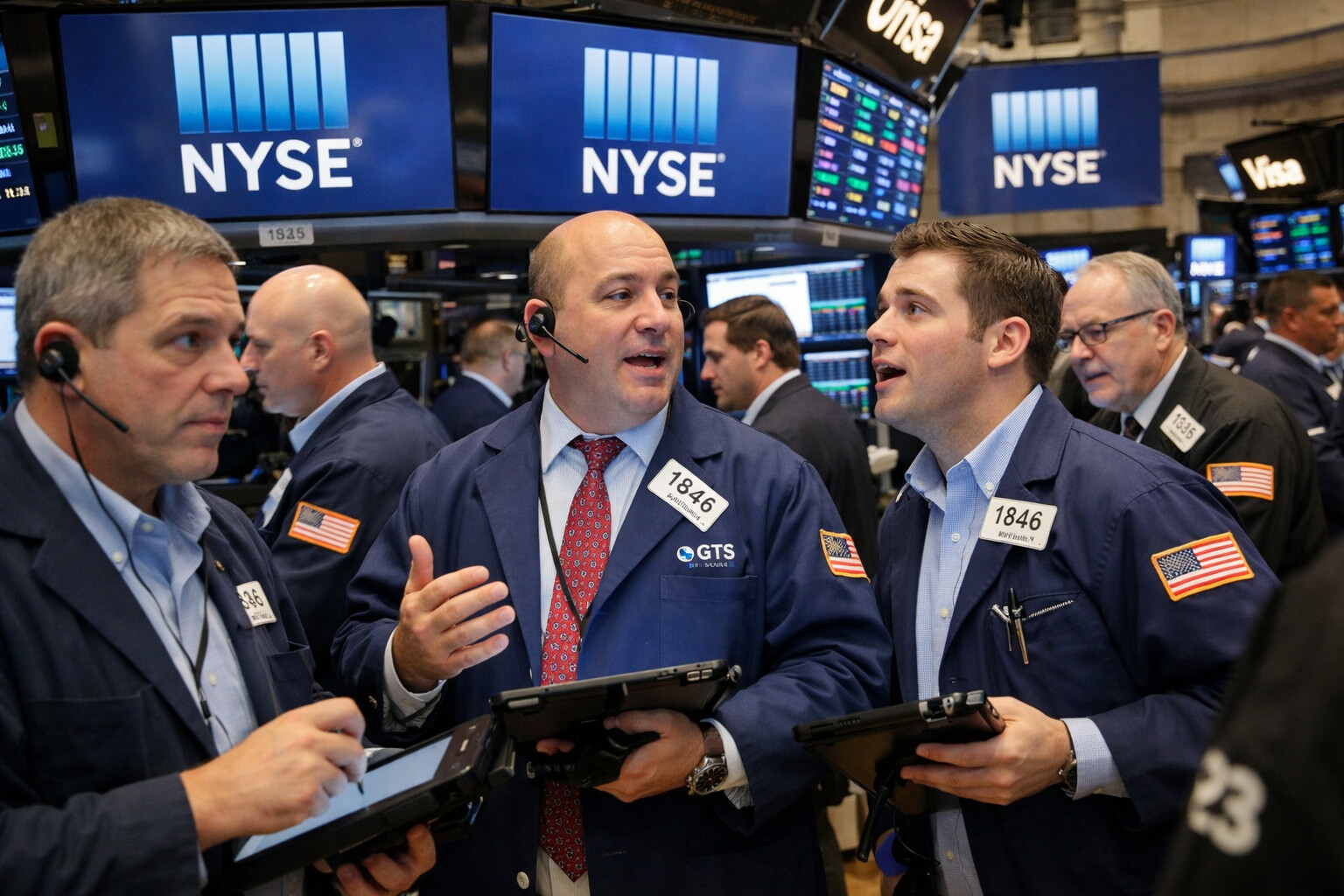
Stock Market Today: Dow, S&P 500 and Nasdaq Split as Palantir Rockets and Gold Snaps Back Toward $4,950
Dow holds near 49,400, S&P 500 hovers around 6,950 and Nasdaq stalls near 23,400 while TER surges on AI demand, PYPL slides to the low $40s, WMT hits $1T and DIS taps Josh D’Amaro as CEO | That's TradingNEWS
U.S. INDEXES AND MACRO BACKDROP
Major benchmarks: Dow, S&P 500, Nasdaq, Russell 2000
U.S. stocks are chopping around early Tuesday with a clear split between value and growth. The Dow Jones Industrial Average is hovering near 49,400, roughly 0.2%–0.4% higher after Monday’s 515-point surge that kicked off February with a bang. The S&P 500 is fluctuating around 6,950–6,960, once again within striking distance of a fresh record after closing just shy of an all-time high yesterday. The Nasdaq Composite is the weak point, down around 0.4%–0.8% near 23,400 as traders take profits in crowded tech and AI trades after a big rebound in late January. Small caps, measured by the Russell 2000 around 2,655, are up about 0.5%–0.6%, showing that risk appetite has not collapsed and that capital is rotating rather than fleeing the equity complex. Overall, the tape is saying “orderly digestion” rather than panic.
Rates, dollar, volatility
The 10-year Treasury yield is pinned around 4.28%–4.30%, only a few basis points above Friday’s level, keeping financial conditions stable even as the market digests heavy earnings and macro headlines. The dollar index is sitting in the mid-90s, around 94.8–97.7 depending on the basket referenced, close to multi-year lows as investors price in a Fed that has already cut three times and is expected to ease a bit more this year. Volatility is contained with the VIX near 16.5, up slightly but well below stress levels. This combination—equities near records, yields elevated but steady, dollar soft, vol moderate—is exactly the environment where stock-specific earnings and sector rotations dominate the intraday story.
AI LEADERSHIP: PALANTIR, TERADYNE AND THE NEW TECH PECKING ORDER (PLTR, TER, PYPL)
Palantir Technologies (PLTR) is the single clearest outperformer on the board. The stock is ripping higher by low-double digits, roughly 10%–12%, trading in the mid-$150s after another explosive quarter. Revenue jumped about 70% year-over-year to roughly $1.41 billion, crushing expectations around $1.33 billion, and adjusted EPS of $0.25 beat the $0.23 consensus. The crucial detail is mix: U.S. commercial revenue surged roughly 137% to more than $500 million, while U.S. government revenue climbed about 66% to roughly $570 million. That is not “AI sentiment”; that is hard demand from customers who do not churn easily. Management is guiding 2026 revenue toward the $7.2 billion region versus the street in the low-$6 billions earlier, essentially forcing analysts to recalibrate their models. After a three-month slide that left the stock finishing 2025 just under $178, PLTR had been bleeding confidence; today’s move reasserts it as a core AI winner. With this growth profile and record profit around $609 million last quarter, PLTR is a Buy with high volatility, not a trade you fade just because the chart looks extended.
On the hardware and test side of the AI stack, Teradyne (TER) is delivering one of the strongest earnings reactions in the market. The stock is up well into double digits, trading around $265–$270, after Q4 revenue near $1.08 billion and adjusted EPS around $1.80 smashed expectations closer to $973 million and $1.37. Even more powerful is the guidance: Q1 revenue projected in the $1.15–$1.25 billion range versus the street under $1.0 billion. That tells you that AI-driven semiconductor and robotics demand is not only real but accelerating into 2026. With market cap pushing toward $40 billion and the chart pressing record highs, TER is being repriced from cyclical tester to structural AI infrastructure beneficiary. On risk/reward, this is a Buy on pullbacks, not something to short into strength.
The flip side of tech is PayPal Holdings (PYPL). Here the market is ruthless. The stock is down around 16%–18%, trading near $42–$43, after the company warned that 2026 adjusted profit will be flat to low single-digit, versus Wall Street expectations for about 8% growth. Q4 missed estimates as well, with U.S. retail spending soft, branded checkout growth slowing, and competition intensifying. The appointment of Enrique Lores from HP as the new CEO signals that the board knows the franchise needs a reset, but investors are not going to pay up for a transition story without clear re-acceleration. At these levels PYPL is probing multi-year lows it hasn’t seen since 2017; cheap optics alone are not enough. This remains a Hold to underweight, not a high-conviction turnaround, until the company proves it can re-ignite branded checkout and rebuild operating leverage.
MEGA-CAP TECH, CHIPS AND THE AI BUBBLE DEBATE (AMD, NVDA, INTC, NXPI, TDK, SAMSUNG)
Chipmakers sit at the center of every macro conversation now. Advanced Micro Devices (AMD) reports after the close, with the street looking for Q4 EPS around $1.32 on $9.6 billion in revenue, up from $1.09 on $7.7 billion a year earlier. The share price has risen roughly 110% over the last 12 months and about 14% year-to-date, so the burden of proof is heavy. The market does not only want a beat; it wants a credible roadmap for AI GPU ramp, data-center share gains and clarity that spending from hyperscalers is sustainable after mixed reactions to MSFT and META capex last week. Short term, AMD is a Hold into earnings; the attractive setup is a sharp, sentiment-driven pullback that takes the name to a more reasonable multiple while leaving the AI thesis intact.
Nvidia (NVDA) is softer today, down around 2% as investors digest headlines about tension with major AI customers and speculation that OpenAI may not be fully satisfied with its newest chips. After a more than 50% gain in the last year and a more than tenfold rally since late 2022, any hint of saturation in AI GPU demand or diversification of supply away from NVDA has an outsized impact on sentiment. Fundamentals are still very strong, but the market is now scrutinizing every data point on pricing power and competitive moat. At this valuation NVDA remains a Hold with a bullish tilt, but it is no longer a one-way momentum bet; risk management matters.
Intel Corporation (INTC) is enjoying a modest rebound, up around 2%, after a SoftBank-backed unit, Saimemory, agreed to partner on commercializing next-generation memory technology. This is exactly the kind of ecosystem validation INTC needs as it pivots from lagging PC supplier to leading-edge foundry and AI infrastructure provider. Around the high-$40s, with the balance sheet still solid and Washington backing domestic fabs, INTC is a Speculative Buy for patient investors; the upside lies in execution on foundry strategy and AI server penetration, not in legacy PC volumes.
NXP Semiconductors (NXPI) is a classic “good numbers, bad reaction” case. Q4 revenue of about $3.34 billion beat the roughly $3.3 billion consensus; adjusted EPS of $3.35 topped the ~$3.31 expectation. Automotive, which is more than half of sales, grew 5% year-over-year to about $1.8 billion, but that was a slight slowdown from 6% growth in the prior quarter and just under the roughly $1.9 billion investors were hoping for. The stock is down around 9% to roughly $210, even though management guided Q1 revenue to about $3.15 billion and diluted EPS above $4, both ahead of consensus. The message from the tape is clear: positioning in auto-exposed semis was crowded, and any deceleration gets punished. Fundamentally, though, the combination of better-than-expected guidance and reasonable valuation makes NXPI a Buy on weakness rather than a name to abandon.
In Asia, the AI memory trade is driving remarkable moves. Samsung Electronics surged more than 11% in Seoul, its biggest one-day gain since 2008, as investors price in a global scramble for high-bandwidth memory and AI-related storage. The Kospi index jumped roughly 6.8% to above 5,280, extending its year-to-date gain to around 25% and making it one of the best-performing major indices globally. SK Hynix added more than 9%, and the iShares MSCI South Korea ETF (EWY) is up roughly 4% in U.S. trading. With both Samsung and SK Hynix up more than 39% this year alone and still considered reasonably valued by many local managers, the structural AI memory shortage narrative remains intact. Both remain Bullish long-term, but after such an aggressive run, new entries should accept that pullbacks of 15%–20% are normal in this kind of trend.
In Japan, TDK Corporation (6762.T) jumped about 11% after raising its full-year operating profit forecast by 8% to ¥265 billion, ahead of the analyst average. Strong demand for smartphone batteries and sensors and a weaker yen are doing the heavy lifting. With Apple (AAPL) as a key customer and data-center demand still firm for storage components, TDK is benefitting from both consumer device cycles and AI infrastructure. The upgrade, plus a higher dividend forecast to ¥34 per share, supports a Buy stance for investors looking at Japan’s electronics complex as a medium-term winner.
U.S. CONSUMER, HEALTHCARE AND UTILITIES: DEFENSIVES QUIETLY OUTPERFORM (PEP, MRK, PFE, DVA, AES)
In consumer staples, PepsiCo (PEP) has shifted from “defensive laggard” back toward “quality compounder.” The company delivered Q4 revenue and earnings ahead of expectations, with management highlighting a sequential acceleration in reported and organic revenue growth across both North America and international markets. Volumes are under pressure as consumers trade down and trim discretionary purchases, but PEP is still extracting pricing and protecting margins. The stock is up about 3.5% around $161. At this level, the valuation is not cheap, but the combination of brand power, global distribution and pricing discipline keeps PEP firmly in Hold/accumulate on dips territory.
Merck & Co. (MRK) initially traded lower after issuing a 2026 revenue outlook of roughly $65.5–$67 billion versus consensus near $67.6 billion, as the market adjusted to a more modest top-line trajectory amid looming patent expirations and generic competition. The stock has since pushed higher and is now up around 3% near $117 as investors focus on the oncology franchise and pipeline depth rather than headline revenue guidance. As long as the core cancer treatments continue to grow and pipeline readouts are supportive, MRK remains a Hold-to-Buy, offering lower beta and solid cash flows in a market still dominated by cyclical narratives.
Pfizer (PFE) remains under pressure. Q4 results topped estimates, but revenues fell sharply versus the pandemic peak, and management reaffirmed a modest 2026 outlook that disappointed investors back in December and still has not materially improved. The stock is down about 3%–4% around $25–$26. With the COVID franchise in structural decline and the new pipeline still proving itself, the market is not willing to pay a premium multiple. Dividend support and restructuring efforts help, but from a pure equity angle PFE is a Hold, not a clear Buy, until there is concrete evidence that non-COVID products can generate consistent mid-single-digit or better growth.
The outlier in healthcare is DaVita (DVA). The stock is soaring over 20% after posting blowout earnings and raising full-year guidance well above prior ranges. That strength comes even as Berkshire Hathaway sold another 1.66 million shares last week, reducing its stake to just under 45% as part of a pre-agreed program. The fact that the stock can rally this hard right after a major shareholder sells into strength tells you the market is focused on fundamentals: better pricing, tighter cost control and strong demand for dialysis services. At these levels, after a vertical move, DVA is a Hold for existing holders who just benefited from the rerating; new buyers should be selective and patient rather than chase a 20% gap higher.
In utilities and infrastructure, AES Corporation (AES) is moving sharply higher, up about 5% after news that BlackRock’s Global Infrastructure Partners is teaming up with EQT in a bid to acquire the company. With AES providing renewable power to big clients like Microsoft (MSFT), the name sits at the intersection of decarbonization and data-center expansion. A formal deal could come within weeks, according to the reporting. With takeover speculation now in the price, AES effectively trades as a Hold for deal-risk players; the upside from here is mostly tied to the final bid premium and regulatory clarity.
RETAIL, MEDIA AND LEADERSHIP SHIFTS: WMT HITS $1 TRILLION, DIS, TGT RESET STRATEGY
Walmart (WMT) crossed the $1 trillion market-cap line as shares ticked above $125, up more than 12% since the start of the year. The CEO transition from Doug McMillon to John Furner has been received as a “continuation, not reinvention” story, with the company already executing well on grocery, omnichannel, membership and advertising. Piper Sandler raised its price target to $130, and other brokers have echoed the view that WMT can keep stealing share from weaker retailers, especially as consumers remain choosy. In a market where defensives with structural growth are scarce, WMT is a clear Buy-to-Hold name for long-term portfolios.
The Walt Disney Company (DIS) is wrestling with succession and strategy at the same time. Shares fell more than 7% yesterday despite better-than-expected earnings, as speculation around Bob Iger’s exit and the identity of his successor spooked the market. This morning, the company confirmed that Disney Experiences chairman Josh D’Amaro will become CEO on March 18, with Iger staying on the board through year-end. Disney’s Experiences segment—parks, cruises and related businesses—has been the most reliable profit engine, and elevating its leader to the top job signals that the board wants operational discipline and guest-experience focus at the center of the story. The stock is modestly higher, around +1%, as investors digest the move. Execution risk is high, but if D’Amaro can maintain Experiences momentum and stabilize streaming economics, DIS shifts from “succession overhang” toward “speculative turnaround.” On a two-to-three-year horizon, at these levels, DIS is a Speculative Buy, with the clear caveat that any missteps will be punished.
In broader retail, Target (TGT) and Walmart now illustrate two different strategic paths. Target’s new CEO Michael Fiddelke inherits four straight quarters of revenue declines, share price down more than 20% over the last year, and questions around merchandising missteps and slower logistics build-out. Walmart’s new CEO John Furner inherits a company that is already winning share and impressing on digital execution. The market is treating TGT as a High-risk Hold at best, requiring proof of reinvention, and WMT as a structural Buy.
PRECIOUS METALS AND MINERS: EXTREME VOLATILITY, ETF WHIPSAW AND $6,000 GOLD TALK (GLD, SLV, MINERS)
Gold and silver have turned into the most violent trade on the screen. Gold futures have rebounded more than 6%, trading near $4,940–$4,950 per ounce after a historic two-day wipeout that took prices down roughly 13% from last week’s peaks above $5,600. Silver has swung even more aggressively, soaring around 13%–14% back toward $87–$88 after plunging from a spike above $121 last week and suffering its worst day in decades. Spot gold around $4,890–$4,940 and spot silver in the mid-$80s tell you this is not a calm repricing; it’s a positioning shock.
Bank of America is openly discussing a path for gold to reach $6,000 in the coming months, arguing that rallies don’t end on overbought technicals but when the underlying drivers fade—weak dollar policy signals, geopolitical uncertainty and concerns about central-bank independence. At the same time, volatility is extremely high, and the market is already processing Trump’s Fed chair choice and shifting expectations around central-bank behavior. Gold’s move has also pushed the Dow/gold ratio down toward 10x, below a long-term average around 13.8x, signaling that the metal is expensive relative to blue-chip equities by historical standards.
The ETF complex and miners are mirroring this chaos. SPDR Gold Shares (GLD) is up roughly 5%–6% on the day, around $452, but down more than 10% over the past week. iShares Silver Trust (SLV) is jumping around 9%, yet has lost close to 30% in just five sessions. Levered products like ProShares Ultra Silver have seen pre-market gains above 16%. Gold and silver miners such as Endeavour Silver (EXK), Coeur Mining (CDE), Hecla Mining (HL) and First Majestic Silver (AG) are up 8%–10% in early trade. For traders, this is an environment for tight risk controls; for longer-term investors, the message is that the gold trade now prices in a huge amount of macro fear. On a 12–18-month horizon, gold-linked assets are a Cautious Hold to small Buy if you need a hedge, but no longer a quiet defensive corner of the portfolio.
Read More
-
Yen Stalls at 160 Despite a 3% JGB and Tokyo Core CPI at 2.0% — Intervention Sits at 164, Friday's Payrolls Decide
02.09.2026 · TradingNEWS ArchiveEnergy
-
AMD ($560.68) Rebounds 10% From Its October Low on the Meta Helios Win — November 3 Report Holds the Key to $649
27.10.2026 · TradingNEWS ArchiveStocks
-
Ethereum ($2,312) Lags Bitcoin and AI Stocks as BitMine Nears Its 5% Cap — Break of $2,295 Opens $2,200
27.10.2026 · TradingNEWS ArchiveCrypto
-
Brent ($113.88) Trades a $2.35 Range as Houthi Strikes Meet Saudi-Iran Diplomacy — Break of $117 Unlocks $120
27.10.2026 · TradingNEWS ArchiveCommodities
-
Nasdaq Rips 1.3%, S&P 500 Hits 7,728, Dow Stalls as BA Drops to $171
27.10.2026 · TradingNEWS ArchiveMarkets
-
GBP/USD (1.3310) Can’t Cash In on 5.43% Gilt Yields as Budget Risk Meets a Firm Dollar — Break of 1.3274 Opens 1.3200
27.10.2026 · TradingNEWS ArchiveForex
CRUDE OIL, INDUSTRIALS AND MACRO SENTIMENT (CL=F, BZ=F)
West Texas Intermediate crude (CL=F) is stabilizing after a sharp sell-off. Futures are up almost 1% around $62.70–$63.00 a barrel after dropping about 4.5% on Monday. Brent (BZ=F) is slightly firmer as well. The move lines up with a market that is more focused on central-bank policy and AI equities than on supply shocks for now, especially as U.S.-Iran diplomatic efforts and shifting sanction expectations cool some of the geopolitical premium. For energy equities, this level is not catastrophic but it is uncomfortable; many balance sheets and dividend policies assume prices closer to the high-$60s or $70s. At current levels, high-quality integrated majors remain Hold/Buy on weakness, while more levered shale names are a High-beta trading vehicle, not core holdings.
Industrial sentiment is mixed but leaning positive. AES, as discussed, is in the crosshairs of infrastructure capital. Elsewhere, the market is watching power-hungry AI data-center demand as a structural tailwind for utilities, renewables and grid equipment makers. That theme supports a Bullish multi-year view on well-capitalized infrastructure names even if near-term rate moves create valuation noise.
CRYPTO, DIGITAL FINANCE AND RISK SENTIMENT (BTC-USD, GLXY)
Bitcoin (BTC-USD) is trading around $77,000–$78,000, roughly flat on the day after briefly dipping to about $74,500 yesterday, its lowest print since April. The recent slide came hand-in-hand with the metals crash and a short-lived wobble in risk appetite, but the resilience near the mid-$70k band shows that long-term holders are not capitulating yet. As the dollar remains weak and the market still expects further Fed easing, Bitcoin continues to function as a high-volatility macro asset rather than a simple risk-on tech trade. At these levels, BTC-USD is a Speculative Hold/Bullish for high-risk capital only, not a safe haven; position sizing is crucial.
Galaxy Digital (GLXY) illustrates what happens when crypto beta cuts the wrong way. The stock is down more than 10% after the company posted roughly $500 million in Q4 losses, with adjusted loss per share around $1.08 versus expectations for a narrower $0.92 loss. Revenue of about $10.2 billion missed estimates closer to $12.15 billion, as digital-asset prices and trading volumes weakened. Trading activity dropped about 40% quarter-on-quarter after a record Q3. The firm still talks up its data-center build-out and has secured ERCOT approval lifting its Helios campus capacity to more than 1.6 gigawatts, but equity investors are focused on realized losses and shrinking trading revenue. At this point, GLXY is firmly a High-risk Speculative Hold or Avoid, depending on risk tolerance; it is a leveraged bet on both crypto prices and the firm’s ability to scale infrastructure profitably.
GLOBAL EQUITIES, TRADE FLOWS AND AI CAPITAL WAR (SENSEX, ADANIPORTS, SAMSUNG, EWY)
Beyond the U.S., risk assets are sending a strong pro-growth message. In India, the benchmark Sensex jumped about 2.5% after President Trump agreed to slash tariffs on Indian goods to around 18% under a new trade deal, with New Delhi promising to stop buying Russian oil. Adani Ports & Special Economic Zone (ADANIPORTS.NS) rallied more than 9%, and Bajaj Finance (BAJFINANCE.NS) climbed about 6.7%. That move signals that global capital sees India as one of the key long-term winners of supply-chain re-orientation and trade realignment. Indian equities at these levels remain a Bullish long-term theme, but single-stock entry points need to respect the strong rallies already in place.
In Europe, the Stoxx 600 is up about 0.6% with the DAX and CAC 40 each advancing more than 0.4%, and the FTSE just above flat. Mining names are leading as gold and silver rebound. At the same time, AI disruption fears are hitting traditional publishers hard: RELX and Wolters Kluwer are both down more than 10%–15% on the day and over 40% in six months as investors price in new AI tools from Anthropic that threaten parts of the legal-publishing profit pool. Those charts say the market believes AI is not just lifting semis and software; it is also eroding the moat of incumbents whose value rests on proprietary data and workflows. The sector is in Bearish re-rating mode until business models are visibly adapted.
Across all these moves, one strategic thread is clear: capital is flowing aggressively into the AI supply chain—chips, memory, infrastructure, software—and punishing any business that looks exposed to AI cannibalization or stuck in pre-AI economics. That capital war is not a headline; it is visible every day now in relative performance between PLTR/TER/AMD/NVDA on one side and traditional content or legacy tech on the other.
BOTTOM-LINE STANCE: BUY/SELL/HOLD ACROSS THE KEY TICKERS
U.S. indices are near records with a mild tech wobble, AI leaders like PLTR and TER are being rewarded for real numbers, PYPL and weak-guidance names are being punished, gold and silver are in an outright volatility regime, and global markets from Seoul to Mumbai are riding AI and trade-deal tailwinds. Within that landscape, the clear Buy or Buy-on-pullback camp includes PLTR, TER, WMT, selected AI semis like AMD on weakness, memory leaders such as Samsung and SK Hynix, quality defensives like PEP, and structurally solid autos/industrial semis like NXPI after this reset. The Hold/neutral bucket includes richly valued but dominant players like NVDA, stable healthcare names MRK and PFE, gold and silver exposures for hedging rather than speculation, and AI-linked infrastructure names like INTC and AES where execution and deal risk drive the next leg. The Sell or avoid cluster is concentrated around structurally challenged stories like PYPL, where guidance undercuts the growth narrative, and legacy information publishers hit by AI headwinds until strategies are clearly rebuilt. The tape is rewarding real earnings, real AI leverage and real balance-sheet strength and is ruthless with weak guidance and business models vulnerable to the next generation of tech.