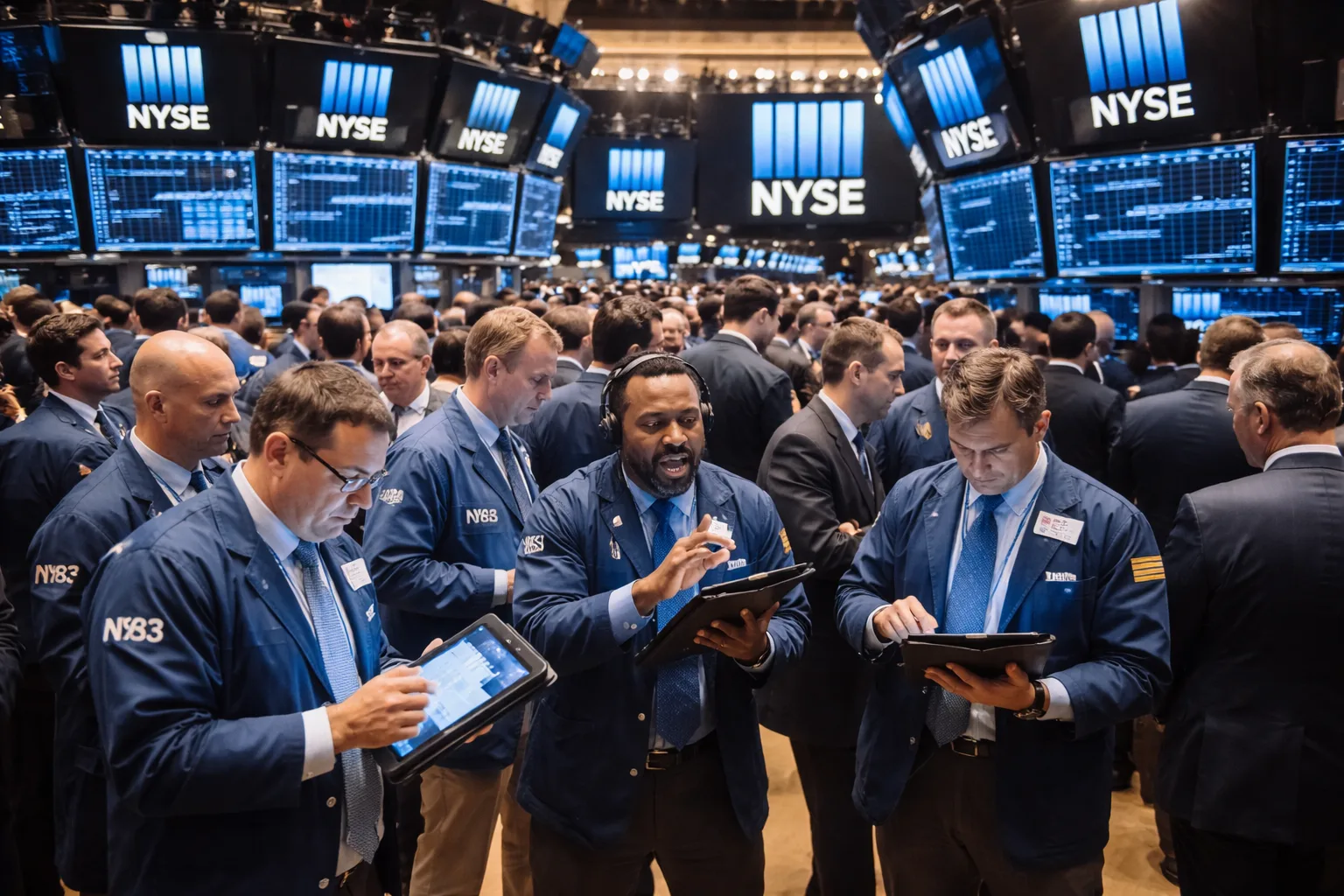
Stock Market Today: Dow, S&P 500 and Nasdaq Retreat as Oil Tops $100 Again — $MLKN Craters 22%, $WVE Crashes 55%, $OLPX Soars 50%
Brent crude surges to $101.74, the 10-year Treasury yield hits 4.39%, and the Nasdaq sits just 0.6% from correction territory | That's TradingNEWS
Key Points
- Oil Reclaims $100 and Breaks the Market's Back — Brent surged 4.61% to $101.74 and WTI jumped 4.41% to $94.30 after Iran rejected negotiations and Israel killed the Iranian naval commander who shut down the Strait of Hormuz. The Dow is now down 5.2% in March alone, heading for its worst monthly drop since December 2024.
- Google's TurboQuant Torches the Memory Trade — Sandisk fell 4%, Micron dropped 3%, Western Digital and Seagate each lost 2%-3%, and the VanEck Semiconductor ETF shed 2.92% after Google unveiled compression technology that shrinks AI memory requirements by a factor of six. This directly threatens the thesis behind stocks that ran 300% to 1,200% over the past year.
- The Fed Rate-Hike Probability Doubled Overnight — Markets are now pricing a 32.8% chance the Fed hikes rates by December, up from 20.2% just 24 hours earlier, as the 10-year Treasury yield surged 41.2 basis points in March — its biggest monthly move in 17 months. BlackRock's Rob Kapito warned oil could still hit $150 even if the war ends tomorrow, and Saudi Arabia's Finance Minister said the real economic damage hasn't been priced in yet.
Thursday turned ugly fast. The Dow Jones Industrial Average (DJIA) slid 219 points — 0.47% — to sit at 46,209. The S&P 500 (SPX) dropped 54 points, or 0.83%, to 6,537. The Nasdaq Composite (COMP) fell 242 points, 1.11%, to 21,686. These aren't headline numbers to gloss over — the Dow is now down more than 5.2% for the month of March, on pace to snap 10 consecutive months of gains and hand investors the worst monthly performance since December 2024. The Nasdaq, meanwhile, is now 9.4% below its October closing high of 21,705, sitting on the razor edge of correction territory. The Russell 2000 (RUT) wasn't spared either, falling 0.70% to 2,518. The VIX — the market's fear gauge — spiked 5.72% to 26.78, a number that tells you clearly: professional traders are hedging hard and buying protection. Premarket futures had already telegraphed the pain — Dow futures were off 405 points or 0.9%, S&P 500 futures were 0.9% lower, and Nasdaq futures pointed down 1.1%.
Brent Breaks $100 Again — WTI Surges 4.4% as Hormuz Fears Grip the Energy Market
Crude oil is back above triple digits, and it's not a fluke. Brent crude (BRN00) surged 4.61% to $101.74 a barrel — reclaiming the psychological $100 threshold it briefly surrendered Wednesday on premature ceasefire optimism. West Texas Intermediate (CL00) jumped 4.41% to $94.30. Wednesday's pullback, triggered by a New York Times report that the U.S. had delivered a 15-point peace plan to Tehran, lasted less than 24 hours. Iran's foreign minister Abbas Araghchi flatly rejected direct negotiations with Washington the same night. Then came the headline that rattled energy markets even harder: Israel claimed it killed Iran's naval commander Alireza Tangsiri — the architect of the Strait of Hormuz shutdown — and oil's ascent resumed with full force. Since the conflict ignited at the end of February, crude has been in a one-directional trade that is now approaching a nearly $30 move off pre-war levels. BlackRock President Rob Kapito warned Thursday at the Asia Pacific Financial and Innovation Symposium in Melbourne that even if hostilities end tomorrow, oil could still spike to $150 a barrel — because supply chains take time to heal. He estimated growth could be hit by as much as 2 percentage points, while inflation could rise by a similar margin. The S&P GSCI Index — the broad commodity benchmark — was up 2.61% to 719.62. Gasoline at the pump did register its first decline since the war began, with the national average falling to $3.981 per gallon according to AAA — but Americans are still paying roughly $0.99 more per gallon than before Iran-related hostilities erupted.
LNG Producers: Goldman Sachs Says Buy — And the Math Supports It
The Goldman Sachs playbook on energy is worth understanding in detail. Analysts at the bank issued a note earlier this week recommending purchases of Cheniere Energy (LNG), Venture Global (VG), and Golar LNG (GLNG), with raised price targets across the board. Goldman lifted its target on Cheniere to $312, implying approximately 10% upside from Wednesday's close. The target on Venture Global sits at $18.50, roughly 11% above recent levels. Golar gets a $60 target, suggesting a 13% potential rise. Thursday's pullback — Cheniere and Golar each slid around 3% in sympathy with broader energy selling — looks like noise against the structural backdrop Goldman is describing. Their core thesis: even if a ceasefire is reached imminently, it could take three to five years to bring damaged LNG facilities — responsible for approximately 3% of global supply — back online. That supply squeeze could persist well into winter and potentially beyond. Venture Global has already more than doubled year-to-date. Cheniere and Golar are both up more than 40% since January. Goldman's upside case is a buy on all three names. The disruption thesis isn't going away with a peace deal.
Memory Stocks Crater — Google's TurboQuant Sends $SNDK, $MU, $WDC, $STX Into a Tailspin
The biggest thematic trade in tech over the past 12 months just took a serious shot. Sandisk (SNDK) fell nearly 4% Thursday after losing a similar amount the previous session. Micron Technology (MU) dropped close to 3%, extending Wednesday's slide. Western Digital (WDC) declined 2%, while Seagate Technology (STX) fell 3%. The trigger? Google unveiled TurboQuant, an advanced memory compression technique its researchers say can shrink an AI model's cached memory by a factor of six — and allow those models to run up to eight times faster at a lower cost. The implications spooked memory investors who have been riding one of the most violent rallies in semiconductor history. Sandisk is up 1,200% over the past year. Western Digital has risen nearly 600%. Micron is up 300%. That kind of performance is built on the premise that memory demand is insatiable and supply perpetually constrained — and Google just handed the market a reason to question that premise. The global ripple was significant. SK Hynix (HXSCL) fell as much as 6.4% on the Korea Exchange. Kioxia Holdings dropped by a comparable magnitude in Tokyo. The VanEck Semiconductor ETF (SMH) was off 2.92% to $387.36, heading for a nearly 4% monthly decline. The iShares Expanded Tech-Software Sector ETF (IGV), by contrast, gained 0.20% — showing clearly that the rotation away from chips toward software is well underway. Morgan Stanley's analysts pushed back in a Thursday note, writing that after speaking with industry contacts, TurboQuant represents "an evolutionary development, with basically no surprises for memory," and that "there's just no indication that demand for memory or storage is going down." That's a credible bull case — the Jevons Paradox argument suggests that more efficient systems lead to greater adoption and thus higher aggregate demand — but the market is selling first and asking questions later. MU and SNDK remain holds at best until the dust settles; the risk/reward no longer justifies fresh longs here.
The Bond Market Is Screaming — 10-Year Yield Logs Biggest Monthly Surge in 17 Months
Here is a number that should command every equity investor's attention: the 10-year Treasury yield has climbed approximately 41.2 basis points in March alone, reaching 4.389% Thursday morning — its biggest monthly upward move since October 2024, according to Dow Jones Market Data. The 2-year yield rose 5 basis points Thursday to 3.953%. The 30-year Treasury bond yield reached 4.933%. This is a full-on bond selloff across every maturity from the 1-month bill to the 30-year. The yield on the 10-year note affects mortgage rates, auto loans, credit card borrowing costs, and corporate financing — meaning this move isn't abstract. It's already tightening financial conditions in real-time. Simultaneously, Fed funds futures traders are now pricing in a 32.8% probability of a Federal Reserve rate hike by December, up dramatically from just 20.2% a day earlier. That 12.6 percentage point jump in a single session tells you how quickly market expectations are repricing the inflation risk from an oil-driven supply shock. Fed Governor Stephen Miran attempted to temper concerns Wednesday, arguing he's more focused on the labor market than inflation and believes the Fed can "look through" an oil-driven price spike over a 12-to-18 month policy horizon. Miran's argument is that oil-induced headline inflation tends to be transitory. The problem: the longer the Strait of Hormuz stays disrupted, the harder it becomes to call this "transitory." UK 2-year gilt yields topped 4.5% Thursday — a nearly one full percentage point gain month-to-date — and analysts are invoking the Liz Truss meltdown of 2022 as a market analog. Global bonds are not just worried about Iran. They're worried that central banks have run out of room.
META and GOOGL Face a Big Tobacco Moment — The $6 Million Verdict Is the Least of Their Problems
Wednesday's Los Angeles jury verdict against Meta Platforms (META) and Alphabet (GOOGL/GOOG) was a $6 million decision that carries $100 billion in implications. The jury found that Meta was 70% responsible and YouTube 30% responsible for causing mental health harm to the plaintiff in a social media addiction trial — the first product-liability verdict of its kind against these platforms. Meta fell approximately 4.5% to 5.5% Thursday. Alphabet dropped roughly 1% to 1.5%. Both were the worst performers in the S&P 500 Communication Services Sector (XX:SP500.50), which itself was off 2.30% — the worst of all 11 S&P sectors Thursday. The $6 million damages figure barely registers against Meta's balance sheet. The existential risk is structural. Thousands of similar lawsuits are queued up for trial this year. Legal scholars are comparing this to the tobacco industry's slow-motion reckoning — the kind where early wins for plaintiffs gradually shift the burden of proof and open the floodgates for regulatory overhaul. Instagram and YouTube's advertising-driven business models depend on engagement mechanics that the courts just labeled as negligent. If Meta and Alphabet are forced to fundamentally alter their feed algorithms and engagement systems to escape liability, ad revenue — the lifeblood of both companies — comes under direct pressure. Both companies said they would appeal. Meta is still evaluating options. But the legal calendar ahead is not their friend, and the Communication Services selloff Thursday reflects real fear about the downstream consequences. This is a sell catalyst for META on any bounce — the liability overhang is only going to grow.
ARM Holdings Stands Alone as the Nasdaq's Bright Spot — But It Needs to Hold $155
While the rest of the chip space collapsed, Arm Holdings (ARM) added 1.5% Thursday after an extraordinary 16% single-session surge Wednesday that led the entire Nasdaq. The catalyst: Arm unveiled its first in-house chip design, paired with rosy revenue projections that caught the market off-guard in the best possible way. In an environment where semiconductor stocks are getting hammered by TurboQuant fears, ARM's architecture-licensing model gives it a different exposure profile — it doesn't sell memory, it sells the intellectual foundation on which chips are built. That distinction matters enormously right now. If AI efficiency improves and devices proliferate to take advantage of lower compute costs, Arm's instruction set architecture sits at the center of that expansion. ARM is a hold for existing positions and a tactical buy on pullbacks toward the $155-$160 range.
MillerKnoll Craters 22% — The Iran War Has a Furniture Casualty
Few stories Thursday illustrate the cascading economic consequences of the Middle East conflict more vividly than MillerKnoll (MLKN), the Michigan-based furniture maker that plunged more than 22% Thursday, wiping out the stock's gains for the year entirely. The company issued fourth-quarter guidance of $955 million to $995 million in revenue and adjusted EPS of $0.49 to $0.55 — both ranges falling well below analyst projections compiled by Visible Alpha. CFO Kevin Veltman detailed on the earnings call that the guidance assumes higher fuel prices inflating shipping costs and the near-total suspension of its $12 million in Middle East orders. The company estimated an $8 million to $9 million direct hit from the conflict this quarter alone. MLKN is an avoid at current levels — the Middle East conflict has an indefinite timeline, fuel cost escalation is accelerating, and the demand recovery in contract furniture remains fragile. When a furniture company's geographic order book becomes a war casualty, there's no near-term fix.
Read More
-
Yen Stalls at 160 Despite a 3% JGB and Tokyo Core CPI at 2.0% — Intervention Sits at 164, Friday's Payrolls Decide
02.09.2026 · TradingNEWS ArchiveEnergy
-
QQQ ETF ($739) Fades From an Early Tech Rally as a 77.9 ISM Prices Index Meets Micron's $61.5B Guide — $760 Record Test Ahead
01.10.2026 · TradingNEWS ArchiveStocks
-
XRPR and XRPI Follow XRP's $1.49 Test as Spot Funds Hold 1.16B XRP and a 1 Billion Token Escrow Release Lands — $1.70 in Play
01.10.2026 · TradingNEWS ArchiveCrypto
-
November NG Slips Below $3 as Decade-High Storage Meets Capped LNG Exports — $2.75 in Sight
01.10.2026 · TradingNEWS ArchiveCommodities
-
Dollar-Yen at 158 Presses Toward 160 as a 363 bp Carry Gap Meets Katayama-Bessent Intervention Risk — 159 in Sight
01.10.2026 · TradingNEWS ArchiveForex
Wave Life Sciences Implodes 55% — Weight-Loss Drug Trial Results Miss in the Worst Possible Way
Wave Life Sciences (WVE) suffered its worst single-session decline ever Thursday, with shares plunging nearly 55% to $5.43 — an all-time record drop according to Bloomberg data. The collapse stemmed from Phase results for WVE-007, the company's experimental weight-loss drug positioned as a competitor to Novo Nordisk's (NVO) Ozempic/Wegovy and Eli Lilly's (LLY) Zepbound. Prior data showed a 240mg dose reduced total fat mass by 5% without lean muscle loss — a differentiated profile that had excited investors. Thursday's results for the 400mg dose showed total fat mass reduction of less than 1%, with less than 0.2% lean mass loss — dramatically below expectations for a higher dosage. The company offered a partial explanation, noting the 400mg cohort had lower BMI and healthier baseline visceral fat levels, arguing those characteristics suppressed the observable effect. The explanation may hold scientific merit — but markets don't wait for nuance. WVE-007's differentiation thesis is seriously damaged. WVE is a sell — the stock may find a technical floor near $4 to $5, but fundamental conviction in the program has collapsed with this data. NVO and LLY retain their dominant positioning in the GLP-1 space without a credible near-term challenger.
Super Micro Computer Hit With Fraud Lawsuit — $SMCI Continues Its Descent
Super Micro Computer (SMCI) fell another 6.94% Thursday to $22.38 as a new shareholder fraud lawsuit filed in San Francisco federal court compounded the already catastrophic damage from the past week. Shareholders alleged the company concealed its dependence on sales to Chinese entities that violated U.S. export control laws — specifically related to Nvidia (NVDA) chip smuggling charges leveled against co-founder Yih-Shyan Liaw, sales manager Ruei-Tsang Chang, and contractor Ting-Wei Sun. Liaw resigned from Super Micro's board following his indictment. The stock lost 33% on March 20 alone when the criminal charges were first announced — a single-session wipeout of approximately $6.1 billion in market capitalization. The lawsuit alleges Super Micro overstated its business prospects and inflated its stock price by knowingly failing to disclose that a significant portion of server revenue was derived from Chinese buyers in violation of export restrictions. Between the criminal charges, the securities lawsuit, and the export compliance overhang, SMCI is uninvestable at this stage. Sell or avoid entirely.
JetBlue Exploring a Sale — $JBLU Falls 6% as Airline M&A Complexity Surfaces
JetBlue Airways (JBLU) slid 6.11% to $4.46 Thursday after a brief 13% surge the prior session. The airline reportedly asked advisers to evaluate potential acquisition scenarios involving United Airlines (UAL), Alaska Airlines (AAL), or Southwest Airlines (LUV), according to Semafor reporting. All three potential acquirers fell roughly 2% Thursday in response. JetBlue's M&A history is not reassuring — its planned merger with Spirit Airlines collapsed in 2024 after regulators blocked the deal on antitrust grounds. The current exploration faces similar scrutiny, particularly in a regulatory environment that has become increasingly skeptical of consolidation in the airline industry. JetBlue is structurally squeezed — budget travelers are gravitating toward Frontier (ULCC) and the restructured Spirit, while premium travelers are choosing Delta (DAL) or United. JetBlue's middle positioning is its fundamental problem. A sale would be the rational exit for current shareholders, but regulatory clearance remains the largest obstacle to deal completion.
Olaplex Surges 50% on $1.4 Billion Henkel Acquisition — $OLPX Is a Clean Takeout
One clean story amid Thursday's carnage: Olaplex (OLPX) soared 50.75% to $2.005 after German personal care giant Henkel (HEN3.DE) announced it would acquire the hair-care brand for approximately $1.4 billion. Olaplex had been one of the more prominent consumer brand disappointments of recent years following its post-pandemic revenue collapse, but the Henkel premium validates the brand's long-term equity. At $2.00 per share post-pop, OLPX is a hold pending deal closure — there is minimal arbitrage spread at current levels, and assuming deal certainty is high, the remaining upside is limited.
Fannie Mae Goes Crypto — Better Home and Coinbase Launch Token-Backed Mortgages
Fannie Mae (FNMA) is entering the cryptocurrency-collateralized mortgage market through a product launched jointly by Better Home & Finance (BETR) and Coinbase Global (COIN). The product allows borrowers to pledge Bitcoin (BTC-USD) or USD Coin (USDC-USD) as collateral against Fannie Mae-conforming mortgage loans — a government-backed structure bringing digital assets deeper into mainstream housing finance. Better Home jumped 9.17% to $34.30 following the announcement. Coinbase fell 1.1%. Fannie Mae itself slid roughly 4.6% in over-the-counter trading. A Redfin survey from 2025 found more than 10% of millennial and Gen Z homebuyers sold crypto holdings to fund their down payments — the product taps directly into that behavior, allowing those buyers to keep their digital holdings liquid while using them as collateral. This is structurally significant: Fannie's government backstop gives crypto mortgage products institutional credibility they've never had before. BETR is speculative but interesting on pullbacks. COIN remains tied to Bitcoin price action and broader crypto sentiment.
Gold and Silver Are Getting Crushed — $GLD Down 15% for the Month
The conventional wisdom that gold thrives in geopolitical uncertainty is being tested and failing in real time. Gold futures (GC00) dropped 2.49% Thursday to $4,439. Silver (SI00) sank 5.30% to $68.79. SPDR Gold Shares (GLD) fell 2.03% to $407.84. Global X Silver Miners ETF (SIL) declined 2.33% to $83.39. Gold is now on pace for approximately a 15% monthly decline. Silver's March drop is approaching 26%. The mechanism is straightforward: rising Treasury yields and a strengthening dollar are mechanically hostile to non-yielding metals. The U.S. Dollar Index gained 0.21% Thursday to 99.81. When real yields rise — and with nominal yields climbing without a commensurate CPI drop, real yields are moving higher — gold's opportunity cost increases and institutional money rotates out. The Iran war's inflationary impulse, paradoxically, has been a gold headwind rather than a tailwind because it's forcing rate-hike expectations upward. GLD is a hold for existing positions — the long-term inflation thesis remains intact, but the near-term setup is punishing.
Bitcoin Pulls Back to $68,900 — Crypto Sentiment Cracks With Risk Assets
Bitcoin (BTC-USD) traded around $68,913, down 2.72%, pulling back from an intraday high near $71,500. The correlation between crypto and risk assets tightened Thursday as institutional positioning unwound across the board. The Fundrise Innovation Fund (VCX), a pre-IPO vehicle that had surged 1,200% since its March 19 debut on explosive demand for private company exposure, collapsed 47.37% Thursday to $200 — giving back $180 of its value in a single session after Christine Ji's MarketWatch reporting on Wednesday highlighted how speculative that run-up had become. Bitcoin's pullback is consistent with the broader de-risking — not a structural breakdown, but a reminder that even crypto can't decouple from macro fear.
Jobless Claims: 210,000 — Labor Market Holding But Not Growing
Initial unemployment claims for the week ending March 21 came in at 210,000 — up 5,000 from the prior week's 205,000 and precisely in line with consensus economist expectations. Continuing claims fell to 1.82 million from a revised 1.85 million — the lowest level for continuing claims since May 25, 2024. The data paints a labor market that is stable but cooling: employers are not cutting aggressively, but hiring has slowed meaningfully. Fed Governor Miran read the jobs data as supportive of his view that the central bank should keep its focus on employment rather than pivoting to a hawkish inflation response. The market, however, is repricing fast — the jump in Fed rate-hike probability from 20.2% to 32.8% in a single session reflects a market that is less convinced than Miran that oil inflation will stay contained.
Deutsche Bank Survey: 54% Expect Ceasefire by End of April — The Other 46% Are Running the Scenarios
Investor positioning around Iran resolution is split in ways that create violent two-directional risk. A Deutsche Bank survey of global investors conducted at the start of this week found that 54% expect a ceasefire by the end of April, with that number rising to 76% by the end of May. Yet the actual negotiating posture Thursday told a different story entirely — Iran's foreign minister ruled out direct talks, Trump warned on Truth Social that Tehran had better "get serious soon, before it is too late," and mediators from Turkey, Egypt, and Pakistan were reportedly scrambling to arrange a meeting within 48 hours while both parties remained "far apart," per a Wall Street Journal report. Jared Kushner, speaking at the FII Priority summit in Miami, advised ignoring Iran's public statements entirely, calling them "for their domestic audiences." Saudi Arabia's Finance Minister Mohammed Al-Jadaan offered the most sobering read of all: the serious economic impacts "have not yet been priced in." Al-Jadaan specifically flagged that the disruption has already rippled beyond oil into refined products, urea, and aluminum. The OECD separately warned Thursday of a "large setback to growth and a jump in inflation" if the energy crisis worsens and persists. This is a market that has priced in an April resolution and is extremely vulnerable to the scenario where one doesn't materialize.
The Magnificent Seven Fractures Further — MAGS ETF Down 1.59%
The Roundhill Magnificent Seven ETF (MAGS) fell 1.59% to $58.01 Thursday, capturing the damage across the AI megacap cohort. Microsoft (MSFT) was the sole standout from Wednesday's session, but even the broader software leadership is buckling. The S&P 500 Information Technology Sector (XX:SP500.45) dropped 1.50% to 5,191, while Communication Services (XX:SP500.50) fell 2.30% to 415. The AI narrative remains intact in valuation models — but between Google's TurboQuant memory compression raising questions about chip demand, rising yields compressing growth multiples, and litigation pressure building on social media platforms, the structural tailwinds for Mag Seven are seeing real headwinds compound simultaneously for the first time since this cycle began.
Wall Street Bonuses Hit $246,900 Average — Securities Industry Thrives While Main Street Absorbs the Shock
New York State Comptroller Thomas DiNapoli released figures Thursday showing the average bonus for New York City securities industry employees reached $246,900 for 2025 — a record high. In 2024, bonuses accounted for nearly half of average total compensation in the securities industry. The figure underscores a bifurcated economic reality: the financial sector captured enormous upside from a year of volatile markets and record deal flow, while the broader economy now faces rising fuel costs, climbing borrowing rates, and an oil shock that is compressing consumer purchasing power in real-time. The bonus figures, while good for individual bankers, fell short of New York City's budget projections — meaning even fiscal planning couldn't keep pace with the pace of sector compensation growth.
Warner Bros. Discovery Sets April 23 Vote on Paramount Skydance Deal — $31/Share Cash on the Table
Warner Bros. Discovery (WBD) confirmed Thursday that its shareholder vote on the proposed merger with Paramount Skydance is scheduled for April 23. Under the deal terms, Warner shareholders will receive $31 per share in cash. If the transaction does not close by September 30, shareholders will receive an additional $0.25 per share per quarter as a "ticking fee" until closing. The company expects the deal to close in the third quarter. The media consolidation rationale is clear in a streaming environment where scale is the only durable competitive advantage — but the integration complexity of two struggling legacy media companies creates execution risk. At $31 per share, existing WBD holders are being offered an exit at a premium; whether that premium is sufficient relative to the combined entity's long-term streaming upside is the live debate.
The S&P 500's Critical Line — 6,522 Is Where the Bulls Absolutely Must Hold
LPL Financial's chief technical strategist Adam Turnquist identified 6,522 as the "critical line in the sand" for the S&P 500 Thursday morning, after the index briefly touched as low as 6,533 before bouncing. The index's equal-weighted version — what performance would look like if every stock in the S&P carried the same weight — was actually up 0.3% Thursday, versus the cap-weighted index's 0.83% decline. That divergence is important: 345 stocks in the S&P 500 were on track to close higher. The damage is concentrated in the largest-cap names — where valuations were highest and Iran-related earnings revisions hit hardest. That's a structurally healthier setup than a broad market collapse, but the cap-weighted index is what determines the headline number, and the Mag Seven's gravitational pull means any further deterioration in megacap tech bleeds into the benchmark's psychological and technical levels fast. A close below 6,522 would be a material technical break that invites algorithmic selling pressure.