Stock Market Today - GSPC Camps at 6,914 as GC=F Hits $4,508 and NKE Stock, DVAX, PATH Top the Tape
Wall Street trades mixed with ^DJI and ^IXIC near records while 4.3% GDP, 214K jobless claims, NVDA vs INTC and insider-driven moves in NKE, DVAX and PATH set the tone | That's TradingNEWS
Stock Market Today: Records, Metals Mania And Mixed Tech Tape
U.S. indices hover at records into the Christmas half-day
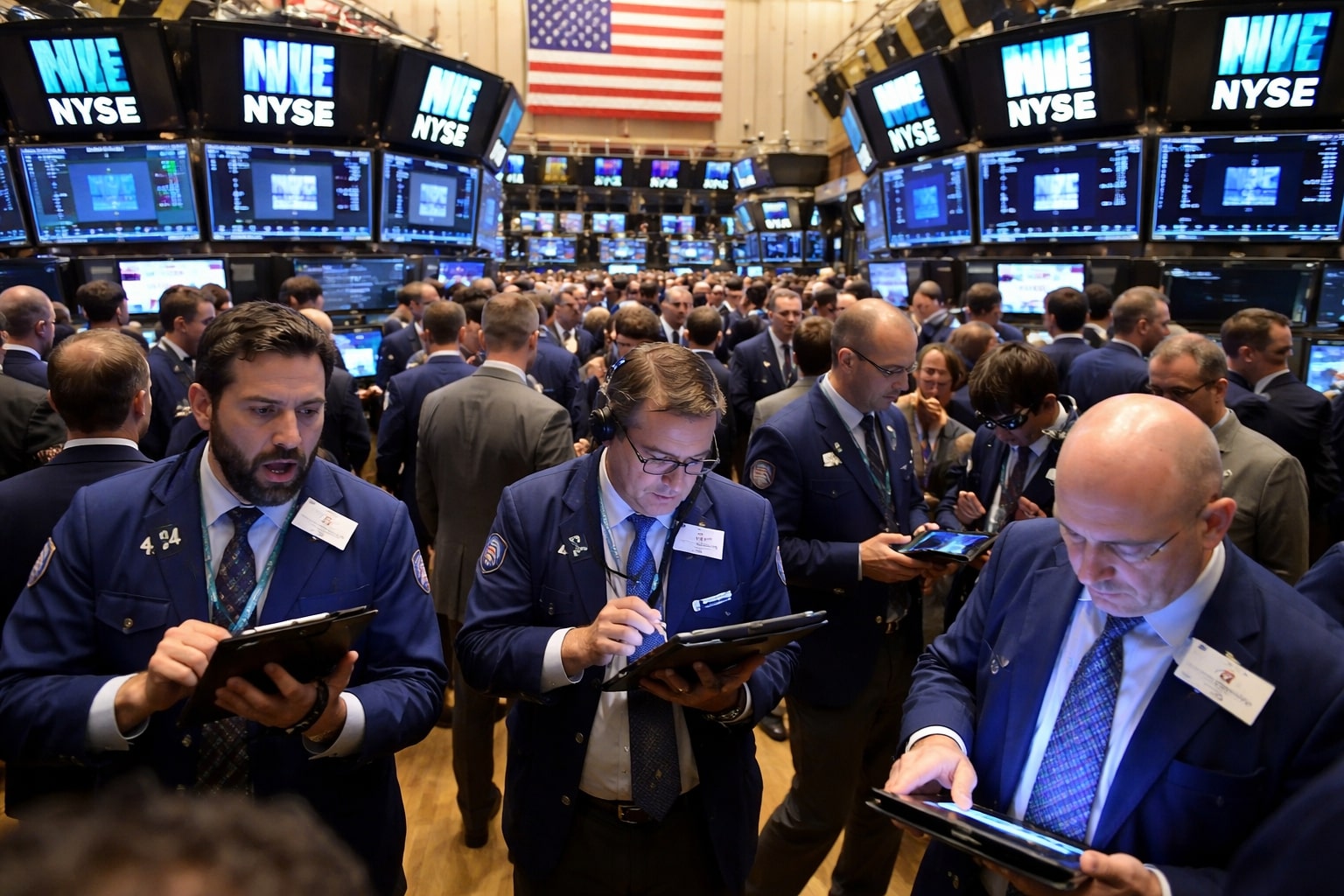
The S&P 500 (^GSPC) is trading around 6,914, up roughly 0.1%, sitting just under Tuesday’s record intraday high at 6,920.34 and above the record close at 6,909.79. The index is up about 1.1% week to date and roughly 17.5% year to date, so today’s muted move is consolidation at the top, not a reversal. The Dow Jones Industrial Average (^DJI) adds about 0.1%–0.25% – roughly +50–100 points – while the Nasdaq Composite (^IXIC) is fractionally negative, slipping around 0.1% as traders take profits in recent tech winners. Liquidity is naturally thinner with a half-day session ahead of tomorrow’s Christmas closure, which caps intraday follow-through but doesn’t change the dominant uptrend.
Santa Claus rally probabilities, breadth and sector rotation
The Santa Claus period – last five sessions of the year plus the first two of the new year, Dec. 24–Jan. 5 – is historically constructive. Over this seven-day window, the S&P 500 has delivered average gains near +1.3% with a 78% probability of finishing higher, versus a typical seven-day return close to 0.3% and a 58% positive rate. Current price action fits that pattern: new highs, limited volatility and an incremental shift from pure mega-cap tech into cyclicals. Market breadth is still narrower than ideal for an index at records, but participation is quietly broadening as industrials, materials and parts of energy start to close the gap with the AI complex.
GDP shock, labor data and what 4.3% growth really signals
The macro surprise is the 4.3% third-quarter U.S. GDP print, far above the 3.2% Dow Jones estimate. Consumer spending remained strong through the summer despite higher rates and political noise. That upside forces investors to concede that growth has more momentum than the “soft landing” narrative implied. At the same time, labor data show easing, not a crash. Initial jobless claims fell to 214,000 for the week ended Dec. 20, down from 224,000 and better than the 225,000 expected. The four-week average near 216,750 nudged lower, reversing part of November’s spike that pushed claims to their highest since 2020 and drove the unemployment rate to a four-year high. Net result: the economy is expanding at a pace that supports earnings, while the jobs market cools just enough to keep the Fed from tightening again.
Fed path, futures pricing and political pressure on the next chair
Fed funds futures still discount an easing cycle despite the growth surprise. Odds of a January cut have slipped to just above 13%, but markets continue to price two cuts by the end of next year/2026 as inflation glides lower and real rates remain restrictive. Inside Washington, the tone is openly pro-easing. President Donald Trump has been explicit that the Fed chair he appoints to replace Jerome Powell should cut rates even when growth and equities look strong, arguing for “a market that goes up on good news, and down on bad news.” Treasury adviser Joe Lavorgna reinforces this, saying 3% growth driven by supply-side gains alongside falling inflation implies that holding real rates high tightens policy further and justifies cuts. The Fed’s official stance is more cautious, but the political drift is clear and supports risk assets, growth stocks and higher equity multiples into 2026.
Consumer sentiment reset and the ‘K-shaped’ spending pattern
Sentiment does not match the macro data. The Conference Board consumer confidence index fell 3.8 points to 89.1 in December, the weakest level since the latest tariff wave earlier in the Trump term. University of Michigan surveys show almost two-thirds of households expect unemployment to rise over the next year. That disconnect – strong GDP and falling claims versus anxious consumers – reflects an uneven recovery. Higher-income cohorts, buoyed by rising portfolios and wage gains, are spending; lower-income households, facing higher borrowing costs and depleted excess savings, are not. For equities, this “K-shaped” pattern matters most in retail, discretionary and travel stocks, where 2026 earnings will depend on which side of the consumer barbell each brand serves.
Gold at $4,500+, silver and platinum at records, oil consolidates
The most aggressive bull move is in metals, not indices. Gold (GC=F) has broken to an all-time high above $4,500/oz, with February futures around $4,508.90, up more than 70% year to date – the strongest annual performance since 1979. The rally is driven by elevated central-bank purchases, consistent ETF inflows, expectations of further U.S. rate cuts and geopolitical stress centered on Venezuela, where U.S. actions blocking oil tankers have amplified haven demand. Silver (SI=F) and platinum (PL=F) are also at records, with silver up roughly 150% this year and platinum trading above $2,300/oz on tight supplies. Oil (CL=F, BZ=F), after a run-up on Venezuela tensions and broader geopolitical risk, is pausing in today’s session. For equities, this metals spike is a signal: markets are simultaneously pricing tighter physical supply, looser future policy and a higher risk premium on political shocks.
Copper’s 40% surge and what it says about the cycle
Copper (HG=F) is delivering a classic late-cycle message. March futures trade near $5.60/lb, with London prices around $12,200/ton, after touching intraday highs close to $12,282/ton. Prices have jumped nearly 40% this year, putting copper on track for its best annual gain since 2009. The drivers are concrete: mine outages, traders front-running possible U.S. tariffs by pushing metal into the country, and expectations of abundant global liquidity alongside stable macro growth. For equities, sustained copper strength supports miners and industrial cyclicals, but it also raises the risk of renewed margin pressure if input costs stay elevated as 2026 unfolds.
Mega-cap AI complex: Alphabet, Nvidia, Broadcom and Amazon still dictate the tone
Tuesday’s record close was again powered by the AI and cloud leaders. Alphabet (GOOGL/GOOG), Nvidia (NVDA), Broadcom (AVGO) and Amazon (AMZN) led the S&P 500 higher to 6,909.79, confirming that the earnings and market-cap center of gravity is still anchored in AI infrastructure, hyperscale cloud and digital advertising. The Nasdaq Composite is marginally negative today as traders lock in some of those gains into a thin holiday tape, but the index remains near its highs. Strategists arguing that 2026 will rotate away from mega-cap tech may eventually be correct, yet current price action says leadership is intact. As long as Fed expectations lean dovish and GDP growth holds above trend, the market will continue to pay a premium for these cash-rich, high-growth platforms.
Semiconductors diverge as Nvidia walks away from Intel’s 18A process
Under the AI umbrella, the chip space is splitting. Intel (INTC) is under pressure, down roughly 2%–3% toward the mid-$30s, after reports that Nvidia (NVDA) has stopped testing Intel’s 18A manufacturing process and decided not to proceed with using Intel foundries for advanced chip production. Intel says 18A is “progressing well,” but losing Nvidia as a prospective foundry client weakens the bull case for Intel Foundry Services as a major third-party player. Nvidia itself remains a primary driver of the S&P 500 and Nasdaq, reclaiming key technical levels noted by institutional desks and underscoring how the AI hardware profit pool is concentrating at the leaders. For investors, the implication is straightforward: NVDA remains core AI exposure; INTC slides back into a higher-risk turnaround that still has to prove its relevance in leading-edge manufacturing.
Single-stock movers: Nike, Dynavax, UiPath and event-driven spikes
Stock-specific stories are driving sharp dispersion under quiet indices. Nike (NKE) is outperforming, up more than 4%, after a filing showed Apple (AAPL) CEO Tim Cook bought nearly $3 million of Nike stock. This comes with NKE near a seven-month low after a poor 2025, marked by earnings disappointments and multiple compression. A high-profile insider buy at these levels is a direct signal that the risk/reward has improved and that long-term brand equity is being undervalued by the market.
Biotech is moving on deals. Dynavax Technologies (DVAX) has jumped around 38% to the mid-$15s after Sanofi (SNY) agreed to acquire the company for $15.50/share, valuing the deal at roughly $2.2 billion, a 39% premium to the prior close at $11.13. Sanofi has spent 2025 expanding beyond Dupixent, with a $1.5B acquisition of Vicebio and an up-to-$9.5B BluePrint Medicines deal earlier in the year. The DVAX transaction, funded entirely with cash and not impacting SNY’s 2025 outlook, adds an approved adult hepatitis B vaccine plus a differentiated shingles candidate to Sanofi’s pipeline and effectively caps near-term upside in DVAX at the deal spread.
Automation software is benefiting from index mechanics. UiPath (PATH) is up about 6%–7% to roughly $17 after S&P Dow Jones Indices said PATH will join the S&P MidCap 400, replacing Synovus Financial (SNV) once Pinnacle Financial Partners (PNFP) completes its acquisition. Inclusion forces buying from ETFs such as MDY and IJH, increases liquidity and expands the institutional shareholder base. For PATH, that structural demand sits on top of its existing automation and AI narrative, giving the stock a cleaner runway into 2026.
Smaller names are whipping around on binary events. Agios Pharmaceuticals (AGIO) slipped roughly 1%–2% to the mid-$24s despite FDA approval of Mitapivat (EcVSmi) for alpha and beta thalassemia-related anemia, as the market weighs commercialization risk against approval upside. Fight BioPharma (FIGHT) collapsed nearly 30% to around $0.17 following an extreme 1-for-3000 reverse split, a signal of prior dilution and balance sheet stress. Cush Pharmaceuticals (CUSH) surged more than 20% to about $1.27 after reporting a Q4 loss of $0.11/share, far better than the expected -$0.43, while Ramaco Resources (METC) rallied over 7% to roughly $18 on news of a $100 million share repurchase – an aggressive capital-return move given its market cap.
Read More
-
Yen Stalls at 160 Despite a 3% JGB and Tokyo Core CPI at 2.0% — Intervention Sits at 164, Friday's Payrolls Decide
02.09.2026 · TradingNEWS ArchiveEnergy
-
QQQI ($53.80) Turns Nasdaq Volatility Into a 14.2% Monthly Yield as Assets Top $15B — Big Tech Earnings Set November
27.10.2026 · TradingNEWS ArchiveStocks
-
XRPI ($7.09) Rises 2.46% as Spot XRP Funds Hold $1.47B but Flows Stall Near Zero — $1.35 Breakout Sets the Next Leg
27.10.2026 · TradingNEWS ArchiveCrypto
-
NG($3.002) Takes the Front Month Near a Multi-Month Low as Record Production Meets Mild Weather — Break of $2.945 Opens $2.80
27.10.2026 · TradingNEWS ArchiveCommodities
-
USD/JPY (157.86) Squeezed Between a 2.8-Point Carry Edge and Tokyo’s 160 Line — BoJ Hawkish Hold Friday Sets the Break
27.10.2026 · TradingNEWS ArchiveForex
Index reshuffles, Motive’s IPO plans and the broader AI infrastructure trade
Beneath the surface, the structure of the investable universe is shifting in favor of AI and software infrastructure. UiPath’s move into the S&P MidCap 400 marks another AI-adjacent name graduating into the “core” institutional benchmark layer. At the same time, the IPO window is cracking open. Motive, an Alphabet-backed fleet management and logistics software provider, has filed to list on the NYSE under ticker MTVE. In Q3, Motive generated $115.8 million in revenue, up 23% year over year, while posting a $62.7 million net loss – wider than the $41.3 million loss a year earlier. The cap table includes GV (Alphabet), Base10, Greenoaks, Index Ventures, Kleiner Perkins and Scale Venture Partners, signaling that top-tier venture money is ready to exit into public markets again. This sits alongside expectations that Anthropic, OpenAI and SpaceX will pursue public or quasi-public liquidity events in 2026. The broader theme: capital is still flowing aggressively into AI infrastructure, from chips and cloud to automation software and data-center-linked infrastructure plays.
Bonds, 60/40 portfolios and the challenge from metals
The combination of record equities, strong metals and a still-restrictive Fed is reshaping multi-asset allocation decisions. With policy rates high and inflation falling, bond yields now offer real income again, reviving the appeal of the classic 60/40 portfolio. Providers like Vanguard argue that fixed-income allocations can once more contribute meaningfully to total return instead of acting purely as ballast. At the same time, metals’ performance is impossible to ignore: gold up 70%, silver up 150%, and platinum at records mean that even small allocations have outpaced both stocks and bonds in 2025. CIOs who stayed underweight real assets will face pressure if the move extends into 2026. The key challenge is balancing fully-priced equities, newly attractive bonds and a metals complex that is already discounting a large easing cycle and high geopolitical risk.
Trend assessment and positioning: indices, AI leaders, cyclicals and metals
Technically, the bull trend remains intact. The S&P 500 is holding above the 6,900 breakout zone, the Dow grinds higher on value and dividend names, and every shallow dip in the Nasdaq tied to profit-taking in NVDA, GOOGL, AVGO and AMZN is being bought. Volatility remains suppressed; options markets do not price meaningful stress despite political noise around the Fed transition and international flashpoints.
From a positioning standpoint, the data on Dec. 24, 2025 support a Hold with bullish bias on the major indices – ^GSPC, ^DJI, ^IXIC – rather than a full de-risking. The AI mega-caps (NVDA, GOOGL/GOOG, AVGO, AMZN) remain core holdings but are no longer cheap; adding is best done on pullbacks, not breakouts. INTC tilts toward Sell after the 18A setback, as the foundry story loses credibility without Nvidia. NKE shifts toward accumulate/Buy, with insider conviction at depressed levels improving the long-term setup. DVAX is now a merger-arb carry trade around $15.50 rather than a standalone biotech story. PATH is a structural Buy, given forced index demand and an AI-automation growth runway. In commodities, core gold/silver/platinum positions justify a Hold/Trim stance after a parabolic year, while copper remains tactically Bullish with clear sensitivity to any reversal in tariffs or supply disruptions. Overall, the U.S. stock market today is still in a bullish phase, driven by AI leaders and metals strength, but it is undeniably late-cycle: entry points matter, valuations are rich, and stock selection is more critical than at any point in this run.