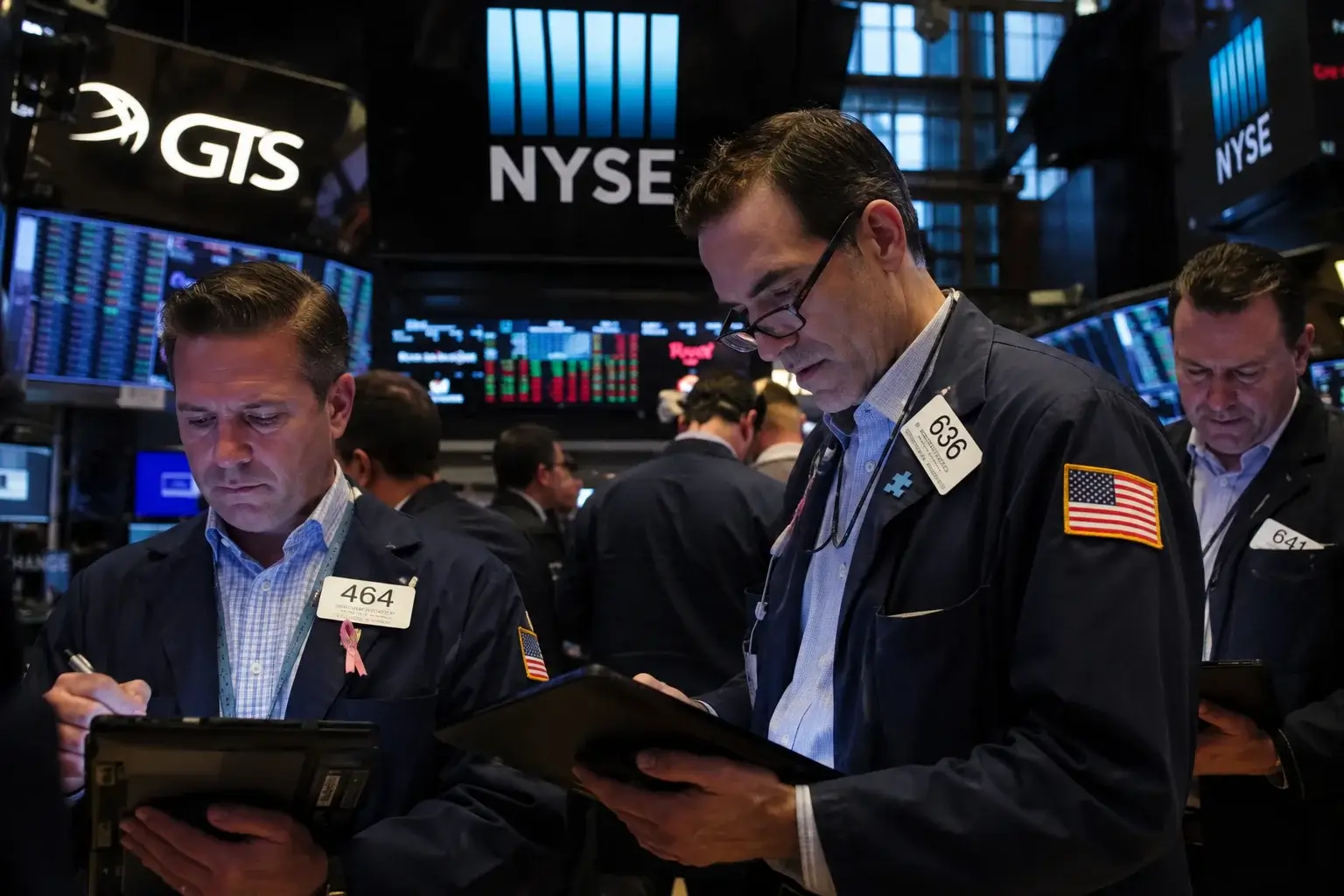
Stock Market Today: Nasdaq Rebounds 0.92% to 25,945, S&P 500 Climbs to 7,432, Dow Adds 188 Points as MU Stock Jumps 7%
Wall Street snapped back from Friday's chip-driven rout, with semiconductors leading after Marvell (MRVL) climbed 8.95% on its S&P 500 inclusion and Micron (MU) added 7.14% | That's TradingNEWS
Key Points
- The Nasdaq (IXIC) rebounded 0.92% to 25,945 after Friday's 4.18% collapse, with Micron (MU) +7.14% and Marvell (MRVL) +8.95% leading the chip bounce.
- The 10-year Treasury yield climbed to 4.57% and December rate-hike odds sit near 70% after May payrolls hit 172,000 versus an 85,000 forecast.
- Brent crude swung toward $94 and WTI near $91 as Israel and Iran exchanged strikes; the VIX dropped 13.85% to 18.53.
Stocks ripped higher out of the gate Monday, with the same semiconductor names that gutted the tape on Friday now dragging it back up. The S&P 500 climbed 0.66% to 7,432.37, adding 48.63 points. The Nasdaq Composite led the charge, up 0.92% to 25,944.78, a gain of 235.35 points, as chip stocks staged a violent reversal. The Dow Jones Industrial Average tacked on 187.86 points, or 0.37%, to 51,054.64. The small-cap Russell 2000 joined the party, rising 1.00% to 2,861.92, a sign the bid extended past the mega-cap complex. The fear gauge collapsed: the Cboe Volatility Index dropped 13.85% to 18.53, unwinding most of Friday's panic premium in a single morning. This was a buy-the-dip session in its purest form, and the dip-buyers showed up early and in size.
The Friday Wreck That Set the Stage
To understand Monday's snapback, you have to look at what got broken Friday. The Nasdaq cratered 4.18% to close at 25,709.43, its ugliest single-day drop going back to April 2025. The S&P 500 shed 2.64% to 7,383.74, snapping a nine-week winning streak — the index's first down week in ten. The Dow lost 695.15 points, or 1.35%, settling at 50,866.78. The trigger was twofold. A chip-stock unwind that started midweek when Broadcom (AVGO) reiterated rather than raised its 2026 AI outlook turned into an outright stampede by Friday, with the semiconductor group leading the rout. Then a blowout May jobs report poured gasoline on it, sending Treasury yields vertical and forcing traders to price in the once-unthinkable: a Federal Reserve rate hike before year-end. The overnight read-through was brutal — South Korea's Kospi, heavy with chip exposure, tumbled more than 8% before Monday's US open. The setup heading into Monday was either capitulation or a coiled spring. It turned out to be the spring.
Semiconductors Stage the Reversal
The chips that led the carnage led the recovery. Micron (MU) jumped 7.14% to $925.71, one of the most actively traded names on the tape. Marvell Technology (MRVL) surged 8.95% to $287.06. Intel (INTC) ripped 8.60% to $107.70, also among the day's volume leaders. Nvidia (NVDA), the bellwether, added 0.81% to $206.76 after running stronger earlier in the session, and it sat near the top of the most-active list alongside Micron, Marvell, and Nokia (NOK). The reversal had real fundamental fuel behind it, not just dip-buying reflex. Nvidia and SK Hynix announced a multi-year agreement to co-design future generations of AI memory chips, a direct win for the South Korean supplier in its arms race with Samsung — and a signal that AI infrastructure spending isn't slowing despite the Broadcom scare. The semis that got cut hardest Friday were exactly where the morning money flowed.
Marvell and Flex Get the S&P 500 Golden Ticket
The single biggest stock-specific catalyst came from the index committee. S&P Dow Jones Indices announced that Marvell (MRVL) and Flex (FLEX) will join the S&P 500 on June 22, replacing The Campbell's Company (CPB) and Pool Corp (POOL). Marvell jumped nearly 9% on the news; Flex rose roughly 4%. Index inclusion reliably drives a near-term pop as passive funds tracking the benchmark are forced to buy, and the timing handed Marvell a perfect bounce off a brutal week — the stock fell 16% Friday in the chip selloff. Zoom out and Marvell's run remains staggering: shares are up 210% since the start of 2026, pushing the custom-silicon maker's market cap to roughly $230 billion. The inclusion cements Marvell's transition from a mid-cap also-ran into a core AI-infrastructure holding, and the forced passive bid gives it a tailwind into the June 22 effective date.
Corning's Amazon Windfall
Outside the chip complex, Corning (GLW) was the standout, surging 9.31% to $194.16 in premarket trade after Amazon (AMZN) unveiled a multibillion-dollar agreement to buy optical fiber from the materials-science company to wire and power its rapidly expanding US data-center footprint. The deal is a direct play on the AI buildout — the unglamorous physical plumbing of hyperscale compute — and it reframes Corning as an AI-infrastructure beneficiary rather than a legacy glass maker. Amazon shares rose 1.2% to $249.02 on the announcement, a measured move that reflects the deal's outsized importance to Corning relative to Amazon's trillion-dollar base. The trade fits the day's dominant theme cleanly: anything tied to data-center capacity got bid, while the broader AI-spend doubts that crushed Broadcom last week got pushed to the back burner.
Jensen Huang Calls the Bottom
The psychological anchor for the rebound came straight from the top of the AI food chain. Speaking in Seoul, Nvidia (NVDA) CEO Jensen Huang flatly called the global tech selloff a buying opportunity, arguing the industry is still at the front end of building the infrastructure that will underpin an AI-driven economy. His exact framing — that investors should be happy because they can now buy at a discount — landed at the perfect moment, with the Kospi down 8% overnight and US futures wobbling. Huang's comments, paired with the fresh SK Hynix memory deal, gave the dip-buyers cover and a narrative. South Korean President Lee Jae Myung added to the steadying tone, calling his domestic market undervalued, and Kospi-listed names including SK Hynix pared their overnight losses. When the most credible voice in AI hardware tells you the rout is a gift, a market that fell 4% on Friday tends to listen.
The Jobs Report Still Hangs Over the Tape
For all the morning's risk appetite, the macro overhang that triggered Friday's selloff hasn't gone anywhere. The May employment report showed the US economy added 172,000 jobs, blowing past the consensus near 85,000, while the unemployment rate held at 4.3% and average hourly earnings rose 0.3% on the month. March and April figures were revised higher. The print torched the soft-landing-into-cuts thesis and forced a wholesale repricing of Fed expectations. Markets now put the odds of a rate hike by December at roughly 70%, up from about 50% before the data. That's a stunning shift — Wall Street spent most of 2026 debating when the Fed would ease, and a single payrolls beat flipped the conversation to when it might tighten. A strong labor market plus oil-driven inflation risk leaves the Fed with little room to maneuver, and that tension will define every session until the picture clarifies.
Treasury Yields and the Rate-Hike Math
The bond market is where the rate-hike fear lives, and yields confirmed it. The 10-year Treasury yield climbed to around 4.57% Monday, its highest in two weeks, after rising to 4.544% Friday in the immediate wake of the jobs data. The policy-sensitive 2-year yield jumped to 4.162% Friday, its highest since late February 2025, and the long-bond 30-year sat near 5.01%. Higher yields are a direct headwind for the high-multiple growth and chip names that lead the Nasdaq, which is precisely why Friday's yield spike hit tech hardest. The Fed is still widely expected to hold its benchmark rate steady at the June 16-17 meeting under Chairman Kevin Warsh, but the December hike now in play changes the calculus for risk assets all summer. Every basis point higher on the 10-year tightens financial conditions and raises the bar for the AI trade to keep paying off.
Oil Spikes Then Cools as Israel and Iran Trade Fire
The geopolitical wildcard reasserted itself over the weekend. Iran launched a new wave of strikes against Israel in retaliation for Israeli strikes on Lebanon, Israel struck back, and the exchange — the first direct trading of blows since April — threatened the fragile ceasefire as the war hit its 100th day. Crude reacted hard then faded. Brent climbed as much as 4% toward nearly $98 a barrel before cooling to a gain of about 1% near $94. West Texas Intermediate followed the same arc, spiking toward $95 before settling back to roughly $91. The pullback came after President Trump spoke by phone with Israeli Prime Minister Benjamin Netanyahu, urged both sides to stop shooting, and Iran said it had ended its latest volley of strikes. Trump framed diplomacy as still proceeding. The oil fade was the unsung hero of the equity rebound — had Brent held its $98 spike, the inflation and yield math would have looked far uglier, and the chip bounce might never have gotten traction.
The Dollar, Gold, and the Volatility Reset
The cross-asset tape told a clean risk-on story. The US dollar index firmed to around 100.07, up 0.64%, riding the higher-rates tailwind from the jobs report. Gold slipped 0.33% to $4,350.90, a modest give-back as the geopolitical bid faded alongside oil and the safe-haven trade unwound with the de-escalation headlines. The headline event was the volatility collapse: the VIX cratered 13.85% to 18.53, shedding 2.98 points in a single morning. Friday's panic — a 4% Nasdaq drop tends to spike implied vol hard — reversed almost as fast as it built. A VIX back below 19 signals traders treating the selloff as a one-day event rather than the start of something deeper. The dollar up, gold down, vol crushed: that's the textbook signature of a market that decided overnight the world wasn't ending.
Breadth, Movers, and the Day's Leaderboard
Participation was broad, with the Russell 2000's 1.00% gain to 2,861.92 confirming the bid reached down the cap spectrum rather than concentrating in a handful of AI names. The day's individual leaderboard skewed sharply toward risk. Among the biggest gainers, Tango Therapeutics (TNGX) ripped 34.57% to $27.21, Cerebras Systems (CBRS) jumped 14.82% to $230.79, Galaxy Digital (GLXY) rose 11.69% to $28.08, Sable Offshore (SOC) added 10.29% to $13.51, and Sportradar (SRAD) gained 9.57% to $15.23. The losers were a mixed bag tied to company-specific stories: Argan (AGX) fell 8.81% to $633.53, Brady (BRC) dropped 8.20% to $81.38, KB Financial (KB) lost 7.47% to $99.85, Telkom Indonesia (TLK) slid 7.63% to $14.36, and Ciena (CIEN) fell 4.98% to $463.91. Within the Dow, Nvidia (NVDA), Apple (AAPL), and Chevron (CVX) led the gainers, while Salesforce (CRM), Walt Disney (DIS), and Microsoft (MSFT) lagged — a rotation that put hardware and energy ahead of software.
Read More
-
Yen Stalls at 160 Despite a 3% JGB and Tokyo Core CPI at 2.0% — Intervention Sits at 164, Friday's Payrolls Decide
02.09.2026 · TradingNEWS ArchiveEnergy
-
CHAT Fund Holds $96.37 as Korean Memory and Chip Exposure Drive a 109.73% Year — Break of $98.02 Opens $105.20
18.09.2026 · TradingNEWS ArchiveStocks
-
First-Generation XRPR and XRPI Ride XRP's Rebound to $1.386 as Spot Funds Post First Outflow — Break of $1.40 Opens $1.54
18.09.2026 · TradingNEWS ArchiveCrypto
-
NG Holds $2.9255 as Storage Surplus Narrows From 5.5% to 3.7% in 3 Weeks — Break of $3.00 Opens $3.15
18.09.2026 · TradingNEWS ArchiveCommodities
-
Dollar Surges to 157.90 as BoJ's Divided Hike Fails to Lift the Yen — Break of 158.87 Opens 159
18.09.2026 · TradingNEWS ArchiveForex
Sector Scorecard
Technology reclaimed leadership it surrendered Friday, with semiconductors doing the heavy lifting — Micron, Marvell, Intel, and Corning all posting outsized gains and dragging the sector green. Energy caught a bid early on the oil spike, with Chevron (CVX) among the Dow's leaders before crude pared its gains. Software, the relative haven during Friday's flight from chips, lagged on Monday as money rotated back into the beaten-down hardware names — Salesforce (CRM) and Microsoft (MSFT) both traded lower within the Dow. The reversal of Friday's rotation was the tell: where Friday saw investors flee chips for defensives, Monday saw them sprint right back into the wreckage. Financials were uneven, with KB Financial (KB) among the day's bigger decliners. The clean read is a market repositioning into the AI-infrastructure trade — chips, optical, data-center plumbing — on the bet that the Broadcom-driven scare was overdone.
Apple's WWDC and the Week's Loaded Calendar
The session opened the same morning Apple (AAPL) kicked off its Worldwide Developers Conference in Cupertino, running through June 12. The stakes are unusually high: it's Tim Cook's last WWDC as CEO, and the event is being positioned as a reboot of Apple's lagging AI strategy. The headline is expected to be the debut of the long-delayed, AI-infused version of Siri — a feature Apple first teased in 2024 and then struggled to ship. Apple shares were among the Dow's better performers in the morning. The rest of the week is just as loaded. The May Consumer Price Index lands Wednesday and will tell investors whether the oil spike is bleeding into core inflation — the single most important data point for the rate-hike debate. Oracle (ORCL) reports earnings Wednesday evening, with shares up about 2% ahead of a print that will retest the AI-datacenter thesis. And the SpaceX (SPCX) IPO is slated for Friday, expected to be the largest public offering on record.
The Session Verdict
Bullish, and decisively so through the morning. The market took Friday's worst day in over a year and treated it as a sale rather than a warning, with the Nasdaq's 0.92% rebound to 25,944.78 reclaiming a chunk of the 4.18% it lost. The chip names that broke the tape — Micron up 7.14%, Marvell up 8.95%, Intel up 8.60% — led it back, the VIX crashed 13.85% to 18.53, and breadth confirmed the move with the Russell 2000 up 1.00%. But this is a relief rally riding on top of an unresolved problem. The 10-year at 4.57%, December hike odds near 70%, and a Middle East conflict that can spike oil 4% on a headline all remain live. Wednesday's CPI is the hinge. A hot print revives the rate-hike fear and the yield-driven pressure on tech that started this whole episode; a soft one validates Monday's bounce and lets the AI trade run. For now, the dip-buyers have the tape — but they're buying into a yield backdrop that hasn't given them permission yet.