Stock Market Today: Nvidia (NVDA) Tumbles 5% as Nasdaq Slides 1.8% and S&P 500 Cools
Wall Street’s AI leaders stumble despite NVDA’s $68.1B quarter, while NTNX soars, SJM and STLA jump on earnings, and gold above $5,100 with Bitcoin near $67,000 signal a cautious rotation across risk assets | That's TradingNEWS
Wall Street cools after AI-driven rebound hits resistance
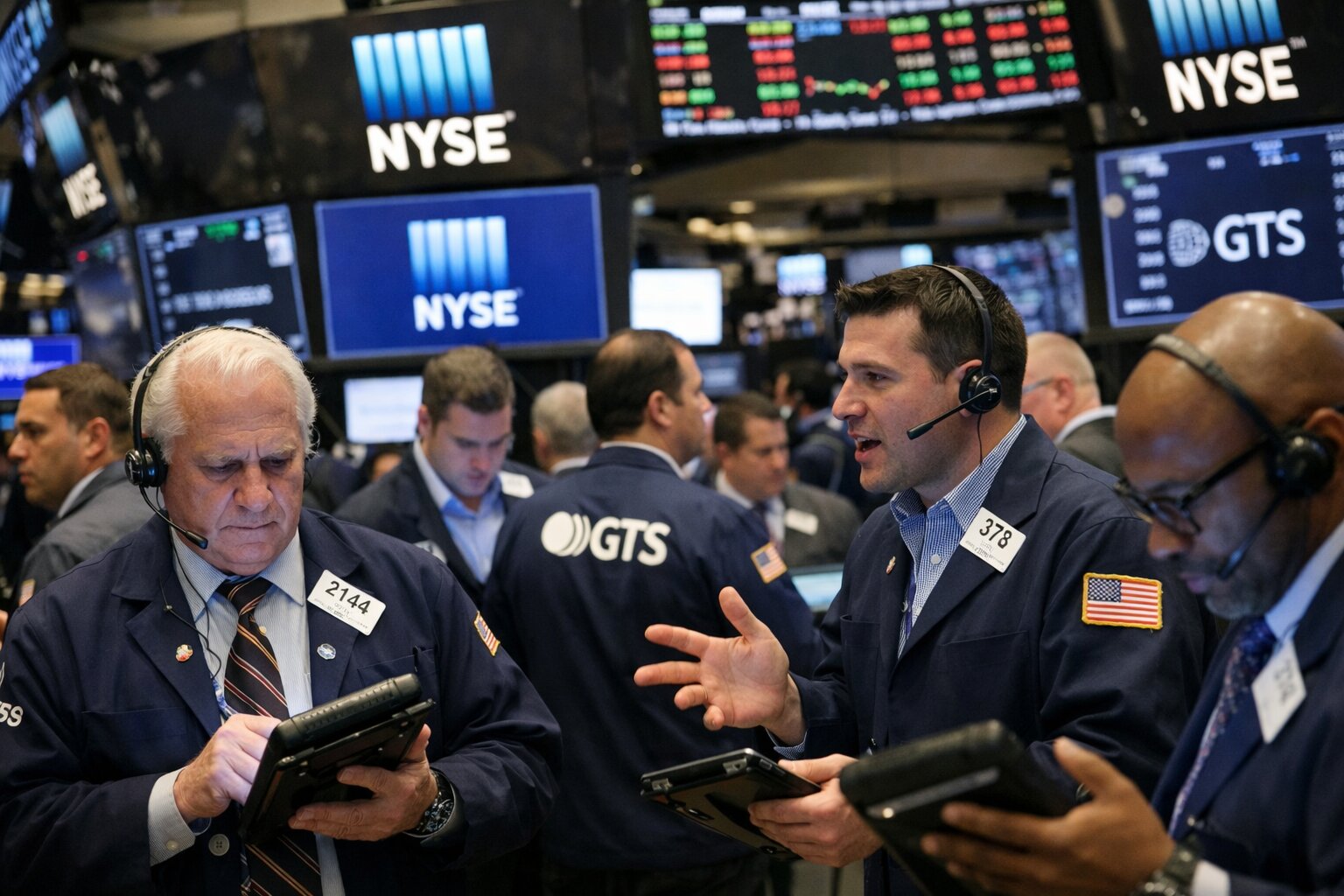
U.S. equities are slipping after the post-Presidents Day bounce. The Dow Jones Industrial Average (^DJI) sits just under 49,300, off about 0.4%. The S&P 500 (^GSPC) trades near 6,870, down roughly 1.1%. The Nasdaq Composite (^IXIC) is the pressure point, dropping close to 1.8% toward 22,730 as investors rotate out of crowded AI trades. Yesterday’s sharp rebound—Nasdaq up about 1.3%, S&P 500 up 0.8%, Dow up 0.6%—is fading as traders shift from chasing momentum to defending gains. Futures set the tone early: ES=F, NQ=F and YM=F all drifted lower, flagging a pause in the rally that followed tariff headlines and AI-disruption worries earlier in the week.
Risk positioning, skew, and the S&P 500 ceiling
The S&P 500 has spent most of this year churning just below the 7,000 mark, and derivatives markets show how uneasy that plateau has become. Put–call skew on the index recently pushed to a two-year high as buyers paid up for downside protection. Two-month skew is now near the upper end of its five-year range, signaling demand for crash insurance rather than upside call speculation. The VIX hovers around 19 with a daily gain above 6%, confirming that hedging is back in fashion. At the same time, leverage indicators built from ETF flows and futures positioning have sunk to lows last seen in November. That combination—rising protection and reduced leverage—usually points to de-risking and rotation, not outright panic selling.
NVIDIA prints a monster quarter, but NVDA stock runs into gravity
NVIDIA (NVDA) delivered numbers that would normally support a major breakout and still lost altitude. Quarterly revenue jumped 73% year-over-year to about $68.1 billion, while net income surged 94% to roughly $43 billion. Data-center revenue hit $62.3 billion, up about 75% and now more than 90% of total sales as hyperscalers keep pouring cash into AI capacity. Management guided next quarter’s revenue to around $78 billion, comfortably above the roughly $72–73 billion Wall Street penciled in. Yet NVDA trades near $186, down roughly 4.5–5%. The market is focused on concentration risk—about half of data-center sales tied to a handful of mega-cap buyers—and on the sustainability of a trillion-dollar AI spend cycle when GOOGL, MSFT, AMZN and META are pushing in-house silicon. Expectations were simply too high; anything short of incremental upside commentary on China exposure, competitive threats, and AI margins was enough to trigger profit-taking in the world’s key AI bellwether.
Enterprise software split: CRM stabilizes while AI and TTD absorb damage
The software tape shows how selective investors have become. Salesforce (CRM) posted a clean quarter, with revenue up about 12% and a fiscal-year outlook calling for roughly 10% growth—essentially flat versus last year’s pace. The longer-term fiscal 2027 revenue guide of $45.8–46.2 billion only marginally clears the $46.06 billion consensus midpoint, which initially dragged the stock almost 4% lower in pre-market. As the call progressed and management emphasized steady demand, AI integration and a willingness to reinvest for innovation even at the cost of margins, the tone shifted. CRM has since pushed back into positive territory, up around 2% near $195–196. On the other side, C3.ai (AI) shows what happens when the story fails to convert into durable growth. A weak quarter and a planned workforce cut of roughly 26% sent the stock down about 20%. The Trade Desk (TTD), already down nearly two-thirds over the last year, sold off another 17–20% after forecasting Q1 revenue of $678 million and adjusted EBITDA of about $195 million, both below expectations of $688.1 million and $221.3 million. Even with Q4 revenue and EBITDA slightly ahead and EPS at $0.59 in line, soft guidance is unacceptable in this tape.
Nutanix and AMD: infrastructure winners beneath the AI noise
The second-order AI trade—companies that build and run the infrastructure under the big models—is getting rewarded. Nutanix (NTNX) rallied more than 15% pre-market and now trades above $40 after a solid fiscal Q2 and a strategic tie-up with Advanced Micro Devices (AMD). Nutanix delivered adjusted EPS of roughly $0.54–0.56 on revenue of $722.8 million, beating consensus estimates near $0.44 and $709.7 million. Full-year revenue guidance of $2.80–2.84 billion and a targeted non-GAAP operating margin of 21–22% underscore that this is now a profitable, scaled cloud business. AMD is committing about $250 million split between an equity stake and joint engineering and go-to-market funding to build an AI infrastructure platform for “agentic AI” workloads. AMD stock is softer, off around 1–1.5% as investors digest Meta-driven gains earlier in the week and Nvidia’s dominance in GPUs, but the partnership deepens AMD’s exposure to data-center AI without relying solely on head-to-head GPU competition.
Stellantis absorbs a €22.3B hit to reset its EV trajectory
Legacy autos are paying for years of delayed adjustment to the EV curve, and Stellantis (STLA) is a prime example. The group posted a full-year net loss of €22.3 billion (around $26.3 billion), driven by €25.4 billion in unusual charges tied largely to EV-related write-downs and restructuring. The headline loss looks extreme, but second-half numbers point to a gradual stabilization rather than systemic collapse. H2 net revenue climbed 10% to €79.25 billion (about $93.5 billion), within guidance of €78–80 billion and up from €71.86 billion a year ago. Adjusted operating income in the back half swung to a €1.38 billion loss within a guided €1.2–1.5 billion loss range, compared with a €185 million profit in H2 2024 and €10.2 billion profit in 2023. The equity market is taking the medicine: STLA trades roughly 4.5% higher near $8.06, signaling that investors prefer a front-loaded reset and a clearer path for CEO Antonio Filosa’s turnaround plan over prolonged slow bleeding.
Coffee, pricing power, and the squeezed consumer: SJM and Starbucks
Consumer staples are quietly proving why they belong in a late-cycle mix. J.M. Smucker (SJM) turned aggressive coffee pricing into real earnings leverage. The company reported adjusted EPS of $2.38 versus expectations of $2.26, on net sales of $2.34 billion against $2.33 billion estimates. The standout is its U.S. Retail Coffee unit, where net sales surged 23% to $908.2 million, driven mainly by higher net pricing across brands like Folgers and Café Bustelo. The stock, which had been down about 2% over the last year but up roughly 9% in 2026 before earnings, shot higher by about 7–8%. That confirms investors will pay a premium for proven pricing power. Parallel to that, Starbucks (SBUX) is reshaping its business around the reality that cold drinks now represent about two-thirds of U.S. orders and roughly 60% of global sales. Higher-margin iced beverages, Refreshers and flavored cold coffee bring complexity and cost, at a time when the middle of the income distribution is being eroded by food inflation and wider inequality. Smucker’s ability to push through price and Starbucks’s need to adjust format and price architecture tell the same story: segmentation between value and premium customers will decide who wins.
Energy trade-off: sub-$3 gasoline, tighter margins for XOM and CVX
Energy markets reflect the political push for cheap fuel and the financial strain that push creates. Under Trump’s “drill, baby, drill” posture, U.S. oil and gas output is at or near record highs, and average gasoline prices are sitting below $3 per gallon nationwide. That supply abundance weighs on crude prices and, in turn, on integrated major profits. Exxon Mobil (XOM) and Chevron (CVX) both grew production and beat top-line revenue expectations, but each reported year-on-year declines in annual profit as the oil glut compressed margins. XOM trades around $149 with little net move today as investors balance strong volume with weaker earnings power. Benchmark West Texas Intermediate (CL=F) hovers near $65.3–65.4 per barrel after an earlier drop of almost 2%, while the S&P GSCI Spot Index sits near 602.7, down about 0.3%. The takeaway is straightforward: voters are getting the low pump price they were promised, but E&Ps and majors are forced to focus on capital discipline and shareholder payouts over aggressive expansion.
Read More
-
Yen Stalls at 160 Despite a 3% JGB and Tokyo Core CPI at 2.0% — Intervention Sits at 164, Friday's Payrolls Decide
02.09.2026 · TradingNEWS ArchiveEnergy
-
QQQ ETF ($739) Fades From an Early Tech Rally as a 77.9 ISM Prices Index Meets Micron's $61.5B Guide — $760 Record Test Ahead
01.10.2026 · TradingNEWS ArchiveStocks
-
XRPR and XRPI Follow XRP's $1.49 Test as Spot Funds Hold 1.16B XRP and a 1 Billion Token Escrow Release Lands — $1.70 in Play
01.10.2026 · TradingNEWS ArchiveCrypto
-
November NG Slips Below $3 as Decade-High Storage Meets Capped LNG Exports — $2.75 in Sight
01.10.2026 · TradingNEWS ArchiveCommodities
-
Dollar-Yen at 158 Presses Toward 160 as a 363 bp Carry Gap Meets Katayama-Bessent Intervention Risk — 159 in Sight
01.10.2026 · TradingNEWS ArchiveForex
Gold above $5,100, Bitcoin near $67K, and American Bitcoin’s leveraged bet
The cross-asset backdrop is risk-aware but not frozen. Gold futures are trading just over $5,150–5,190 per ounce after slipping roughly 0.7–1.1% on the day, still holding convincingly above the $5,100 breakout as traders watch U.S.–Iran talks and reprice the timeline for Fed cuts. Silver has taken a sharper hit, down about 4% toward $87.30 an ounce. Bitcoin (BTC) trades around $66,980–67,000, down more than 3% from levels that approached $69,900–70,000 yesterday, but remains comfortably above recent pivot areas. The equity proxy on the crypto side is shaky. American Bitcoin Corp., backed by Eric Trump and Donald Trump Jr., flipped from a $3.5 million profit in the prior quarter to a $59 million net loss. For the full year it lost $153 million on $185 million of revenue, primarily because of mark-to-market hits on its 5,401 BTC holdings. The stock trades near $1.04, barely changed today but far below its post-listing highs. It is a textbook example of how balance-sheet exposure to BTC magnifies cyclicality: the upside in rallies is huge, but a 3% daily pullback in Bitcoin can drive another quarter of red ink when leverage is high.
Labor market data, Treasury yields, dollar and volatility: macro still supports risk
Macro inputs do not match the level of fear implied by some options pricing. Initial jobless claimstick up to 212,000 for the week ended February 21, up from an upwardly revised 208,000, but still below the roughly 215,000–216,000 economists had projected. Continuing claims edge down to about 1.83 million from 1.87 million, versus expectations near 1.86 million. The message is of a labor market that is cooling slowly, not cracking. The 10-year Treasury yield trades around 4.02–4.04%, slightly lower than yesterday, reflecting steady demand for duration as equities wobble. The KBW Nasdaq Bank Index is up around 0.8% near 166.8, a sign that credit stress is not emerging. The dollar is largely stable, with one widely watched dollar index print around 94.83 (up 0.14%) and another measure near 97.74 (up 0.04%). The VIX near 19 signals tension, but this is repricing of growth expectations and AI exposure, not a macro shock.
China’s AI stress test: Baidu’s 20% slide and the demand for proof
China’s flagship AI search player, Baidu (BIDU), is illustrating what happens when AI spending outruns visible payback. BIDU shares have dropped about 20% over the past month and are down more than 6% today, trading around $124. Analysts expect December-quarter revenue and profit to fall year-over-year despite strength in cloud services, as weakness in the advertising business—tied closely to China’s slowing economy—offsets AI-driven gains. Since a three-year high on January 23, the stock has shed around $11 billion in market value. The market is sending a clear signal: AI capital expenditure must convert into measurable revenue and profit, not just slide decks and demos. That same standard is increasingly being applied to U.S. software and AI names that benefited from “AI halo” valuation multiples over the last year.
Breadth check: movers from VAC and PSKY to WBD, NFLX, ZM and TTD
Today’s tape still shows broad dispersion, which argues for rotation rather than outright risk liquidation. Marriott Vacations Worldwide (VAC) is up nearly 15% around $66.6 after beating revenue expectations in its latest quarter, confirming that high-end travel demand remains intact. Paramount Skydance (PSKY) is ahead by about 6–7% as streaming revenue grows even while traditional TV slows, while Warner Bros. Discovery (WBD) is roughly flat after a larger-than-expected loss, as investors keep optionality on a revised Paramount bid and potential asset deals with Netflix (NFLX). NFLX itself is up roughly 1–1.5%. On the downside, Zoom Video (ZM) is off about 3% following a softer profit outlook. The Trade Desk (TTD) and C3.ai (AI) extend their downtrends after disappointing guides. The pattern is clear: investors are selectively punishing names where guidance cannot justify valuation, while rewarding companies that are executing in travel, media and staples even in a slower macro tape.
Market stance: indices are a Hold, trim crowded AI, add quality on volatility
Taking everything together, the U.S. index complex looks stretched but not broken. The Dow near 49,270, the S&P 500 around 6,870, the Nasdaq just above 22,700, and the Russell 2000 near 2,659.9 with only a 0.13% dip all tell the same story: weakness is concentrated where expectations and valuation were extreme, not across the entire market. Gold above $5,100, Bitcoin around $67,000, a 10-year yield near 4.0%, and jobless claims at 212,000 are not the setup for a forced liquidation event. The right stance on the indices is Hold: valuations do not justify aggressive fresh buying at the headline level, but macro and earnings are not weak enough to call for an outright Sell on the market as a whole. Under the surface, the allocation call is sharper. In AI mega-caps like NVDA, the bias is Hold to Trim after a historic run and a quarter that met the numbers but failed to move the sentiment bar higher. In high-quality cyclicals, cash-generative energy and staples—names like XOM, CVX, SJM, and selective infrastructure and cloud plays such as NTNX—the pullback offers Buy on weakness opportunities. The session is not about abandoning risk; it is about shifting capital from narratives that were priced for perfection into companies where the fundamentals and the numbers still have room to surprise on the upside.