Stock Market Today: S&P 500, Nasdaq Cling to Records, Dow Wavers as Trump Slams Iran Proposal
S&P 500 at 7,413.37, Nasdaq at 26,277.71, Dow at 49,598.68 as Brent crude jumps to $103.41. Micron rips to $782, Monday.com pops 26%, Moderna jumps 9% | That's TradingNEWS
Key Points
- S&P 500 at 7,413, Nasdaq at 26,277, Dow flat at 49,598 as indices cling near Friday's record highs.
- Trump calls Iran's offer "unacceptable"; Brent crude jumps 2.09% to $103.41, WTI climbs to $96.82.
- Micron (MU) rips 4.75% to $782; Monday.com (MNDY) pops 26% on Q1 beat; Moderna (MRNA) jumps 9%.
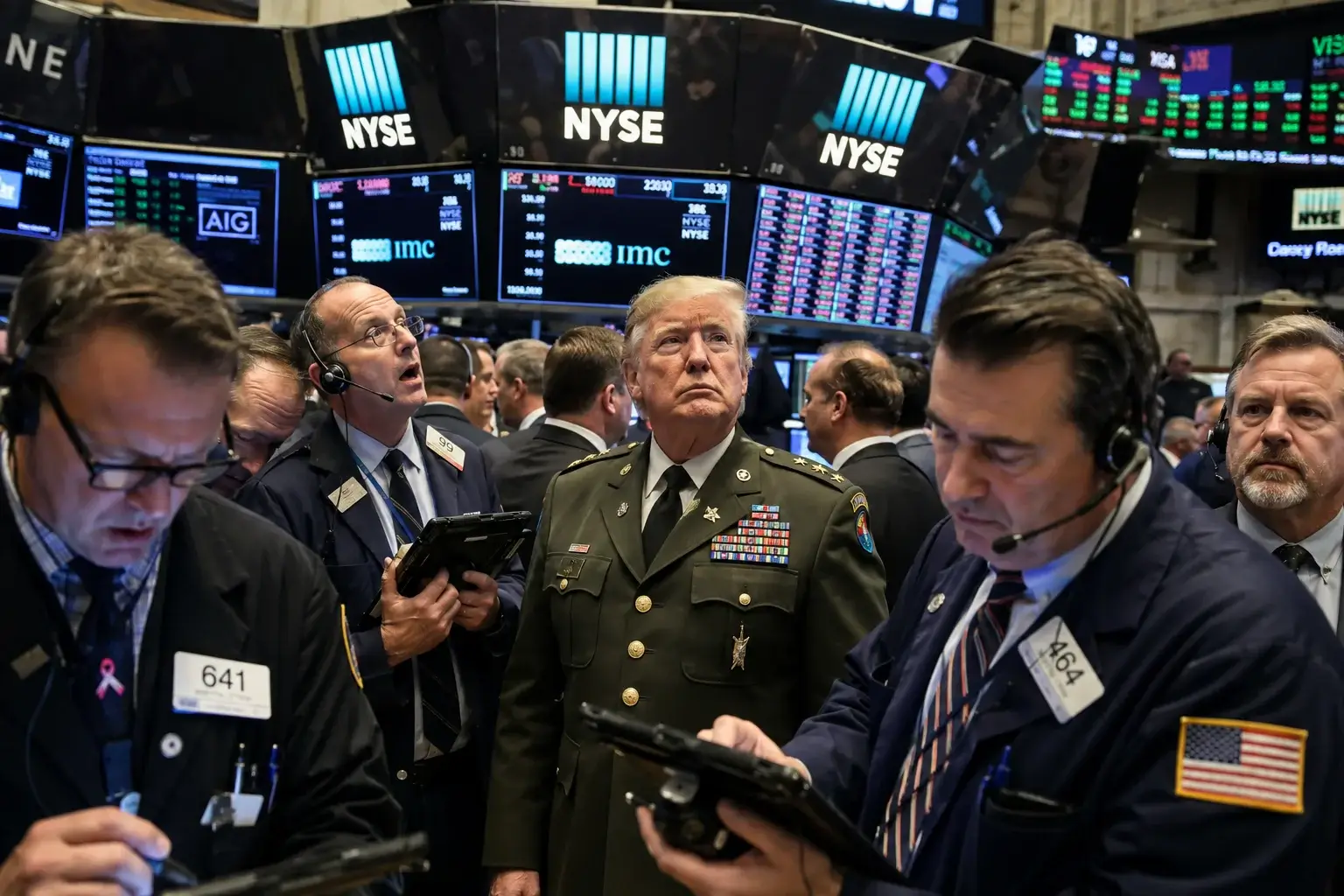
Wall Street drifted within a whisker of fresh all-time highs Monday morning after the White House summarily rejected Iran's latest framework to terminate the Middle East war, igniting a renewed bid under crude futures and routing safe-haven flows into the dollar, gold, and the short end of the Treasury curve. The benchmark S&P 500 (^GSPC) scraped out a 0.19% advance to 7,413.37, the Nasdaq Composite (^IXIC) added 0.12% to 26,277.71, and the Dow Jones Industrial Average (^DJI) wobbled around unchanged, slipping a fractional 10.48 points to 49,598.68. The Russell 2000 (^RUT) outpaced the large-cap averages with a 0.67% gain to 2,880.47, sitting just 6.30 points beneath its May 6 record close of 2,886.77 and putting the small-cap tape on the verge of reclaiming record territory for the first time in nearly a week. The Cboe Volatility Index (^VIX) detonated 5.82% to 18.19, on pace for its sharpest single-session surge since the May 4 spike of 7.7% — a quiet signal that hedging desks are repricing tail risk into Tuesday's inflation print. Friday's session had stamped fresh intraday and closing records on both the S&P 500 and Nasdaq, the sixth straight winning week for each — the longest such streak since 2024 — with the S&P rallying north of 2%, the Nasdaq more than 4%, and the Dow tacking on 0.2% for its fifth weekly gain out of the last six. The macro foundation under that run was the April nonfarm payrolls release: 115,000 jobs against a 55,000 consensus, an upside surprise that more than doubled expectations and turbocharged risk appetite into the weekend. That goodwill collided head-on with a hostile Truth Social outburst and an oil shock by Sunday night.
The Tehran Standoff That Re-Lit the Energy Tape
Trump's flat refusal of Iran's revised package is the trigger for almost everything else moving on the screen this morning. Tehran's counteroffer, transmitted through the semi-official Tasnim news agency, anchored on three demands — termination of the war on all fronts, removal of sanctions, and a reportedly novel concession to ship a portion of its highly enriched uranium stockpile to a third country, though Iran refused to dismantle nuclear facilities, per a Wall Street Journal account that Iran subsequently disputed. Trump's response was characteristically unfiltered — "TOTALLY UNACCEPTABLE!" — and the energy complex re-priced violently. West Texas Intermediate (CL=F) climbed 1.47% to $96.82 a barrel, having punched briefly above the $100 handle after Sunday's open. Brent crude (BZ=F) advanced 2.09% to $103.41, with intraday highs at $104.80 and overnight Asian futures touching $104.83 before settling. Israeli Prime Minister Benjamin Netanyahu compounded the geopolitical premium by warning the conflict "is not over," and last week's Iranian strikes on UAE infrastructure plus vessel attacks around the Strait of Hormuz anchored the supply-disruption narrative firmly in trader psychology. JPMorgan strategists now describe the three-month near-closure of the Strait — which historically carries roughly one-fifth of global oil and gas — as the first near-total stoppage in the waterway's recorded history. Goldman Sachs pegs cumulative supply removal north of 10 million barrels per day, with global inventories drained to near-record lows. The bank's commodities desk argued in a Monday note that depletions are likely to "ultimately force the reopening of the Strait of Hormuz, one way or another." A coalition of more than 40 nations, led by France and the United Kingdom, was convening today to architect naval escort logistics for vessels once a credible Washington-Tehran ceasefire materializes — a meaningful tell that NATO-aligned governments are war-gaming the post-conflict supply restoration mechanics in real time.
Memory Chips and the Fastest ETF Asset-Gather in Recorded History
If a single chart captures the AI memory mania, it sits in the Roundhill Memory ETF (DRAM), the Micron Technology (MU)-led vehicle that just demolished the record for fastest fund to amass $6.5 billion in assets, accomplishing the feat in just 36 days according to Bloomberg Intelligence ETF analyst Eric Balchunas. The benchmarks it eclipsed are the headline-grabbers of recent vintage — BlackRock's iShares Bitcoin Trust (IBIT) needed 43 days, and Fidelity's Wise Origin Bitcoin Fund (FBTC) required 51 days, both during the celebrated early-2024 spot bitcoin ETF launch that itself was treated as a watershed moment in flow concentration. DRAM ripped 13% on Friday and absorbed roughly $1 billion in fresh inflows in a single session — a one-day capital infusion most thematic ETFs do not see in a quarter. Micron itself accelerated another 4.75% to $782.24, extending one of the most violent equity rallies in the AI hardware complex. Intel (INTC) stacked on roughly 5%-6% in early action after a 14% Friday eruption, with Bank of America boosting its price target while paradoxically holding an Underperform rating — sell-side desks struggling to keep pace with price action, and a wink-and-nod admission that fundamentals have not yet caught the move. Reports that Intel is on the verge of a chip-fabrication arrangement with Apple (AAPL) layered additional speculative fuel onto the bid. Advanced Micro Devices (AMD) added 3% in premarket and roughly 5% during regular trading, while Nvidia (NVDA) — already the most valuable publicly traded company on the planet — scratched out another 1%-plus gain to a new all-time high. The cross-border corroboration arrived overnight: South Korea's SK Hynix surged more than 11% in Seoul, mirroring the U.S. memory cohort's parabolic move and signaling that the trade is global rather than U.S.-momentum-only.
The Breadth Divergence That Belongs in Every Market Conversation
Beneath the cheery record print sits a structural fissure that deserves substantially more airtime than it is getting. BTIG strategist Jonathan Krinsky surfaced the smoking gun: Friday's S&P 500 closed 7.7% above its 50-day moving average, yet only 52% of constituent stocks closed above their own 50-day moving averages. In the past three decades, that combination has no precedent — the index has never had fewer than 55% of components above their 50-day lines while sitting 7%+ above its own. Compounding the dissonance, Friday was just the third session since 1990 on which the S&P 500 logged more new lows than new highs while simultaneously printing a new record. The plain-English read is that a tiny club of semiconductor and mega-cap technology names is doing the heavy lifting while a meaningful portion of the 500 is quietly bleeding underneath. CFRA's Sam Stovall reinforced the warning by flagging that the S&P 500 relative strength index closed in overbought territory as of May 6, joined by overbought readings across communication services, information technology, and the Nasdaq 100. His base case is a digestion phase that lets the bull "buy the dip" before resuming — not a regime change, but a meaningful pause. The cleaner tell to monitor is the small-cap tape: a Russell 2000 close above 2,886.77 on convincing volume would confirm widening breadth and signal that the rally is broadening; failure to clear that level would corroborate the BTIG warning and likely catalyze a 3%-5% S&P pullback that allows the AI cohort to digest.
Earnings That Hit the Tape Before the Bell
Three names reported pre-market and broadly cleared the bar. Fox Corporation (FOX) beat top- and bottom-line consensus and traded up 4%, rewarded for monetization execution in a political content cycle that has been a structural tailwind. Barrick Mining (B) also beat — leveraging the gold tailwind, with bullion futures parked at $4,737.20 — though the price reaction was muted given how much of the move was already embedded in the stock. Constellation Energy (CEG) delivered an earnings and revenue beat but the stock slipped 1.5%, a textbook "priced-in" reaction after a multi-quarter rally driven by AI data-center power demand and the company's positioning as the cleanest play on nuclear baseload. The standout print of the morning is Monday.com (MNDY), which exploded 26% after its Q1 report — revenue grew 24% year-over-year to $351.3 million, a clean beat versus the $339.1 million consensus, with management crediting its newly launched AI platform as the growth accelerant. That is precisely the kind of re-acceleration in the work-management software space the market had largely given up on, and the magnitude of the move signals heavy short covering combined with active positioning rebalancing. Circle Internet Group (CRCL) delivered a split decision — earnings per share landed at 21 cents, three cents above estimates, but revenue of $694 million missed the $722 million consensus by roughly 4%. USDC in circulation climbed 28% year-over-year while operating expenses surged 32% on AI-agent infrastructure investments and post-IPO compensation costs. The headline-grabbing item from Circle was the $222 million token presale that priced its new Arc blockchain at a $3 billion valuation, with BlackRock, Apollo Global Management, and Intercontinental Exchange (ICE) anchoring the round. The stock straddled flat to slightly negative — premarket up 1% before sliding 3.5% on closer reading of the revenue line. Lumentum (LITE) surged nearly 5% on confirmation it will be added to the Nasdaq 100 on May 18, replacing CoStar — index-inclusion moves carry mechanical buying from passive funds, and that flow should anchor the move over the next two weeks as rebalancing trades roll through.
Moderna's Hantavirus Spike and the Pure Optionality It Represents
Moderna (MRNA) ignited another 8%-9% in premarket trade, extending Friday's 12% surge, after the Department of Health and Human Services confirmed a U.S. citizen tested positive for the Andes strain of hantavirus, with a second American showing symptoms but not yet confirmed. Moderna disclosed last week that it is in the early stages of researching a hantavirus treatment, building on a 2023 research agreement with Korea University to develop an mRNA hantavirus vaccine and ongoing collaboration with the U.S. Army Medical Research Institute of Infectious Diseases. The trigger for the speculative bid was the Hondius cruise ship outbreak abroad, which has resulted in three deaths and a global repatriation scramble for the vessel's passengers. The setup is pure optionality — there is no approved hantavirus vaccine or treatment globally, so any platform with a credible mRNA candidate gets priced as a call option on a hypothetical outbreak. The next two weeks of U.S. case-count data will determine whether the move extends or unwinds.
Nintendo's Switch 2 Stumble and the Cerebras IPO Re-Price
Asia's tape carried its own drama. Nintendo (NTDOY) got pummeled 7%-8% in Tokyo after the company simultaneously raised Switch 2 pricing and trimmed shipment guidance. The Japan-market Switch 2 jumps 10,000 yen — roughly $63.73 — to 59,980 yen effective May 25, with U.S. price increases following on September 1. Morningstar's Kazunori Ito framed the year-on-year decline in game shipment guidance as a signal that Nintendo "lacks confidence in its pipeline," though he pushed back on the bearish read by noting user engagement typically accelerates in the second year of a console cycle. The portfolio still leans on The Legend of Zelda and the surprise hit Pokemon Pokopia, but the absence of an obvious blockbuster on the slate is exactly what gets a Japanese-market large-cap punished in this tape. Meanwhile in IPO land, Reuters reported that Cerebras Systems is preparing to lift its IPO range to $150-$160 per share from the originally filed $115-$125, with the offering size expanded from roughly 28 million shares to as many as 30 million. That is a meaningful re-rating ahead of pricing — implying a 30%-40% valuation jump before the stock even opens — and a clean tell that institutional demand for AI silicon exposure remains insatiable. The IPO pipeline chill that defined the previous two years is unambiguously over.
Read More
-
Yen Stalls at 160 Despite a 3% JGB and Tokyo Core CPI at 2.0% — Intervention Sits at 164, Friday's Payrolls Decide
02.09.2026 · TradingNEWS ArchiveEnergy
-
QQQ ETF ($739) Fades From an Early Tech Rally as a 77.9 ISM Prices Index Meets Micron's $61.5B Guide — $760 Record Test Ahead
01.10.2026 · TradingNEWS ArchiveStocks
-
XRPR and XRPI Follow XRP's $1.49 Test as Spot Funds Hold 1.16B XRP and a 1 Billion Token Escrow Release Lands — $1.70 in Play
01.10.2026 · TradingNEWS ArchiveCrypto
-
November NG Slips Below $3 as Decade-High Storage Meets Capped LNG Exports — $2.75 in Sight
01.10.2026 · TradingNEWS ArchiveCommodities
-
Dollar-Yen at 158 Presses Toward 160 as a 363 bp Carry Gap Meets Katayama-Bessent Intervention Risk — 159 in Sight
01.10.2026 · TradingNEWS ArchiveForex
The Fed Path Just Got Materially Longer
The rate-cut calculus shifted overtly on Monday. Goldman Sachs' chief U.S. economist David Mericle pushed back his rate-cut forecast by three months — the two quarter-point cuts previously pencilled in for September and December 2026 now slide to December 2026 and March 2027. The reasoning is straightforward: the Iran-driven oil shock is feeding into headline and core inflation faster than the Fed had hoped, and the labor market — with 115,000 April jobs printed — does not need the support of a near-term easing cycle. The CME FedWatch Tool now prices roughly a 17% probability of at least one Fed hike in 2026 — small in absolute terms but climbing, and structurally important because it signals traders are no longer treating the next policy move as a one-way bet on accommodation. Goldman's chief economist Jan Hatzius offered a more constructive overlay, trimming the 12-month U.S. recession probability to 25% from 30% — though still 5 percentage points above pre-war levels — and arguing the economy is "bending, not breaking." His three-pillar thesis: oil hasn't rallied as much as the supply math implied because of elevated pre-war inventories; jet fuel demand destruction via flight schedule trimming has been "relatively painless"; and the AI capex boom plus supportive fiscal policy have kept equities buoyant. Hatzius also flagged the principal risk vectors — a softer consumer as tax refund cash flow runs dry, persistent gas-price pressure on lower-income households, and slower wage growth. BlackRock's chief fixed-income investment officer Rick Rieder echoed the constructive view, arguing larger structural components should keep the aggregate economy in much better shape than headlines suggest.
Rates, Currency, and the UK Gilt Wobble That Almost Spilled Over
The 10-year Treasury yield climbed 3.3 basis points to 4.392%, while the 30-year kissed 4.970% — within striking distance of the 5% psychological threshold. ING strategists argued the move higher reflects more than just oil pass-through, citing robust corporate earnings and sturdier-than-expected growth dynamics as additional inputs pulling the long end up. The Dollar Index (DXY) held near 97.87-97.92, firming modestly on safe-haven flows tied to Iran. The more concerning rates story unfolded in London. UK gilt yields jumped violently after Prime Minister Keir Starmer's speech failed to quiet political turbulence following devastating local-election losses for Labour. The 10-year gilt yield rose 9 basis points to 5.005%, and the 30-year climbed 11 basis points to 5.688%. Labour MP Catherine West initially threatened to trigger a leadership election before walking the threat back into a petition strategy collecting names for a September timetable — the moderation took some pressure off, but the gilt move was already locked in. German 10-year Bunds rose to 3.039%, a more modest move, while Treasury yields stayed contained relative to the UK rout despite global pressure.
Gold's Quiet Outperformance and Bitcoin's Stall
Gold futures climbed 0.6% to $4,755.00 an ounce, with the spot complex steady at $4,737.20 on the broader tape. Bitcoin drifted to roughly $81,110, easing from overnight highs near $82,400 and printing a meaningful divergence from gold that strategists should not ignore. When war risk escalates and the dollar firms simultaneously, gold has historically outperformed bitcoin — and that is exactly the rotation playing out. The case for bullion sits on three legs: oil-driven inflation that pushes the Fed further out, a war that won't quit, and a 30-year Treasury inching toward 5% that erodes the appeal of long-duration sovereign exposure. The crypto complex is range-bound, with bitcoin consolidating in the high $80,000s and Circle's print signaling the on-chain infrastructure story still has substantial work ahead before flows broaden.
Global Tape Decoded — Korea Explodes, Europe Splits, Defense Sold
The international map painted a clear picture of where the marginal capital is flowing. South Korea's Kospi ripped 4.32% to a fresh record 7,822.24 — its second consecutive record-setting open — anchored by SK Hynix surging more than 11% in sympathy with the U.S. memory cohort. The small-cap Kosdaq finished flat at 1,207.34. Japan's Nikkei 225 fell 0.47% to 62,417.88 on the Nintendo drag and profit-taking, though the broader Topix managed +0.30% at 3,840.93. Australia's S&P/ASX 200 slipped 0.49% to 8,701.80. China's CSI 300 added 1.64% to 4,951.84 even as April CPI and PPI both came in hotter than expected on commodity pass-through from Iran. Hong Kong's Hang Seng finished flat in late trade, and India's Nifty 50 dropped 0.94%. Across Europe, the picture was bifurcated — the FTSE 100 added 0.49% to 10,283.40, the FTSE MIB climbed 0.48% to 49,524.93, Germany's DAX edged 0.11% lower to 24,311.65, France's CAC 40 dropped 0.78% to 8,049.57, Spain's IBEX 35 dipped 0.08% to 17,875.60, and the broad STOXX Europe 600 held flat at 612.52, up a fractional 0.06%. Telecoms led European sector gains with a 1.2% advance. The notable selling pressure landed in defense — Leonardo fell 4.6%, German tank-parts maker Renk dropped 4.2%, Rheinmetall lost 3.1%, and UK aerospace mainstay Babcock International slipped 3.2%. The defense weakness traces to Putin's Victory Day comments hinting at a Ukraine resolution, with chatter that the war could be approaching its endgame — though Russian drone strikes over the weekend, in apparent violation of a two-day ceasefire, complicate that narrative considerably.
The Inflation Week and the Macro Catalysts That Will Define the Tape
Tuesday's April Consumer Price Index is the marquee macro event of the week. Headline CPI is expected to accelerate from 3.3% to 3.8% — a 50-basis-point jump driven almost entirely by energy pass-through — with core CPI ticking to 2.7% from 2.6%. Wednesday brings Producer Price Index data, which will offer the first read on whether energy costs are bleeding into upstream pricing power, followed by retail sales — the cleanest single indicator of whether $4.50-plus gasoline at the pump has fractured the consumer's spine yet. The March CPI report had logged a more-than-20% jump in energy prices without triggering broader category contagion, and consumers spent 15.5% more at gas stations in March than in February while still funding growth across discretionary categories. But the personal spending pace slowed last quarter, and shifts toward cars and household equipment may reflect a get-ahead-of-expected-price-hikes dynamic rather than confident consumption. Walmart and United Airlines executives have publicly argued consumer spending is holding up better than headlines suggest, and Starbucks posted its first quarter of income and earnings growth in two years — but analysts note high gas prices and stagnant wages are weighing on low-income consumers, and may be starting to slow growth at discount and dollar stores. Earnings traffic from Cisco Systems (CSCO) in networking, Applied Materials (AMAT) in semi-cap equipment, Oklo (OKLO) in small modular nuclear, and USA Rare Earth (USAR) in critical-minerals supply will round out the week. The bonus catalyst is the much-discussed Trump-Xi summit in China, with implications across tariffs, semiconductors, and rare-earth supply routes that could move the tape independently of the inflation data.
California's Billionaire Tax and the Wealth Migration Subtext
A ballot measure heading to California voters in November would impose a one-time 5% tax on net worth of $1 billion or more, with roughly 1.6 million signatures already collected — more than half of which still need verification to qualify the initiative. The policy direction nationally is unambiguous: Maine has already passed a 2% surtax on income above $1 million for single filers, effective 2027, and Washington state will hit residents with 9.9% on income above $1 million starting in 2028. For asset allocators advising high-net-worth clients, the domicile arbitrage implications are real and accelerating. The secondary read is that state budget gaps are widening enough that wealth-tax initiatives are migrating from theoretical to operational, with the obvious knock-on risk of capital relocation. Texas, Florida, and Tennessee remain the natural beneficiaries, with implications for regional real estate, financial services, and state-municipal credit spreads.
Index Inclusion Mechanics and the Mega-IPO Plumbing Story
The structural story most retail flow-watchers are sleeping on involves index inclusion mechanics for mega-IPOs. Nasdaq has rolled out "fast entry" rules allowing new mega-cap stocks — those with market values placing them in the top 40 of the Nasdaq 100 — to enter the index after just 15 trading days, versus the prior wait period of up to a year. S&P Dow Jones Indices is also weighing changes to its inclusion criteria. The pipeline drives the urgency: SpaceX and artificial intelligence startup Anthropic, both privately valued in territory that rivals most public-market large-caps, are queuing for market debuts in the coming months. The mechanical implication is enormous — the Vanguard S&P 500 ETF (VOO), iShares Core S&P 500 ETF (IVV), and SPDR S&P 500 ETF (SPY) collectively manage roughly $2.5 trillion in assets, every dollar of which gets rebalanced when index composition changes. A fast-track inclusion of an Anthropic or SpaceX-style mega-cap could generate billions in automatic, mechanical buying. Baird's Head of Program Trading Rich Lee flagged the legitimate risk — fast-tracking truncates the vetting period that index providers traditionally apply — but the direction of travel is clear: indices are racing to stay relevant to the AI-era pipeline of public-market debutants, and passive funds will absorb whatever is added at whatever the prevailing market price.
HSBC Joins the Bull Camp and the Sell-Side Race Toward 8,000
HSBC bumped its year-end S&P 500 target to 7,650 from 7,500, citing higher earnings expectations, and outlined a pathway above 8,000 contingent on four catalysts: a tech re-rating driven by IPOs, easing geopolitical and trade uncertainty that boosts laggards, AI efficiency gains feeding margin expansion, and a "Goldilocks" macro backdrop with long-term rates falling. Yardeni Research still holds the published high-water mark for year-end targets, but the consensus tape is migrating higher, which itself creates a self-reinforcing dynamic — strategists chase price action, strategist upgrades feed price action, and the cycle compounds. The risk is that this is exactly the kind of consensus enthusiasm that historically peaks alongside the breadth divergence Krinsky documented Friday.
Where the Tape Sits Right Now
The setup heading into Tuesday's CPI print is asymmetric in the truest sense — a record-high index resting on a thin breadth foundation, with re-escalating geopolitical risk, an oil shock leaking into inflation prints, a Fed pushed further out the calendar, and a sell-side community climbing over itself to raise year-end targets. That constellation historically produces one of two outcomes: a sharp 4%-6% correction that resets sentiment before the next leg higher, or a multi-week consolidation that lets the laggards catch up while the leaders digest gains. Crude at $96.82 WTI and $103.41 Brent are not yet at the levels that historically choke off consumption — but with the 30-year Treasury yield at 4.970%, the VIX detonating to 18.19, and headline CPI expected to print 3.8% Tuesday morning, the cushion for any further negative surprise is unusually thin. The AI memory trade led by DRAM, MU, INTC, AMD, and NVDA remains the single most concentrated flow story of the post-pandemic era, and while the underlying capex narrative is structurally real, the velocity of the recent move demands respect. Records are made to be broken — and they are also made to be tested.