Stock Market Today: S&P 500 Near 7,000 As NVDA And Metals Dominate The Tape
Wall Street Near Records With SPX, NDX And DJI Moving In Inches
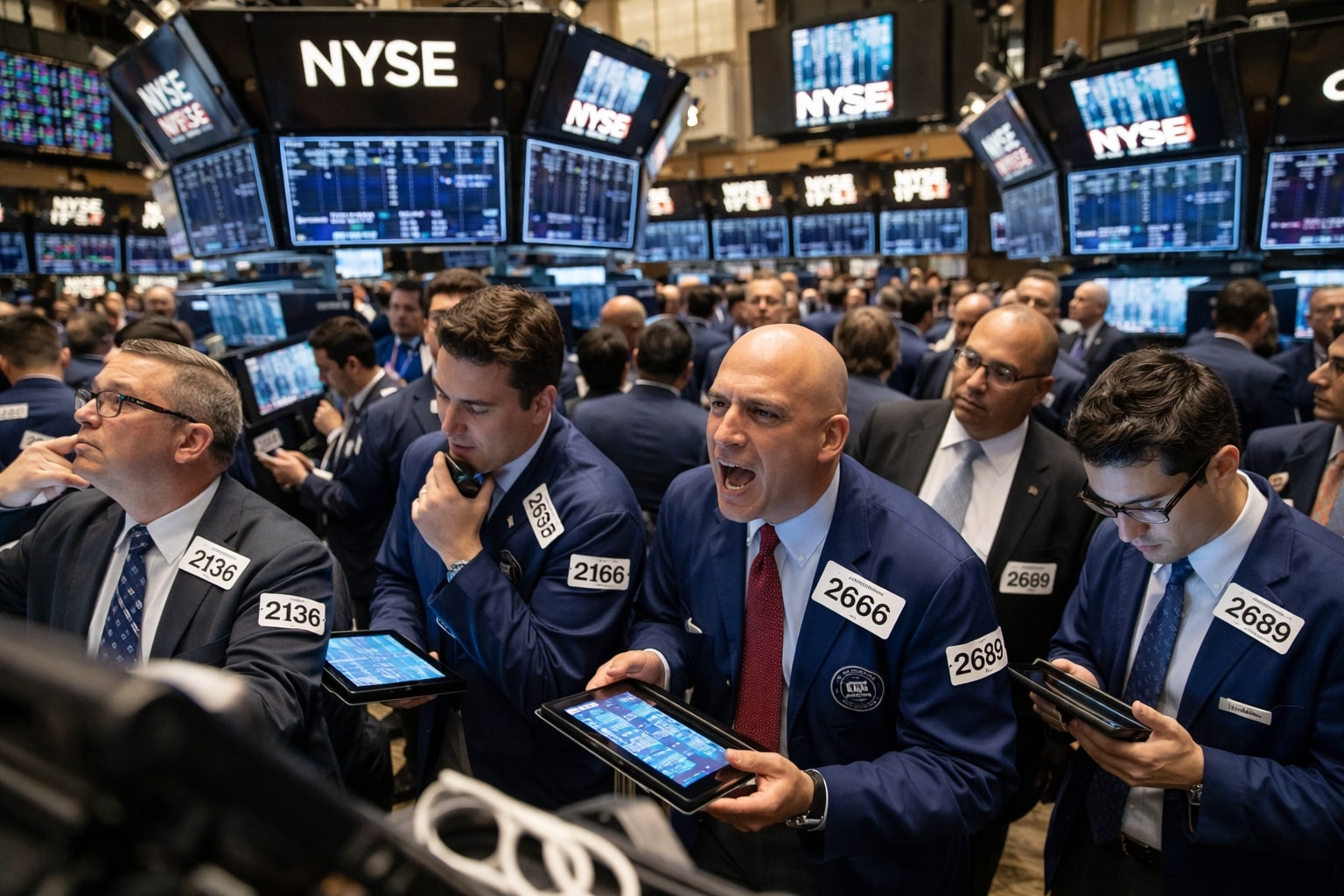
U.S. equities trade quietly but at stretched levels. The S&P 500 (SPX) fluctuates around 6,936–6,942, up roughly 0.1% and sitting within touching distance of the 7,000 line. The Nasdaq Composite (IXIC) is pinned near 23,645 with a gain of about 0.1–0.2%, while the Dow Jones Industrial Average (DJI) grinds around 48,700, essentially flat. Post-Christmas liquidity is thin, so relatively small orders move prices, but the critical point is that all three benchmarks remain parked near record territory rather than giving back 2025’s gains.
Santa Window Meets A 6,900–7,000 SPX Showdown
The traditional Santa-Claus period – last five sessions of December plus the first two of January – is usually a tailwind, but this year it unfolds with SPX already hovering just below 7,000. On December 15, the index closed close to 6,816.34 and has since added about 120 points in less than two weeks. Short-term support now sits near 6,900; below that, the December 15 region becomes the first serious test. A clean break and hold above 7,000 in early January would confirm that buyers still control the tape. A rejection that drives SPX back toward 6,816 would turn this Santa window from a sentiment boost into an early warning.
Mega-Cap Tech Split: NVDA Leads While TSLA, META, GOOGL And Others Fade
The mega-cap complex is no longer a single uniform trade. Nvidia (NASDAQ:NVDA) trades around $190–191, up roughly 1–2% intraday and up about 40% for 2025, cementing its role as the core AI benchmark. Apple (NASDAQ:AAPL) edges higher near $274.47. Alphabet (NASDAQ:GOOGL) is modestly lower around $313. Tesla (NASDAQ:TSLA) slips about 1.3–1.4% toward $478–479. Meta Platforms (NASDAQ:META) trades marginally in the red near $666, while Amazon (NASDAQ:AMZN) and Microsoft (NASDAQ:MSFT) drift slightly lower around $232 and $486. The pattern is clear: the market is still willing to pay for dominant AI infrastructure via NVDA, but it is increasingly selective across the rest of big tech as valuations stretch.
AI Race Tightens: NVDA–Groq Pact Reshapes The Inference Stack
Nvidia’s licensing and talent deal with Groq is the key AI catalyst in this session. Rather than a full acquisition, NVDA is licensing Groq’s inference-oriented architecture and bringing senior Groq executives in-house, while Groq continues operating as a cloud provider. Strategically, that move pulls a potential rival architecture inside the Nvidia ecosystem, reinforces the CUDA moat, and deepens Nvidia’s grip on inference workloads just as AI spending shifts from training to real-time deployment. The market response – NVDA up while the Nasdaq barely moves – confirms that investors still reward targeted, moat-enhancing AI investments even after a huge multi-year rally.
Biotech Extremes: KYTX Rockets As BHVN Stumbles
Biotech remains the sharpest source of single-name volatility on the board. Kyverna Therapeutics (NASDAQ:KYTX) jumps more than 30% after strong Phase 2 data for its CAR-T candidate miv-cel (KYV-101) in stiff person syndrome, showing meaningful disability improvement with a clean safety profile. That kind of data puts Kyverna on a path toward a BLA filing in the first half of 2026 and positions it as a leading contender for the first approved CAR-T therapy in autoimmune disease. In contrast, Biohaven (NYSE:BHVN) trades lower after its depression program failed a key endpoint, extending a string of disappointments. The spread between KYTX and BHVN underlines why biotech remains a high-beta satellite allocation even when the main indices look calm.
Defensives And Consumer Plays: HSY Supported, COST Marked Down
Defensive equities are not moving in a straight line higher. Hershey (NYSE:HSY) trades firmer after an upgrade that highlighted earnings visibility, pricing power and balance-sheet strength, characteristics investors increasingly value heading into a potentially choppier 2026. Costco (NASDAQ:COST), on the other hand, trades lower after a downgrade to Sell on stretched valuation and early signs of growth moderation. The takeaway is that even elite retail franchises are exposed when multiples run far ahead of the fundamental data; “defensive” status is not enough to protect a stock if the starting price is aggressive.
E-Commerce Relief: CPNG Clears A Cyber Overhang
Coupang (NYSE:CPNG) stands out as one of the stronger gainers in the e-commerce space. Management confirmed that customer information linked to a South Korean security incident was deleted and did not spread widely, removing a key headline risk. With the cyber overhang reduced, the market can re-focus on fundamentals: Coupang’s share gains in Korean online retail, expanding margins and international optionality. In a year where data-breach and regulatory headlines have destroyed value across tech, that clarification is enough to trigger a sharp relief rally.
Sector Map: Tech And Materials Outperform While Discretionary And Industrials Lag
Sector performance inside the S&P 500 is narrow but internally consistent. Information technology and materials are clearly in the green, while consumer discretionary and industrials lead the declines and most other groups hover near unchanged. Tech rides ongoing AI capex and the prospect of lower real yields. Materials benefit directly from the surge in gold, silver and strength across key industrial metals. Discretionary stocks pause after a multi-year consumer boom, and industrials respond to any doubts about the durability of the global expansion. Capital is rotating within equities rather than exiting the asset class, which is the key signal for risk positioning.
Metals In Control: Gold Above $4,500 And Silver North Of $75
The most explosive price action is in metals, not indices. Spot gold (XAU/USD) trades around $4,532 per ounce, up roughly 1.1–1.2% on the day and sitting at fresh all-time highs. Silver (XAG/USD) has cleared $75 per ounce for the first time and recently traded closer to $77, driven by tight supply conditions and an aggressive safe-haven bid. Equity miners mirror the move: Newmont (NYSE:NEM), Freeport-McMoRan (NYSE:FCX) and Southern Copper (NYSE:SCCO) all benefit as the market re-prices long-dated cash flows at higher underlying commodity prices. With real yields easing after multiple Fed cuts and geopolitical risk still elevated, the current gold level is a direct market verdict on policy credibility and long-term inflation protection.
Energy, FX And Crypto: CL=F Soft, Dollar Flat, BTC-USD Weak
Energy, currencies and crypto are sending a different signal than metals. Crude is soft, with WTI (CL=F) near $57.75 per barrel and Brent (BZ=F) around $61.53, both down a little more than 1%. That caps relative performance in the energy sector despite resilient earnings across integrated majors. In foreign exchange, the dollar index is nearly unchanged; the euro trades around $1.178, GBPUSD near $1.35 and USDJPY close to 156.5, reflecting ongoing policy divergence between an easing Fed and a still-ultra-loose Bank of Japan. Bitcoin (BTC-USD) trades near $87,300–87,400, off around 0.6%, behaving like a high-beta risk asset rather than an independent macro hedge in this environment.
Global Indices: DAX, FTSE 100, TSX, ASX 200 And NIFTY 50 Shape The 2026 Tape
Equity strength is global, not just U.S.-driven. In Europe, the DAX trades close to record levels with investors focusing on Fed signals and ECB cuts. The FTSE 100 holds just below 9,900, with 9,871 watched as a key reference into the next reopen as traders weigh the 2026 IPO pipeline and lower U.K. yields. In Canada, the S&P/TSX Composite prepares to reopen against the mix of softer oil and surging metals, a combination that typically favors gold and diversified miners over pure energy exposure. In Australia, ASX 200 futures suggest a stable restart, supported by strength in copper and gold. In India, NIFTY 50 holds support around 25,700–25,800, with resistance at 26,300–26,500 and upside potential toward 26,500 if that band breaks. The message across these benchmarks is that equities are richly valued almost everywhere, but clear topping patterns remain scarce.
Fed Path, December 30 Minutes And A Data-Heavy January
The rate path is still the central macro anchor. The Fed has already delivered several cuts in late 2025, and the next key event is the release of the December 9–10 meeting minutes on December 30 at 2:00 p.m. ET. Markets will dissect how unified the Committee is on future easing and how concerned they are about extremely loose financial conditions tied to record equities and surging metals. Futures pricing still implies further cuts through 2026. For SPX near 7,000, the risk is not a sudden hawkish pivot; it is a slower or shallower easing path than what is now embedded in tech and long-duration valuations. January labor, inflation and activity data will either lock in the soft-landing narrative or force a sharp repricing.
Street Targets For 2026: 7,269 Base Case, 7,700 Bull Case And Concentration Risk
Strategists are already trading the 2026 landscape. A rough average of major Wall Street targets places S&P 500 around 7,269 at the end of 2026, implying mid-single-digit upside from the current 6,900–6,950 area. One major bullish house projects SPX at 7,700 by late 2026, built on roughly 10% earnings growth, further rate cuts and stable policy. On the other side, prominent value investors argue that the index is more likely to be lower by then because of the extreme concentration in expensive AI leaders. If the most richly valued names stop expanding, the index can deliver negative returns even if cheaper segments log positive performance. Today’s level just below 7,000 is effectively the midpoint of that debate.
Protecting 2025 Gains: Rebalance, Add Defensives And Build Real Hedges
With SPX up around 18% for 2025, capital preservation is as important as chasing the last parts of the rally. The first step is reassessing sector and factor exposures; many portfolios now have accidental overweights to U.S. growth and AI themes simply because of index performance. Redirecting part of that into reasonably priced financials, select industrials with strong order books and quality value names cuts concentration risk. The second step is reinforcing defensive holdings: staples with genuine pricing power, regulated utilities, and high-quality dividend payers that can carry portfolios through a flat or slightly negative index environment. The third step is adding hard hedges via investment-grade bonds, targeted real-estate securities and explicit gold exposure. That mix will not beat stocks in a melt-up, but it matters when markets roll over.
Active Trading Levels: SPX, NDX, DJI And NIFTY 50
Short-term traders are working off a compact set of levels. For SPX, 6,900 is immediate intraday support; below that, the December 15 region around 6,816 is the first significant downside target. A break under 6,816 would confirm that the quiet drift has flipped into genuine profit-taking. For the Nasdaq Composite, 23,000 is the key line; a decisive move below 23,000 combined with sustained weakness in TSLA, META and GOOGL would confirm a shift away from pure AI leadership. For the Dow, the 48,400–48,500 band acts as support and 49,000 as resistance; as long as price remains in that zone, cyclicals and industrials are not signaling macro stress. For NIFTY 50, 25,700–25,800 remains the main support range with scope toward 26,500 if resistance at 26,300–26,500 gives way.
Trading News Verdict: SPX Hold, NVDA Buy On Dips, Metals Buy, Global Equities Selective
At current levels the market is not cheap, but it is not flashing a clear top either. For the S&P 500, around 6,940 with consensus 2026 targets clustered just above 7,000, the risk-reward looks balanced. Valuation, AI concentration and the strength of gold argue against aggressive new index exposure. The stance is HOLD on SPX with a tilt toward sectors not priced for perfection. For the Nasdaq and AI complex, Nvidia (NVDA) remains the structural winner; the Groq deal strengthens its grip on both training and inference, and around $190 the stock is expensive but backed by real earnings power and a powerful ecosystem. The call is BUY NVDA on pullbacks, while the broader NDX earns a neutral to slightly BEARISH tactical view given valuation risk. For metals, with gold above $4,500 and silver above $75 and central-bank demand still strong, the view is BUY as a portfolio hedge even after the spike. For global indices – DAX, FTSE 100, TSX, ASX 200, NIFTY 50 – the stance is selective BUY / OVERWEIGHT in markets and sectors with reasonable earnings yields and direct leverage to the metals rally. Net positioning: U.S. large-cap indices are a HOLD with a defensive tilt, AI leaders like NVDA are BUY on weakness, and metals plus high-quality defensives are the preferred destination for fresh capital going into 2026.
That's TradingNEWS