Stock Market Today: S&P 500, Dow, Nasdaq Pull Back From Records as IBM and NOW Tumble, Hormuz Tensions Flare
SPX near 7,141, DJIA around 49,463 and IXIC at 24,633 slip as Brent climbs toward $105 | That's TradingNEWS
Key Points
- S&P 500 near 7,141, Dow at 49,463 and Nasdaq around 24,633 retreat from record highs as Hormuz tensions reignite.
- IBM sinks 8% to $231 and ServiceNow tumbles 16% to $86 on soft guidance; Tesla falls 3% on $25B capex warning.
- Brent climbs toward $105, VIX near 18.9, jobless claims hit 214,000; URI soars 21%, STM jumps 12%, NOK +6%.
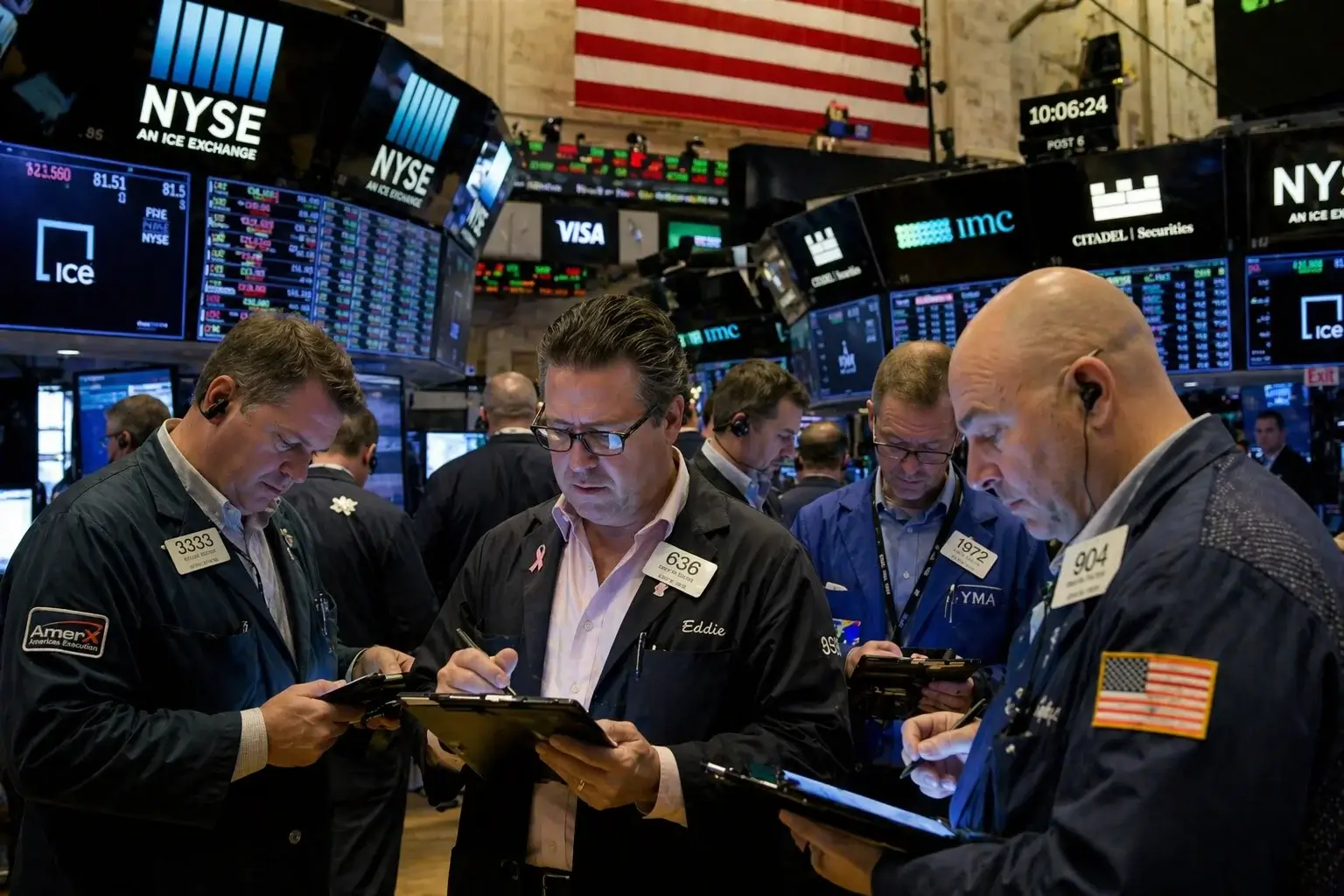
The main US equity benchmarks surrendered ground Thursday morning, giving back a slice of the remarkable advance that had carried both the S&P 500 and the Nasdaq Composite to fresh closing records the prior session. The Dow Jones Industrial Average was hovering near 49,463.16, down about 26.87 points, while the S&P 500 oscillated around 7,141.74 with prints flickering between a gain of 0.03% and a loss of 0.1%, barely clinging to the flat line throughout the opening stretch. The Nasdaq Composite changed hands near 24,633.18, off approximately 24.39 points, or 0.14%, with intraday swings reaching as deep as 0.5% before the bid returned. The Russell 2000 bucked the broader softness with a gain of 4.87 points to 2,790.25, a quiet signal that small-caps — so often left behind during megacap-led rallies — were drawing selective buying interest. The Barron's 400 added 0.72 to 1,526.12, reinforcing the notion that the pullback was not a broad-based capitulation but a concentrated reset in a handful of names that dominate index weightings. The context matters: Wednesday delivered a 1.05% pop in the S&P 500, a 1.64% jump in the Nasdaq and a 340.65-point gain in the Dow worth 0.69%, with the Nasdaq and S&P 500 notching their fourth record closes across six sessions and the Nasdaq registering its fifth intraday high in that span.
Hormuz Standoff Drives the Risk-Off Tape and Pushes Brent Toward $105
Appetite for risk was handicapped by a fresh flare-up in the Strait of Hormuz that dismantled the assumption that Tuesday's extension of the US-Iran ceasefire would steady the complex. US forces reportedly boarded at least one sanctioned vessel in the Indian Ocean carrying Iranian crude, and separate reporting out of Asia suggested as many as three Iranian tankers were intercepted in regional waters. The rhetoric escalated after a Truth Social post ordered the US Navy to "shoot and kill any boat" suspected of laying mines in the Strait, arriving less than 24 hours after Iran's Islamic Revolutionary Guard Corps Navy seized two container ships "for violating protocols." Vice President JD Vance reportedly paused his trip to the peace talks after Tehran negotiators signaled they would not attend, with Iranian state media describing further dialogue with Washington as a "waste of time." The oil complex responded with conviction. West Texas Intermediate futures (CL00) traded at $93.30 a barrel, up 0.34, after briefly reaching higher levels earlier in the session, while Brent (BRN00) added 0.55% to $102.47, having punched above $105 at the peak of the morning's anxiety before paring. International Energy Agency chief Fatih Birol, speaking from Singapore, framed the backdrop in stark language — the world is facing the "biggest energy security threat in history," with European jet fuel supplies set for difficult days ahead. That characterization is not idle commentary; it reinforces why the tape cannot shrug off Hormuz headlines the way it did earlier in April.
Dollar Climbs to a 10-Day High as Treasury Yields Reverse Overnight Selling
The US Dollar Index (DXY) firmed to roughly 98.55 to 98.65, a 10-day high, propelled by a combination of safe-haven demand and America's position as a net oil exporter — a status that increasingly functions as a structural tailwind for the greenback whenever the Middle East erupts. The 10-year Treasury yield hovered near 4.29%, down about 1.6 basis points from Wednesday's 4.31% close, as buyers stepped in to fade the overnight selloff once the softer jobless claims print and broader geopolitical caution shifted sentiment toward duration. Gold futures (GC00) held near $4,751.10, off a marginal 0.04%, with some prints registering $4,740, reflecting consolidation rather than capitulation for a metal that has ridden the entire geopolitical cycle to elevated territory. The combination of a firm dollar, gold at elevated levels and a 10-year yield refusing to break meaningfully in either direction tells a nuanced story: the bond market is not pricing a growth shock, the currency market is pricing a modest flight to quality and the metals complex is pricing persistence of geopolitical friction well beyond any near-term ceasefire headlines.
IBM Strips Roughly 135 Points From the Dow Despite a Double Beat
International Business Machines (IBM) was the most destructive force on the blue-chip index, printing $231.12 and shedding $20.74, an 8.23% decline that, on its own, accounted for roughly 135 points of downside on the price-weighted Dow. The reaction looked counterintuitive at first glance because the quarter itself was a double beat. Big Blue reported adjusted earnings of $1.91 per share on revenue of $15.9 billion, both ahead of consensus, and the Software and Consulting segments delivered results that should have supported sentiment. The friction point lived in the guidance. Management held the full-year framing at revenue growth of at least 5%, consistent with prior messaging, and the market had been positioned for a beat-and-raise sequence given the strength of the first-quarter print. When the raise did not materialize, the crowd that had been layering into the name through the early-April rally hit the exits. The sell-side response fractured in a way that tells the story of a mature franchise in transition. Goldman Sachs kept its buy rating while trimming the price target to $335 from $365, with analyst James Schneider highlighting operational efficiency programs that are offsetting dilution from the Confluent acquisition closed in March and projecting free cash flow to drift higher through the year. Bank of America stayed with a buy. Morgan Stanley's Erik Woodring held at equal-weight, writing that the first-quarter results did not move the narrative in either direction. UBS maintained a neutral posture, pointing to concerns that the as-expected guide does not address long-term AI-related pressure on the software franchise. The technical setup puts the stock close to levels that should invite disciplined accumulation. The verdict here is Hold with a bias to add on a retest of the $225 area, since the fundamentals do not support the punishment the tape is handing out, though momentum needs proof before buyers can realistically target the $260 zone again. Notable: IBM had already entered the session down 15% year-to-date, which means a fresh 8% leg lower is compounding an existing drawdown — that kind of setup tends to produce sharp reflex rallies once forced selling exhausts itself.
ServiceNow (NOW) Sinks 16% as Subscription Guidance Disappoints the AI Bulls
ServiceNow (NOW) was the most punished name across the entire S&P 500, collapsing 16.21% to $86.37, a loss of $16.71 per share. On the numbers, the quarter was a beat: first-quarter adjusted EPS of 97 cents topped the 96-cent consensus, and revenue of $3.77 billion edged the $3.74 billion bar analysts polled by LSEG had set. Yet the reaction function exposed how rarefied the air has become around AI-leveraged enterprise software. Management attributed softer-than-hoped subscription revenue growth to the "ongoing conflict in the region," and a cut to margin guidance amplified the selling pressure. Goldman Sachs analyst Gabriela Borges warned that a durable catalyst for a software sector rally may now be pushed into the second half of the year, after a 12-day stretch delivered a roughly 19% bounce in the software cohort that appears to have exhausted its runway on this print. The broader read-through extends well beyond NOW itself — Borges flagged that several of the themes from the call will likely recur through earnings season, making it "challenging for the group to collectively outperform." The longer-tail message is harder: it is still early to see AI-driven product cycles move the needle on the large SaaS revenue bases that define this cohort. That said, 30 of 49 sell-side analysts tracked by CNBC's consensus tool still carry a buy rating, and 14 of those rate it a strong buy. The stock is now trading at levels that price in a worst-case continuation of the theme. For a franchise with proven AI product traction, even if monetization is arriving more slowly than bulls hoped, this looks like an overshoot. The call is Buy on weakness, favoring scaled entries rather than a single print, with the first technical test of resilience sitting near $83 and a recovery path that requires a clean move above $95 to neutralize the damage.
Tesla (TSLA) Beats the Quarter but Musk's $25 Billion Capex Warning Rattles Holders
Tesla (TSLA) printed $376.15, down $11.36, or 2.93%, with intraday declines reaching 5% as the tape digested a split narrative. The headline quarter was solid. Adjusted earnings of 41 cents per share beat the 37-cent consensus estimate compiled by LSEG, and the initial post-close reaction sent shares up 4% in extended trading. That gain evaporated once Elon Musk signaled on the call that capital expenditure would rise "substantially" to $25 billion this year, funding the dual-track pivot into AI-enabled self-driving vehicles and humanoid robotics. For a name that is priced on future cash generation rather than near-term earnings, a capex expansion of that scale forces a re-underwriting of the free cash flow profile in the intermediate term. Option implied moves into the print had telegraphed a wide band, and the stock delivered one — just in the opposite direction from what the pre-close pop suggested. The stance on Tesla is Hold, acknowledging that the Optimus humanoid and Robotaxi optionality remains tangible but demanding discipline on entry given the valuation has to absorb the spend. A break below $360 would reset the risk/reward calculus in a way that favors adding exposure. A reclaim of $400 with confirmed Cybercab or Optimus operational milestones would reopen the bull case and justify fresh capital commitment.
Microsoft (MSFT) and the Tech Sector Drag the S&P 500 Lower
Microsoft (MSFT) dropped 2.74% to $421.04, an $11.88 decline that positioned it as the single heaviest weight pulling down the S&P 500 information technology sector. That segment was down 0.9%, per FactSet data at last check, establishing itself as the worst-performing group in the benchmark on the session. Given that MSFT still has its own earnings print on the forward calendar, the magnitude of the move looks more like pre-earnings de-risking and broader tech rotation than a fundamental deterioration in the franchise. That creates opportunity. The call is Buy on any dip toward the $415 area. UBS analysis underlines why the tape is this sensitive to individual tech names right now: the technology sector has accounted for roughly 57% of the rebound off the March lows despite carrying just a 35% weight in the index. Concentration of that magnitude means every earnings miss in the complex has an outsized impact, and every guidance disappointment has amplified consequences across the cohort. The firm also notes that of the 4.2-percentage-point increase in MSCI US earnings revisions year-to-date, 78% is attributable to the technology sector. When leadership narrows this aggressively, the tape gets fragile, and the risk management discipline that matters most is scaling positions to the volatility rather than to the conviction.
Intel (INTC) Climbs Into Its Print as Options Market Braces for Volatility
Intel (INTC) added $2.08, or 3.19%, to $67.35, building momentum into a post-close earnings report where the options market was pricing a chunky implied move. The setup is interesting in a specific way — the stock has rallied directly into the number and is trading near resistance, so the risk/reward skew favors caution into the event rather than adding conviction. The stance is a trading Hold into results with readiness to fade a gap-up above $72 and willingness to accumulate on any post-print weakness that respects the $62 level. The semiconductor complex around INTC remains extended — the VanEck Semiconductor ETF (SMH) was trading at $486.31, up 1.99% on the session, capping a 31% rally over just 16 sessions that has Fundstrat's Mark Newton warning explicitly about near-term exhaustion. That kind of trajectory demands respect on the tape even with the thematic tailwinds intact. The call on semis as a cohort is Trim and rotate — take partial profits in the most extended names and redeploy toward laggards in the financial and industrial complex where the rally has been less frothy and the multiples less demanding.
Lululemon (LULU) Dives on CEO Succession That Bypasses Elliott's Preferred Candidate
Lululemon Athletica (LULU) sank 6% in pre-market trading after naming longtime Nike executive Heidi O'Neill as its next chief executive, effective September 8, bypassing the candidate favored by Elliott Investment Management. Elliott reportedly holds a stake north of $1 billion in the Vancouver-based athleisure company and had advocated for former Ralph Lauren CFO Jane Nielsen to replace departing CEO Calvin McDonald after his roughly eight-year tenure concluded at the end of January. The stock had entered the session already down 21% year-to-date and has surrendered more than two-thirds of its value from the December 2023 peak above $500. The activist pressure from Elliott will not evaporate, and founder Chip Wilson has been publicly critical of recent board decisions, calling the appointment of director Chip Bergh "underwhelming" and arguing that the company's outlook demonstrates the need for strategic changes to return to consistent US sales growth. The fiscal 2026 plan to sell more merchandise at full price, announced during the fourth-quarter call, temporarily lifted the stock last month but has not changed the underlying trajectory. The softer US consumer backdrop compounds the governance overhang. The call is Sell into any strength — the succession outcome does not solve the growth problem and the activist dynamic could get uglier before it produces constructive change.
Notable Movers Across the Tape — Netflix, Nokia, United Rentals, QuantumScape
Netflix (NFLX) advanced more than 1% after a regulatory filing revealed an additional $25 billion share repurchase authorization. That is a staggering capital return commitment — the kind of buyback scale that aligns management incentives with shareholders and functions as a close cousin to insider accumulation. When a board authorizes $25 billion in repurchases, it is delivering a blunt signal about forward cash generation and valuation. The call is Buy with a medium-term bias as the cash flow engine funds the program without squeezing the content slate. Nokia ADR (NOK) jumped 6.34% to $10.48, reaching a 16-year high, after network infrastructure sales surged on AI and data-center demand. The read-through to the broader AI capex theme is constructive and the call is Buy with a first target near $11.25. United Rentals (URI) soared 20.80% to $969.76 after a well-received first-quarter print and a raised 2026 profit outlook — a blowout move for a large-cap industrial that validates the cyclical recovery thesis. Buy, with trailing stops below $900 given the magnitude of the gap. QuantumScape (QS) surged 6.09% to $7.76 after signaling plans to expand its battery technology beyond the automotive end-market. Hold — the story is getting more interesting but commercialization timing remains the binding constraint. STMicroelectronics (STM) stood out among the pre-bell movers, rallying 11.93% to $50.21 on a print that cut against the broader softness in the semiconductor complex. Buy with a target near $55 as the chip cyclical rotation broadens beyond the megacap names.
Read More
-
Yen Stalls at 160 Despite a 3% JGB and Tokyo Core CPI at 2.0% — Intervention Sits at 164, Friday's Payrolls Decide
02.09.2026 · TradingNEWS ArchiveEnergy
-
QQQ ETF ($739) Fades From an Early Tech Rally as a 77.9 ISM Prices Index Meets Micron's $61.5B Guide — $760 Record Test Ahead
01.10.2026 · TradingNEWS ArchiveStocks
-
XRPR and XRPI Follow XRP's $1.49 Test as Spot Funds Hold 1.16B XRP and a 1 Billion Token Escrow Release Lands — $1.70 in Play
01.10.2026 · TradingNEWS ArchiveCrypto
-
November NG Slips Below $3 as Decade-High Storage Meets Capped LNG Exports — $2.75 in Sight
01.10.2026 · TradingNEWS ArchiveCommodities
-
Dollar-Yen at 158 Presses Toward 160 as a 363 bp Carry Gap Meets Katayama-Bessent Intervention Risk — 159 in Sight
01.10.2026 · TradingNEWS ArchiveForex
Pre-Bell Industrials, Financials and Miners Present a Mixed Earnings Docket
The pre-open calendar delivered a deep roster of reports. American Express (AXP) changed hands at $322.83, down 3.02%. Blackstone (BX) traded at $123.71, off 4.64%, a meaningful move given the alternative asset manager's sensitivity to both Federal Reserve policy and credit spread conditions. Lockheed Martin (LMT) slipped 4.33% to $531.36, a curious print for a defense contractor operating against a backdrop of escalating Middle East tensions that theoretically should deliver tailwinds — the stance is Buy on weakness given the structural demand outlook from sustained geopolitical friction. Dow Inc (DOW) eased 4.48% to $37.07, Freeport-McMoRan (FCX) shed 7.74% to $64.92 on copper-sensitive concerns, and Fiserv (FISV) drifted 2.32% lower to $61.79. Newmont (NEM) ticked 1.96% lower to $109.66 even with gold holding up, while Baker Hughes (BKR) climbed 3.15% to $64.51 on the oilfield services rebound theme — a Buy given the torque to a sustained oil price backdrop. Honeywell (HON) shed 5.6% after issuing second-quarter EPS guidance of $2.35 to $2.45, below the $2.56 FactSet consensus, even as first-quarter adjusted EPS of $2.45 topped the $2.32 estimate on revenue of $9.1 billion that missed. Hold — the beat-and-lower sequence is manageable but does not justify chasing. American Airlines (AAL) climbed 3.96% to $11.96 after a first-quarter adjusted loss of 40 cents came in narrower than the 47-cent expected loss, with revenue of $13.91 billion edging the $13.79 billion consensus, despite the carrier cutting its 2026 earnings outlook on ballooning fuel costs that have added billions to expense runs across the airline space this year. Hold — the relief rally off a low base is real, but the jet fuel environment demands patience before committing fresh capital.
Helix Energy, Spirit Airlines and Avis Budget Produce the Tape's Sharpest Moves
Helix Energy Solutions (HLX) rose more than 3% on the announcement of an all-stock merger with Hornbeck Offshore Services, set to close in the second half of 2026 under the new Hornbeck banner and ticker (HOS). Hold — the integration arithmetic needs to play out before chasing the combined entity. Spirit Airlines (FLYYQ) more than doubled to $1.50 — its highest price since last August — after reports the Trump administration is nearing a $500 million convertible loan arrangement for the twice-bankrupt budget carrier. The Commerce Department, Transportation Department and the President have reportedly all been involved in discussions, with Trump floating publicly that "Spirit's in trouble, and I'd love somebody to buy Spirit. It's 14,000 jobs, and maybe the federal government should help that one out." When the company exited bankruptcy last April, the stock resumed trading near $9 and slid steadily before the August 2025 re-filing at $1.22. Avoid — trading bankrupt equities on political rescue speculation is a casino, not a rigorous investment process. Avis Budget (CAR) cratered a further 40.42% to $264.49, compounding Wednesday's 37.8% plunge as the short-squeeze dynamics that levitated the stock unwound violently. Avoid — the tape is mean-reverting and the short-interest-driven melt-up has no fundamental backstop.
Jobless Claims Tick Higher, PMIs Beat Expectations and the Labor Market Stays Firm
Initial jobless claims printed 214,000 for the week ended April 18, above the 210,000 Dow Jones consensus and up 6,000 from the prior week, according to the Labor Department release. Continuing claims, which lag by a week, edged to 1.82 million. The print is a nudge in the direction of more layoffs, but the absolute level remains historically low and does nothing to shift the Federal Reserve's runway. Bond buyers interpreted the data as permission to fade the overnight yield backup. The flash S&P Global PMI data surprised meaningfully to the upside. The manufacturing gauge printed 54.0 against a 52.5 forecast, the highest reading since May 2022, with both production and new orders at multi-year highs. The services index came in at 51.3 versus the 51.0 estimate. The softer edge in the report was in forward-looking output expectations, which improved in April but remained historically low — a reminder that firms are not yet betting on a sustained capital expenditure upcycle. Taken together with the claims data, the tape is telling a specific story: the US economy is running hotter than feared on current activity but softer than hoped on forward confidence, and that is precisely the kind of data mix that keeps the Fed on a patient glidepath.
Volatility Index Steady While AAII Bullish Reading Flashes a Contrarian Caution
The Cboe Volatility Index (VIX) printed 18.89, down 0.03, having climbed as high as 19.7 earlier in the session before retreating as the tape stabilized. Any reading above 20 tends to be interpreted as elevated volatility, and the fact that the VIX could not sustain that handle this morning tells a specific story: the selling is orderly, not panicked, and option markets are not pricing a fundamental regime shift. The American Association of Individual Investors' latest survey pushed bullish sentiment to 46%, a three-month high. That is a level that starts to look like a contrarian caution flag even as the structural trend remains constructive. Historically, when retail bullishness jumps to these kinds of readings after a sustained advance, the tape tends to deliver short-term consolidation as new buyers exhaust themselves. Pair that with the semi-specific warning from Fundstrat and the concentration math from UBS, and the case for tactical discipline on fresh longs strengthens considerably.
Bitcoin Eases From 11-Week High as Institutional Adoption Keeps Bid Under the Complex
Bitcoin (BTC) traded at $78,212.55 in some prints and $78,050.47 in others, down roughly 1%, pulling back from overnight highs near $78,900 after testing levels not seen since February. The 11-week peak was the product of several converging forces: the US-Iran ceasefire extension released pent-up risk appetite, the rolling "institutional adoption" narrative with Morgan Stanley (MS), Goldman Sachs (GS) and Charles Schwab (SCHW) all recently launching crypto products and services reinforced the structural bid, and broader risk-on flows reached into the digital asset complex. Hashdex's Gerry O'Shea tied the latest move higher directly to the extension of the ceasefire, describing institutional adoption as "helping fortify" those gains. Bespoke Investment frames the technical setup clearly — BTC has broken out of the downtrend that ran from the October high near $126,000 through the February low in the low $60,000s, and the next test sits at $85,000. The call is Buy on dips toward the $75,000 level, treating $85,000 as the first meaningful resistance band and $90,000 as a staging ground for a potential retest of the prior all-time highs. Ethereum and XRP were also soft in sympathy with the BTC pullback, a typical beta dynamic that should not disrupt the core thesis.
Global Tape Shows Japan and Korea Minting Records Before Hormuz Knocks Asia Lower
Japan's Nikkei 225 touched an all-time intraday high of 60,013.98 before settling 0.75% lower at 59,140.23 on profit-taking, after reports that the US intercepted Iranian tankers stoked concerns the Middle East conflict could drag on. Japan's manufacturing PMI showed the fastest expansion in four years as firms front-loaded output on Middle East supply concerns. Softbank Group (9984.T) gained more than 6% on reports the company is seeking a $10 billion margin loan backed by its OpenAI holdings, funding its AI push through additional leverage. South Korea's Kospi set its own intraday record at 6,538.72 before closing 0.90% higher at 6,475.81, with Samsung Electronics (005930.KS) hitting a fresh intraday peak of 227,000 won ahead of a planned 30,000-worker labor rally. Korean first-quarter GDP grew 1.7% quarter-over-quarter, the fastest pace since the third quarter of 2020 and well above the 1.0% Reuters consensus, rebounding from a 0.2% contraction the prior quarter. The small-cap Kosdaq dropped 0.58% to 1,174.31. Australia's S&P/ASX 200 fell 0.57% to 8,793.40, China's CSI 300 slipped 0.28% to 4,786.33, Hong Kong's Hang Seng fell 0.92% in its final hour of trade, and India's Nifty 50 was down 0.67% as of 3:40 a.m. ET. In Europe, the pan-regional Stoxx 600 (SXXP) hovered at 614.76, up 0.14%, with the CAC 40 (FCHI) adding 1.03% to 8,240.33 thanks in large part to L'Oreal rallying 8.54% to €374.35 on its fastest quarterly growth in two years. The FTSE 100 eased 0.12% to 10,463.98, the German DAX was essentially flat at 24,188.02 with a 0.03% decline, the FTSE MIB added 0.27% to 47,915.02, and the IBEX 35 dropped 0.54% to 17,909.90.
Sector Lookback and the Architecture of Wednesday's Record-Setting Advance
The Wednesday tape that delivered records for both the S&P 500 and Nasdaq was paced by three sectors rising in unison: information technology (+2.31%), communication services (+1.41%) and energy (+1.14%). The laggards on that record-setting day were real estate (-0.69%), industrials (-0.20%), financials (-0.17%) and utilities (-0.16%). Seven of 11 GICS sectors finished higher. That is a narrower advance than the headline index prints would suggest, and the narrowness of leadership is precisely why Thursday's action is delivering such violent single-name moves — when the tape is carried by a concentrated group of names, individual earnings disappointments within that leadership cohort produce outsized index drag. The IBM and ServiceNow moves today are the direct consequence of that architecture. Thursday's pullback is best characterized as a partial digestion of the record advance rather than a reversal of character.
Strategy Framework From UBS and B. Riley Points to a Bumpy Climb Higher
UBS chief investment officer for the Americas Ulrike Hoffmann-Burchardi framed the forward view as a bumpy path higher, with US equities expected to finish the year above current levels on a still-supportive economic backdrop, though AI-investment concerns and geopolitical risk are expected to drive episodic volatility. The recommendation to diversify across sectors and geographies while maintaining exposure to bonds, gold and commodities is a textbook hedge configuration for this kind of tape. B. Riley Wealth's Art Hogan captured the dual reality facing the complex — the rotation from macro focus to micro earnings focus during reporting season has been constructive for dispersion trades, but a single social media post can flip sentiment, which is why the downside moves so far have been measured rather than dramatic. Hogan's observation that traders "have a pretty strong muscle memory of what happens when this administration decides to use their preferred news dissemination vehicle to announce something that may well be market positive" is directly relevant to position sizing — the asymmetry of being underweight into a surprise ceasefire announcement or diplomatic breakthrough exceeds the asymmetry of being long into a tactical Hormuz escalation. Barnum Financial Group's Chris Kampitsis added that stocks are becoming "less sensitized to Iran headlines," with investors increasingly focused on earnings, fundamentals and Federal Reserve policy, an observation that aligns with the relatively contained VIX response despite the escalation.
Earnings Season Read-Through and What It Tells Us About the Tape
The earnings tape is handing out differentiated verdicts that deserve close attention. Beats are getting punished when guidance does not clear an elevated bar, as demonstrated by the (IBM) and (ServiceNow) reactions. Misses are getting mixed treatment depending on the forward narrative, as the (Honeywell) response illustrates. The few clean beat-and-raises are being rewarded aggressively — (United Rentals) advancing more than 20% and (STMicroelectronics) jumping nearly 12% stand as proof that capital is available for names delivering true positive surprises on both the quarter and the outlook. The implication is specific and actionable: position sizing should favor names with conservative guidance setups heading into their prints, where the bar is low enough to produce the kind of narrative-resetting beats that trigger genuine re-rating. The (Netflix) $25 billion buyback authorization delivered in parallel with this earnings tape functions as a separate signal entirely — it is a capital return commitment of a scale that signals management conviction about forward cash generation, and buyback-driven signaling at this magnitude is a close cousin to insider accumulation. When a board authorizes repurchases equal to a meaningful percentage of market capitalization, the implicit message is that the equity is undervalued relative to management's view of forward free cash flow, and this is the kind of signal that compounds over time rather than producing a single-session reaction.
Tactical Stance and the Highest-Conviction Calls Across the Tape
The tape is serving a nuanced message that rewards discipline. The breadth of the April rally, the labor market firmness implied by 214,000 claims, the manufacturing PMI reading of 54.0 — the highest in nearly four years — and the AAII bullish reading at a three-month high all argue for participation in the structural uptrend. At the same time, the Hormuz escalation, the concentration of the rally in overbought semiconductors and the punitive tape response to anything short of a beat-and-raise argue for selective exposure rather than blanket buying. The overall stance on US equities is Cautiously Bullish. The highest-conviction Buy calls concentrate in Microsoft (MSFT) on weakness near $415, Netflix (NFLX) on the $25 billion buyback signal, Nokia (NOK) on the AI infrastructure theme with a target near $11.25, United Rentals (URI) on the cyclical validation with trailing stops below $900, ServiceNow (NOW) on the 16% overshoot with scaled entries favored, STMicroelectronics (STM) on the chip cyclical broadening, Baker Hughes (BKR) on the sustained oil backdrop, and Lockheed Martin (LMT) on weakness given structural geopolitical demand. The Hold bucket with a constructive bias includes IBM (IBM) awaiting a retest of $225, Tesla (TSLA) pending the capex digestion, Intel (INTC) into its post-close print, Honeywell (HON) on the beat-and-lower sequence, American Airlines (AAL) on the relief rally framework, Helix Energy (HLX) on the merger integration, and QuantumScape (QS) on the commercialization timeline. The Sell or Avoid bucket includes Lululemon (LULU) on the succession and growth overhang, Avis Budget (CAR) on the violent mean-reversion from the squeeze, and Spirit Airlines (FLYYQ) on the political rescue speculation that has no fundamental backstop. The macro overlay rounds out the framework — long gold (GC00) as a persistence-of-friction hedge, long selective energy exposure through names like (BKR), and long duration through Treasuries while the 10-year yield orbits 4.29% as a defensive ballast against any escalation that would trigger a flight to quality. That configuration is built to weather a Hormuz-driven oil shock without surrendering the structural tailwinds that carried the S&P 500 to 7,141.74 and the Nasdaq Composite above 24,633 in the first place.