Stock Market Today - S&P 500, Dow Jones (^DJI) and Nasdaq Slide as Oil Surges Above $71 and Walmart (WMT) Beats Expectations
Dow, S&P 500 and Nasdaq ease after Presidents Day while Brent hits $71, WTI holds $66, jobless claims drop to 206,000, Walmart (WMT) climbs, and high-beta names like CVNA and W sell off as Bitcoin hovers near $66,000 | That's TradingNEWS
Holiday-shortened week turns sour as ^DJI, ^GSPC, ^IXIC give back gains
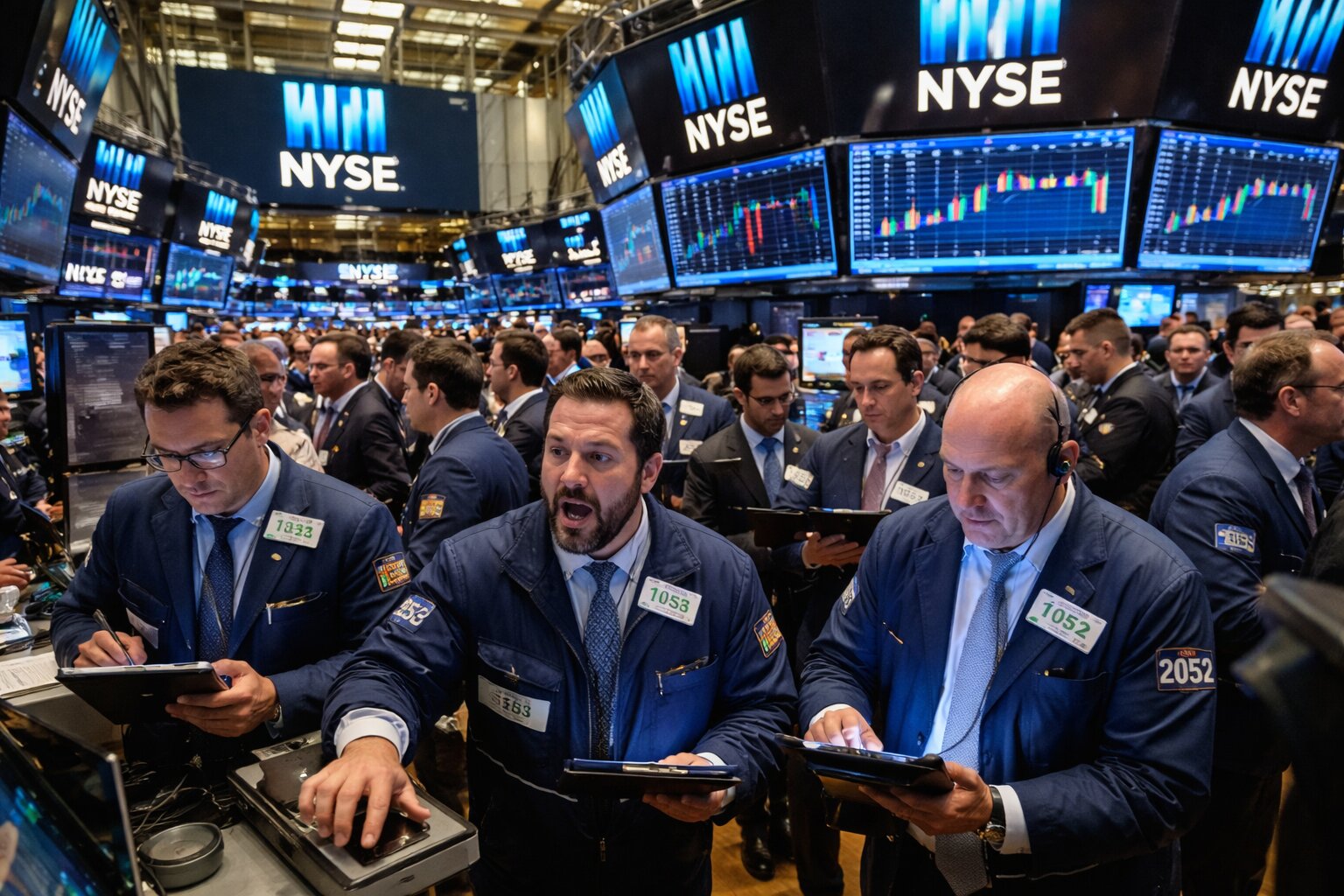
After starting the post-Presidents Day stretch on a strong footing, US equities rolled over on Thursday as oil’s surge, fresh macro data and mixed corporate results pushed risk appetite lower. The Dow Jones Industrial Average (^DJI) dropped around 0.5%–0.6%, losing more than 200 points. The S&P 500 (^GSPC) slipped roughly 0.3%, trading near 6,865, while the tech-heavy Nasdaq Composite (^IXIC) fell about 0.3%–0.4%, surrendering part of Wednesday’s rebound. Sellers were broad: mega-cap tech, high-multiple growth and some of the recent earnings winners all faced profit-taking, even as a handful of names in e-commerce, logistics and industrials outperformed.
Under the surface, the leadership pattern shifted. Energy linked to crude benchmarks, select gold miners and a narrow group of earnings winners outpaced the indices, while richly valued AI and e-commerce plays, some cyclicals and parts of the “Magnificent Seven” lagged. The backdrop remained a holiday-shortened week after Monday’s Presidents Day closure, with liquidity concentrated into fewer sessions and macro headlines hitting a market already stretched by a powerful year-to-date run.
Oil shock from U.S.–Iran tensions drives energy leadership and inflation fears
Crude dominated the macro narrative. Brent futures (BZ=F) traded above $71 a barrel, up more than 1% on the session and more than 11% for the month, after a 4%+ spike the day before. West Texas Intermediate (CL=F) held above $66. A potential US military campaign against Iran, reports of an expanded carrier presence and partial closure moves in the Strait of Hormuz pushed traders to price a higher risk premium into crude.
The move matters for equities on several fronts. First, it pushes energy stocks back into leadership as investors re-hedge against supply disruptions from a region responsible for roughly a third of global oil output and a major share of seaborne flows through Hormuz. Second, it reopens the inflation risk channel just as markets were trying to price in a benign disinflation glide path. Higher fuel costs filter quickly into transportation, input prices and consumer sentiment, which is why equity traders immediately tied the oil jump to a repricing in rate-cut expectations and higher Treasury yields.
Gold followed its classic crisis-hedge playbook. Futures (GC=F) hovered around $5,000 an ounce after spiking yesterday, reflecting a flight to safety and a hedge against both geopolitical escalation and renewed inflation shock. Silver held near $77–$78 an ounce. The combination of surging crude and resilient precious metals underlines that this is not just a headline squall; the market is actively hedging tail risks in energy and rates rather than dismissing them.
Labor market, trade gap and PCE keep the Fed’s next steps under scrutiny
Macro data delivered a mixed but market-relevant message. Initial weekly jobless claims fell to 206,000, a drop of 23,000 and well below consensus around 223,000. That’s the largest week-on-week decline since November and reinforces the picture of a labor market that is cooling only gradually rather than cracking. Continuing claims ticked up to 1.87 million, hinting that it’s still slightly harder to exit unemployment, but the headline signal is clear: no sharp deterioration that would force the Fed’s hand into rapid easing.
At the same time, the December trade deficit widened sharply to $70.3 billion, up roughly a third from the prior month. For 2025, the full-year deficit printed around $901.5 billion, only marginally below the roughly $903.5 billion level recorded in 2024 despite an aggressive tariff regime. That undercuts the idea that tariff skirmishes have materially improved the structural trade balance and reminds markets that policy noise does not automatically translate into fundamental shifts in flows.
All of this lands just ahead of Friday’s PCE inflation release, where economists expect headline PCE near 2.8% year-over-year and core PCE around 3.0%, both uncomfortably above the Fed’s 2% goal. With oil now adding fresh upside risk, traders dialed back the probability of near-term rate cuts. Futures markets price roughly a 94% chance that the Fed holds the funds rate at 3.50%–3.75% at the March meeting and only two cuts by year-end. The 10-year Treasury yield moved up to roughly 4.10%, from about 4.08%, as investors demanded slightly higher compensation to hold duration in an environment where both inflation and term premia are nudging higher.
Walmart (WMT) and Amazon (AMZN) reshape the retail pecking order after Presidents Day
Quarterly results from WMT gave the market a clean read on the US consumer. Adjusted EPS for fiscal Q4 2026 printed at $0.74, a cent ahead of consensus, on revenue of $190.7 billion, up 5.6% year-over-year and effectively in line with forecasts around $190.6 billion. For the full fiscal year, revenue reached $715.9 billion versus Street estimates just under $713 billion, with full-year adjusted EPS at $2.64, again a touch above expectations.
The beat was driven by double-digit growth in e-commerce and advertising. Online sales increased around 24%, and the Walmart Connect ad platform grew roughly 33%–37%, confirming that the retailer is evolving into a data-rich omnichannel platform rather than a pure brick-and-mortar story. Market share gains among higher-income households underscore how persistent price sensitivity and “value hunting” are reshaping shopping habits.
The drag came from guidance. Management projected current-year net sales growth of 3.5%–4.5% and adjusted EPS in the $2.75–$2.85 range, below consensus around $2.96. Tariffs, geopolitical risk and sticky inflation all featured in the risk language, and that cautious tone initially pushed the stock down about 3% pre-market before buyers stepped in. By mid-session, WMT traded roughly 2% higher near $129, as investors focused on market share, scale and high-margin ad growth rather than the conservative outlook.
At the same time, Amazon.com, Inc. (AMZN) quietly seized a headline of its own. With 2025 net sales of $716.9 billion, Amazon overtook Walmart’s $713.5 billion full-year revenue, officially becoming the world’s largest company by top line. The baton pass matters for index investors: between them, the two giants now anchor both defensive retail exposure and much of the market’s structural bet on cloud, logistics and digital advertising. It also reinforces why AMZN can underperform on a given day while still reshaping the competitive landscape for the entire consumer complex.
Mega-cap tech, OpenAI’s $100B round and the limits of the ‘Magnificent Seven’ trade
US large-cap tech spent Thursday on the back foot. Nvidia (NVDA), Apple (AAPL), Alphabet (GOOG), AMZN, Meta (META) and Tesla (TSLA) were all modestly lower, while MSFT eked out a small gain. That divergence mirrors the market’s recalibration of AI expectations and capital-spending burdens across the group.
Valuation remains the core tension. The “Magnificent Seven” forward price-to-sales multiple has eased from a peak near 8.3x in late 2025 to roughly 7.1x, but that is still historically rich. Earnings have largely impressed, yet the bar is so high that even solid beats can trigger selling once guidance fails to match the most optimistic AI narratives.
A fresh catalyst arrived from OpenAI, which is close to locking down $100 billion-plus in new funding at a valuation that could eventually exceed $850 billion. Strategic investors including Amazon, SoftBank Group Corp., NVDA and MSFT are expected to anchor the round. That scale of capital underscores how enormous AI infrastructure bills will be over the coming decade. For equity markets, it sharpens two questions: which names will capture incremental economics from AI, and how much of those future cash flows is already baked into today’s multiples?
The near-term impact is straightforward: after a strong Wednesday rebound in high-beta tech, traders used the OpenAI headlines, oil spike and rate jitters as excuses to trim positions into strength. With macro uncertainty rising and valuations still elevated, the group is vulnerable to further rotation into cyclicals, financials and energy whenever yields back up.
ETSY, EBAY, DASH and DE highlight where the market still pays up for execution
The day’s biggest winners came from names that delivered credible growth and clear capital-allocation stories rather than grand narratives.
Etsy, Inc. (ETSY) exploded higher, with shares up around 20%–22% after the company posted Q4 EPS of $0.92 versus expectations near $0.85. Revenue landed at $881.6 million, slightly below the roughly $884 million consensus but still growing about 6.6% year-over-year excluding Reverb. Gross merchandise sales reached $3.59 billion, up 2.4%, and adjusted EBITDA of $222.5 million implied a healthy 25.2% margin. The real catalyst was strategic: Etsy is selling Depop to eBay Inc. (EBAY) for $1.2 billion, simplifying the portfolio and freeing capital to focus on its core marketplace. The forward guide calls for Q1 GMS between $2.38–$2.43 billion and an adjusted EBITDA margin around 28%–30%, with an expected take rate near 25.5%. Those numbers justify paying up for a leaner, more profitable model.
EBAY gained roughly 6%–7% as the market cheered both its own Q4 beat and the Depop acquisition, which aims to deepen its reach with younger, resale-focused consumers. The message is that scale marketplaces still have room to refine their demographic targeting and fee structures rather than simply defending share.
Food-delivery heavyweight DoorDash, Inc. (DASH) climbed as much as 10%–13% after reporting Q4 EPS of $0.48 versus consensus closer to $0.55 but delivering muscular 28% revenue growth to $3.96 billion and a 32% jump in total orders to 903 million. Marketplace GOV came in at $29.7 billion, ahead of the roughly $29.1 billion forecast, and guidance for Q1 GOV of $31.0–$31.8 billion topped expectations around $30.75 billion. The only soft spot was 2026 adjusted EBITDA guidance of $675–$775 million, shy of an ~$800 million Street view, but investors looked through that to the scale of user and order growth.
On the industrial side, Deere & Company (DE) rallied about 5%–6% after beating on both top and bottom lines. Q1 EPS printed around $2.42 versus estimates near $2.05 on revenue of $8.0 billion against expectations of $7.69 billion. A rebound in construction demand offset some of the cyclical risk in agriculture, positioning Deere as a quality way to own late-cycle industrial and infrastructure exposure in an environment where fiscal spending and re-shoring remain key themes.
Read More
-
Yen Stalls at 160 Despite a 3% JGB and Tokyo Core CPI at 2.0% — Intervention Sits at 164, Friday's Payrolls Decide
02.09.2026 · TradingNEWS ArchiveEnergy
-
QQQ ETF ($739) Fades From an Early Tech Rally as a 77.9 ISM Prices Index Meets Micron's $61.5B Guide — $760 Record Test Ahead
01.10.2026 · TradingNEWS ArchiveStocks
-
XRPR and XRPI Follow XRP's $1.49 Test as Spot Funds Hold 1.16B XRP and a 1 Billion Token Escrow Release Lands — $1.70 in Play
01.10.2026 · TradingNEWS ArchiveCrypto
-
November NG Slips Below $3 as Decade-High Storage Meets Capped LNG Exports — $2.75 in Sight
01.10.2026 · TradingNEWS ArchiveCommodities
-
Dollar-Yen at 158 Presses Toward 160 as a 363 bp Carry Gap Meets Katayama-Bessent Intervention Risk — 159 in Sight
01.10.2026 · TradingNEWS ArchiveForex
CVNA, W, EPAM, CHWY and HIMS show how unforgiving valuation air pockets still are
Not every growth story found a bid. Carvana Co. (CVNA) slumped more than 15% in after-hours trading after Q4 adjusted EBITDA of $511 million missed an already aggressive consensus near $536 million. Non-vehicle costs and higher depreciation ate into profitability, feeding concerns that the company is once again leaning too hard into volume and marketing to sustain top-line momentum. Even after a recent slide to around $337 from a record $478 in January, the stock remains priced for near-perfect execution. With short sellers highlighting related-party questions and the broader market less forgiving on misses, the risk/reward has become highly asymmetric: any hint of execution slippage is punished.
EPAM Systems, Inc. (EPAM) dropped roughly 17% after guidance for Q1 landed merely in line with expectations rather than ahead. For a premium-valued IT services name, “in line” is simply not good enough, particularly as investors re-price the impact of AI and automation on traditional consulting and outsourcing models.
Home-goods platform Wayfair Inc. (W) fell more than 6% despite delivering its first annual sales growth since 2020 and Q4 EPS of $0.85 against a consensus around $0.66 on revenue of $3.34 billion, ahead of estimates. The issue is structural: the market is still skeptical about the durability of pandemic-era online furniture tailwinds and wary of macro-sensitive categories tied to housing turnover and discretionary remodel spending.
The action around Chewy, Inc. (CHWY) and Hims & Hers Health, Inc. (HIMS) highlights a broader point. CHWY has fallen about 36% over 12 months and roughly 27% year-to-date, yet only now is attracting an “outperform” call from Raymond James with a $28 price target after a 33% slide since its fiscal Q3 print. Telehealth player HIMS ticked higher after announcing a $1.15 billion acquisition of Australia’s Eucalyptus, but the market is no longer rewarding growth at any price. Profit visibility, unit economics and capital discipline are the filters.
Samsung (005930.KS) and the AI memory cycle reprice chipmakers’ earnings power
Outside the US, Samsung Electronics Co., Ltd. (005930.KS) surged to a record high, rising about 4.8%–5.4% on the Korea Exchange after local reports that the company is negotiating HBM4 AI memory chip prices roughly 30% above the previous generation, around $700 per unit. That would leapfrog earlier deals that reportedly put rival SK Hynix (000660.KS) pricing for NVDA in the mid-$500 range and could force peers to push through their own increases.
The implication for global equity investors is twofold. First, the AI arms race is expanding from GPUs and accelerators into upstream memory suppliers, concentrating pricing power in a small handful of firms. Second, if pricing holds anywhere near these levels, the earnings leverage for high-end memory producers in 2026–27 could be significant, even if unit volumes undershoot the rosiest scenarios. That is why Samsung’s move reverberated across global semiconductor ETFs and helped soften the blow from weaker US mega-cap tech trading on the day.
Cross-asset moves – gold, dollar, crypto and bonds point to a controlled risk reset
The day’s broader cross-asset picture did not resemble a disorderly risk-off event, but it did signal a measurable tightening in financial conditions.
As noted, gold near $5,000 and silver just under $78 show demand for hard-asset hedges as crude rallies and Iran headlines multiply. The US dollar index climbed about 0.4% to roughly 98.10, supported by higher yields and safe-haven flows, particularly against currencies of economies more exposed to imported energy.
The 10-year Treasury yield’s move toward 4.10% was notable but not extreme, essentially reversing some of the dovish pricing that crept in after recent CPI optimism. Credit spreads widened modestly but remained far from stress levels seen during previous risk-off episodes.
Crypto told a similar story. Bitcoin (BTC-USD) traded around $66,000, off overnight highs above $67,000, while Ethereum (ETH-USD) and XRP (XRP-USD) also weakened, consistent with a mild de-risking across high-beta speculative assets rather than a sector-specific shock. Given that crypto had rallied sharply into the week, a 1–3% pullback in the face of rising real yields and geopolitical risk is more profit-taking than capitulation.
Post-Presidents Day stance: hold the indices, overweight energy and high-quality compounders
Pulling together the moving parts of this holiday-shortened week, the message for broad US equities is nuanced. Index-level price action shows a market pausing rather than breaking: the S&P 500 and Nasdaq gave back a slice of Wednesday’s gains but remain near record territory, while the Dow has slipped from its highs yet still reflects strong year-to-date performance. Earnings from WMT, ETSY, DASH, DE and others prove that corporate America can still expand sales and margins in a 3%-plus growth world, even as other names like CVNA, W and EPAM demonstrate that the bar for richly valued growth remains unforgiving.
Macro-wise, the combination of a solid labor market (jobless claims at 206,000), a wider trade deficit and still-elevated PCE expectations argues against aggressive easing any time soon. The Fed has room to stay patient, especially with oil above $70 and geopolitical risk skewing inflation risks to the upside. That caps multiple expansion for the indices but does not yet threaten earnings outright.
From a positioning standpoint, the rational stance for broad US equity exposure here is hold on the major indices with a cautiously bullish tilt rather than an outright chase. Breakouts in energy, selective industrial names like DE, and high-quality, cash-generative growth stories such as ETSY, EBAY and DASH deserve to be overweighted relative to expensive, fully-owned mega-cap tech where expectations are still extreme. On the other side, leveraged, execution-sensitive cyclicals and high-beta growth without clear profitability – the likes of CVNA and weaker IT services names – remain vulnerable as rates back up and the market grows more discriminating.
The net takeaway for Trading News readers: after the long Presidents Day weekend, Wall Street is shifting from a phase where everything AI-adjacent and momentum-driven worked to one where earnings quality, balance-sheet strength and pricing power in a more volatile macro backdrop decide who outperforms. In that environment, keeping core exposure steady, leaning into energy and select fundamental winners, and demanding real numbers rather than narratives is the right way to navigate a market that is digesting new geopolitical and inflation risks rather than collapsing under them.