Stock Market Today: S&P 500, Nasdaq and Dow React to Fed Signals and Tech Earnings
Wall Street tracks fresh index moves as big tech, bank stocks and oil names swing on earnings, yields and macro data | That's TradingNEWS
Wall Street Repricing AI Risk While Dow Blasts Through 50,000
The U.S. equity session ended with a violent risk-on reversal that did not change the underlying message: the market is no longer willing to fund limitless AI capex without proof of earnings, even as the Dow Jones Industrial Average rips to a record close above 50,000 and small caps and cyclicals finally outperform the mega-cap software complex.
Major indices – euphoric headline, conflicted internals
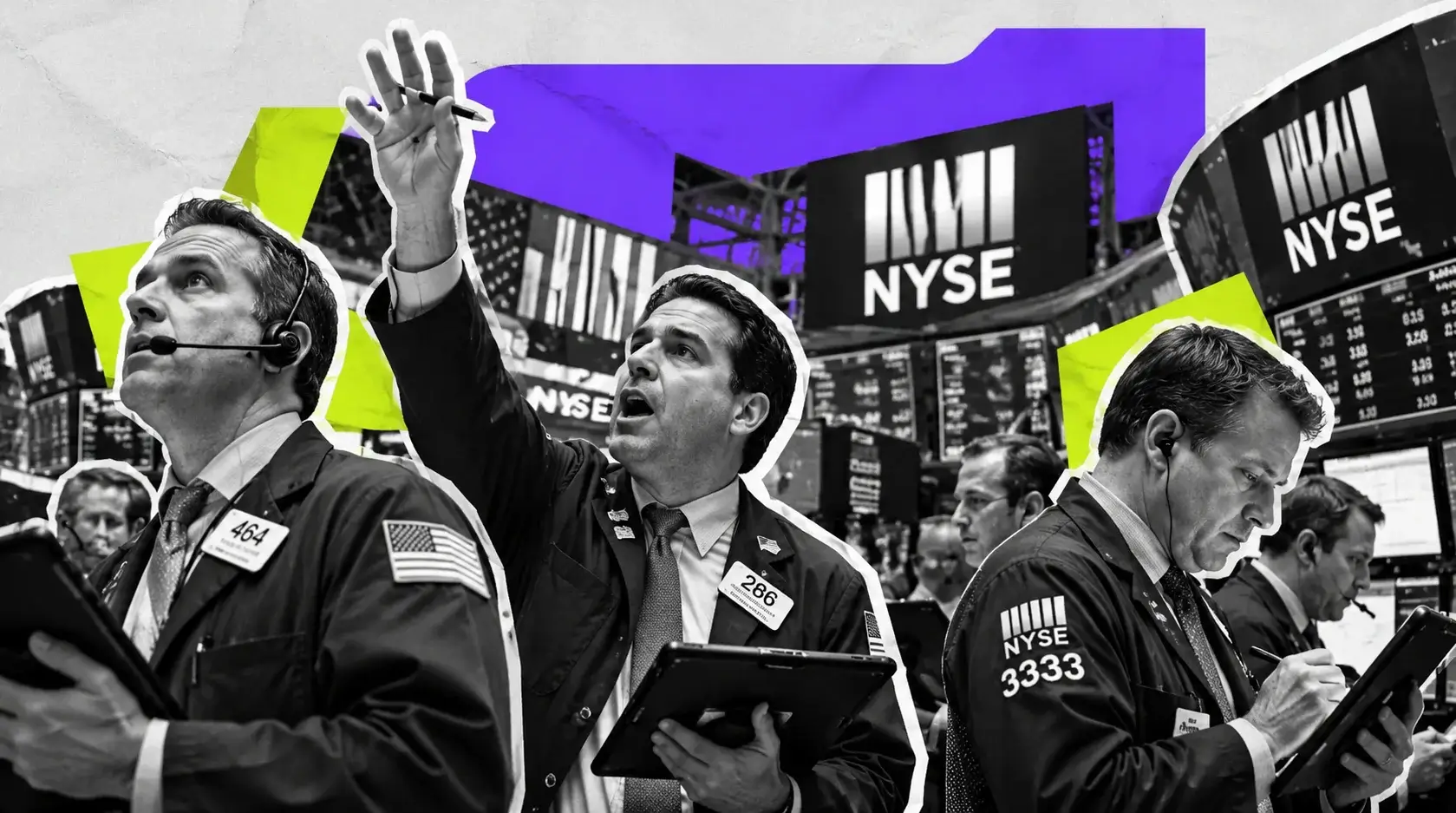
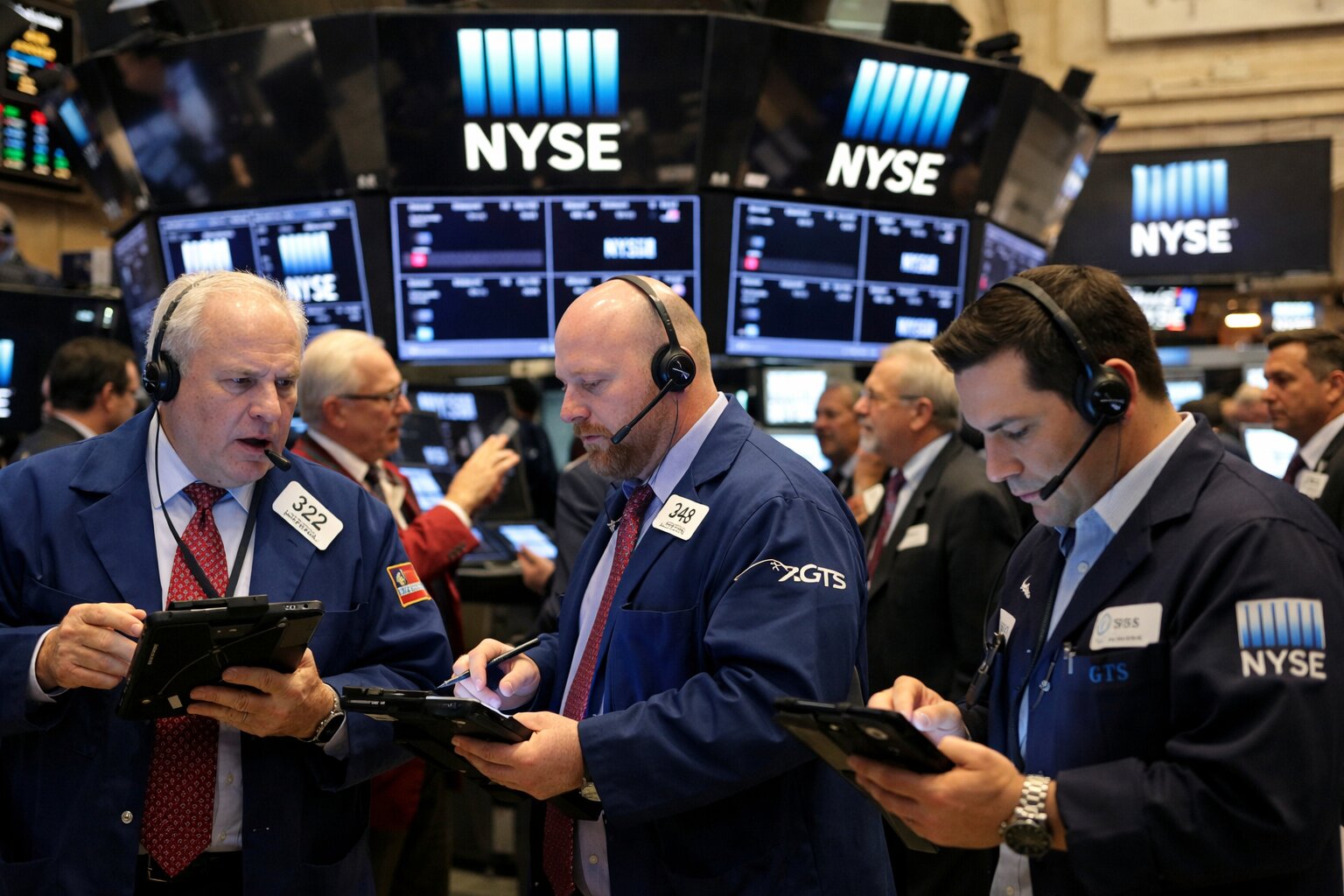
The Dow Jones Industrial Average closed at 50,115.67, up 2.5% on the day (+1,206 points), marking the first ever close above 50,000 after an intraday rally of more than 1,100 points. The S&P 500 jumped 1.97% to 6,932.30, reclaiming its 50-day moving average and moving back toward all-time highs, while the Nasdaq Composite climbed 2.18% to 23,031.21, ending a three-day slide but still sitting below key trend resistance. Small caps outperformed with the Russell 2000 up 3.6% to 2,670.34, a classic “risk switch” that says investors are willing to go down the quality spectrum after a bruising week for high-multiple tech. Breadth confirmed the move, with roughly four winners for every loser on both the Nasdaq and NYSE, while the volatility gauge VIX dropped 18% to 17.76, signaling aggressive volatility selling into the bounce.
Macro backdrop – sentiment spike, dollar softer, Fed cut odds creeping higher
The macro trigger for the session’s turn was a sharper-than-expected improvement in the University of Michigan consumer sentiment index, which jumped to 57.3 in early February versus 56.4 in January and against expectations for a decline toward 54–55. That six-month high in sentiment arrived alongside mixed labor data that pushed the implied probability of a near-term Fed rate cut to roughly the high-teens in March. The U.S. dollar index eased to around 97.6–97.7 as equity strength reduced safe-haven demand, even though some Fed speakers continued to stress the need for restrictive policy. In parallel, U.S. consumer credit expanded by about $24 billion, reinforcing the picture of a household sector still willing to borrow into equity gains. The combination of stronger confidence and growing expectations of eventual easing provided the macro oxygen for Friday’s melt-up.
Big headline: Dow 50,000 powered by AI cyclicals, even as AI capex becomes a liability
The headline story is the clash between the AI infrastructure trade and investor patience with profitless spending. Inside the Dow, Caterpillar and Nvidia (NASDAQ: NVDA) both rallied more than 7%, with NVDA delivering a 7.8% gain that added roughly $325 billion in market value in a single day. That move came after Big Tech outlined a combined ~$650 billion AI infrastructure budget for 2026, with Amazon (NASDAQ: AMZN) alone talking about $200 billion capex and Alphabet (NASDAQ: GOOGL) signaling plans to double 2026 investment to as much as $185 billion. The market’s message is no longer uniform: names that are clear shovel-sellers into this spend (chips, networking, power, fiber) rallied aggressively, while some platform heavyweights saw their shares punished for stretching balance sheets without sufficiently convincing earnings guidance.
AI capex shock: Amazon punished, software repriced, hardware rewarded
The session was defined by the bifurcation between AI beneficiaries and AI spenders. Amazon dropped around 5–10% intraday, threatening its 200-day moving average, after Q4 numbers and a 2026 operating income forecast of $16.5–$21.5 billion came in short of the roughly $22.2 billion Wall Street had penciled in. Q4 EPS of $1.95 slightly missed consensus despite AWS revenue beating at $35.6 billion, as the company outlined that $200 billion capex program across AI chips, robotics, logistics and satellites and confirmed 16,000 job cuts plus closures of Amazon Fresh and Amazon Go stores. Investors read this as a direct hit to free cash flow in 2026 and a potential headwind to valuation even if AI infrastructure ultimately pays off.
The software complex, already under pressure from concerns that AI could cannibalize traditional seat-based models, saw a violent relief rally but not a full reversal of damage. The iShares Expanded Tech-Software ETF bounced nearly 4% on the day, yet remains down about 30% from late-2025 highs and around 12% just this week. The “software apocalypse” narrative is forcing investors to differentiate fiercely: cash-generative, mission-critical names are still being supported, while high-multiple, slower-growing names remain vulnerable to further de-rating.
Semiconductors and data-center infrastructure – core winners of the AI reset
The clear outperformers were in the physical AI stack. Nvidia rallied 7–8% as investors re-engaged with the GPU leader after a brief flirtation with a deeper correction; the stock is still less than 20% off its peak, underscoring how little real damage the recent sell-off inflicted on the long-term trend. Broadcom (NASDAQ: AVGO) surged about 7.1% to $332.92, with Jefferies reiterating a buy and flagging upside of roughly 62% to a $500 target driven by Alphabet’s aggressive capex path and Broadcom’s ASIC edge versus rivals. Management already expects AI semiconductor revenue to double year over year next quarter, and Wall Street now effectively treats AVGO as a levered play on hyperscaler custom silicon.
Other chip and data-center infrastructure names followed suit. The PHLX semiconductor index climbed 5.7%, while the VanEck SMH ETF bounced more than 3% off its 50-day moving average. In the Nasdaq-100, chip names ARM, AMD (NASDAQ: AMD) and KLA (NASDAQ: KLAC) posted gains in the 8–12% range. Monolithic Power Systems (NASDAQ: MPWR) gapped to a record high above 1,200 after Q4 revenue increased 21% to $751.2 million. On the optical side, Lumentum Holdings (NASDAQ: LITE) jumped around 8%, extending a six-day run to a year-to-date performance near 49% as investors chase fiber-optic exposure linked to AI data-center builds; the stock now outperforms 99% of its tracked peer universe.
Mega-cap platforms – Meta and Microsoft re-rated from “free option” to “must earn it”
Within the megacap AI platforms, the week’s message is that the “free lunch” phase of AI spending is over. Meta Platforms (NASDAQ: META) closed Friday around $661.46, down 1.3% on the day and about 6.4% for the week, as markets processed CEO Mark Zuckerberg’s plan to ramp AI and infrastructure investment to as much as $135 billion in capex for long-lived assets like data centers and servers. Despite that pullback, Meta still trades at roughly 23x forward earnings, supported by Q4 2025 revenue of $59.89 billion, up 24% year on year, net income of $22.77 billion and a net margin near 38%. AI-boosted ad tools such as Advantage+ and the Andromeda recommendation engine generated an 18% jump in ad impressions, while Reels now accounts for approximately 35% of screen time with daily views at 200 billion, delivering an estimated $4.52 return for each dollar of ad spend.
Microsoft (NASDAQ: MSFT), backed by its 27% stake in OpenAI and a cloud business posting revenue growth above 30% via Azure, recovered with a 2% move on the day, yet investors are increasingly asking for harder evidence that AI workloads can drive incremental margin rather than just headline revenue. Scott Galloway’s call that OpenAI’s IPO could be pulled, given a “vibe shift” in capital markets and concerns about brand, governance and political entanglements, only adds to the pressure: AI narratives must now be matched by cash-flow-accretive economics across the ecosystem or face multiple compression.
Stock-specific AI stories – Tesla, CleanSpark, Broadcom, Meta, Bitcoin leverage
In single-name action, Tesla (NASDAQ: TSLA) rallied about 3.5% to $411.11 with roughly 62 million shares traded, after news of a new AI training center in China and hiring tied to a U.S. solar manufacturing buildout. The stock’s rebound fits the pattern of investors selectively backing platforms that can monetise AI both in software and in physical assets such as EVs and energy systems.
Bitcoin-levered equity CleanSpark (NASDAQ: CLSK) jumped about 22% to $10.08 after quarterly results and an AI-infrastructure update. With annual revenue around $785 million but a net loss of $267 million, the share price remains volatile; however, intrinsic value estimates around $23.16 imply over 100% upside if CleanSpark can execute its power-capacity expansion and if Bitcoin’s rebound above $70,000 holds. Peers Marathon Digital (NASDAQ: MARA) and Riot Platforms (NASDAQ: RIOT) also spiked as crypto-exposed names traded like leveraged calls on a 10–12% intraday bounce in Bitcoin after the coin’s plunge toward $60,000 earlier in the week.
Traditional value and income – insurance, banks and staples reassert relevance
While AI dominated headlines, classic value and income sectors quietly delivered strong risk-adjusted performance, confirming the ongoing rotation flagged by Wall Street houses. In insurance, RenaissanceRe Holdings (NYSE: RNR) has now gained 96.4% over five years yet still screens cheap, with an estimated intrinsic value around $948.17 versus a recent price near $300, implying roughly 68% upside. Earnings per share of $44.41, a return on equity near 14.3% and a P/E around 5.1 compared with sector averages underline how investors still underpay for reinsurance cash flow.
American International Group (NYSE: AIG) closed at $76.72, modestly down over 30 days but up 4.9% over one year and 107.7% over five years. An intrinsic value estimate of $156.73 based on Excess Returns puts fair value about 51% above the current price, supported by solid risk management and capital strength. The valuation gap suggests the market has not fully priced in improved underwriting discipline and balance-sheet resilience.
In banking, Barclays (LSE: BARC) has gained roughly 190% over three years, with a 61.4% 12-month return, yet still trades at an estimated 45.7% discount to an Excess Returns-based intrinsic value of £8.82. In North America, Royal Bank of Canada (TSE: RY) broke above its 200-day moving average at C$210.10, closing near C$232.72 with multiple analyst upgrades and a Moderate Buy consensus, supported by quarterly EPS of C$3.85 and revenue of C$17.21 billion.
Consumer staples demonstrated why some investors are rotating toward “real-economy” cash generators. Coca-Cola (NYSE: KO), trading just below $79 after a 13% year-to-date gain and a recent record high, is expected to post Q4 revenue around $12 billion, up 4% year on year, and EPS near $0.57. Shares have returned about 58% over five years with a 2.7% dividend yield, underpinned by pricing power that allowed management to raise prices roughly 89% between 2020 and 2025, supporting a 32% operating margin. Philip Morris International (NYSE: PM) offers a roughly 3.1% yield with a gross margin near 69%, reinforcing the income argument as equity valuations stretch.
Stock-level valuation dislocations – from deep value to overextension
Beneath index-level records, the tape is full of valuation extremes. On the cheap side, Pfizer (NYSE: PFE) closed at $27.22, up 8.1% year to date but still down 25.7% over three years. A DCF-derived fair value of $61.97 per share implies over 56% undervaluation, with free cash flow expected to reach around $15.7 billion by 2030 and a P/E near 20, roughly in line with peers. United Airlines (NASDAQ: UAL), at $115.91, is modeled at an intrinsic value near $304.52 based on growing free cash flow from roughly $1.94 billion to $6.81 billion by 2030, suggesting a 62% discount if execution risks can be managed.
In telecoms, BCE Inc (TSE: BCE) trades around C$34.25 but sports a theoretical DCF value of C$840.66 per share, implying almost 96% undervaluation. That number is clearly model-sensitive but underscores the disconnect between the market’s skepticism and BCE’s projected free cash flow climb from C$2.7 billion to the mid-single-digit billion range into the next decade.
Growth software names show the opposite pattern. Datadog (NASDAQ: DDOG) has fallen about 21% over the month but still carries a rich price-to-sales multiple; nonetheless, one DCF framework pegs intrinsic value around $224.65 per share, roughly double the current price, supported by free cash flow of $874.3 million last year and projections of $3.6 billion by 2030. The tension here is between long-duration cash-flow potential and the market’s new intolerance for valuation drift with no path to sustained margin expansion.
At the speculative end, Nebius Group (NASDAQ: NBIS), recently rebranded from Yandex and pivoting to AI infrastructure, trades around $88.16 after a 20% 90-day slide, while some models estimate fair value near $159.29, reflecting 45.6% revenue growth and 15.2% net income growth but also heavy regulatory and competitive risk. DoorDash (NYSE: DASH) fetches $182.47 with a P/E above 90, yet one DCF suggests fair value north of $435, implying that if growth and margins materialize, current pricing may understate the long-term optionality – but execution risk and regulatory overhang remain substantial.
Read More
-
Yen Stalls at 160 Despite a 3% JGB and Tokyo Core CPI at 2.0% — Intervention Sits at 164, Friday's Payrolls Decide
02.09.2026 · TradingNEWS ArchiveEnergy
-
Nasdaq Rips 1.3%, S&P 500 Hits 7,728, Dow Stalls as BA Drops to $171
27.10.2026 · TradingNEWS ArchiveStocks
-
Bitcoin ($80,427) Loses the AI Capital Race Before Fed Day — Reclaim of $82,500 Unlocks $85,000
27.10.2026 · TradingNEWS ArchiveCrypto
-
NG ($2.775) Decoupled From Europe’s €88 Gas Crisis as LNG Feedgas Hits 18.9 Bcf/d — $3.30 Upside on Cold Weather
22.10.2026 · TradingNEWS ArchiveCommodities
-
Dollar-Yen (157.35) Loses 157.65 as the Yen Rallies on Haven Demand — 155 Target if 156 Breaks
22.10.2026 · TradingNEWS ArchiveForex
International equity snapshots – India, Canada, Singapore and Australia rotate
Outside the U.S., the rotation away from pure tech mirrors global macro shifts. In India, the Nifty 50 closed at 25,693.70 and the Sensex at 83,580.40, rebounding on the back of an interim India-U.S. trade deal that cut reciprocal tariffs on key goods to 18% and an RBI decision to hold the policy rate at 5.25%. Volatility cooled as India VIX dropped 20% toward 12. Domestic cyclicals – real estate, energy, autos – outperformed, while IT lagged with a 6.9% weekly decline as investors reassessed export-oriented software models under AI pressure.
In Canada, large caps with yield or structural growth continued to attract flows. Royal Bank of Canada and Brookfield Renewable Partners (TSE: BEP.UN) both pushed above their 200-day moving averages, with Brookfield hitting C$41.60 versus a 200-day line at C$37.99, supported by C$2.11 billion in quarterly revenue, EPS of C$0.74 and a 3.6% yield despite a leverage ratio above 100% debt-to-equity. In engineering, WSP Global (TSE: WSP) dipped below its 200-day moving average at C$267.85 to around C$261.09, but the street still sees upside to a consensus target near C$330.83 on the back of C$4.53 billion in revenue and EPS of C$2.82.
Singapore’s Straits Times Index slipped 0.8% to about 4,934 as regional tech weakness and Moody’s downgrade of Indonesia’s outlook hit risk sentiment. Local names reflected a mix of idiosyncratic drivers: Singapore Airlines (SGX: C6L) eased to around S$6.70 on higher maintenance and inventory costs tied to global parts shortages, Wilmar International (SGX: F34) fell to roughly S$3.44 alongside softer palm oil prices, while Singapore Exchange (SGX: S68) edged down to roughly S$17.57 despite record derivatives revenue of S$695.4 million and adjusted net profit of S$357.1 million.
In Australia, the S&P/ASX 200 dropped around 2% in its worst session since November, erasing year-to-date gains as only eight constituents rose. Defensive large caps like CSL Ltd (ASX: CSL) held near A$180.50, while tech names Wisetech Global and Life360 sank 3–4%. At the same time, healthcare and infrastructure plays with structural earnings support are emerging as candidates for rotation among global funds looking beyond U.S. megacaps.
Commodities, crypto and “safe havens” – gold’s meme-like behavior, Bitcoin’s fragile bounce
In alternative assets, the week underscored that “safe haven” is now a contested label. Gold dropped 7% on the week amid record volatility, even as it remains up roughly 14% year-to-date and some street targets still call for levels as high as $6,300 per ounce later this year. That kind of forecast, paired with meme-like price swings and CME margin hikes, has shaken confidence in gold as a stabilizer, even if macro and geopolitical narratives remain supportive. Silver slid as much as 1% intraday after stabilizing from an historic plunge last week, reinforcing the message that precious metals are trading as leveraged macro proxies rather than quiet hedges.
Bitcoin, after crashing from an October 2025 high near $126,000 to test $60,000 this week, rebounded around 10–12% to just above $68,000–70,000 as dip-buyers stepped in again. The crypto remains roughly 8% lower on the week, and policy noise – including tariff threats on China from President Trump – has highlighted how macro shocks can override any “digital gold” narrative. Crypto-linked equities such as MicroStrategy (NASDAQ: MSTR) and Robinhood (NASDAQ: HOOD) traded with extreme beta to this swing; MSTR spiked about 7%, while HOOD rallied more than 10% but remains over 40% under its peak.
Sentiment and positioning – from tech “garage sale” to targeted accumulation
On the sell-side, the message from Wall Street houses is converging: this is not the end of the bull market, but it is the end of indiscriminate AI euphoria. Piper Sandler and Goldman Sachs both describe a rotation into “old economy” or “real economy” segments such as energy, materials, industrials, staples and banks. Bank of America frames electrification, grid and infrastructure build-out, metals and defense as the “perfect hedge” against an eventual AI bubble: ways to benefit from AI without owning the most over-owned AI narratives.
Stock-pickers like Futurum Group’s Daniel Newman are using the drawdown to sharpen selection criteria: they want platforms that can demonstrate measurable returns on AI capex, build or control their own chips, monetize AI for enterprises and move into “physical AI” – robots, devices, vehicles. That framework favors names like Amazon, Microsoft, Alphabet, ServiceNow (NYSE: NOW), Palantir Technologies (NYSE: PLTR) and Tesla over pure-story software names with unproven monetisation.
Perennial tech bull Dan Ives at Wedbush is explicit: he views the sell-off as a “garage sale” and argues that the scale of the software drawdown now prices in a near-Armageddon scenario that is disconnected from demand reality. His buy-the-dip list is crowded with high-quality AI and software enablers: Microsoft, Palantir, Snowflake (NYSE: SNOW), Salesforce (NYSE: CRM) and CrowdStrike (NASDAQ: CRWD). The market’s behavior Friday – violent buying of quality tech while punishing weak guidance – broadly supports that stance.
Directional stance – bullish on quality AI infrastructure and core value, cautious on leveraged story tech
Putting all of this together, the tape points to a market that is still in a secular bull phase but entering a far more selective, valuation-sensitive regime. The broad equity rally, Dow 50,000 milestone and strong consumer sentiment argue against an imminent top, while extreme CAPE readings near 40, Trump-era tariff risks and concentrated AI capex all warn that drawdowns will be sharper and more idiosyncratic.
On balance:
-
The bias is constructive (bullish) on high-quality AI infrastructure and semiconductor names such as Nvidia, Broadcom, and mission-critical data-center suppliers, provided they keep converting hyperscaler budgets into visible revenue and cash flow.
-
The stance is positive but selective on megacap platforms like Meta, Microsoft and Alphabet – they remain core holdings, but the bar for incremental upside is rising, and capex discipline will be scrutinized quarter by quarter.
-
Traditional value – insurance, banks, staples, select industrials – screens as under-owned and broadly attractive, with names like RNR, AIG, BARC, RY, KO and PM offering a blend of yield, multiple support and inflation protection.
-
Long-duration, unprofitable growth and highly leveraged AI “story” names remain high-risk: they will trade like options on sentiment and rates rather than durable businesses until they prove otherwise.
For now, risk has clearly “returned in a big way,” but the leadership is rotating away from indiscriminate software and into tangible earnings power tied to AI infrastructure and real-economy cash generators.