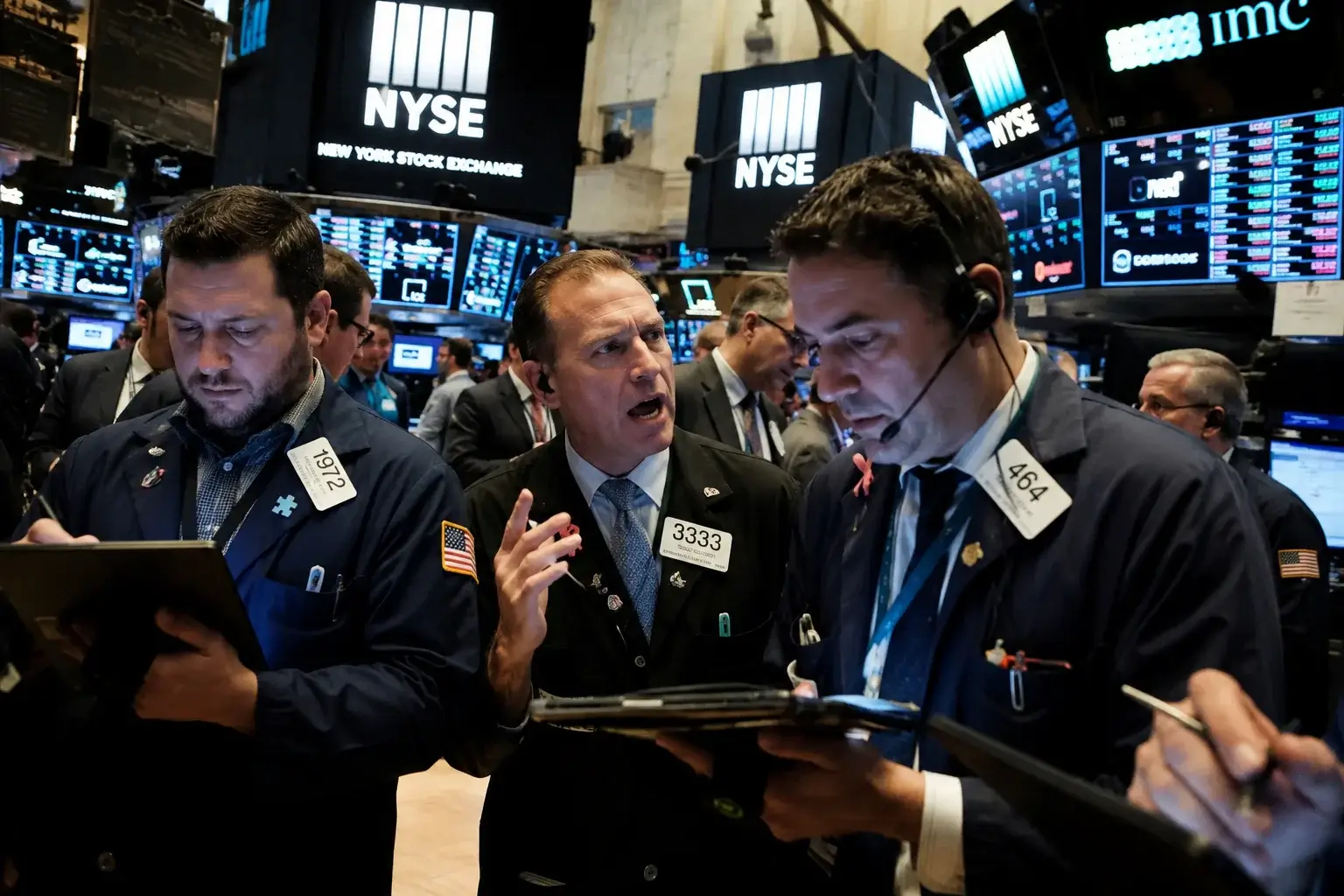
Stock Market Today - SpaceX SPCX Lands in Record $75B IPO as Dow DJI Adds 200 to 51,050, S&P 500 SPX Holds 7,394
Wall Street opened mixed Friday with the Nasdaq IXIC down 0.3% at 25,730 as a $1.78 trillion SpaceX listing met a wall of $100 billion-plus in retail orders | That's TradingNEWS
Key Points
- SpaceX SPCX opened on the Nasdaq at $135, raising $75B in the largest IPO ever at a $1.78 trillion valuation.
- Dow DJI rose 200 points to 51,050; S&P 500 SPX flat at 7,394; Nasdaq IXIC fell 0.3% to 25,730.
- Adobe ADBE dropped 6.25% to $218.80 on a CFO exit despite record $6.62B revenue and raised guidance.
Wall Street opened Friday, June 12, in a holding pattern, caught between the single largest market debut in history and the clearest signal yet that the months-long conflict with Iran may be winding down. The S&P 500 (SPX) hovered right on top of its prior close of 7,394.30, essentially flat in the first minutes of the session. The Dow Jones Industrial Average (DJI) carried the strongest tone of the three, adding roughly 0.4%, or about 200 points, to trade near 51,050 after closing Thursday at 50,848.75. The tech-heavy Nasdaq Composite (IXIC) leaned the other way, slipping about 0.3%, or roughly 75 points, toward 25,730 from Thursday's 25,809.66 finish. The small-cap Russell 2000 firmed about 0.3% to around 2,935, and the Cboe Volatility Index sat near 19.33, down about 0.6% and signaling that fear is easing even as the tape stays choppy.
The split open tells the story of a market trying to price two enormous, simultaneous events without overreacting to either. Thursday delivered a violent relief rally — the Dow surged 929.97 points, or 1.86%, the S&P 500 climbed 1.75%, and the Nasdaq Composite led with a 2.54% jump after the White House called off planned strikes and floated an imminent settlement. Friday's task was different: absorb a $75 billion listing while waiting for a 14-point document to be signed in Europe. The result has been rotation rather than direction, with money sliding out of high-flying names and into beaten-down cyclicals.
SpaceX rings the bell in the biggest IPO ever recorded
The marquee event needs no introduction. SpaceX (SPCX) priced its offering Thursday night at $135 per share and opened for trading on the Nasdaq under that ticker Friday morning, with company leadership ringing the opening bell in New York while Elon Musk joined remotely from Texas. The deal sold 555.6 million shares of Class A common stock, raising approximately $75 billion — a figure that dwarfs every prior listing and sets an initial market value of roughly $1.78 trillion. For context, that raise eclipses the previous record holder, the 2019 listing that pulled in about $29 billion, by a factor of more than two and a half.
The mechanics are as eye-catching as the headline number. Underwriters hold a greenshoe option covering an additional 83 million shares, worth roughly $11.2 billion, that can be exercised over the next 30 days if demand outruns the initial allotment. The offering is expected to close June 15. SpaceX targeted an unusually large retail slice of around 30% — far above the typical 5% to 10% reserved for the public in most deals — and the appetite has been ferocious, with retail orders reportedly exceeding $100 billion against a far smaller pool of available shares.
That imbalance is the crux of why the stock is so combustible. The float, the portion of shares actually available for public buying and selling, is estimated at just 3% to 5% of the company. A $75 billion raise represents only about 4.3% of the $1.75 trillion-plus valuation, which means a small slice of supply is meeting a wall of demand. Pre-listing signals captured that tension all morning: gray-market derivatives implied a market value as high as $2.4 trillion, or more than 35% above the IPO price, while perpetual futures on one crypto venue traded around $180 — a level implying a valuation north of $2.3 trillion. One overseas retail broker quoted the shares as high as $208 in Thursday's session, a 54% premium to the $135 print. Anything short of a sizable first-day gain would land as a disappointment given expectations stacked this high.
Valuation, index inclusion, and why the whole market is paying attention
The bull case rests on the breadth of the business. SpaceX is no longer a pure rocket story; it now spans launch, the Starlink satellite-internet network, the Starship deep-space program, and an ambition to put AI data centers in orbit. One brokerage initiated coverage Thursday at the equivalent of an Outperform rating with a $190 price target, implying roughly 40% upside from the $135 offer and pinning a hefty $2.5 trillion value on the firm. The same note warned that Starship "needs to enter commercial service before year-end" for the more aggressive growth assumptions to hold, a reminder that the valuation is leaning on execution that hasn't happened yet. At the $1.78 trillion mark, Musk is positioned to become the world's first trillionaire on paper.
There's a structural wrinkle that matters far beyond SpaceX itself. The major index providers split on how to treat the listing. The Nasdaq and one global index family rewrote eligibility rules to accommodate a low-float megacap, but the committee behind the S&P 500 declined to follow, confirming on June 4 that it would keep its existing financial-viability screens, 12-month seasoning period, and minimum float requirements unchanged. SpaceX reported a $4.28 billion GAAP loss in the first quarter of 2026 and floats only 3% to 5% of its shares — both disqualifiers under the unchanged S&P rules. The practical effect: passive funds tracking the Nasdaq-100 and the broad Russell index will be forced to buy SpaceX, selling slivers of Apple, Microsoft, Nvidia, and every other constituent to fund the purchase, while S&P 500 trackers sit out for at least another 12 months. At a market-cap weighting, SpaceX would represent more than 4% of the Nasdaq-100 and about 2.4% of the S&P 500 — enough to slot in just ahead of Tesla as roughly the seventh-largest holding in both. Part of Thursday's chip-stock churn reportedly stemmed from funds trimming big tech to make room, and at least one major asset manager placed orders of $5 billion or more in the listing.
An Iran framework moves from rumor to draft document
The second pillar of Friday's action is geopolitical. After two days of renewed strikes, the administration reversed course overnight, with the President stating the U.S. had reached "a great settlement of the war with Iran," subject to finalizing documents. By Friday morning, the contours of that settlement had firmed considerably. Iranian state media described a 14-point draft memorandum of understanding under which the U.S. would lift oil sanctions and Iran would commit to reopening the Strait of Hormuz within 30 days. The document reportedly stipulates that final negotiations will not begin until three conditions are met: the release of half of Iran's frozen funds, the suspension of oil sanctions, and the lifting of the naval blockade.
Timing has sharpened the market's attention. The agreement could be signed as soon as Sunday, with Geneva floated as a possible venue, just ahead of the Group of Seven leaders' summit running June 15 to 17 in the French Alps. That said, the framing remains cautious on both sides. Officials briefed on the talks stressed that any near-term outcome would likely take the form of a memorandum rather than a finalized treaty, and that Iran has not yet confirmed readiness for a signing ceremony. An Iranian foreign-ministry spokesman acknowledged progress but said, "We have not yet reached a conclusion on this matter." Communications between the two governments have reportedly been slow since hostilities began in February, and prior diplomatic openings have repeatedly failed to convert into signed deals — a pattern that keeps a discount baked into the optimism.
Oil slides to a two-month low as the energy premium unwinds
The clearest cross-asset expression of the de-escalation showed up in crude. West Texas Intermediate dropped nearly 3% at the open to around $85.13 a barrel — the lowest level since April 17 — before paring some of the decline, while one snapshot had the benchmark down roughly $3.50 near $84.21. Brent crude tumbled as much as 5% in early Friday trade to its weakest reading since March before recovering somewhat. The move unwinds part of the enormous risk premium that built up while the Strait of Hormuz, the chokepoint handling about one-fifth of global crude and fuel flows under normal conditions, sat effectively closed.
Two structural factors are softening the move even further. Sharply lower Chinese crude imports have reduced fears of a global bidding war for barrels, with one estimate suggesting China can hold imports near 8.7 million barrels per day without materially drawing down inventories. Alternative shipping routes around the strait have also helped, and several desks noted that prices stayed surprisingly contained even through the most recent exchange of strikes. The falling energy complex offers a double benefit to the broad market: it relieves the inflation pressure that has dogged consumer prices and it eases the bond-yield backdrop, with yields pulling back alongside crude on Friday.
Adobe stuns with record revenue — and a CFO exit that overshadowed it
The day's most instructive single-stock story is Adobe (ADBE), which delivered a textbook example of a market caring more about who steers the ship than where it's headed. The software maker posted record fiscal second-quarter revenue of $6.62 billion, up 13% year over year and comfortably ahead of the roughly $6.45 billion consensus. Adjusted earnings came in at $5.96 per share against a $5.82 estimate, and GAAP net income reached $1.71 billion, or $4.25 per diluted share, up from $3.94 a year earlier. AI-first annual recurring revenue crossed the $500 million threshold and tripled compared with the same period last year. Management raised full-year fiscal 2026 revenue guidance to a range of $26.5 billion to $26.6 billion, up meaningfully from the prior $25.9 billion to $26.1 billion, with full-year earnings now pegged at $24.35 to $24.45 per share.
None of that mattered. Buried near the bottom of the same release was a three-sentence disclosure that the chief financial officer would depart June 15 to take the same role at a semiconductor firm. Shares fell about 6.25% to $218.80, after sliding as much as 8% in the overnight and pre-open sessions and carrying as many as three downgrades into Friday. The departure compounds an already unusual leadership picture: the chief executive announced in March that he intends to step down once a successor is named, leaving the company heading into the back half of its fiscal year with two of its three most senior roles filled on an interim or transitional basis. A 20-year company finance veteran will serve as interim CFO. Adding to the unease was a downward revision to organic ARR growth guidance and a broader worry that AI could eventually pressure software subscription revenue. The stock has now shed 38.1% year to date, a stark divergence from the strength of the underlying numbers.
Movers: chips and airlines fly, Oracle and Autodesk fade
Beneath the indexes, the rotation was vivid. Among the most active names, Intel (INTC) jumped about 9.3% to $116.96 and Super Micro Computer (SMCI) climbed roughly 9.2% to $31.97, as money rotated back into the hardware corner of the chip trade. American Airlines (AAL) advanced about 9.2% to $14.65, a textbook beneficiary of cheaper jet fuel as crude rolled over. Nvidia (NVDA) added about 2.2% to $204.87, holding the line as the largest single influence on the broad tape, while Nokia (NOK) rose roughly 5.2% to $14.09.
The downside was concentrated in software and select industrials. Oracle (ORCL) slid about 8.5% to $184.10, one of the heaviest large-cap declines of the morning, and Autodesk (ADSK) fell roughly 7.1% to $205.57, extending the software-sector anxiety that Adobe's report crystallized. PTC (PTC) dropped about 12.4% to $118.39, and auto-parts supplier Dana (DAN) tumbled roughly 15.1% to $30.11, the steepest decline among widely followed names. On the leaderboard of top gainers, a cluster of smaller specialty and space-adjacent names led the way: York Space Systems (YSS) surged about 22.1% to $33.72, Viasat (VSAT) rose roughly 18.2% to $72.71, Firefly Aerospace (FLY) added about 17.8% to $39.37, Ichor Holdings (ICHR) climbed roughly 16.5% to $84.04, and Voyager Technologies (VOYG) advanced about 16.0% to $47.87.
The space trade reverses as the main event arrives
In a classic "sell the news" twist, the broad basket of space-economy stocks that had ridden SpaceX enthusiasm for days reversed sharply at Friday's open. Rocket Lab (RKLB) fell about 9% even as it prepares to join the Nasdaq-100 in the June rebalancing. Redwire (RDW) and Satellogic (SATL) each dropped more than 10% after big run-ups, EchoStar (SATS) slid about 12%, and AST SpaceMobile (ASTS) gave back ground after an 11%-plus surge the prior session. Virgin Galactic (SPCE), which had leapt about 23% Thursday on a wave of speculative buying and short-covering, traded volatile again, last quoted around $5.73, up roughly 22% in one snapshot but swinging hard as short sellers and momentum buyers fought over the tape. The exchange-traded fund tracking the broader space economy slipped below the flatline after jumping 8% the day before. The pattern underscores how much of the sector's recent move was anticipation of the listing rather than fresh fundamentals.
The June Nasdaq-100 rebalancing adds five names — Astera Labs (ALAB), CoreWeave (CRWV), Nebius Group (NBIS), Rocket Lab (RKLB), and Teradyne (TER) — further concentrating the index in a handful of high-growth themes spanning AI infrastructure and space. Tesla (TSLA), separately, traded cautiously higher, up less than 1% pre-market; the company holds a roughly $2 billion stake in SpaceX, so a strong debut directly lifts the value of that position.
Read More
-
Yen Stalls at 160 Despite a 3% JGB and Tokyo Core CPI at 2.0% — Intervention Sits at 164, Friday's Payrolls Decide
02.09.2026 · TradingNEWS ArchiveEnergy
-
CHAT Fund Holds $96.37 as Korean Memory and Chip Exposure Drive a 109.73% Year — Break of $98.02 Opens $105.20
18.09.2026 · TradingNEWS ArchiveStocks
-
First-Generation XRPR and XRPI Ride XRP's Rebound to $1.386 as Spot Funds Post First Outflow — Break of $1.40 Opens $1.54
18.09.2026 · TradingNEWS ArchiveCrypto
-
NG Holds $2.9255 as Storage Surplus Narrows From 5.5% to 3.7% in 3 Weeks — Break of $3.00 Opens $3.15
18.09.2026 · TradingNEWS ArchiveCommodities
-
Dollar Surges to 157.90 as BoJ's Divided Hike Fails to Lift the Yen — Break of 158.87 Opens 159
18.09.2026 · TradingNEWS ArchiveForex
Global markets surge and the macro backdrop turns
The relief rally that started Thursday in New York rolled around the globe overnight. South Korea's Kospi soared 7.8% to 8,370.82, narrowing a sharp month-to-date drawdown tied to AI-related selling, with Samsung Electronics up 11.2% and one major memory-chip maker rising 7.2%. Tokyo's Nikkei 225 gained 3.5% to 66,442.95, led by technology, while Hong Kong's Hang Seng rose 1.8% to 24,689.32 and the Shanghai Composite added 1.6% to 4,050.51. Australia's benchmark climbed 1.9% and Taiwan's main index rose 2.6%. The synchronized bounce reflects how heavily global risk appetite had been leaning on the prospect of an Iran resolution and an end to the energy shock.
The domestic macro calendar offers its own test Friday with the release of the University of Michigan's consumer sentiment reading, which fell to an all-time low of 44.8 in May as elevated gasoline prices weighed on household outlooks. If crude's slide holds, that gauge could be at an inflection point, though it will take time for cheaper energy to filter through to confidence surveys. The backdrop is complicated by a still-hot labor market: the May payrolls report showed a gain of 172,000 jobs against a consensus near 80,000, an upside surprise that several desks attributed in part to hiring around the soccer World Cup, which kicked off in the U.S. on June 11. That strength pushed yields higher last week and has kept the inflation conversation alive even as energy prices retreat.
Cross-asset check: gold shines, bitcoin firms, volatility eases
The flight-to-safety trade did not fully unwind despite the risk-on tone in equities. Gold pushed up about 2.46%, or roughly $101, to around $4,215 an ounce, a notable move higher even as stocks held firm — a sign that some money is hedging the possibility that the Iran framework slips, or simply leaning into the metal as yields ease. Bitcoin firmed about 1.9% to roughly $63,312, recovering some ground after a stretch of pressure tied to geopolitical uncertainty and a long run of outflows from the funds that track it. The volatility index near 19.33, down about 0.6% on the day and off roughly 12% during Thursday's surge, rounds out a picture of a market where fear is draining but hasn't disappeared.
What to watch into the close and the weekend
Three threads will define the next 48 hours. First, where SpaceX's first real trade prints relative to the $135 offer — a gain in the 30% to 50% range would validate the gray-market signals, while anything muted would sting given the $100 billion-plus in retail orders chasing a 3% to 5% float. Second, whether the Iran memorandum is actually signed, possibly as soon as Sunday in Geneva, ahead of the G7 gathering that starts Monday; a confirmed document would likely accelerate crude's decline and extend the equity relief, while another stall would reintroduce the energy premium fast. Third, how the software complex digests the Adobe template — record numbers undercut by leadership turnover and AI-disruption fears — as Oracle's 8.5% slide and Autodesk's 7.1% drop show the sector is primed to punish any ambiguity.
For now, the market is doing something unusual: staging a historic listing and pricing in the possible end of a war on the same morning, and choosing caution over euphoria. The Dow's modest 200-point advance to near 51,050, the S&P 500's flat read around 7,394, and the Nasdaq Composite's 0.3% dip toward 25,730 together describe a tape that has already banked Thursday's 1.75%-to-2.54% gains and is now waiting for confirmation before committing to the next leg.