Stock Market Today: SPX, Nasdaq and Dow Head for Fourth Losing Week as SMCI Crashes 27% on Chip Smuggling Charges
S&P 500 Breaks Below Its 200-Day Moving Average, Dow Nears Correction Territory, FedEx Surges 8% on Earnings Beat as Oil Holds Above $108 | That's TradingNEWS
War, Oil, and a Fourth Straight Week of Losses: Wall Street Searches for a Floor
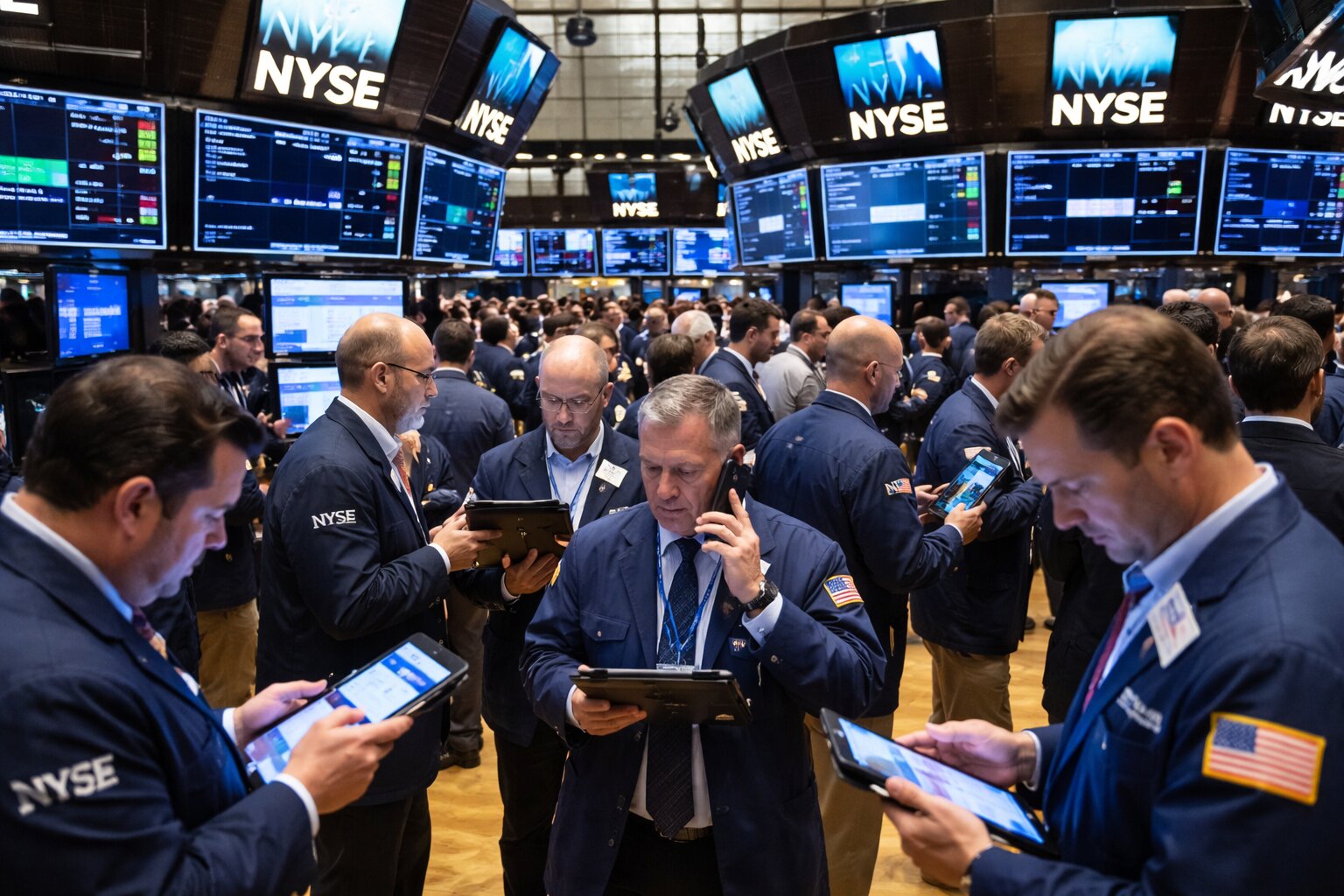
Friday's session delivered exactly what the past four weeks have trained traders to expect — relentless headline risk, crude oil stubbornly above $100, and indexes that keep sliding without finding conviction in either direction. The S&P 500 (SPX) closed at 6,549, down 0.87% on the day. The Dow Jones Industrial Average (DJIA) shed 237 points to settle at 45,784, a 0.52% drop. The Nasdaq Composite (COMP) absorbed the sharpest blow at 1.32% lower, closing at 21,798. The Russell 2000 fell 1.47% — small-caps never lie about broad sentiment, and right now sentiment is ugly.
Four consecutive losing weeks across all three major indexes. The S&P 500 and Dow are down 0.9% and 1.5% respectively on a weekly basis. The Nasdaq lost 0.8% for the week. The Dow sits 8.6% below its February 10 record close. The Nasdaq is 8% below its October 29 all-time high. The S&P 500 is roughly 5% off its peak — and not everyone agrees that's cheap enough given what's coming.
Every Headline Carries a 200-Point Swing: The Iran War Enters Week Four
Iran and Israel exchanged strikes overnight into Friday while the Pentagon confirmed it is deploying thousands of additional Marines to the Middle East. Brent crude touched $119 Thursday before pulling back to around $108–$110 on Friday — still more than 40% above where it traded on February 28, the day before the conflict erupted. WTI tracked similarly. Fed Governor Christopher Waller told CNBC he was prepared to dissent in favor of a rate cut two weeks ago after the jobs report printed at negative 92,000. Then the Strait of Hormuz closed. He voted for a pause instead. That single shift says everything about where monetary policy stands right now.
Baird investment strategist Ross Mayfield put it plainly: if this escalates to ground troops, expect weeks more of elevated oil prices, energy infrastructure anxiety, and equity markets that haven't fully repriced the damage. Unlimited CEO Bob Elliott went further — with the S&P 500 only 5% off its highs, he argues stocks are still pricing in stronger growth relative to bonds than makes any sense given that households are absorbing a 1%–2% real purchasing power hit even if the conflict ends tomorrow.
Deutsche Bank's 15-Day Rule and Why It's Hard to Trade This Time
Deutsche Bank's Jim Reid noted Friday marks the 15th trading day since the conflict began — historically the average bottom for U.S. equities following a geopolitical shock. He acknowledged the data offers a sliver of optimism but warned that with this much fundamental uncertainty, headlines matter more than historical averages. The geopolitical playbook hasn't been violated yet, but no one should be trading mechanically off it right now.
Quadruple Witching Pours Gasoline on an Already-Burning Market
Friday's session carried an additional structural accelerant: quadruple witching, the simultaneous quarterly expiration of stock options, index options, index futures, and single-stock futures. Trillions of dollars in derivatives rolled off the board, amplifying intraday swings as institutions rebalanced or unwound positions. David Laut, CIO at Kerux Financial, flagged that this particular witching event lands into a market that has already been on edge for weeks — making the volatility compounding effect more severe than a typical expiration Friday.
Yields Surge, Rate Hike Bets Surface: The Fed's Impossible Position
The 10-year Treasury yield rose to 4.39%, on pace for its highest closing level since August. The 2-year yield climbed to 3.93%, also its highest since late July. The 30-year hit 4.95%. Fed-funds futures are now assigning a 10.3% probability to a quarter-point rate hike at the April meeting — not yet at the 20% threshold considered statistically meaningful, but the direction of travel is unmistakable. Traders have fully priced out any 2026 rate cuts. A Fed that was preparing to ease is now being forced to consider the opposite, all because Brent crude spiked 40% in under four weeks.
Trump's ongoing pressure campaign on Fed Chair Jerome Powell escalated further Thursday when the president renewed accusations of criminal wrongdoing tied to the Fed's Washington headquarters renovation — a federal judge last week quashed the DOJ's subpoenas targeting Powell and stated there was "no evidence whatsoever" of any crime beyond displeasing the president. Powell's term as chair ends May 15, but his board governorship runs through January 2028. Kevin Warsh, Trump's nominee to replace Powell, still hasn't been scheduled for Senate confirmation. The longer the legal fight drags on, the longer Powell stays — and the more the Fed's independence question hangs over markets.
Read More
-
Yen Stalls at 160 Despite a 3% JGB and Tokyo Core CPI at 2.0% — Intervention Sits at 164, Friday's Payrolls Decide
02.09.2026 · TradingNEWS ArchiveEnergy
-
QQQ ETF ($739) Fades From an Early Tech Rally as a 77.9 ISM Prices Index Meets Micron's $61.5B Guide — $760 Record Test Ahead
01.10.2026 · TradingNEWS ArchiveStocks
-
XRPR and XRPI Follow XRP's $1.49 Test as Spot Funds Hold 1.16B XRP and a 1 Billion Token Escrow Release Lands — $1.70 in Play
01.10.2026 · TradingNEWS ArchiveCrypto
-
November NG Slips Below $3 as Decade-High Storage Meets Capped LNG Exports — $2.75 in Sight
01.10.2026 · TradingNEWS ArchiveCommodities
-
Dollar-Yen at 158 Presses Toward 160 as a 363 bp Carry Gap Meets Katayama-Bessent Intervention Risk — 159 in Sight
01.10.2026 · TradingNEWS ArchiveForex
SMCI Implodes 27%: Co-Founder Charged in $2.5 Billion Chip Smuggling Scheme
Super Micro Computer (SMCI) suffered one of the worst single-session collapses in its history, falling 27.36% to $22.37 and wiping roughly $4.5 billion from a market cap that stood at $18.5 billion as of Thursday's close. Federal prosecutors in the Southern District of New York unsealed an indictment charging co-founder and board member Yih-Shyan "Wally" Liaw — who controls $464 million worth of SMCI shares — along with sales manager Ruei-Tsan "Steven" Chang and contractor Ting-Wei "Willy" Sun with violating the Export Control Reform Act. The alleged scheme diverted billions of dollars worth of servers containing restricted Nvidia (NVDA) AI chips to China through a Southeast Asian pass-through entity. That entity reportedly became one of Supermicro's largest customers, accounting for nearly $100 million in quarterly revenue. Supermicro placed the two employees on administrative leave and terminated the contractor. The company is not named as a defendant and states it is cooperating with investigators.
This is the second major governance crisis for the company in under two years. Supermicro only recently resolved an auditing scandal that forced an overhaul of its financial leadership in 2024. The compliance narrative is shattered again. SMCI is a SELL here — there is no fundamental floor until regulatory uncertainty clears, and that timeline is unknowable.
Nvidia Caught in the Crossfire — And Jensen Huang Pitches AI Tokens
Nvidia (NVDA) fell 1.57% to $175.57, dragged partly by the SMCI association and broader chip sector weakness. The VanEck Semiconductor ETF (SMH) dropped 0.8%, giving back Thursday's gains entirely. Micron Technology (MU) fell 3.81% to $427.36. Western Digital (WDC) cratered 6% to $297.91. Lam Research, Taiwan Semiconductor, Advanced Micro Devices, Sandisk, and Seagate all traded around 1% lower.
Against this backdrop, CEO Jensen Huang was pitching a vision of AI token compensation — proposing that engineers receive a token budget equal to roughly half their base salary to deploy autonomous AI agents as productivity multipliers. Nvidia currently employs 42,000 people but Huang expects to manage hundreds of thousands of digital workers eventually. The structural implication is significant: AI agents are becoming the primary consumers of software infrastructure, not human developers — a framework that, if correct, justifies Nvidia's $4.3 trillion market cap even in a rough tape.
FedEx Blows Away Estimates, Raises Full-Year Guidance Despite $100 Oil
FedEx (FDX) was the standout earnings story of the day, surging more than 7%–9% in premarket and holding gains into the session. The company reported fiscal Q3 adjusted EPS of $5.25 against the Street's $4.09 estimate — a beat of over $1.16 per share. Revenue came in at $24 billion, up 8% year-over-year, against expectations of $23.43 billion. Quarterly net profit hit $1.06 billion versus $909 million a year ago.
FedEx raised full-year fiscal 2026 revenue guidance to 6%–6.5% growth and lifted adjusted EPS guidance to $19.30–$20.10, up from the prior range. The company is cutting more than $1 billion in permanent costs this year and trimmed its capital spending outlook to $4.1 billion from $4.5 billion. It is suing to recover tariffs paid after the Supreme Court struck down Trump's emergency-powers tariffs as unconstitutional. The freight spinoff, separating FedEx Freight into its own publicly traded company by June 1, remains on track — and management believes the post-spinoff valuation multiple will expand. Bank of America reiterated its buy rating and raised its price target to $440, implying 23% upside from Thursday's close. Analyst Ken Hoexter flagged the strongest U.S. market share gains in 20 years as the core thesis. FDX is a BUY — execution is clearly there even against brutal macro headwinds.
Chipotle Upgraded, Same-Store Sales Trajectory Flipping Positive
Chipotle Mexican Grill (CMG) received an upgrade from Mizuho, moving to outperform from neutral with a new price target of $40 — implying more than 20% upside from Thursday's close. Analyst Nick Setyan shifted his same-store sales forecast from a decline to flat, with acceleration expected into Q2 driven by value promotions, marketing initiatives, and menu innovation. Mizuho also noted that margin compression is "almost at an end" and that the current valuation represents an overly pessimistic read on the company's mid-teens long-term EBITDA growth profile. Shares rose 1% in premarket. CMG at current levels with an improving comp trajectory and a mean-reversion setup in margins is worth a BUY consideration.
Costco Gasses Up on Rising Fuel Prices
Costco Wholesale (COST) received continued conviction from Gordon Haskett, which maintained its buy rating and $1,200 price target — representing approximately 23% upside. The thesis here is counterintuitive but data-backed: foot traffic to Costco gas stations inflected sharply in the first week of March and accelerated through mid-month as fuel prices surged more than 15% since the conflict began February 28. Costco's higher-income membership base is insulated from the consumer stress hitting lower-income cohorts, and historically, rising pump prices drive more shoppers toward Costco's deeply discounted fuel. COST is a HOLD to BUY — not a momentum trade, but a defensive compounding machine with a fuel tailwind that only grows if oil stays elevated.
Gold Rebounds But Still Heads for Its Worst Week Since 2020
Gold ($GC00) staged a Friday recovery, with spot gold rising 0.5% to $4,670.89 per ounce and April futures up 1.4% to $4,668.90. The rebound came off a near two-month low hit Thursday. Despite the bounce, gold is tracking toward its worst weekly performance since 2020, having fallen in six of the last seven sessions. The dollar strengthening on rate-hike expectations and energy-driven inflation concerns has been the primary headwind. Ned Davis Research chief global strategist Tim Hayes maintains the long-gold/short-dollar structural trade remains intact — gold stays above its rising 200-day moving average smoothing while the dollar, although temporarily above its 200-day, is still in a descending smoothing trend. The short-term is dollar-bullish, but the medium-term structural case for gold hasn't broken.
S&P 500 Breaks Below 200-Day Moving Average — A Technical Line in the Sand
Thursday's losses pushed the S&P 500 below its 200-day moving average. Adam Turnquist, chief technical strategist at LPL Financial, flagged a breach of the November lows at 6,522 as the next level that would raise serious questions about the durability of the bull market. The index closed Friday at 6,549 — uncomfortably close to that level. The VIX hit 26.35, up 9.52% on the day, reflecting genuine fear rather than hedging noise. CNN's Fear & Greed Index flashed "extreme fear" for the first time since the conflict began, touching 15 Thursday — its lowest reading since November — and holding at 17 Friday.
Fannie Mae and Freddie Mac Face the Worst Possible IPO Window
Fannie Mae (FNMA) rose 2.46% Friday but the broader picture is grim. Shares hit a 52-week high in September and have since lost 75% of their value. The Trump administration's repeated signals about releasing the GSEs from conservatorship have produced nothing concrete, and the current environment — 30-year mortgage rates above 6%, a Fed that won't cut, surging energy inflation, and midterm election optics — makes a share offering politically and financially toxic. White House officials have gone largely silent on restructuring. FNMA is a HOLD at best, avoid for now — the thesis depends entirely on policy timing that has no catalyst in the current macro setup.
McCormick Eyes a $37 Billion Unilever Food Deal — Condiment Empire in the Making
McCormick & Co. (MKC) fell 1.43% to $53.28 Friday but the real story is strategic. Unilever (UL) is reportedly in talks to sell its entire food division — Hellmann's, Marmite, Pot Noodle, and a portfolio of global condiment brands — to McCormick in a deal valued at up to $37 billion. TD Cowen analyst Rob Moskow says the combination would "completely transform" McCormick, giving it scale, international reach, and retailer leverage it currently lacks. The implied enterprise value is roughly 9.5x EBITDA. McCormick would fund the deal through a mix of stock and cash. For Unilever, it completes a decade-long transformation into a pure-play beauty and personal care company, following previous divestitures of its tea and ice cream units. MKC's 52-week range runs from $52.63 to $83.15 — the stock is sitting at the absolute floor. If this deal closes on reasonable terms, MKC is a BUY at current levels.
Amazon Resurrects the Smartphone and Acquires Stair-Climbing Robots
Amazon (AMZN) fell 0.73% to $207.24 with two significant strategic developments crossing the tape. First, an internal project codenamed "Transformer" is reportedly developing a smartphone designed as a deep AI assistant — leveraging Prime history, Alexa, and purchase data to build a mobile data moat that bypasses restrictions Apple (AAPL) and Alphabet (GOOG) have placed on Amazon's apps. The 2014 Fire Phone was a product failure; this appears to be a data strategy wearing a hardware costume. Second, Amazon quietly acquired Swiss robotics startup Rivr — recently valued at $100 million — which makes a four-legged wheeled robot capable of climbing stairs and navigating curbs autonomously, solving the "final 100 yards" problem that grounded Amazon's previous Scout delivery bots. Both moves are consistent with Jeff Bezos's parallel push to raise $100 billion for a "physical AI" manufacturing transformation fund. AMZN remains a BUY — the infrastructure flywheel is accelerating, not decelerating.
Tesla Chases 100 Gigawatts of Solar and Readies Semi Rollout
Tesla (TSLA) fell 1.82% to $373.38 but two operational developments are worth watching. Reuters reported Tesla is seeking $2.9 billion in Chinese-made solar equipment to push toward 100 gigawatts of solar capacity by 2028 — a target that would represent roughly 74% of current total U.S. solar capacity of 135 gigawatts. Separately, WSJ reported positive early feedback from truckers piloting the Semi, with the centered driving position, 500-mile range, and faster charging drawing strong reviews ahead of a planned summer delivery rollout. The regulatory risk around Chinese solar sourcing is real given current geopolitical tensions, but the energy infrastructure ambition is clearly serious. TSLA is a HOLD — the valuation still demands execution across too many simultaneous bets.
Retail Faces an Uncomfortable Triple Threat Heading Into Spring
The consumer picture heading into Q2 is deteriorating. Real spending rose just 0.1% in both December and January, and February is unlikely to improve. Gasoline prices surged more than 15% in March alone through mid-month. TD Cowen's Oscar Munoz is flagging a slowing labor market, a falling stock market, and energy-driven real income compression as a trifecta that even high-income consumers won't fully escape. J.P. Morgan's Natasha Kaneva notes demand destruction has already begun in Asia and Europe, from industrial users to airlines. Jefferies analysts are specifically cautious on department stores and turnaround names including Kohl's, Macy's, V.F. Corp., and Capri Holdings — companies that need a tailwind and instead face a headwind. Tapestry and Ralph Lauren are flagged as relatively insulated given stronger pricing power. The homebuilder sector is getting hit from a different angle — the State Street SPDR S&P Homebuilders ETF (XHB) fell more than 2% Friday to $96.71 and is now down more than 16% since February 28.