Stock Market Today - Dow +1,100, Tesla +4.5%, Oil -10%: Trump's 5-Day Iran Strike Pause Ignites Wall Street's Biggest Reversal of 2026
S&P 500 jumps 2.2% to 6,650 and Nasdaq adds 2.4% to 22,181 as WTI crude crashes to $88.70, American Airlines rockets 8%, and gold wipes out all 2026 gains in a single historic session | That's TradingNEWS
Key Points
- Dow surges 1,117 points to 46,705 and Russell 2000 leads all indexes with a 3.25% gain after Trump orders a 5-day pause on Iran strikes
- WTI crude crashes 9.7% to $88.70 and Brent falls 10% to $100.57, sending Tesla up 4.5%, American Airlines rocketing 8%, and Carnival surging 7%
- VIX retreats from above 30 to 24.52, the 2-year Treasury yield plunges from 4.014% to 3.801%, and 90% of S&P 500 stocks close green — but gold wipes out all 2026 gains entering bear market territory
The Numbers: Dow +1,117, S&P +2.2%, Nasdaq +2.4% — Russell 2000 Leads the Entire Market
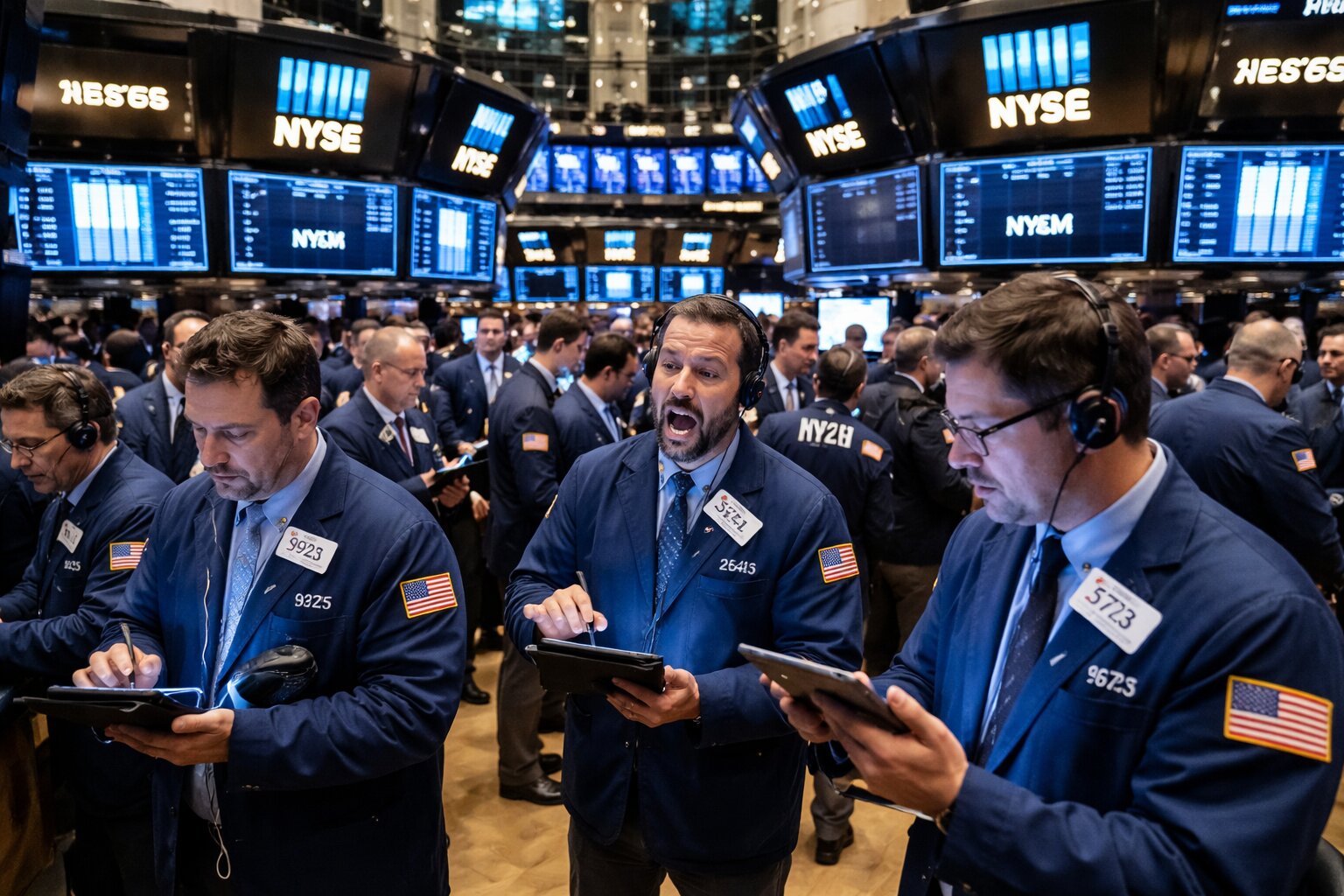
By mid-session, the Dow Jones Industrial Average had surged 1,117 points, or 2.47%, to 46,705. The S&P 500 added 143 points, or 2.21%, to 6,650. The Nasdaq Composite climbed 533 points, or 2.47%, to 22,181. But the real outperformer on the day was the Russell 2000 — the small-cap index that had already officially entered correction territory on Friday — which jumped 3.25% to 2,517, decisively outpacing every large-cap benchmark. This is not a coincidence. Small-caps carry disproportionate exposure to domestic economic conditions, consumer sentiment, and credit availability. When oil was spiraling toward $115 a barrel and inflation expectations were being revised sharply higher toward 4%, small businesses and the stocks representing them were being annihilated. Monday's reversal gave those names a reason to catch a bid in size. The breadth of the session was extraordinary — at the NYSE, advancers outpaced decliners 7-to-1, with 2,181 names advancing against only 395 declining, and more than 90% of S&P 500 components closed in the green. Every single one of the index's 11 sectors finished higher. This was not a narrow tech-driven bounce. This was a full-market, broad-based repricing of risk.
Oil's Collapse: WTI Drops 9.7%, Brent Cracks Below $101 — The Energy Trade Unwinds in Hours
Nothing defined Monday's session more viscerally than what happened to crude oil. West Texas Intermediate futures (WTI) had been trading as high as $102 a barrel earlier in the session — the continuation of a months-long surge driven by the closure of the Strait of Hormuz since February 28. Then Trump's post hit markets. By mid-session, WTI had cratered 9.7% to $88.70 a barrel. The international benchmark Brent crude fell more than 10% to $100.57, after having traded above $114 on Friday. For context, Brent was sitting around $70 a barrel before the U.S. and Israel attacked Iran — meaning even after Monday's massive selloff, crude remains roughly 43% above pre-war levels. Chevron CEO Mike Wirth, speaking at the S&P Global CERAWeek conference in Houston on Monday, warned that physical oil markets remain tighter than financial futures pricing suggests. "The markets are trading on some scant information and perception," Wirth said, signaling that the forward curve may be underestimating physical supply tightness as long as the Strait of Hormuz stays effectively closed. The energy sector (XLE) — the only positive S&P 500 sector since the war began, up 5.9% over that stretch and a staggering 31.8% year-to-date — reversed sharply on Monday as oil sold off. Occidental Petroleum (OXY) fell more than 2.5%, EOG Resources (EOG) dropped more than 1.5%, and Chevron (CVX) slipped around 1%. The message from the market was blunt: energy bulls built their positions on war premium, and the first credible signal of de-escalation triggered an immediate exodus.
Airlines and Cruise Lines Surge: DAL, UAL, AAL, CCL, RCL All Gap Higher
The sectors that had suffered most from the oil price shock became Monday's biggest winners the moment crude started falling. Delta Air Lines (DAL) surged more than 4%, United Airlines Holdings (UAL) jumped 6%, and American Airlines Group (AAL) rocketed as much as 8% in early trading. Airlines carry fuel costs as their second-largest expense after labor, and the war-driven surge in jet fuel prices had been decimating margins across the industry. A 10% drop in crude in a single session represents a meaningful shift in the cost structure for these carriers, and the market repriced them accordingly. The cruise industry told a similar story. Carnival Corporation (CCL) had plunged more than 23% from its pre-war levels through Friday's close, while Royal Caribbean Cruises (RCL) had shed more than 15%. On Monday, Carnival surged more than 7%, Royal Caribbean climbed more than 5%, and Norwegian Cruise Line Holdings (NCLH) gained roughly 5.5%. These companies don't just get hurt by fuel costs — they carry massive consumer discretionary exposure. A Middle East war that spikes gas prices, inflates overall consumer costs, and raises recession fears crushes leisure travel demand across the board. Monday's rally reflected a recalculation of that risk, even if one with a five-day expiration date attached to it.
Tech Bounces: NVDA, AAPL, TSLA Lead the Magnificent Seven Recovery
Technology stocks joined the broad rally, though the moves were measured compared to the extreme swings in energy and travel names. Nvidia (NVDA) gained approximately 2-3%, while Apple (AAPL) added around 2%. Tesla (TSLA) led the Magnificent Seven with gains of approximately 4.5%, recovering from a third consecutive losing session on Friday. The Nasdaq Composite had been within a hair of entering official correction territory before Monday — down approximately 9.8% from its record high through last week. A formal correction would have marked a psychologically significant threshold, and the relief rally prevented that from being triggered, at least for now. Fundstrat technical strategist Mark Newton had flagged semiconductor stocks as particularly vulnerable heading into this week, warning that if the VanEck Semiconductor ETF (SMH) cracked below $369, a rotation lower in memory names, optical stocks, and semi-cap equipment could accelerate into April. SMH had closed Friday at $384.74, so the buffer was thin. Monday's bounce in tech provided breathing room, but Newton's warning about a potential final selloff into April/May before a meaningful summer rally still stands as a live thesis.
Synopsys (SNPS) Pops 4% on Elliott Stake; Super Micro (SMCI) Slides 2% on Criminal Charges
Two major stock-specific stories cut through Monday's macro noise. Synopsys (SNPS), the chip-design software maker, climbed approximately 4% after the Wall Street Journal reported that activist investor Elliott Investment Management had built a multibillion-dollar position in the company. Elliott's involvement typically signals a push for operational changes, capital returns, or a strategic review — and the market's immediate 4% response reflects the premium the street attaches to Elliott's track record of unlocking value. On the other side, Super Micro Computer (SMCI) fell around 2%, extending a drop that began last week after the Department of Justice charged a co-founder of the server maker and two other individuals in connection with an alleged scheme to smuggle Nvidia (NVDA) chips to China. The charges represent a serious legal and reputational overhang for SMCI, which has already endured a turbulent stretch involving accounting irregularities and Nasdaq delisting threats. A 2% decline on a day when the broader market was up 2.2% implies relative underperformance of more than 4 percentage points — a meaningful signal that investors are not inclined to give this name the benefit of the doubt.
GameStop (GME) Earnings Tuesday: Options Pricing an 8% Move, Meme Energy Still Live
With all eyes on geopolitics, the market still has a scheduled event that will command its own distinct audience: GameStop (GME) reports quarterly earnings after the close on Tuesday. Options pricing currently implies a move of up to 8% in either direction by the end of the week following the release. An 8% upward move from Friday's close would push shares above $24, while an 8% decline would drag them back toward $21. GME has surged close to 13% since the start of 2026, fueled by an endorsement from Michael Burry of "The Big Short" fame, and public comments from CEO Ryan Cohen suggesting a major acquisition of a larger consumer company could be imminent. Cohen told CNBC in January he is looking to make a "very, very, very big" acquisition. The company has been expanding into collectibles and purchasing Bitcoin as its core video game retail business continues to shrink and store closures mount. Whether Monday's broad market rally gives meme-stock traders the confidence to bid GME into earnings or whether the 8% implied move contains meaningful downside risk remains the question heading into Tuesday's close.
Berkshire Hathaway Takes $1.8 Billion Stake in Tokio Marine — Buffett's Japan Bet Deepens
Away from the war-driven volatility, one of the most strategically significant announcements of the day came from Omaha. Berkshire Hathaway (BRK.A, BRK.B) confirmed it will invest $1.8 billion in Tokio Marine Holdings, Japan's largest publicly listed insurer, through its core reinsurance unit National Indemnity Company. The investment will give Berkshire an initial 2.49% stake in the Tokyo-based firm. Ajit Jain, Berkshire's Vice Chairman of insurance operations, described the deal as a "long-term collaborative relationship" expected to create "compelling long-term opportunities for both organizations." Tokio Marine plans to use the proceeds from the share sale to fund buybacks in 2026, which will help offset dilution for existing shareholders. This move fits squarely within Buffett's deepening affinity for Japanese financial institutions and insurance businesses — assets that generate significant float, carry disciplined underwriting cultures, and trade at valuations that remain more attractive than U.S. equivalents. At $1.8 billion, this is not a token position. It signals a genuine long-term partnership with one of the most respected insurance franchises in Asia.
Treasury Yields and the Fed: 2-Year Drops Below 4%, Rate Hike Probability Collapses
The bond market told its own story on Monday. The 2-year Treasury yield — the instrument most sensitive to Federal Reserve rate expectations — had earlier in the session reached 4.014%, its highest since June 11, 2025. After Trump's announcement, it plunged to as low as 3.801%, before settling around 3.83%. The 10-year yield fell approximately 7 basis points to 4.315%, while the 30-year dropped roughly 4.8 basis points to 4.897%. The directional message from fixed income was clear: markets walked back aggressive rate hike pricing the moment oil started falling. Fed funds futures now point to roughly 58% odds that rates will remain unchanged at 3.50% to 3.75% at the October policy meeting — a dramatic swing from less than 8% a month ago, according to the CME FedWatch tool. Chicago Fed President Austan Goolsbee complicated the picture in a Monday morning CNBC interview, confirming that rate hikes remain on the table depending on how inflation evolves — a statement that validated the bond market's prior fear that the oil shock could force the Fed's hand. Inflation derivatives known as fixings are pricing the headline CPI annual rate at approximately 3.4% for March, rising to nearly 3.8% for April, and approaching 3.9% for May — levels not seen since 2023. Pantheon Macroeconomics chief economist Samuel Tombs had projected PCE inflation surging to a 3.7% annual rate in April, up from 2.5% in February, with the unemployment rate potentially peaking at 4.7% this year versus 4.3% in January. These projections don't disappear with a five-day ceasefire window.
Read More
-
Yen Stalls at 160 Despite a 3% JGB and Tokyo Core CPI at 2.0% — Intervention Sits at 164, Friday's Payrolls Decide
02.09.2026 · TradingNEWS ArchiveEnergy
-
QQQ ETF ($739) Fades From an Early Tech Rally as a 77.9 ISM Prices Index Meets Micron's $61.5B Guide — $760 Record Test Ahead
01.10.2026 · TradingNEWS ArchiveStocks
-
XRPR and XRPI Follow XRP's $1.49 Test as Spot Funds Hold 1.16B XRP and a 1 Billion Token Escrow Release Lands — $1.70 in Play
01.10.2026 · TradingNEWS ArchiveCrypto
-
November NG Slips Below $3 as Decade-High Storage Meets Capped LNG Exports — $2.75 in Sight
01.10.2026 · TradingNEWS ArchiveCommodities
-
Dollar-Yen at 158 Presses Toward 160 as a 363 bp Carry Gap Meets Katayama-Bessent Intervention Risk — 159 in Sight
01.10.2026 · TradingNEWS ArchiveForex
Gold Craters, Bitcoin Rallies: Safe Haven Hierarchy Gets Reshuffled
The war's impact on traditional safe havens was one of the most analytically jarring subplots of the past five weeks, and Monday crystallized it further. Gold — widely viewed as the ultimate crisis hedge — entered bear market territory on Monday, at one point falling more than 20% from its all-time high, effectively wiping out all of its 2026 gains. Even after paring losses when Trump's announcement hit, spot gold was still down approximately 5.5% to $4,233, while gold futures fell more than 6% to around $4,289. The dynamic at work here is not complicated but is often misunderstood: when institutions need to raise cash quickly, they sell whatever is liquid and has gains. Gold, having surged dramatically heading into the conflict, became a source of funds rather than a destination for them. Bitcoin (BTC), by contrast, jumped more than 4% on Monday, trading around $71,500 after having dipped below $68,000 in early session lows. The VIX, which had topped 30 earlier in the day for the first time since March 9 — a reading that signals extreme fear — pulled back sharply to 24.52, a decline of 8.44% on the session. A VIX above 20 is generally considered elevated; above 30 represents genuine panic. The retreat from 30 back to 24 in a single session mirrors the speed and scale of the broader market reversal.
Europe and Asia Were Already in Freefall Before the Announcement — Then Reversed
Before Trump's post changed everything, global markets were in serious trouble. Asian sessions on Monday were brutal. Japan's Nikkei 225 had fallen nearly 5% at its lows before closing down 3.5% at 51,515. South Korea's Kospi plunged 6.5% to 5,405.75 — a move severe enough that the Korean exchange briefly suspended trading after the Kospi 200 futures index fell more than 5%. The Kosdaq dropped 5.6% to 1,096.89. Australia's S&P/ASX 200 shed 0.74% to 8,365. Hong Kong's Hang Seng Index and China's CSI 300 dropped 3.5% and 3.3% respectively. In Europe, the pan-European Stoxx 600 had been more than 1.5% lower before Trump's announcement — with basic resources down 3.1% and industrials off 2.8% at the lows. After the post, European markets sharply reversed. The Stoxx 600 finished up 1.98%, Germany's DAX surged 2.68% to 22,981, France's CAC 40 gained 2.18% to 7,833, and Spain's IBEX 35 added 2.47% to 17,126. The intraday swing in European equities — from down more than 1.5% to up nearly 2% — was a testament to just how violently sentiment shifted in real time.
The Bear Trap Thesis: Evercore's Emanuel Warns the Bottom May Already Be In
Julian Emanuel at Evercore ISI raised a scenario that deserves serious consideration: that Trump's de-escalation push may have sprung a bear trap on investors who had been aggressively positioning for further downside. The put-call ratio for the Invesco QQQ Trust (QQQ) had reached a level as heavily skewed toward puts as markets had seen since the start of the AI-driven bull market in late 2022. That degree of one-sided bearish positioning sets the stage for violent short-covering rallies when even a modest positive catalyst emerges. Emanuel's view is that the market may have reached a near-term bottom — not a certainty, but a credible probability. QQQ was up approximately 2.31% on the session to $594.78. The counterargument comes from Freedom Capital Markets Chief Market Strategist Jay Woods, who noted that with only a five-day reprieve in place, the rally should be faded until concrete progress emerges from Washington. "The trade for now is to fade until we get more news out of Washington," Woods wrote. Both views have merit. The positioning data supports a washout narrative. The geopolitical reality — Iranian state media denying any talks even occurred, and Iran's parliamentary speaker threatening U.S. Treasury bond holders on X over the weekend — argues for continued caution. Mohammad Bagher Ghailbaf, Iran's parliamentary speaker, wrote Sunday: "US treasury bonds are soaked in Iranians' blood. Purchase them, and you purchase a strike on your HQ and assets." That is not the language of a country eager to de-escalate. The five-day clock is running, the Strait of Hormuz remains effectively closed, and the S&P 500 is still more than 5% below its all-time high even after Monday's surge. This market is not out of the woods — but for the first time in five weeks, it finally found a reason to stop falling.