Stocks Tread Water at 7,548 With Dow at a Record as Warsh's First Fed Decision Looms; uniQure QURE Explodes +66%
Brent crude collapsed 5.06% to $78.96 and WTI fell to $76.05 on the U.S.-Iran peace framework, sending money out of semiconductors | That's TradingNEWS
Key Points
- S&P 500 SPX +0.10% at 7,548, Nasdaq IXIC +0.34%, Dow DJI at a record; Russell 2000 lags -0.87% pre-Fed.
- Fed seen holding 3.50%–3.75% at 97% odds; the June dot plot likely erases 2026's last projected cut.
- uniQure QURE +66% on AMT-130 Huntington's BLA path; SpaceX SPCX holds $2.64T after $60B Cursor deal.
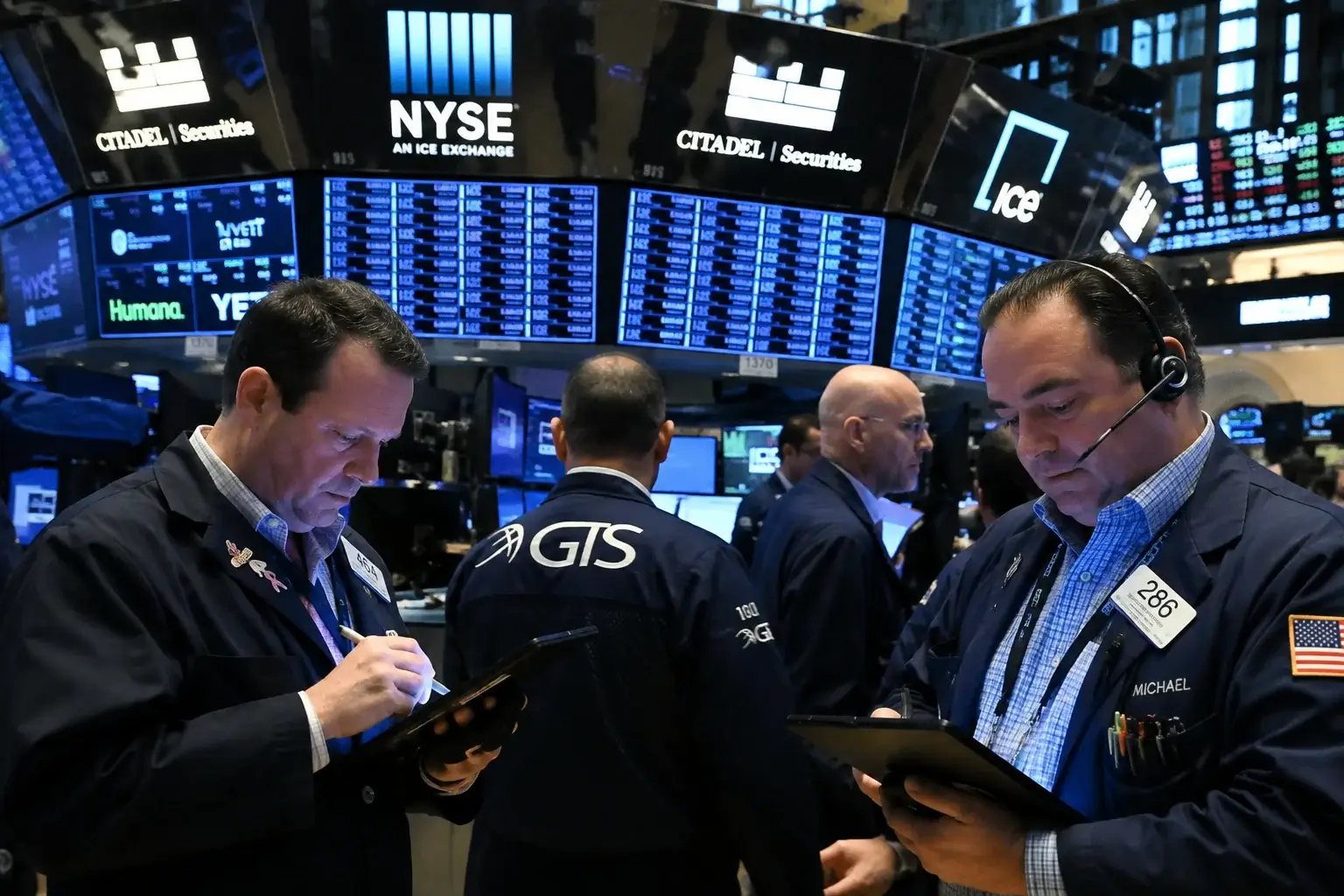
Wall Street is holding its breath. The S&P 500 (SPX) is up 0.10% at roughly 7,548 in late-morning trade, the Nasdaq Composite (IXIC) has clawed back 0.34% to sit near 26,376, and the Dow Jones Industrial Average (DJI) is grinding 0.15% higher to fresh records after closing at an all-time high Tuesday. The numbers are tiny because the day is binary: at 2 PM ET the Federal Reserve delivers its rate decision, and at 2:30 PM Kevin Warsh steps to the podium for the first time as Chair. Nothing else on the tape is going to print until that's done.
The Russell 2000 is the one index actually moving, and it's moving the wrong way — down 0.87% — which tells the whole story about how the rate-sensitive corners of the market are positioned. Small caps live and die on the cost of money, and a crowd that spent the first quarter pricing cuts is now staring down a dot plot that might pencil in hikes. The VIX is sitting near 16.34, low enough to signal complacency but not so low that anyone's asleep. This is a market coiled, not calm.
The setup is unusual. The funds rate is a 97% lock to stay pinned at 3.50%–3.75%, a level the committee hasn't touched since the December 2025 cut. Three holds already this year — January, March, April — and the April session under the outgoing regime split 8-4, the most contentious vote since 1992. So the decision itself is a non-event. What the desk is actually trading is the projection material that lands alongside it, and the tone of a brand-new Chair who has spent years criticizing the very communication machinery he now controls.
The one-line thesis for the session: this is not a rate day, it's a guidance day, and the market that's pricing a flat outcome has the most room to get hurt if the dots shift toward tightening. Everything green on the screen this morning is provisional. The buyers nudging the S&P and Nasdaq higher are doing it on thin conviction, parking money in defensives and financials while the duration-heavy growth names sit out the open. The bid is real but shallow, and it can vanish in the time it takes to read a single-page statement.
Why the Rate Number Is the Least Interesting Thing Today
Strip away the noise and the federal funds target is settled. Futures pricing puts a hold at 97%, and the prediction-market crowd has the June outcome locked near 89% with the residual leaning toward a token cut nobody believes lands. The band stays at 3.50%–3.75%. That's not where the money is being made or lost.
The action is in the Summary of Economic Projections — the quarterly release that maps where each of the 19 committee participants thinks rates belong through 2028. The single number that matters is the 2026 median. In March, that dot still carried one lonely rate cut. The expectation walking into this print is that the cut gets erased entirely, and the harder scenario — the one that smokes growth equities — is the dots sliding into hike territory, with at least three members reportedly penciling in 2026 increases.
The mechanism here is straightforward and brutal. When the cost of money stops falling and starts threatening to rise, the discount rate baked into every valuation model climbs with it. The assets that bleed first are the high-duration names whose entire case rests on cash flows a decade out. That category maps almost perfectly onto the AI and semiconductor complex that now drives the Nasdaq's weight. A hawkish dot plot doesn't require a single basis point of actual tightening to reprice a tech portfolio — the projection is the event.
That's why the Russell is sagging while the Dow sits at records. The blue-chip industrial average is stacked with cash-flow-rich, lower-duration businesses that don't flinch as hard when the rate path firms. Small caps and growth carry the duration risk, and they're the ones getting trimmed into the print. The rotation is already visible in the breadth: value and defensive factors are carrying the tape, utilities and financials are leading as rates wobble, and the megacap growth engine that powered the indexes through the spring is idling.
So the rate gets a yawn and the dots get the white-knuckle treatment. A market that's spent four months flipping from a cut bias to a hike bias is asking the Fed to confirm or deny, and the answer prints at 2 PM sharp.
Warsh's Debut and the Coming Communication Overhaul
Kevin Warsh took the oath as the 17th Chair on May 22, and Wednesday is his first time running the meeting. The personality angle is the easy story; the institutional one is the trade. Warsh has spent years arguing that the Fed talks too much, projects too much, and boxes itself in with forward guidance that turns into a commitment the moment it's published. His debut could matter more for what he doesn't say than for anything he does.
The genuine tail risk on the tape isn't the rate or even the median dot — it's whether a new Chair starts dismantling the guidance architecture that's anchored markets for over a decade. Warsh has reportedly signaled he may withhold his own dot entirely, a small gesture with outsized implications. Strip away explicit projections about where rates are headed and the market doesn't shrug — it reprices uncertainty. A less-predictable Fed means a higher risk premium on every forward-looking asset, and that premium gets paid first by the longest-duration names on the board.
That's the paradox of the session. A Chair who has personally argued for cuts could deliver a more hawkish outcome simply by removing the scaffolding the market leans on. Less guidance, more volatility, a wider band of plausible outcomes — and a tape that has to fend for itself without the running commentary it's grown addicted to. The crowd will parse the statement's wording line by line: does any easing-bias language survive, how is the inflation backdrop framed, and does Warsh validate or push back on a market that's quietly priced a hike this year.
There's a political dimension layered underneath. The administration pushed hard for cuts and backed Warsh expecting delivery. The energy shock from the Iran conflict changed the arithmetic, and inflation has run hotter than anyone modeled for four straight months. Warsh inherits a committee with one dove, three hawks, and an eight-member middle he has to herd on day one, against a backdrop that hands both camps ammunition. The press conference at 2:30 is where the real tape-moving happens — a debut audience studies tone and framing harder precisely because there's no history to anchor on.
The number is a lock. The man behind the microphone is the variable.
Inflation Ran Hotter, and Energy Is the Culprit
The reason this hold is fraught rather than routine is that the price data keeps surprising to the upside. May CPI, released June 10, printed 4.2% year over year, up from 3.8% in April and the third straight month of accelerating headline inflation. That's a number that doesn't fit a Fed itching to cut, and it's the single biggest reason the 2026 dot is at risk.
Energy is doing most of the damage. The conflict with Iran that erupted in late February, and the repeated disruptions around the Strait of Hormuz, pushed energy prices up 23.5% over the trailing year — a sharp acceleration from 17.9% a month earlier. When fuel rips at that pace it bleeds into transportation, logistics, and every input cost in the economy, and it does it in a way the Fed can't fix with rates. A central bank can't drill a barrel of oil or reopen a shipping lane, which is exactly why an energy-driven inflation spike is so awkward for policy.
One reading cut the other way, and it's the doves' lifeline. Core CPI, stripping out food and energy, rose just 0.2% on the month — half of April's pace — even as the annual core rate edged up to 2.9%. That cooling core is the argument that the underlying disinflation trend is intact and the headline is just an energy tax that washes out once oil normalizes. The Fed's preferred gauge, PCE, last ran 3.8% headline and 3.3% core in April, and the May update doesn't land until after this meeting, which leaves the committee projecting into a fog on its own favorite metric.
That split is the entire tension of the dot plot. A hot headline arms the hawks who want the last cut gone and a couple of hike dots on the board. A cooling core arms the doves who say the energy shock is transitory and the path lower is still alive once the Iran premium drains out of crude. Both sides walked into this meeting with a number to wave around, and Warsh has to produce a median that reconciles them.
For the tape, the math is uncomfortable. Four months of upside inflation surprises have flipped the market's bias from cuts to potential hikes, and a 4.2% headline doesn't give anyone cover to argue the Fed should ease. The energy line is the swing factor, and that pulls the focus straight back to oil and the Iran framework.
A Labor Market That Refuses to Crack
The other half of the Fed's mandate is doing the hawks no favors either. May payrolls came in at +172K against a consensus near +80K — more than double the expectation — and revisions tacked a combined +93K onto the prior two months. Unemployment held at 4.3%. A labor market that strong removes the usual justification for cutting; you don't ease into job growth that's running hot.
The one soft spot is wages, where annual growth eased to 3.4%. That's the data point doves point to as evidence the labor market is cooling at the edges even as the headline number stays firm. Slower wage growth takes some of the demand-side pressure off services inflation, and it's the cleanest argument that the economy isn't overheating in the way a +172K print might suggest on its own.
But the broad picture is a jobs market that simply won't roll over, and that's a problem for anyone hoping the Fed delivers relief. The classic case for cuts is a softening labor backdrop — rising unemployment, slowing hiring, the early signs of recession. None of that is in the data. Hiring is accelerating, the unemployment rate is parked, and revisions are running positive rather than negative. A central bank looking at that data has every reason to sit on its hands and no statistical cover to ease.
Stack the two mandates together and the message to the dot plot is consistent: inflation is above target and accelerating at the headline, employment is firm and beating, and the only soft readings — core CPI and wage growth — are the ones doves have to lean on hardest. That's a committee that holds, projects no near-term relief, and probably erases the last cut on the dots. The hike scenario, the one the market hasn't fully priced, gets its oxygen from exactly this combination of sticky prices and a jobs market that won't quit.
The crowd nudging stocks higher this morning is implicitly betting Warsh threads the needle — acknowledges the hot data without slamming the door on future easing. The data itself argues for caution on that bet. A labor market this firm hands the Fed permission to stay restrictive far longer than the spring consensus assumed, and the rate-sensitive corners of the tape — small caps down 0.87%, growth idling — are positioned for exactly that risk.
Yields and the Dollar Sit on a Knife's Edge
The bond market is pricing the same standoff. The 10-year Treasury yield is hovering around 4.47% after easing in the prior session, with the front end heavier — the 2-year sits near 4.17%, its highest since early 2025. That's a curve that's lost most of its inversion and is bracing for a Fed that stays higher for longer rather than one cutting into a slowdown.
The path here is whipsaw. Yields fell Monday when the US-Iran framework cooled the inflation premium baked into the long end, then firmed back up Tuesday as the crowd rotated focus from the peace deal to the rate decision. The 10-year has been swinging in a tight band, and the direction it breaks after 2 PM depends entirely on the dots. A hawkish projection — the cut erased, hikes appearing — sends yields higher across the curve and lifts the dollar against the majors. A surprisingly dovish framing does the reverse, though the data makes that the lower-probability outcome.
The duration math flows straight into equities. Higher yields compress the multiple on the longest-dated cash flows, which is why the Nasdaq's growth complex is the most exposed and the Dow's industrial mix the most insulated. The 0.87% drop in the Russell 2000 is the bond market's pessimism expressed in equity form — small caps carry floating-rate debt and refinancing risk that gets heavier with every basis point the front end climbs.
The dollar is the cleaner read on a hawkish surprise. If the dots tighten, the greenback rips against everything, and that's a headwind for the megacap multinationals that book a chunk of revenue overseas. It's also a global story this week, with central banks in Japan, Australia, and the UK all delivering decisions, so the dollar's reaction to Warsh ripples through every cross.
The setup leaves the rates desk fully hedged and waiting. Nobody wants to be caught long duration into a hawkish dot plot or short into a dovish surprise, so the 10-year is pinned near 4.47% in a holding pattern that mirrors the equity tape. Both markets are frozen on the same 2 PM catalyst, and both will move fast once the page hits the wire.
The Iran Framework Drains the Oil Premium
Underneath the Fed drama, the geopolitical story that's dominated the tape for months is unwinding in real time. President Trump announced the US and Iran reached a peace agreement, with a memorandum of understanding set to be signed Friday and reports indicating energy exports through the Strait of Hormuz will be restored. That's the catalyst that sent oil sharply lower and pulled the inflation premium out of the long end of the curve.
The crude move has been violent. WTI slipped 2.6% to around $78.66 in the prior session, with Brent down 2.4% to roughly $81.17, and the front-month contract has been printing in the mid-$75 range as the market prices Iranian barrels coming back online. That's a brutal reversal from the conflict-driven spike that pushed energy up 23.5% year over year and lit the fuse on the inflation problem the Fed is now wrestling with. Every dollar crude sheds is a dollar of relief on the headline CPI the hawks are pointing at.
But the bid faded on the details. The crowd scrutinized the practicality of the agreement after the initial relief rally, with the deal's specifics still unreleased and doubts creeping in about how fast the Strait actually reopens. A framework signed Friday is not the same as tankers moving freely next week, and the market got more skeptical as the session wore on, which is part of why oil bounced off its lows and the Tuesday tape turned defensive rather than euphoric.
The oil unwind is the cleanest bull case for stocks that exists right now, and it's why the inflation hawks may be fighting a problem that's already solving itself. If crude keeps draining and the Strait genuinely reopens, the energy spike that drove four months of hot CPI prints reverses, the headline cools, and the Fed's last cut suddenly looks less doomed. The catch is timing — the May CPI that scared the committee is backward-looking, and the oil relief is happening now, which means the data the Fed is projecting from may already be stale.
The tape is caught between the two. A defensive, value-led session Tuesday with utilities and financials leading reflects a market that's not yet ready to bet the energy relief sticks. The Friday signing is the next hard catalyst, and it lands two days after the Fed prints its dots into an oil picture that's changing faster than the data can capture.
SpaceX Mania Holds Above $2.64 Trillion
The single name that's rewired the market-cap leaderboard is SpaceX (SPCX), and it's holding its ground after a three-session frenzy. The stock finished Tuesday up nearly 5% at $201.80, giving it a market value of $2.64 trillion — a hair below Amazon's $2.65 trillion and good for fifth among the world's most valuable public companies, after it briefly eclipsed both Amazon and Microsoft during the session. Today it's churning near $203, digesting one of the most explosive debuts in market history.
The fuel was a $60 billion all-stock deal to acquire Anysphere, the maker of AI coding platform Cursor — disclosed in an 8-K and converting an April option into a final agreement. The deal exercises a clause that let SpaceX either buy the startup outright for $60 billion or pay $10 billion for the joint work, and it represents roughly 3.4% dilution at the IPO valuation. The merger is slated to close in the third quarter and folds Cursor into Musk's broader AI push, which already absorbed xAI earlier this year. The stated goal: a frontier model jointly trained with Cursor, surfacing in Cursor and Grok Build.
The numbers behind the mania are staggering and a little unhinged. SpaceX raised a record $85.7 billion in its IPO at $135 a share, and the stock has soared more than a third in three sessions since. Nearly a million SPCX call options traded on day one as the crowd piled into upside bets, and retail flows have been ferocious — one desk noted retail bought almost as much SPCX over two sessions as it bought across the entire US market the prior week. The leveraged long ETF tied to the name jumped 10% in a session while its bearish twin got smoked for the same.
The valuation case is where it gets dangerous. One research shop cut its fair value estimate to $62 from $63 after the Cursor deal, which pegs the stock at roughly 3.2x fair value and implies a 69% downside from current levels — among the most expensive names in its entire coverage universe. Cursor's own position is slipping, too: its share of the AI coding category fell from 41% in June 2025 to about 26% in May, with a well-funded rival now controlling half that market.
SpaceX is the purest expression of the AI mania on the tape right now — a rocket company valued like a hyperscaler on the strength of a coding-tool acquisition, riding a retail call-buying frenzy into the world's top five. It's the kind of single-name fireworks that lights up a flat session, and it's exactly the kind of high-duration story that a hawkish dot plot would test hardest.
uniQure Goes Vertical on a Huntington's Green Light
The biggest percentage move on the board belongs to uniQure (QURE), which ripped roughly 66% to near $44.84 after the gene-therapy company cleared a regulatory hurdle that had crushed it earlier in the year. The catalyst: the FDA communicated, at a recent Type B meeting, that the three-year analysis from the Phase I/II study of AMT-130 would be acceptable as the primary basis of a Biologics License Application for accelerated approval in Huntington's disease. The company plans to submit the BLA in the third quarter.
The reversal here is the whole story. Back in March, the FDA had told uniQure it could not agree that the Phase I/II data, measured against an external control, were sufficient to support a marketing application, and strongly recommended a full sham-surgery-controlled trial — a setback that gutted the stock. Wednesday's news flips that stance: the agency now accepts the existing three-year dataset as the primary evidence base, seeking alignment on a confirmatory study design that may use a standard-of-care control rather than a sham procedure. For a one-product binary biotech, that's the difference between a multi-year delay and a near-term filing.
The clinical case underpinning the move is genuinely strong. At three years, the high-dose arm showed a statistically significant 75% slowing of disease progression on the composite Unified Huntington's Disease Rating Scale against a propensity-matched external control, with a p-value of 0.003, and the therapy was generally well-tolerated. Roughly 75,000 people live with Huntington's in the US, and there's no disease-modifying treatment on the market — a clean unmet-need setup that explains why the desk is willing to pay up violently on a regulatory path opening.
Read More
-
Yen Stalls at 160 Despite a 3% JGB and Tokyo Core CPI at 2.0% — Intervention Sits at 164, Friday's Payrolls Decide
02.09.2026 · TradingNEWS ArchiveEnergy
-
CHAT Fund Holds $96.37 as Korean Memory and Chip Exposure Drive a 109.73% Year — Break of $98.02 Opens $105.20
18.09.2026 · TradingNEWS ArchiveStocks
-
First-Generation XRPR and XRPI Ride XRP's Rebound to $1.386 as Spot Funds Post First Outflow — Break of $1.40 Opens $1.54
18.09.2026 · TradingNEWS ArchiveCrypto
-
NG Holds $2.9255 as Storage Surplus Narrows From 5.5% to 3.7% in 3 Weeks — Break of $3.00 Opens $3.15
18.09.2026 · TradingNEWS ArchiveCommodities
-
Dollar Surges to 157.90 as BoJ's Divided Hike Fails to Lift the Yen — Break of 158.87 Opens 159
18.09.2026 · TradingNEWS ArchiveForex
The balance sheet buys time. The company reported $586.6 million in cash and investments as of the end of March, with runway into the second half of 2029, which means it can fund the BLA process and a confirmatory study without an immediate dilutive raise hanging over the stock. For a clinical-stage name, financing overhang is often the silent killer, and uniQure has enough cushion to chase the filing without a fire-sale capital event.
A 66% single-day rip is the kind of move that only happens when a binary catalyst flips from negative to positive, and AMT-130 just did exactly that. It's the day's clearest reminder that beneath a frozen index tape, individual stories are still printing fortunes and detonating shorts. The risk from here is the confirmatory study design — the FDA wants alignment before submission, and any friction on that front is the next thing that moves the name.
CarMax Tops the Line but Gets Sold
Not every story is a moonshot. CarMax (KMX) reported fiscal first-quarter results before the bell and got sold off roughly 5% to near $49.36 despite beating on the top line — a classic case of a number that clears the bar and still disappoints the crowd. Net revenues rose 6.2% to $8.0 billion, ahead of estimates near $7.39 billion, and combined retail and wholesale unit sales hit 392,357, up 3.3%.
The problem was margins and the bottom line. Net earnings per diluted share came in at $1.31, down from $1.38 a year earlier — a 5.1% decline — even though that still topped a consensus that had drifted toward $0.94 to $0.97 after analysts slashed expectations. Gross profit per retail used unit dropped to $2,177 from the prior year's all-time record of $2,407, a $230 hit that reflects the pricing actions the company pushed through to spur a sluggish sales trend. Comparable-store used unit sales actually fell 0.8%, which undercuts the headline revenue beat.
The strategic reset is the new variable. CEO Keith Barr unveiled a four-pillar growth framework aimed at restoring unit and earnings growth, and management is leaning hard on cost discipline — raising the fiscal 2027 exit-rate SG&A reduction target to $200 million from $150 million while planning to open just four new stores and cut capital spending to roughly $400 million from the prior two years' pace. The financing arm, CarMax Auto Finance, originated nearly $1.9 billion at 42.8% sales penetration, a slight improvement. Buybacks are paused with leverage sitting just above target, after the company repurchased 1.3 million shares for $50 million in the prior quarter.
The reaction tells you what the crowd actually cares about. A revenue beat and an EPS line that crushes a beaten-down consensus would normally lift a stock the market had given up on, but the margin compression — that $230 drop in gross profit per used car — is the number that got the focus. The pricing cuts that drove the unit volume came straight out of profitability, and a market already nervous about consumer demand and the rate path isn't paying up for revenue growth bought with thinner margins.
CarMax is the consumer-cyclical read in a session dominated by macro and mania, and the message is cautious. A used-car retailer slashing prices to move metal, capping store growth, and pausing buybacks isn't the picture of a confident consumer-facing business heading into a Fed decision that may keep rates restrictive. The stock's slide is a small but real data point on how the rate-sensitive real economy is faring.
BMW Cracks as the Iran Shock Hits the Real Economy
The clearest evidence that the Iran conflict is bleeding into corporate fundamentals came from BMW, whose shares dropped nearly 7% to $63.28 — their lowest level in more than five years — after the German automaker cut its 2026 profit outlook. The company cited weakening demand in China alongside disruptions tied directly to the Iran war, a one-two punch that hit the same morning the Fed wrestles with the inflation those disruptions helped create.
The detail is telling. BMW said positive volume trends in Europe and the US couldn't offset the sales decline in China and the broader Asia-Pacific region, and it flagged that elevated energy prices driven by the Iran conflict are weighing on costs. That's the energy shock showing up not as an abstract CPI line but as a direct hit to an automaker's margin guidance — the same 23.5% year-over-year energy spike that's complicating the Fed's job, expressed in a profit warning.
The China weakness is the structural worry layered on top. Western automakers have been losing ground in China to domestic players for years, and BMW's call that Asia-Pacific demand can't be rescued by Western strength is a warning about the largest auto market on the planet. Pile the energy-cost pressure on top of structural share loss and you get a five-year low in the stock and a cut to the year's profit outlook.
The read-through matters beyond one carmaker. BMW is a bellwether for global industrial demand and a clean proxy for how the Iran energy shock and China softness are hitting margins in the real economy rather than just the inflation data. When a premium automaker cuts guidance citing both, it's a signal that the geopolitical premium the equity market keeps trying to look past is already showing up on income statements.
It also reinforces the defensive tilt running through the tape. A session where utilities and financials lead while a global industrial bellwether craters is a market quietly bracing for slower growth and stickier costs — the exact stagflationary cocktail that makes the Fed's hold so uncomfortable. BMW's profit warning is the macro story made concrete, and it lands at the worst possible moment for anyone hoping the energy shock was purely a headline phenomenon.
Breadth, Rotation, and the Defensive Tilt
Pull back from the single names and the internals tell a consistent story: this is a defensive, value-led tape, not a growth-led melt-up. Utilities and financials have been leading as rates wobble, the equal-weight index is roughly flat, and the megacap growth complex that powered the spring is sitting out the open. That rotation is the market's way of bracing for a Fed that stays restrictive.
The semiconductor and AI names that dominate the Nasdaq's weight are the tell. Nvidia (NVDA) is churning near $208, up a fraction, while the broader chip and hardware complex is mixed — a far cry from the relentless leadership that defined the index for the past year. Intel (INTC) is the exception, up around 2% near $119, but the heavyweight growth engine is idling rather than driving. When the highest-duration sector on the board goes quiet ahead of a dot plot that might add hike dots, that's positioning, not coincidence.
The rotation winners are the lower-duration, cash-flow-stable corners. Financials benefit from a steeper curve and higher-for-longer rates that fatten net interest margins, while utilities offer the bond-proxy stability that money flees to when the growth outlook fogs over. That the Dow sits at records while the Nasdaq wobbles and the Russell drops 0.87% is the rotation in three numbers — blue-chip industrials insulated, growth and small caps exposed.
The single-name fireworks underneath — SpaceX's mania, uniQure's 66% rip, CarMax's slide, BMW's crack — don't change the index-level read because they cancel out and the indexes themselves are pinned on the Fed. A 66% move in a mid-cap biotech and a $2.64 trillion rocket company can light up the tape without budging the S&P, because the benchmark is frozen on a macro catalyst that swamps any individual story. The dispersion is the signature of a market waiting on one event while individual catalysts keep detonating in the background.
The breadth picture leaves the session balanced on a coin flip. A defensive tilt with value leading is a market that's already half-positioned for a hawkish outcome, which cuts both ways: it limits the downside if the dots tighten as expected, but it also means a genuinely dovish surprise — the lower-probability path the data argues against — could trigger a violent rotation back into the beaten-down growth names. The crowd is leaning defensive into the print, and the print decides whether that lean was right.
The Levels and Catalysts That Decide What's Next
The map from here is short and sharp. At 2 PM ET the statement and the Summary of Economic Projections hit the wire, and four things tell you how Warsh's debut went: the 2026 median dot and whether the last cut survives, the vote split and any dissents, whether easing-bias language stays or gets stripped, and the framing of the inflation backdrop. At 2:30 the press conference begins, and a Chair with no track record gets parsed word by word for tone.
For the S&P 500 (SPX) at 7,548, the line in the sand is the prior all-time high zone — a hold confirms the buyers retain control even into a hawkish hold, while a break below the recent congestion opens the door to a deeper flush if the dots tighten. The Nasdaq (IXIC) near 26,376 carries the most duration risk; the growth complex is where a hawkish surprise hits hardest, and the index's ability to defend that level depends entirely on whether Warsh validates or pushes back on the market's hike pricing. The Dow (DJI) at records is the insulated index, and it taking out fresh highs even on a hawkish print would confirm the rotation thesis cold.
The cross-asset confirmations matter just as much. A 10-year yield breaking above 4.47% toward the recent highs signals the bond market reading the dots as hawkish, and that's the headwind for growth. The dollar ripping on the same read pressures the multinationals. Crude is the wild card — the Friday US-Iran signing is the next hard catalyst after the Fed, and if the Strait genuinely reopens and oil keeps draining, the energy-driven inflation that scared the committee starts reversing in real time, which reframes the entire hawkish case within 48 hours of the print.
The single-name watch list into the close: SpaceX (SPCX) holding $2.64 trillion or finally cracking under its 69%-overvalued tag, uniQure (QURE) digesting its 66% rip as the confirmatory-study design becomes the next question, CarMax (KMX) and its margin story as the consumer-cyclical read, and the chip complex led by Nvidia (NVDA) as the duration barometer. These are the names that move the tape once the macro fog clears.
The bottom line for the session is unchanged from the open: this is a guidance day, not a rate day, and a market pricing a flat outcome with a defensive lean has the most to lose if the dots shift toward tightening. Everything green on the screen this morning is provisional until 2 PM. The Fed holds at 3.50%–3.75% — that part's settled. What Warsh does with the dots, the language, and the microphone is the only thing the next few hundred points hinge on.
That's TradingNEWS