Stock Market Today: Nasdaq (IXIC) Leads at 26,635, S&P 500 (SPX) at 7,520, Dow Lags — MU Stock Crosses $1 Trillion at $886
Memory supercycle, fading Iran-war oil premium, and quantum-and-space speculation collide as the post-holiday tape rotates straight back into the AI complex | That's TradingNEWS
Key Points
- Micron MU exploded 18% to ~$886, crossing $1T cap as UBS tripled its target to $1,625 on AI memory pricing power.
- S&P 500 +0.66%, Nasdaq +1.11%, Russell 2000 +1.74%; Dow -0.19% as Brent fell 2.8% and 10-yr yield eased to 4.47%.
- Quantum and space names ripped — RGTI +20%, QBTS +28%, INFQ +31%, ASTS +7% — broadening the risk-on bid sharply.
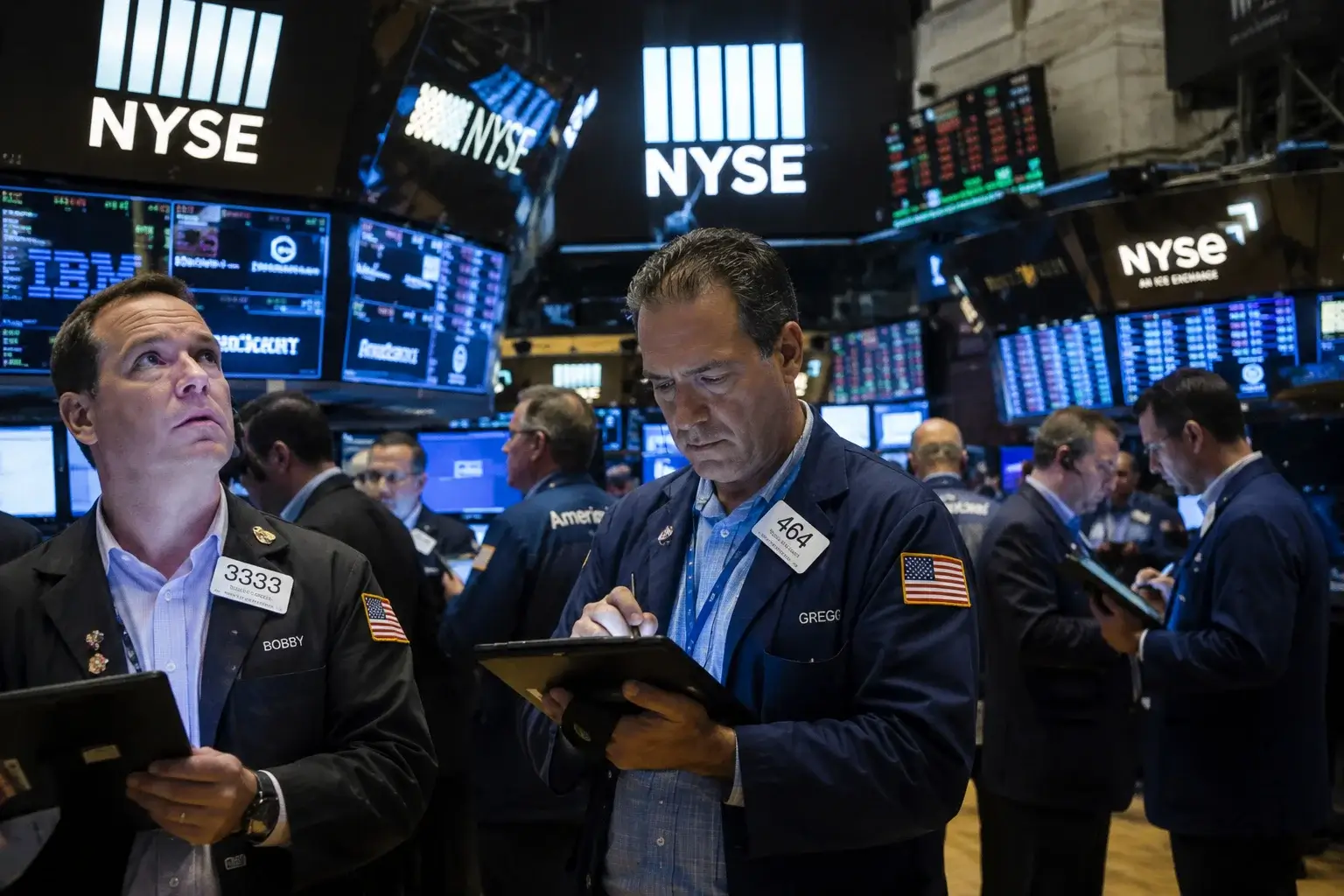
U.S. equities reopened from the Memorial Day weekend with a clean risk-on signature, and the dispersion across the four major benchmarks made clear that flows were aggressively concentrated in the AI complex and small caps rather than blue-chip ballast. The S&P 500 (SPX) climbed 0.66% to 7,522.60 in midday trade, sitting just inside the all-time-high zone after Friday's 7,473.47 record close and tracking toward a fresh print if afternoon flows hold. The Nasdaq Composite (IXIC) ripped 1.11% to 26,635.14, extending what was already a seventh weekly advance in eight, and clearing the prior 26,343.97 settle. The Russell 2000 (RUT) jumped 1.74% to 2,919.26 — the kind of small-cap leadership that typically signals a real broadening of breadth rather than a narrow mega-cap concentration trade — and the index has now decisively reclaimed its post-Iran-shock range. The Dow Jones Industrial Average (DJI), by contrast, slipped 0.19% to 50,481.78, surrendering a sliver of Friday's 294-point record-setting print at 50,580 and underscoring that the blue-chip benchmark's healthcare, consumer-staples and integrated-energy weights simply don't carry the same beta to memory and quantum as the Nasdaq. The VIX (VIX) ticked up 1.51% to 16.84, still well below the 18 line that has framed recent regime shifts since the Iran war broke out in late February.
What Drove The Tape: Iran De-Escalation And A Violent Unwind In The Oil Premium
The single biggest macro driver Tuesday was the renewed conviction that the U.S.-Iran conflict — the primary inflation accelerant for nearly three months — is moving toward a negotiated off-ramp. President Trump said Monday talks were "moving along well" and "proceeding nicely," kept the explicit threat of further military action on the table if negotiations collapse, and reports that Pakistan's army chief was traveling to Tehran added another diplomatic layer beneath the Friday rally. Secretary of State Marco Rubio confirmed "some progress" toward a deal. Crude responded violently: Brent (BZ=F) fell 2.78% to $97.42 a barrel after touching $96.20, and West Texas Intermediate (CL=F) dropped 3.8% to roughly $92.33 — the lowest WTI print of the war and a clean 8.4% weekly decline last week, crude's worst since mid-April. The mechanics matter: every dollar peeled off Brent translates directly into compressed CPI energy contributions, which loosens the financial-conditions noose acting Fed chair Jerome Powell has had to live with as the Kevin Warsh nomination advances. A mid-session reminder of the tail risk — the U.S. and Iran exchanged fire in the Strait of Hormuz, with Washington framing it as self-defense — and stocks didn't blink, which itself is a tell about how aggressively the tape is leaning into the de-escalation thesis.
The Micron Moment: An 18% Pop, A $1 Trillion Cap, And A UBS Target Most Won't Touch
The single-stock story of the day, and arguably of the entire 2026 AI cycle so far, was Micron Technology (MU), which exploded roughly 18% to $886.60 and crossed the $1 trillion market-cap threshold for the first time — joining a peer group containing Nvidia, Alphabet, Apple, Microsoft, Amazon and Broadcom. The catalyst was a UBS price-target hike from $535 to $1,625, an implied near-tripling that would, per Bloomberg's math, push Micron's capitalization to roughly $1.8 trillion and make it the seventh-largest U.S. company, ahead of Tesla, Meta and Berkshire Hathaway. UBS argued the structural changes AI has imposed on the memory complex — long-term agreements with partially fixed pricing, multi-year DRAM and NAND visibility, hyperscaler buyers locking in 2028 capacity already — justify a "more normal" earnings multiple on a stock the Street has historically valued like a deep cyclical. Micron has now tripled year-to-date, up roughly 150% in 2026 alone and nearly 700% over the past twelve months, after printing 74.9% sequential revenue growth in fiscal Q2 and consistently beating guidance for the past year. TrendForce projects 2026 memory revenue to rise 134% to $552 billion, which is the supply-and-demand math the Street is now trying to underwrite.
The Memory And Semis Basket: Sandisk, Seagate, And A SOX Record
Micron was the headline, but the rally was a basket move that extended well beyond the obvious names. The Philadelphia Semiconductor Index (SOX) printed a fresh intraday record after the open, and Roundhill's memory-focused DRAM ETF had already added 12% in Friday's session before extending Tuesday. Sandisk continued to rip alongside Micron, with Stanley Druckenmiller's recently disclosed position increase in both names cited repeatedly in flow desks. Seagate Technology and Western Digital posted gains of 3% and 8% in the prior session and held bid Tuesday. The chips were not uniformly green: Nvidia (NVDA), which printed a record $81.6 billion in Q1 fiscal 2027 revenue on May 20 (+20% sequential, +85% YoY), hiked its dividend to 25 cents, and announced a new Data Center reporting framework splitting Hyperscale and ACIE, is digesting a quieter ~1.8% post-earnings decline as the bar for "amazingly boring" beats keeps rising. Wedbush's Matt Bryson framed it bluntly: "people are saying we expect more — to the point where more becomes unrealistic." Louis Navellier of Navellier & Associates estimates Nvidia now accounts for "as much as 50% of the weight of S&P performance," which captures the embedded concentration risk that Tuesday's broadening was, partly, an antidote to.
Quantum Computing: The Speculative Edge Catches Fire
Where memory was the institutional bid, quantum was the speculative one, and Tuesday's gainers screen left no doubt. Infleqtion (INFQ) led at +30.77% to $14.62. D-Wave Quantum (QBTS) jumped 28.01% to $24.71. Rigetti Computing (RGTI) added 26.48% to $21.35 — with a parallel feed showing $26.42, a 56% one-month gain, and a 48% five-day pop. The trigger was the Trump administration's May 21 announcement of $2.013 billion in CHIPS Act incentive funding flowing to nine quantum computing firms, with Rigetti pulling down a $100 million slice. The fundamentals remain speculative — Rigetti booked just $4.4 million of Q1 sales and is still posting roughly $26 million quarterly losses — but the company holds $569 million in cash with minimal debt, buying years of runway, and analyst price targets now sit near $29-$30. The broader pattern matters: when government grant flow lands on an already AI-saturated tape, marginal speculative dollars rotate into the next-stage compute thesis, exactly the pattern visible across QBTS, IONQ, QUBT and the rest of the quantum sleeve. Applied Digital (APLD) +21%, Wolfspeed (WOLF) +21.46%, BlackBerry (BB) +18.95%, and AXT (AXTI) +16.37% rounded out the higher-beta winners screen.
Space Stocks: AST SpaceMobile, Rocket Lab, And The SpaceX IPO Halo
The space complex added the third leg to Tuesday's speculative bid, with both fundamental and event-driven triggers. AST SpaceMobile (ASTS) climbed roughly 7% mid-session, extending a multi-week 47% rally, after Roth Capital lifted its price target to $108 from $82.50 and reiterated its Buy on the basis of full funding for over 100 satellites and approximately $3.5 billion in cash. ASTS has reaffirmed its full-year 2026 revenue guide of $150-$200 million, flagged over $1.2 billion in contracted revenue commitments, and is positioning into a mid-June BlueBird 8, 9, 10 launch on a Falcon 9 vehicle. Rocket Lab (RKLB) added 6% in the preceding session, Planet Labs picked up 4%, and Redwire (RDW) ripped +26.54% to $22.14 on no obvious news beyond sector beta — all of it underwritten by the impending SpaceX IPO scheduled for June 12 at a $1.75 trillion valuation, which would mark the largest IPO in market history and is pulling speculative capital toward every public-market proxy with even tangential exposure to satellite, launch, or direct-to-cell infrastructure. Defiance and T-REX both launched leveraged 2x ASTS daily-target ETFs, itself a tell about retail flow concentration.
Sector Composition: Why The Dow Lagged While Everything Beneath It Rallied
The intraday divergence between the Dow's 0.19% decline and the Nasdaq's 1.11% rise was almost entirely a sector-weight story rather than a breadth story. Healthcare and consumer staples — the two sectors that propelled Friday's 294-point record close, led by Merck (+5.64%) and Cisco (+2.01%) — gave back a portion of those gains as defensive flows unwound on the risk-on reopen. Energy sat under pressure across the board as oil melted, with refiners and integrateds underperforming as the geopolitical premium drained out of crude — PBF Energy and Delek US Holdings were down 12-13% in recent sessions on margin compression fears. Financials were mixed as the 10-year yield eased 7 basis points to 4.47%, taking some of the steepener trade off the table. Technology and communication services did the heavy lifting, with the semiconductor sub-index (^SOX) printing a fresh intraday record. The cyclical-versus-defensive rotation was visible even within sectors: AutoZone (AZO) cratered 10.97% to $3,032.82 on retail concerns, while industrials with AI-data-center exposure like Modine Manufacturing (MOD) +22.26% and Construction Partners (ROAD) +12.03% acted as second-order beneficiaries of the hyperscaler buildout thesis.
Cross-Asset Read: Yields Ease, Dollar Firm, Gold Steady, Bitcoin Soft
The bond market endorsed the equity-friendly de-escalation narrative without fully buying into a dovish Fed pivot. The 10-year Treasury yield (^TNX) fell roughly 7 basis points to 4.47%, retreating from the 4.595% spike printed on May 15 when 30-year yields hit 5.121% — the highest since May 2025 — on a hot CPI print that put the brakes on any near-term Fed-cut narrative. The 30-year remained near 5.02-5.12% in recent sessions, and the 2-year sat around 4.08% (off the 3.989% earlier in May), pricing the front end consistent with the FOMC's 3.5%-3.75% policy range and the Senate-advanced Warsh nomination markets read as marginally hawkish on balance-sheet policy. Gold (GC=F) was effectively flat at $4,514-$4,518, holding near recent highs as an Iran re-escalation hedge but not catching a fresh bid. The U.S. dollar firmed, with EUR/USD at 1.1625 (-0.15%) and GBP/USD at 1.3446 (-0.42%); USD/JPY held a hot 159.32 (+0.29%), keeping pressure on the BoJ to defend the line. Bitcoin (BTC-USD) sagged to roughly $76,700-$77,200, off about 1.1% on the day in a notable risk-off divergence from equities — a reminder that crypto flows decoupled from tech-equity flows during the Iran shock and have not fully resynced. Brent at $97.42 (-2.78%) and WTI at $92.33 (-3.8%) capped the cross-asset story.
Earnings Dispersion: Nvidia's Beat, Zscaler Tonight, And A Loaded Week Ahead
Earnings season is in its tail end but the names on deck this week carry disproportionate weight for AI sentiment and enterprise software. Nvidia reported May 20 with $81.6 billion Q1 fiscal 2027 revenue (+20% sequential, +85% YoY), beat consensus on EPS at $1.87 vs. $1.76 expected (+6.25%), hiked its quarterly dividend to 25 cents, and announced the new Data Center reporting framework — yet shares declined 1.8% post-print. Zscaler (ZS) reports after the bell Tuesday, with guidance pointing to Q3 FY26 revenue of $834-$836 million (~23% YoY), operating margin of 22.4-22.6%, and full-year ARR guidance of $3.730-$3.745 billion (~24% YoY), where focus lands on Agentforce-equivalent AI security ARR momentum and Red Canary integration. Wednesday brings Marvell (MRVL), Salesforce (CRM), HP Inc. (HPQ), and Synopsys (SNPS), with Salesforce's Agentforce trajectory the single most-watched data point. Thursday delivers Dell Technologies (DELL), Lululemon (LULU), and Costco (COST), where the AI-server ramp at Dell faces a tape that has already priced in a beat — Dell jumped 16.77% to $295.19 in recent sessions on price-target hikes. Adam Parker at Trivariate Research noted that with full-year 2026 S&P earnings projected to grow 23% (and 16% in 2027), forward P/E has actually been "modestly contracting" despite the rally — a nuance bulls are leaning on heavily.
Read More
-
Yen Stalls at 160 Despite a 3% JGB and Tokyo Core CPI at 2.0% — Intervention Sits at 164, Friday's Payrolls Decide
02.09.2026 · TradingNEWS ArchiveEnergy
-
CHAT Fund Holds $96.37 as Korean Memory and Chip Exposure Drive a 109.73% Year — Break of $98.02 Opens $105.20
18.09.2026 · TradingNEWS ArchiveStocks
-
First-Generation XRPR and XRPI Ride XRP's Rebound to $1.386 as Spot Funds Post First Outflow — Break of $1.40 Opens $1.54
18.09.2026 · TradingNEWS ArchiveCrypto
-
NG Holds $2.9255 as Storage Surplus Narrows From 5.5% to 3.7% in 3 Weeks — Break of $3.00 Opens $3.15
18.09.2026 · TradingNEWS ArchiveCommodities
-
Dollar Surges to 157.90 as BoJ's Divided Hike Fails to Lift the Yen — Break of 158.87 Opens 159
18.09.2026 · TradingNEWS ArchiveForex
Consumer, Housing, And Retail Margins: Cracks Beneath The Surface
Beneath the headline indices, the consumer signal is unambiguously softening, and the Case-Shiller print due this week underscores the trend. The 20-City Composite rose just 0.9% YoY in February — the slowest annual growth since July 2023 — down from 1.2% in January, with inflation outpacing home price appreciation for nine consecutive months and over half of major U.S. metros showing year-over-year declines. Denver led losses at -2.2%, Tampa -2.1%, Los Angeles -0.8% and Washington -0.1% rounded out the negative column. NAHB builder confidence remained at 34, well below the 50-point breakeven. Freddie Mac mortgage rates near 6.4%, with projections to 6.1% by year-end, are not enough to thaw a market where the affordability index sits at roughly 100. On the retail side, the bifurcation was stark: Walmart (WMT) -6.63% to $122.17 and KE Holdings (BEKE) -6.78% reflected margin compression and consumer-pullback concerns, while EchoStar (SATS) -7.06% and Intuit (INTU) -20.03% (separate guidance issue) showed the punishment now meted out to any name with even a small miss. Yardeni Research's tracking of net profit margin expectations for consumer-discretionary names continues to soften, and the bond market is reflecting that — high-yield credit spreads remain anchored but issuer-level dispersion has widened materially.
Short Positioning And Speculative Froth: The Other Side Of The Rally
Tuesday's tape was as much a short-squeeze tape as a fundamental tape, and the most-active list confirmed it. NIO (NIO) traded $5.63 with 14M+ shares moving, Plug Power (PLUG) jumped 15.19% to $3.81, and the persistent short interest above 30% in names like Draganfly continues to set up violent two-way moves on any positive catalyst. Sphere Entertainment (SPHR) and EVgo (EVGO) saw short-interest readings elevate again. The most-overbought 14-day RSI screens included CleanCore Solutions (ZONE), AmpliTech Group (AMPG), and Zion Oil (ZNOG), all of which trade with the kind of float characteristics that make them magnets for retail momentum chasers. The leveraged ETF launches around ASTS (Defiance 2x, T-REX 2x) and the existing 2x products around Strategy add structural amplification to flows, meaning even modest fundamental beats can produce 20-30% single-session moves on the upside while disappointments — Intuit, AutoZone, Glaukos at -13.52% — produce equally violent downside. Options volatility around Ford (F) and Cypherpunk Technologies (CYPH) was elevated this past week, per Seeking Alpha tracking.
Deals And Capital Flow: SpaceX IPO, Strategy's Bitcoin Test, IREN-Nvidia
The capital-markets backdrop is exceptionally hot, and the SpaceX IPO targeting June 12 at a $1.75 trillion valuation — raising up to $75 billion structured with dual-class shares to keep Musk's control intact — would mark the largest IPO in history if executed at indicated terms. Starlink's 9 million-plus user base and $15-16 billion of 2025 revenue underwrite the deal's headline math, and the pre-IPO halo is visibly lifting every public-market space proxy. Strategy (formerly MicroStrategy) returned to headlines with another large Bitcoin purchase, with one analyst noting the company "faces the same test it keeps failing" — a reference to the equity premium-to-NAV compression that has dogged the name during BTC drawdowns. IREN — which fell 2.1% to $56.83 in Friday's session but ended the week +7.4% — continues to trade on the back of its $3.4 billion AI cloud deal with Nvidia and a separate $3 billion convertible note offering, illustrating the level of capital being thrown at AI-infrastructure intermediaries. The pipeline of AI-cloud, satellite, and quantum-related capital raises remains the dominant supply-side story for risk assets.
International: Kospi Records, Nikkei Mixed, Europe Bid On De-Escalation
The international read confirmed the U.S. setup. South Korea's Kospi hit a fresh all-time high Tuesday as trading resumed from a public holiday, with SK Hynix (memory) and Samsung Electronics (memory + mobile) catching the same supercycle bid that lifted Micron — Daniel Yoo at Yuanta Securities reiterated his 10,000 Kospi year-end call on CNBC. Japan's Nikkei 225 traded modestly mixed, with one feed showing 64,996.09 (-0.25%) on the day but the index up sharply on the week's prior 3.14% Thursday rally to 61,684.14, driven by 14.8% YoY April export growth and a SoftBank Group surge of nearly 20% on the Nvidia-AI read-through. Hong Kong's Hang Seng added 0.86% to 25,606.03, the Shanghai Composite gained 0.87% to 4,112.90, and Shenzhen rose 2.30% — all reflecting the same liquidity tone. European markets matched the U.S. risk-on signal: the FTSE 100 added 0.22-0.46% to roughly 10,514, Germany's DAX rose 1.15% to 24,888, France's CAC 40 added 0.37% to 8,115, and the Euro Stoxx 50 climbed 0.99% to 6,019. The European Commission cut eurozone 2026 GDP growth forecasts to 0.9% (from 1.4% in 2025 and a prior 1.2% estimate) and bumped its 2026 inflation forecast to 3.0% from 1.9%, citing the "major energy shock" — the same Iran-war fingerprint visible in U.S. CPI prints from April and May. UK posted a 5.0% unemployment rate in the three months to March and CPI of 2.8% in April (down from 3.3%), helped by an energy price cap.
The Final Read: A Tape That's Made Its Mind Up
Tuesday's session was, in the end, a referendum on whether the Iran war's three-month inflation overlay was peaking, and the answer the tape gave was an emphatic yes — yields down, oil down, dollar steady, equities up, with leadership concentrated exactly where you'd expect in a confirmed risk-on regime: AI memory at the institutional core, quantum and space at the speculative perimeter, small caps catching a broadening bid. The risks haven't disappeared. Brent at $97, even after the drop, sits far above the early-year levels that originally allowed the Fed's December rate path. Powell still chairs a divided FOMC, with the Warsh transition layered on top. Strait of Hormuz exchanges of fire remind that "talks proceeding nicely" can reverse with a single tweet, and Fed-funds futures are still pricing a non-trivial chance of a quarter-point hike by December — 25%, up from 21.5% earlier in the month, per CME FedWatch. But until the next CPI print or the next geopolitical headline, the path of least resistance is the one Micron defined Tuesday morning: through 7,520 on the S&P 500, through 26,600 on the Nasdaq, and through whatever multiple the Street is willing to assign a memory supercycle the marginal buyer no longer treats as cyclical.