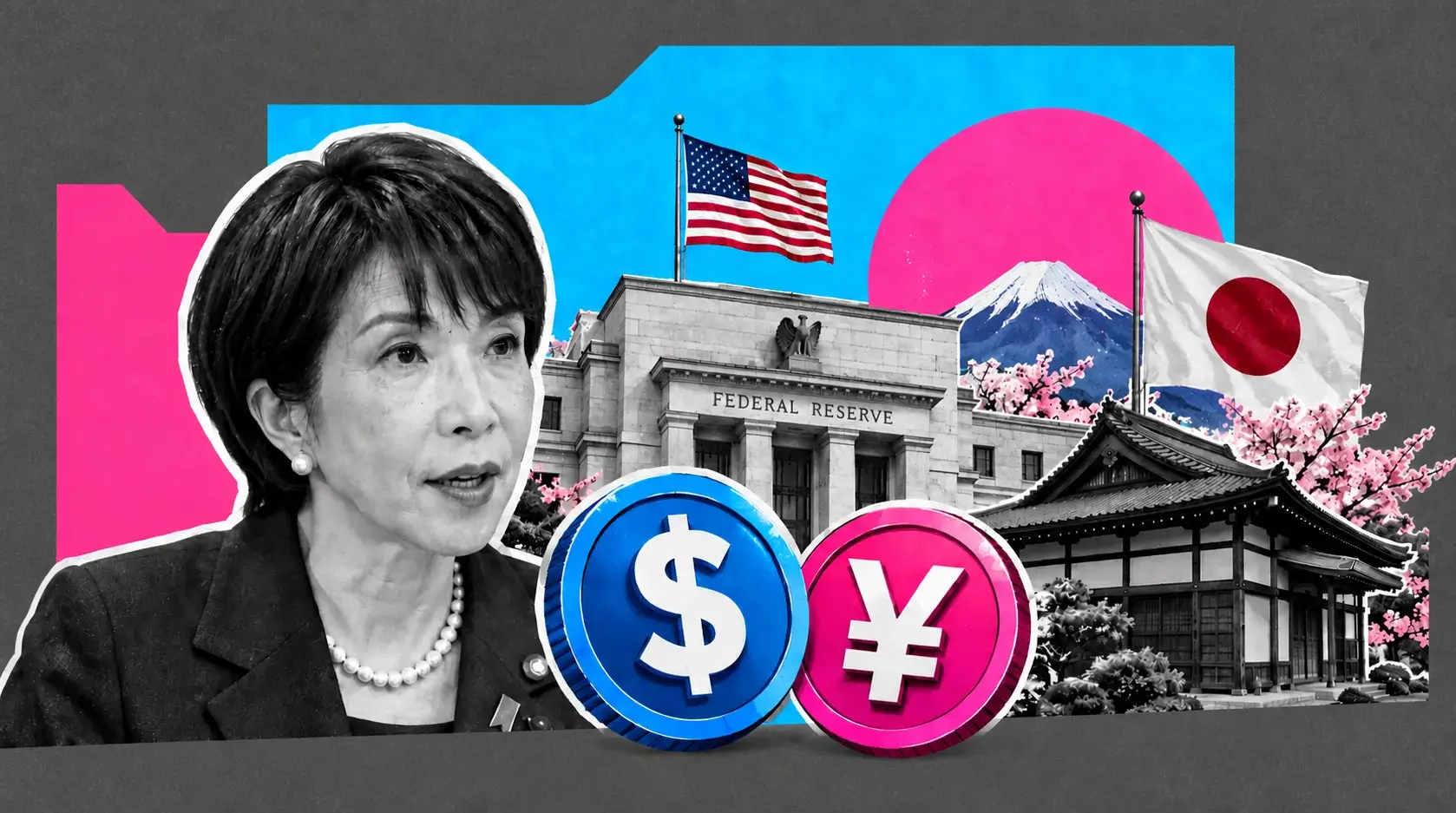
USD/JPY Price Forecast - Dollar to Yen Slips Below 155.00 as BoJ Signals December Rate Hike
Japanese yields surge, Tokyo inflation beats forecasts, and Ueda’s hawkish tone triggers sharp yen rally while USD softens on dovish Fed outlook | That's TradingNEWS
USD/JPY Weakens as BoJ Hawkish Shift and Fed Easing Collide
The USD/JPY pair slipped sharply in early December trading, retreating toward 155.40 after losing more than 100 pips during the London session as renewed yen strength followed a decisive hawkish tone from the Bank of Japan. The move marks a significant shift in market structure, with carry trade positioning unwinding as Japanese Government Bond yields climb to multi-year highs. Traders are now recalibrating rate expectations on both sides of the Pacific, with the BOJ moving closer to tightening while the Federal Reserve signals easing, intensifying downward pressure on the pair’s trajectory.
Tokyo Inflation Sparks Policy Repricing
Japan’s latest Tokyo CPI readings reignited expectations for policy normalization. Headline inflation increased 0.3% month-over-month and 2.7% year-over-year, while core inflation, excluding fresh food, advanced 2.8%, surpassing expectations and remaining well above the central bank’s 2% target. This reinforced the probability of a December rate hike, now priced at 56%, with odds of a second hike by October 2026 exceeding 80%. Governor Kazuo Ueda’s remarks confirmed policymakers are prepared to weigh rate increases “proactively,” emphasizing that delayed tightening could trigger unwanted inflation acceleration. The statement immediately lifted short-end yields, with 2-year JGBs touching 1% for the first time since 2008, while 20-year bonds reached their highest levels since 2020.
Carry Trade Unwind Intensifies Market Volatility
Higher Japanese yields have reignited the reverse carry trade, pressuring speculative positions that depended on ultra-low yen borrowing costs. As bond yields surged, leveraged traders began cutting positions, sending the yen broadly higher across major pairs. The USD/JPY reaction was swift—falling 0.7% on the day—as risk assets from equities to cryptocurrencies declined simultaneously. Analysts view this as a potential structural unwind of the long-standing carry trade, particularly if the BoJ executes multiple hikes within the next 10 months. The pair’s recent decoupling from U.S.–Japan yield spreads highlights the dominance of positioning flows over fundamentals in short-term moves.
Fed Policy Divergence and U.S. Data Weakness Add Pressure
While the BoJ edges toward tightening, the Federal Reserve’s stance remains distinctly dovish. Markets fully price a 25-basis-point rate cut for the December 9–10 meeting, with some traders betting on as much as 100 bps in cumulative easing through 2026. Recent U.S. economic data supports this expectation: the ISM Manufacturing PMI printed at 48.2, its lowest in three months, while the employment index dropped to 44, confirming contraction. A pending leadership change at the Fed, with Kevin Hassett emerging as a potential new chair, adds further downside risk to the dollar given his historically dovish rhetoric. The DXY Index fell below 99.40, its weakest level in two weeks, amplifying the drag on USD/JPY.
Technical Breakdown and Key Levels in Focus
The technical structure of USD/JPY now shows pronounced deterioration after breaking below the mid-October uptrend. The pair currently consolidates near 155.40, defending minor support at 154.50, while the major support zone lies at 152.69, aligned with the 50-day SMA, and deeper structure support at 150.20, marked by the 100-day SMA. Resistance levels emerge at 156.00 and 157.00, followed by the November swing high of 157.90. Oscillators show momentum fatigue: RSI has slipped to 54, a neutral reading after peaking above 70, and MACD has crossed below the signal line near the zero axis, confirming reduced bullish energy. Price remains above both moving averages, maintaining a technically bullish structure, but indicators suggest momentum loss consistent with trend exhaustion.
BOJ Communication Drives Yield Repricing and Yen Demand
Governor Ueda’s rhetoric marks a pivotal communication shift for the Bank of Japan. His insistence on “preemptive tightening” contrasts with prior policy caution. The market’s immediate reaction reflects a reassessment of yield spreads: Japan’s 10-year yield now trades near 1.05%, versus 4.22% for U.S. Treasuries, narrowing the premium by 40 bps in just two weeks. This compression undercuts dollar demand, particularly from institutional investors engaged in long USD/JPY positioning since late summer. The BoJ’s emphasis on wage data as a trigger for tightening strengthens the case for gradual normalization, suggesting that sustained yen appreciation may persist into Q1 2026.
Macro Context: Political Transitions and Market Sensitivity
Political dynamics are adding to the volatility. Prime Minister Sanae Takaichi has publicly supported monetary independence, allowing Ueda latitude to act without political constraint. On the U.S. side, President Trump’s renewed push for energy subsidies and his criticism of “excessively high” rates have increased pressure on the Fed to loosen policy faster, reinforcing dollar softness. This policy divergence—tightening in Japan and easing in the U.S.—has become the defining macro driver of USD/JPY’s reversal. Meanwhile, global equities, including the Nikkei 225, have declined nearly 1.8% since last week, further boosting yen demand as investors seek safety amid volatility.
Read More
-
Yen Stalls at 160 Despite a 3% JGB and Tokyo Core CPI at 2.0% — Intervention Sits at 164, Friday's Payrolls Decide
02.09.2026 · TradingNEWS ArchiveEnergy
-
T-Rex 2X Inverse MSTR ($4.39) Rips 10.44% as Strategy Pauses Bitcoin Buys for a 2nd Week — $4.63 Close Opens $5.27
15.09.2026 · TradingNEWS ArchiveStocks
-
XRPR ($10.59) and XRPI ($7.04) Open at Highs and Close at Lows After Senate Kills CLARITY Act
15.09.2026 · TradingNEWS ArchiveCrypto
-
NG ($2.908) Holds Above $2.80 Low as LNG Feedgas Hits 18.8 Bcf and TTF Trades 9.2x Henry Hub
15.09.2026 · TradingNEWS ArchiveCommodities
-
USD/JPY (155.09) Faces 275bp Policy Gap as BOJ Prepares 31-Year-High Rate — Close Below 154 Opens 153.40
15.09.2026 · TradingNEWS ArchiveForex
Short-Term Sentiment and Market Positioning
Traders remain cautious but not yet fully bearish. The latest CFTC positioning data shows leveraged funds trimming net longs by 12% week-over-week, the largest reduction since April. Retail sentiment is still split, with 53% of traders maintaining long exposure. Daily volatility expanded to 0.9%, compared to a 30-day average of 0.52%, indicating rising short-term instability. Should the pair close decisively below 155.00, it would confirm a structural breakdown, potentially triggering acceleration toward 152.80 and 151.50. Conversely, regaining 155.75 could stabilize short-term sentiment and reestablish the bullish corridor, though upside potential appears capped without renewed U.S. yield strength.
Outlook and Trading Bias for USD/JPY
With Japanese inflation above expectations, rising bond yields, and heightened BoJ credibility, the fundamental balance has shifted against USD/JPY. The pair’s medium-term outlook now hinges on whether the Fed cuts rates next week. A dovish U.S. decision combined with a December BoJ hike would cement a downward bias toward 152.00 levels. From a technical and macro standpoint, the pair remains vulnerable to further weakness, especially if Ueda signals another rate hike for Q1 2026. Considering the fading dollar strength, narrowing yield spreads, and mounting risk aversion, USD/JPY carries a bearish bias in the near term, though any recovery above 156.00 could temporarily pause the slide.