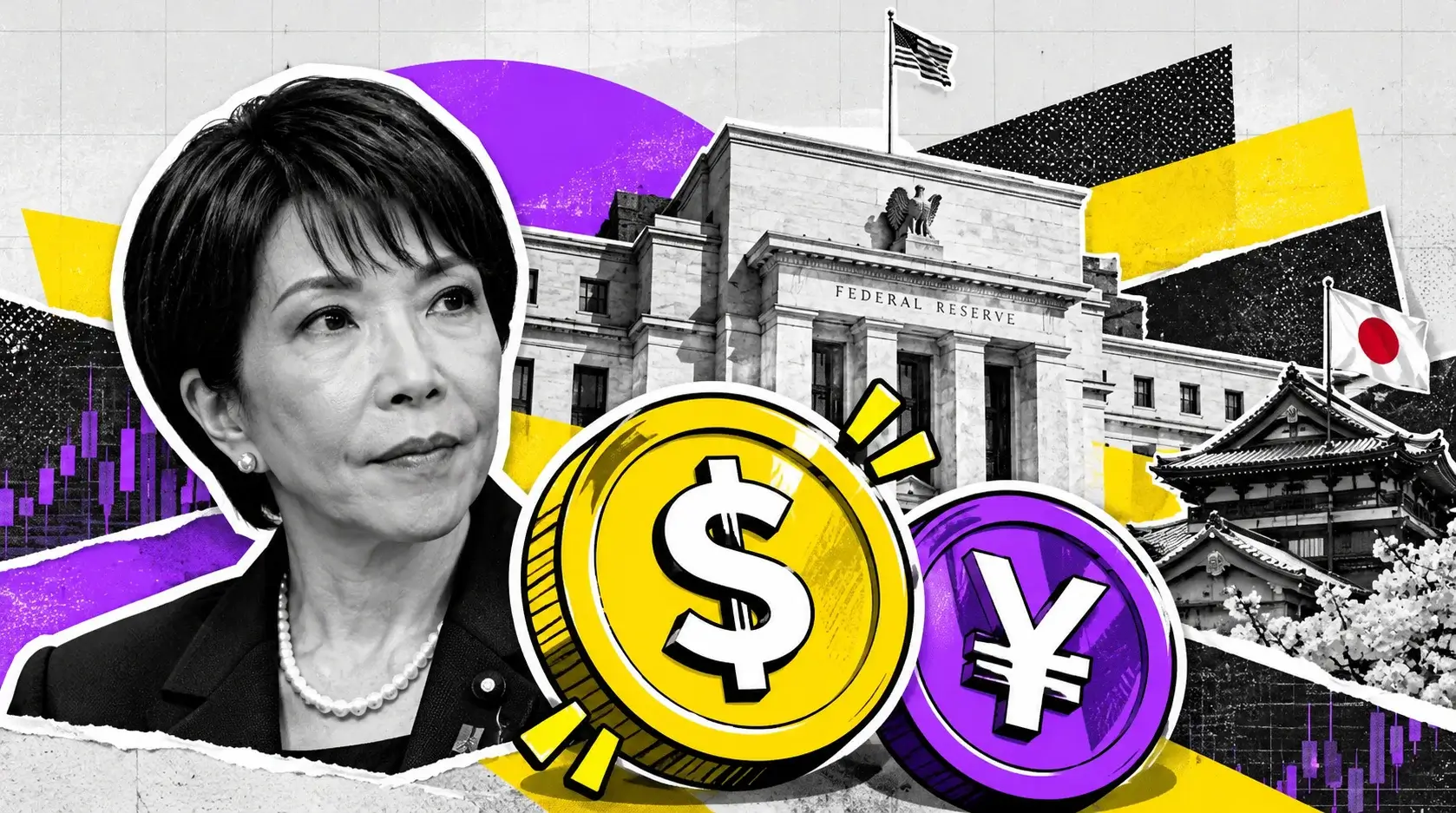
USD/JPY Price Forecast - Pairs Near 157 as Japan Election, BoJ and Fed Paths Collide
Yen weakens into the snap vote while carry trades drive USD/JPY toward 158–160, with intervention risk rising on the upside and a potential medium-term reversal zone shaping up around 152 | That's TraidngNEWS
USD/JPY – Price action pinned near 157 as markets front-run Japan’s election gamble
USD/JPY is circling the 157.00 zone after a violent round-trip that took the pair from an October low near 147.06 up to a January spike around 159.45 and then back down toward 152 before the latest rebound. The recovery from just under 152 has already reclaimed roughly 3.5%, putting spot on track for about a 1.5% weekly gain while the Yen posts its second straight week as the weakest major. The immediate band that matters now is 156.50–158.00: the pair is holding above 156.45 intraday lows and trading around 157.00 as markets price in a highly probable landslide win for Prime Minister Sanae Takaichi’s Liberal Democratic Party and continued carry demand into the weekend.
USD/JPY – Election arithmetic, fiscal fears and the 240% debt overhang
Polls point to the LDP securing at least the 233 seats needed for a simple majority in the Lower House, with several surveys flagging the risk of an LDP–Japan Innovation Party (JIP) bloc pushing toward the 310-seat supermajority threshold. A supermajority would let the coalition override Upper House resistance and ram through expansive fiscal packages at a time when Japan’s debt-to-GDP ratio is already around 240%. That combination – bigger deficits in a country this indebted – has been a core driver of Yen weakness since October and explains why USD/JPY ripped from roughly 147.06 in early October to the 159.45 area by mid-January. Even a plain LDP majority, without a formal supermajority, still strengthens Takaichi’s hand enough to keep the market focused on more borrowing, more bond supply and a Bank of Japan forced to tread carefully on tightening. Near term, that political setup is bullish for USD/JPY, because it reinforces the perception that Tokyo will keep leaning on easy money and fiscal stimulus to support growth.
USD/JPY – Household spending slump exposes the BoJ’s dilemma on inflation and the weak Yen
December household spending fell 2.6% year-on-year after a 2.9% rise in November, a swing of more than five percentage points and a clear negative surprise. With private consumption accounting for roughly 55–60% of Japan’s GDP, a contraction of that magnitude matters. On the surface it softens the case for an aggressive Bank of Japan, because weaker consumption typically cools demand-driven inflation and raises downside risk for growth. The twist is that part of the spending slump is likely imported from the FX market: a weaker Yen pushes up the cost of energy and food, eroding household purchasing power even if nominal wages are not collapsing. The BoJ has already flagged the need to deal with Yen weakness as a channel for import-driven inflation; that is why talk of “rate checks” and intervention re-entered the market when USD/JPY spiked toward the 159 area. The result is an awkward trade-off: allow USD/JPY to stretch higher and you risk further squeezing households; tighten too quickly and you hit a consumer that is already cutting back. For the medium term, that mix still leans toward a BoJ that edges rates higher over 2026 rather than sitting on its hands indefinitely – a Yen-positive shift once election noise fades.
USD/JPY – Fed path, soft US labour data and why carry is still working for now
On the US side, the dollar backdrop is no longer one-way bullish, but the rate gap versus Japan remains wide enough to keep carry trades alive. Jobless claims jumped more than expected in the last week of January and JOLTS job openings dropped to their weakest print in more than five years, while the ADP employment report slowed to about 22K from 41K the prior month. Those numbers pushed markets to increase the probability of a March Fed cut to roughly 24% and a June cut to above 80%, according to Fed funds futures pricing. At the same time, consumer sentiment is expected to dip from 56.4 to around 55.0, hinting at softer consumption and disinflation momentum into mid-year. That setup argues for a slower, more dovish Fed over 2026. Yet even with one or two cuts, the policy gap vs a BoJ that is at or just above zero remains huge. That is why USD/JPY can rally back toward 157–159 at the same time the macro narrative is turning less positive for the dollar on a 6–12 month horizon. In other words: the carry is still paying in the short run, but the rate-differential story is past its peak.
USD/JPY – Positioning, liquidations and why Yen shorts have not cracked yet
Risk-off episodes over the last few days have triggered forced selling in precious metals, crypto and parts of global equities, with Bitcoin sliding from around $70,000 toward the $60,000–65,000 pocket and gold suffering a double-digit percentage correction from its late-January peak above $5,500 an ounce. Those moves have produced sharp position liquidations in crowded trades, but short Yen positions have not seen the same broad clean-out. Investors are still sitting in carry strategies where USD/JPY, USD/ZAR, USD/MXN and other higher-yield pairs generate positive carry every day as long as volatility is contained. MUFG’s stance that Yen shorts have yet to be meaningfully squeezed is visible in this week’s performance table: JPY is down about 1.4% versus USD and weaker against most majors, even as other popular trades have been cut back. That tells you two things. First, there is still fuel for a proper USD/JPY unwind once the macro triggers align. Second, until the BoJ or the Ministry of Finance draws a credible line in the sand, the path of least resistance intraday remains to fade Yen strength dips rather than pre-emptively fight the carry.
USD/JPY – Technical map: 151.90–152.00 as line in the sand and 158.88 as the ceiling to beat
Technically, USD/JPY is stuck between a well-defined floor and an equally clear ceiling. On the downside, the rebound started just pips above a major support cluster in the 151.91–151.98 zone, where the 2022 and 2023 swing highs line up with the 38.2% retracement of the April advance. That area is the structural line in the sand for the longer-term uptrend. A clean weekly close below 151.90–152.00 would be the first serious signal that the multi-year USD/JPY bull phase is breaking down. Above that, intermediate support now sits at 154.10 (roughly the 61.8% retracement of the last leg higher) and then around 154.79–155.00, where prior demand has repeatedly come in. As long as pullbacks hold above roughly 154, dip-buyers can argue the trend is intact. On the topside, resistance is stacked from about 157.70 to 158.08, defined by the 2025 high-week close, the December high close and the January high-week close, with 158.88 marking the key barrier that bulls have failed to close above despite multiple attempts. The previous blow-off spike toward the 159.00 area also coincided with verbal intervention and “rate check” headlines. That zone, 158.88–159.00, remains the obvious battlefield: a daily and then weekly close above it opens space toward the 160.74–161.95 band (2024 high-week close and prior swing high cluster), while another failure keeps the risk of a deeper reversal back toward 154 and then 152 alive.
Read More
-
Yen Stalls at 160 Despite a 3% JGB and Tokyo Core CPI at 2.0% — Intervention Sits at 164, Friday's Payrolls Decide
02.09.2026 · TradingNEWS ArchiveEnergy
-
AMD ($560.68) Rebounds 10% From Its October Low on the Meta Helios Win — November 3 Report Holds the Key to $649
27.10.2026 · TradingNEWS ArchiveStocks
-
Ethereum ($2,312) Lags Bitcoin and AI Stocks as BitMine Nears Its 5% Cap — Break of $2,295 Opens $2,200
27.10.2026 · TradingNEWS ArchiveCrypto
-
Brent ($113.88) Trades a $2.35 Range as Houthi Strikes Meet Saudi-Iran Diplomacy — Break of $117 Unlocks $120
27.10.2026 · TradingNEWS ArchiveCommodities
-
Nasdaq Rips 1.3%, S&P 500 Hits 7,728, Dow Stalls as BA Drops to $171
27.10.2026 · TradingNEWS ArchiveMarkets
-
GBP/USD (1.3310) Can’t Cash In on 5.43% Gilt Yields as Budget Risk Meets a Firm Dollar — Break of 1.3274 Opens 1.3200
27.10.2026 · TradingNEWS ArchiveForex
USD/JPY – Intervention risk and why 158–160 is still a dangerous zone to chase
Every pip USD/JPY adds above the mid-150s resurrects the memory of prior interventions. The last time the pair traded into the 159 handle, Japanese authorities ramped up rhetoric, floated “rate checks” through the press and ultimately triggered a sharp, fast selloff that wiped out several big figures in days. The backdrop today is arguably more intervention-sensitive: household spending is contracting, imported inflation via energy and food is still a concern, and the political class is under scrutiny for how far it will push debt-funded stimulus. If post-election euphoria or strong US data lifts USD/JPY into 158.50–160.00, the probability of at least heavy verbal intervention and potential actual FX action rises sharply. That does not mean the pair cannot trade through those levels intraday, but it does mean the risk/reward for fresh longs deteriorates badly once you are inside a zone that policymakers have already flagged as unacceptable in the recent past.
USD/JPY – How the snap election outcome can shift the 3–6 month path
Into Sunday’s vote, the market is pricing a clear Takaichi win, and that is already reflected in Yen underperformance and USD/JPY trading near 157. The surprise scenarios matter more now. A landslide supermajority, with the LDP–JIP bloc clearing 310 seats, would likely trigger a knee-jerk push toward the 158.50–159.00 band as traders extrapolate faster delivery of tax cuts and spending plans. A plain majority around or slightly above 233 seats, without an overwhelming margin, would be more nuanced: Takaichi still has a mandate, but her freedom to unleash unlimited stimulus is more constrained, giving the BoJ more space to normalise without being accused of undermining fiscal efforts. That medium-term combination – some fiscal expansion, but a BoJ that remains uneasy with a chronically weak Yen – is negative for USD/JPY once the initial relief rally passes. The least-priced scenario is a messy outcome that forces coalition bargaining or weakens Takaichi’s standing. Any sign that the fiscal juggernaut is slowing, or that political capital is too limited for big packages, would be Yen-positive and could pull USD/JPY back toward 154–152 quickly as carry positions unwind.
USD/JPY – Carry trade dynamics and where the risk/reward flips
The core of the USD/JPY story is still carry. US yields, even after a couple of potential Fed cuts, sit far above Japanese short rates; that gap hands leveraged funds and real-money accounts a steady positive carry as long as volatility stays contained and the Yen does not lurch violently higher. With the pair up about 1.5% on the week and JPY down roughly 1.4% against USD, the “carry plus drift” profile has rewarded those willing to sit through drawdowns. That does not last forever. If the Fed path evolves toward multiple cuts in 2026 while the BoJ edges its policy rate up and hints at a higher long-run neutral rate, the differential compresses and carry becomes less compelling. At the same time, the higher USD/JPY trades today, the less tolerance there will be in Tokyo for another sustained depreciation wave. The risk/reward for being structurally long USD/JPY is very different at 157–160 than it was at 130–140. From here, the upside is capped by intervention risk and an eventual shift in central-bank behaviour, while the downside is open if even a partial unwind of Yen shorts collides with a softer dollar and more hawkish BoJ messaging.
USD/JPY – Bias, verdict and what to do around 157–160 versus 152–154
Putting the macro, politics, positioning and technicals together, the near-term tape still favours USD/JPY strength on dips while the election, Fed expectations and carry demand dominate. Into and immediately after Sunday’s vote, the path of least resistance is for spikes toward 157.70–158.88, and a brief extension into the 159.00 pocket cannot be ruled out if the outcome matches or beats the most optimistic LDP–JIP scenarios. However, once the election premium fades and attention returns to BoJ normalisation and Fed easing, the medium-term profile tilts the other way. A BoJ that slowly tightens to address import inflation and currency weakness, combined with a Fed that is pushed by softer labour data toward cuts over 2026, points to narrower rate spreads and a lower USD/JPY over a 6–12 month horizon. Against that backdrop, the clean stance is straightforward: strength into 158–160 is a Sell, not a chase level, with a strategic bias to fade rallies and look for a move back toward 154 initially and potentially into the 150–152 zone if BoJ rhetoric and Fed cuts converge. Weakness into 152–154 is not a place to panic-sell dollars; that region is where short-term participants can still justify tactical Buy trades against the 151.90 floor with tight risk. Overall, on balance and timeframe-adjusted, the pair leans bearish / Sell on rallies over the next 6–12 months, with the current 157 zone sitting in the upper half of what is likely to become a broader 150–160 range rather than the starting point of a new secular surge higher.