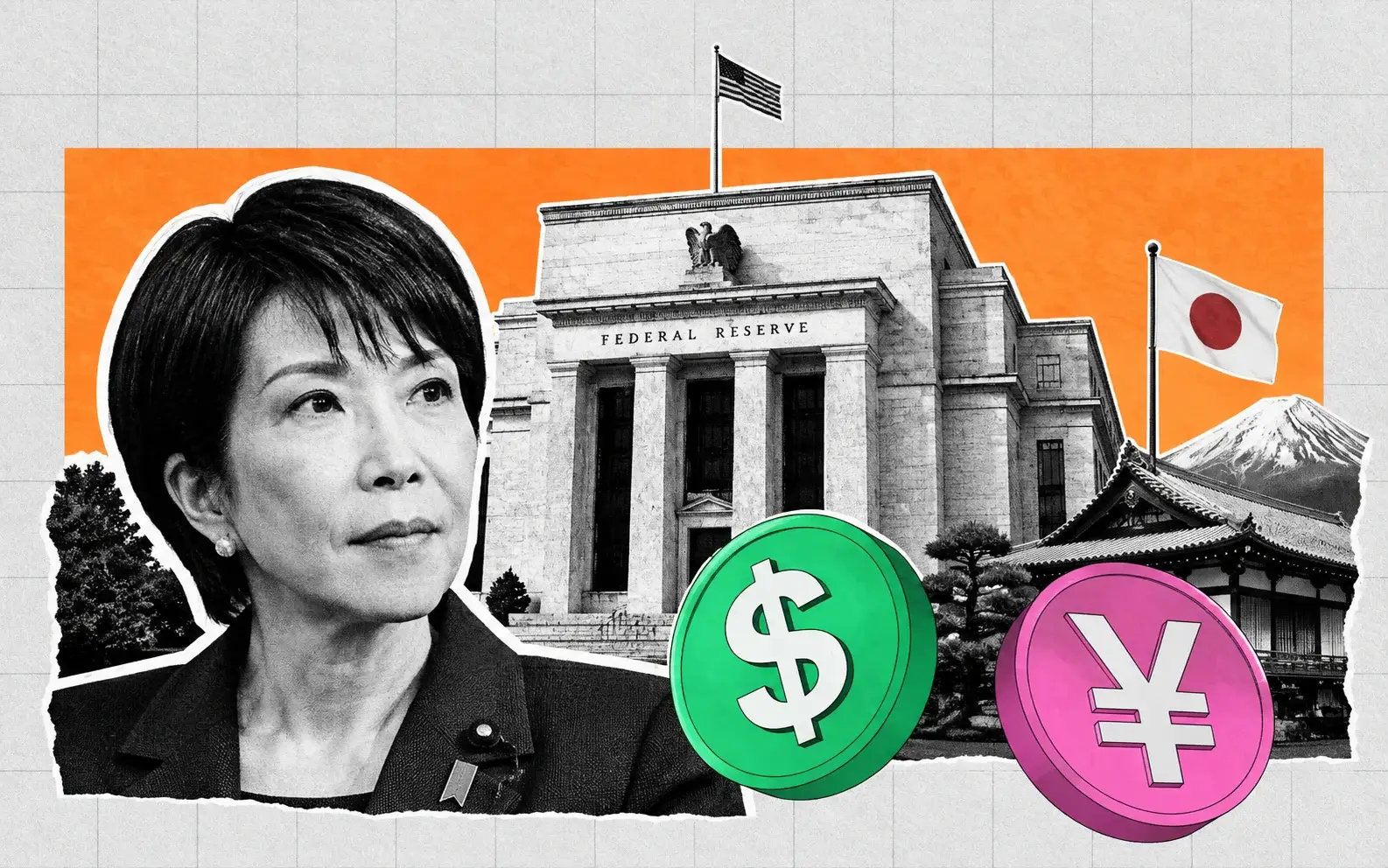
USD/JPY Price Forecast: Yen Pinned Above 159 As Dollar Caches Safe-Haven Bid — BoJ 0.75% vs Fed 3.50-3.75%
250bp policy gap collide with the MoF's intervention warnings to define a 155-162 range | That's TradingNEWS
USD/JPY is trading at 159.32 in midday European action Tuesday, up 0.29% on the day, having pushed back toward the 160 intervention zone that the Japanese Ministry of Finance has historically defended with verbal and direct currency-market action. The pair sits near a one-month high, having rebounded from a brief test of 157 in mid-May when Iran-de-escalation hopes initially weakened the dollar broadly. The 52-week trajectory tells the structural story: USD/JPY peaked at 157.893 on November 20, 2025 — the level that triggered Japanese intervention warnings — then pulled back to 155.799 in mid-December after the BoJ delivered a 25bp hike to 0.75%, before grinding higher through Q1 2026 as the Iran war drove U.S. yields and the dollar sharply higher. The post-October 2025 spike above 150 had been described as "a shock to many" by ING's Chris Turner, and the asset has not closed below 155 in any sustained way through Q2 2026. Tuesday's 159.32 print represents a structurally strong dollar environment that is meaningfully above the ING year-end 2026 forecast of 148 but well within the upper half of the broader 145-160 trading range that has defined the yen's path since mid-2025.
Today's Driver: U.S. Iran Strikes Reset Dollar Higher
The single biggest reason USD/JPY pushed back toward 160 Tuesday is the same Iran-tensions reversal that lifted DXY broadly. U.S. forces conducted overnight self-defense strikes on Iranian vessels near the Strait of Hormuz, Trump told negotiators "not to rush into a deal," and the safe-haven dollar bid that had been draining for weeks resurfaced sharply. The U.S. Dollar Index hit 99.27, a one-month high, with EUR/USD slipping to 1.1625 (-0.15%), GBP/USD to 1.3446 (-0.42%), and USD/JPY firming to 159.32 (+0.29%) — a clean dollar-strength signature across the major-pair complex. The mechanical chain: higher U.S. yields (10-year at 4.47-4.59%) push the carry trade differential further in favor of dollar-yen, and the Iran-reset means the inflation overlay that had been compressing risks of a hawkish Warsh-led Fed is back on the table. Fed funds futures are now pricing a 25% probability of a December hike (up from 21.5% earlier in the month, per CME FedWatch), which is exactly the rate-differential dynamic that pushes USD/JPY toward — and tests — the 160 intervention line. The Camp David peace talks Wednesday now define the next binary catalyst: a clean Iran framework agreement drains the dollar safe-haven premium and likely pushes USD/JPY back toward 157, while a meeting breakdown opens the path to 160 and the test of MoF action.
The BoJ Stance: 0.75% Rate, December Hike Delivered, Q3 Next Move Watched
The Bank of Japan delivered a 25bp hike to 0.75% on December 19, 2025 — the first hike since the BoJ's policy normalization began in earnest, and a move that ING's Chris Turner described as part of Japan "balancing reflation and currency strength." Tokyo CPI cooled to the BoJ's 2% target in late December, signaling that domestic price pressures are stabilizing rather than accelerating, which has reduced the urgency for more aggressive normalization. The annual headline inflation rate slid from 2.1% in December to 1.5% in January 2026, and the so-called "core-core" inflation eased from 2.9% to 2.6% (still above the BoJ's 2% target but trending lower). Governor Kazuo Ueda has signaled a continued path toward additional rate hikes if data warrants, with markets now watching the BoJ's neutral rate debate as the critical factor for USD/JPY direction into 2026. A hawkish BoJ neutral rate band of 1.5%-2.5% would indicate multiple additional rate hikes and strengthen the yen meaningfully; a dovish band at 1.0%-1.25% would limit yen strength and keep USD/JPY range-bound. The next BoJ meeting in late June will be a major catalyst — if Ueda signals a Q3 hike, USD/JPY likely retreats toward 155-156; if the BoJ holds and signals caution, the path extends toward 161-162.
The MoF Intervention Wall: 160 Is The Line In The Sand
The single most consequential structural feature of the USD/JPY tape is the Japanese Ministry of Finance's stated and implied willingness to intervene in the currency market when the pair approaches 160. Forex.com captured the institutional view: "We had long suspected 160.00 was the line in the sand and so it has proved." The November 2025 intervention episode set the precedent — when USD/JPY tested 157.893, Japanese officials issued verbal warnings that capped further upside and eventually pulled the pair back toward 155. The current 159.32 print sits 68 pips below that intervention zone, and traders are positioning around the assumption that any push above 160 triggers either direct yen-buying intervention by the MoF or coordinated G7 action that depresses the dollar. The risk to that assumption: if the BOJ remains constrained by the Japanese government (a dynamic that has been highlighted under prime ministerial pressure) from tightening aggressively, and U.S. rate-hike odds increase with oil prices, the structural drivers favor continued upside in USD/JPY despite the intervention threat. Forex.com's analysis was direct: "the long term USD/JPY forecast tilted to the upside" given the structural rate gap. The trade setup: short USD/JPY at 160 with a stop at 162 is the textbook MoF-intervention trade, with the reward asymmetry favoring the short side if the intervention triggers cleanly.
Technical Framework: 156 Pivot, 160 Cap, 150-140 Bear Targets
The chart structure for USD/JPY defines a clear set of levels that traders are anchoring to. Immediate support sits at the 50-day EMA near 156-157 (the level that has acted as a magnet through most of Q2), then 155 (round number and recent consolidation low), with the 200-day EMA tracking around 153-154 as the structural mid-trend support. LiteFinance's pivot framework places the medium-term pivot at 156.00, with the bias toward additional gains as long as price holds above that level. On the upside, the immediate resistance cluster sits at 160 (the MoF intervention line and round-number psychological barrier), then 161-162 as the structural top from the late-2025 high zone, with 165 as the longer-term extension target if intervention fails to hold. The November 20 high at 157.893 was breached cleanly in Q2 2026, which has invalidated the medium-term bearish structure that FXEmpire and other analysts were positioned for at the end of 2025. The technical signal in the daily chart: USD/JPY remained above the 50- and 200-day Exponential Moving Averages, signaling a bullish bias. RSI sits in neutral-bullish territory around 60, and MACD is positive but flattening, suggesting the rally has lost some momentum but not directional structure.
The Fed Side: Warsh Transition And 25% December Hike Probability
The U.S. side of the USD/JPY rate differential is in a leadership transition that adds an additional layer of uncertainty. Jerome Powell's term as Fed Chair ended May 15, with Powell remaining on the Board of Governors but Kevin Warsh expected to lead the June 16-17 FOMC meeting after Senate Banking Committee approval. The April 28-29 FOMC held rates at 3.50%-3.75% on an 8-4 vote — the most dissents since October 1992 — reflecting the divided posture on whether the Iran-driven energy inflation overlay warrants further tightening or whether underlying disinflation will reassert. Fed funds futures price a 25% probability of a quarter-point hike by December (up from 21.5% earlier in the month, per CME FedWatch), and the bond market positions Warsh as leaning more hawkish than Powell on balance-sheet policy. The Fed-to-BoJ rate differential of 275-300 basis points (3.50-3.75% vs. 0.75%) is what mechanically anchors the USD/JPY carry trade, and any narrowing of that gap on either side compresses the structural support for the pair. The asymmetry: a Warsh hawkish surprise (June hike, or hawkish forward guidance) widens the differential and lifts USD/JPY through 160; a Warsh dovish pivot (clear path to cuts by year-end) narrows the differential and supports the bearish medium-term thesis toward 150-148.
Inflation Picture: Tokyo CPI At 2%, Japan Wage Data Critical
Japan's inflation backdrop has been the cleanest variable for BoJ policy, and the recent path reads as broadly supportive of additional normalization but not aggressively hawkish. Tokyo CPI dropped to the BoJ's 2% target in late December 2025, the first time the headline rate has matched the target after the multi-year overshoot driven by the Iran war's energy pass-through. The annual rate slid further to 1.5% in January 2026, with core-core easing from 2.9% to 2.6% — still above target but trending in the disinflationary direction. The wage data has been the secondary signal: Japanese spring wage negotiations in March 2026 delivered another round of meaningful wage gains, with major employers settling at 3-4% increases that reinforce the BoJ's view that sustainable 2% inflation requires sustained wage growth. Rising services inflation and further evidence of easing U.S. tariff risks could revive bets on a near-term BoJ rate hike — exactly the dynamic that would lift the yen back toward the 150-155 range. Conversely, if Japanese inflation continues to cool below 2% headline, the BoJ has political cover to hold rates and let USD/JPY drift higher through 160.
Cross-Asset Read: Yields Up, Gold Down, Oil Volatile, BTC Soft
The cross-asset chemistry Tuesday is uniformly USD/JPY-supportive. The U.S. 10-year Treasury yield (^TNX) eased 7 basis points to 4.47% early on Iran-peace headlines, then firmed back toward 4.50% as the U.S. strikes hit the tape, with the 30-year still in the 5.02-5.12% zone and the 2-year near 4.08%. Japanese 10-year JGB yields are near multi-decade highs around 1.5-1.6%, but the 250-300bp gap to U.S. Treasuries continues to anchor the carry trade. Gold (XAU/USD) dropped 1.1% to $4,521.80 on dollar firmness — the textbook DXY-up-gold-down chemistry. Brent crude rebounded to $100.40 (from $96.20 morning lows), WTI to $94.19 — the oil volatility that defines every major-pair currency story right now. Bitcoin sagged to $76,700 in a confirmation of the broader risk-off undercurrent. The S&P 500 (SPX) climbed 0.66% to 7,522 and the Nasdaq ripped 1.11% to 26,635 despite the dollar firmness — an equity-USD divergence that reflects Micron's $1 trillion milestone rather than a broader risk preference. The cross-asset configuration favors continued USD/JPY strength until either the Fed-BoJ differential narrows or the Iran tensions resolve cleanly.
Bank Forecasts: ING 148, FXEmpire 140-130 Bear, LiteFinance 156-158
The institutional forecast landscape for USD/JPY clusters around a moderately bearish dollar path that contradicts the current 159 print. ING's Chris Turner projects USD/JPY to reach 152 by year-end 2025 and a modest 148 forecast for year-end 2026 as Japan balances reflation and currency strength — a target that implies roughly 11 figures of downside from current spot if the consensus path plays out. FXEmpire's medium-term view targets a 140-130 range over 4-16 weeks, contingent on a BoJ rate hike and expectations of Q1 2026 Fed cuts materializing — both conditions that have been delayed by the Iran war's inflation overlay. LiteFinance's most recent pivot at 156-158 implies the pair will drift back toward the BoJ-supportive zone but not collapse, with continued upside risk if the BoJ remains hesitant. The bull case (favoring higher USD/JPY) is anchored on hawkish Fed under Warsh, sustained Iran tensions, U.S. yields holding 4.5%+, and BoJ holding rates — a combination that targets 162-165. The bear case anchors on clean Iran de-escalation, BoJ Q3 hike, Fed pivot signals from Warsh, and a U.S. inflation moderation — a combination that takes USD/JPY toward 150-148. The trade-weighted consensus expectation: range-bound between 155 and 162 through Q3 2026, with the resolution coming via the June 16-17 Warsh FOMC and the late-June BoJ meeting.
Read More
-
Yen Stalls at 160 Despite a 3% JGB and Tokyo Core CPI at 2.0% — Intervention Sits at 164, Friday's Payrolls Decide
02.09.2026 · TradingNEWS ArchiveEnergy
-
GLD ETF Sheds Value With Bullion as North American Funds Stay $7.7B in the Red
10.09.2026 · TradingNEWS ArchiveStocks
-
XRP ETF Flows: 7 Funds Split $1.682B With the Complex at Just 1.68% of Market Cap
10.09.2026 · TradingNEWS ArchiveCrypto
-
NG Breaks $2.90 With Production at 113 Bcf/d and LNG Feedgas Capped at 18.3 Bcf/d
10.09.2026 · TradingNEWS ArchiveCommodities
-
USD/JPY Holds Below the 157.23 Average as 2 Central Banks Tighten in 48 Hours
10.09.2026 · TradingNEWS ArchiveForex
Risks: BoJ Hawkish Surprise, Iran De-Escalation, And Direct Intervention
The risks to the bull case for USD/JPY fall into three distinct buckets. First, a clean Iran framework agreement at the Camp David meeting Wednesday that drains the dollar safe-haven premium would push the pair back toward 156-157 immediately and 155 if the dollar weakness extends. Second, a BoJ hawkish surprise at the late-June meeting — particularly if Ueda signals a clear path to 1.00% by year-end — would narrow the rate differential and trigger fast yen strength toward 153-155. Third, direct MoF intervention if USD/JPY breaches 160 cleanly — the precedent from November 2025 and earlier intervention episodes is that the MoF will move with size if the threshold is breached, with the 2022 and 2024 interventions both delivering 4-5 figure moves in single sessions. The bear case to USD/JPY (favoring continued upside) requires sustained Iran tensions, a Warsh-led FOMC that signals continued hawkishness, a BoJ that remains constrained by political pressure, and U.S. data that prevents the Fed from pivoting toward cuts. That combination favors the path through 160 toward 162-165, with the only structural cap being the MoF intervention wall and the eventual policy convergence as Japan continues to normalize.
The Final Read: 155-162 Range Until Iran And Warsh Move The Needle
USD/JPY's Tuesday print at 159.32 sits inside a 155-162 range that has held through May, and the resolution of that range comes down to two sequential binary catalysts over the next 30 days: the Camp David peace talks Wednesday (which define whether the dollar safe-haven bid extends or drains) and the June 16-17 Warsh-led FOMC (which sets the new chair's hawkish-versus-dovish signaling posture). If Iran de-escalates cleanly and Warsh signals at least one cut by year-end while the BoJ confirms a Q3 hike trajectory, USD/JPY targets 155 immediately and 152 by Q3 with the 148 ING year-end target becoming the structural anchor. If Iran tensions persist, Warsh signals a hawkish hold or hike, and the BoJ remains cautious, USD/JPY tests 160 and likely triggers direct MoF intervention — a setup that historically produces violent two-way action over a 5-10 day window before settling at a new equilibrium 200-400 pips lower. The asymmetric tail risk favors yen strength on intervention dynamics, but the structural carry trade and the 275-300bp rate differential favor continued dollar strength on the underlying flow. The trade that defines USD/JPY through Q3 2026 is exactly that: which side of 160 the marginal flow defines, and Tuesday's 159.32 print is the closest the pair has come to testing the MoF's resolve in 2026. The setup favors short-USD/JPY positioning into the 160 zone with a stop at 162 — the textbook intervention trade that has worked in every prior episode where the threshold was tested.