USD/JPY Forecast: Yen Weakest Major at 158, Iran Safe-Haven Breaks Down on Energy Imports, Takaichi Election — Target 160
1990 swing high at 160, Warsh Fed nomination, PPI 0.5%, two cuts priced, JGB rout on fiscal concern, Hormuz threatens Japan's entire energy supply chain | That's TradingNEWS
USD/JPY Forecast: Yen Hits Weakest Major Status at 158, Iran Safe-Haven Surge Collides with Takaichi Election, 160 Breakout Targets 1990 Swing High — Buy Dips
Sunday, March 1, 2026 | TradingNews.com
USD/JPY closed the week pressing against the 158-yen barrier — a level that has contained every rally attempt for weeks and now stands as the final gate before the psychologically massive 160-yen threshold. The Japanese yen finished as the weakest major currency of the past five sessions, underperforming even the Swiss franc (which was the strongest). That relative weakness is not a temporary fluctuation. It reflects a structural divergence between a Federal Reserve that just received hot PPI data (0.5% month-over-month versus 0.3% expected) and a Bank of Japan that remains paralyzed by a government debt load so large that meaningful rate increases would trigger a fiscal crisis. Prime Minister Sanae Takaichi's expansionary fiscal agenda — confirmed by her snap lower house election scheduled for the coming days — promises to make that debt burden worse, not better. Japanese government bond markets have already reacted with a rout that has sent yields higher on fiscal concern rather than monetary tightening expectations, a distinction that weakens the yen rather than strengthening it. And now Iran. The Strait of Hormuz is closed, oil is surging, gold has pushed toward $5,400, silver traded above $93, and the VIX has jumped 6.60% to 19.86. Under normal conditions, geopolitical chaos drives capital into the yen as a safe haven. But Japan imports virtually all of its energy. A sustained oil price spike above $80 — Brent OTC trades indicate exactly that — functions as a terms-of-trade shock that overwhelms whatever safe-haven bid the yen might otherwise receive. The week ahead delivers ISM Manufacturing Monday, Eurozone CPI Tuesday, ISM Services Wednesday, and the headline event: U.S. Non-Farm Payrolls Friday. Each data point either reinforces or challenges the rate differential that has driven USD/JPY relentlessly higher. The 160-yen level is not a ceiling — it is a 1990 swing high, and breaking above it opens a path to moves that have not been seen in 36 years.
The Yen Was the Weakest Major Currency Last Week — And the Structural Reasons Are Getting Worse, Not Better
The Japanese yen lost ground against every other major currency last week. The Swiss franc gained the most, creating the widest divergence between the strongest and weakest G10 currencies — a spread that reflects fundamentally different monetary policy trajectories, fiscal credibility, and energy import vulnerability. Only 11% of all major currency pairs and crosses moved more than 1% last week, indicating compressed volatility across the broader FX market. The yen's underperformance within that low-volatility environment is telling: even when global conditions don't demand aggressive repositioning, capital is steadily draining from yen-denominated assets into higher-yielding alternatives.
The interest rate differential is the mechanism. The Fed sits at 4.75% with markets now pricing only two rate cuts of 0.25% over the course of 2026 — down from three cuts expected the prior week. That hawkish repricing followed Friday's producer price index release, which showed a 0.5% monthly increase versus the 0.3% consensus. The PPI is a leading indicator for consumer inflation, and the overshoot confirms that the disinflation narrative that would have supported aggressive Fed easing has stalled. At two cuts of 25 basis points each, the Fed funds rate would end 2026 at 4.25% — still dramatically above anything the Bank of Japan can offer without destabilizing the entire Japanese government bond market.
Japan's fiscal position makes the interest rate gap structural rather than cyclical. Japanese government debt exceeds 260% of GDP — the highest among advanced economies by a wide margin. The Bank of Japan has been the marginal buyer of JGBs for over a decade, keeping yields artificially suppressed to prevent debt service costs from consuming an unsustainable share of government revenue. Every basis point increase in JGB yields costs the Japanese government billions of yen in additional interest payments. The BoJ cannot raise rates aggressively because doing so would trigger a fiscal spiral — and the market knows this. The yen weakness is not about temporary positioning. It is about the mathematical impossibility of Japan matching U.S. rates without defaulting on its own debt.
Takaichi's Snap Election and the JGB Rout — Expansionary Fiscal Policy Weakens the Yen From the Domestic Side
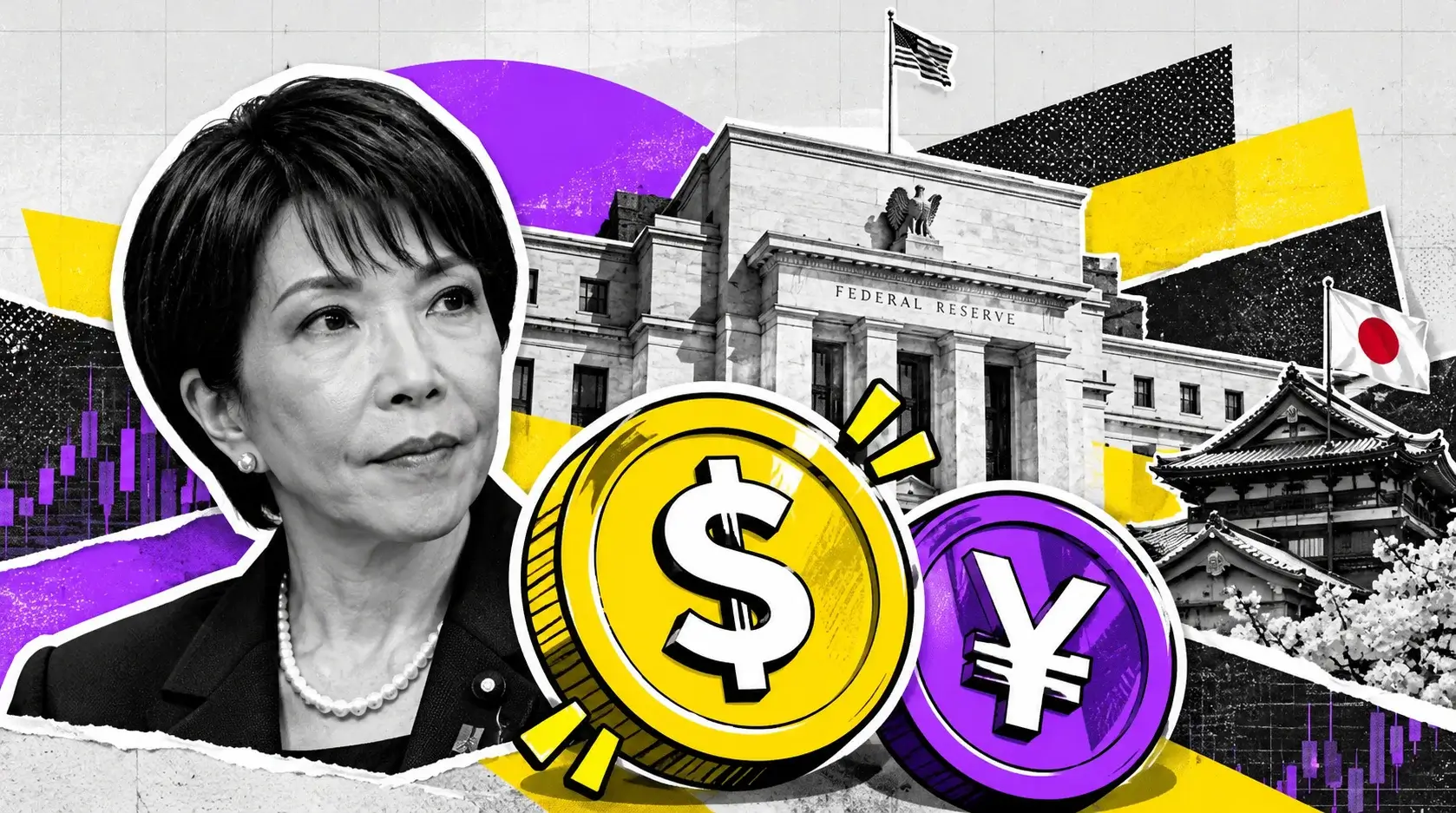
Prime Minister Sanae Takaichi's decision to call a snap lower house election has injected a domestic political catalyst that compounds the yen's structural weakness. Takaichi's party is expected to win a strong majority, giving her greater parliamentary control to implement the expansionary fiscal agenda that markets have been pricing with increasing concern. The election result itself is not in doubt — it is the policy implications that matter.
Takaichi's spending plans involve significant fiscal stimulus — infrastructure, defense, social programs — funded by additional government borrowing at a time when Japan's debt-to-GDP ratio is already the highest in the developed world. The Japanese government bond market has reacted to this fiscal expansion prospect with a selloff that has pushed yields higher through forced repricing of fiscal risk rather than through any expectation of BoJ tightening. This distinction is critical for USD/JPY analysis: when bond yields rise because of inflation expectations or central bank hawkishness, the currency typically strengthens (higher yields attract capital inflows). When bond yields rise because of fiscal concern (lenders demanding more compensation for credit risk), the currency weakens (capital flees the deteriorating fiscal position). Japan's JGB selloff is the latter variety — and it is pushing the yen lower even as yields technically increase.
Takaichi's comments have raised questions about whether Tokyo will intervene in currency markets to support the yen. The ambiguity itself is bearish. If the government were committed to defending the currency, it would signal that commitment clearly. The equivocation suggests that Takaichi views a weaker yen as acceptable — or even desirable — for her export-oriented economic strategy. Japan intervened at approximately 160 yen in 2024, spending hundreds of billions of yen in reserves to slow the depreciation. If Takaichi's government is less willing to intervene, the 160-yen level loses its significance as a policy-defended ceiling and becomes merely another resistance level on the chart.
Kevin Warsh Nominated as Fed Chair — Less Dovish Than Expected, and the Dollar Responded Immediately
President Trump's nomination of Kevin Warsh as the next Federal Reserve Chair adds a structural bullish factor for the dollar that will persist through the confirmation process and into his tenure. Warsh is perceived as less dovish than markets were anticipating — his views on monetary policy suggest a willingness to maintain higher rates for longer if inflation data warrants it. The dollar rebounded sharply from recent four-year lows following the nomination, and the DXY printed a small doji candlestick on the weekly chart that looks more like consolidation than indecision.
The DXY currently trades at 97.57, sitting below its 3-month level but above its 6-month level — a mixed technical picture that reflects the tug-of-war between dollar bears (who cite the long-term downtrend) and dollar bulls (who cite the hawkish shift in Fed expectations). For USD/JPY specifically, the Warsh nomination is unambiguously bullish: a less dovish Fed Chair means the interest rate differential favoring the dollar persists longer than pre-nomination pricing suggested. Incumbent Chair Jerome Powell's term expires in May, and the transition period creates a window where markets price Warsh's expected policy stance before he formally takes office — a window during which USD/JPY should grind higher.
The Senate confirmation process adds uncertainty, but Warsh's credentials (former Fed Governor, Goldman Sachs alumni, established relationships with both parties) suggest confirmation is probable rather than merely possible. The market reaction to the nomination — dollar strength, hawkish repricing of rate cut expectations — is the first-order effect. The second-order effect is a sustained reduction in the probability of aggressive easing, which keeps the dollar bid against low-yielding currencies like the yen.
Iran, Hormuz, and Why the Yen's Safe-Haven Status Breaks Down When Oil Prices Spike
Under textbook conditions, the Japanese yen strengthens during geopolitical crises. Capital flows into safe-haven assets — Treasuries, gold, Swiss francs, and yen — as risk appetite collapses. Saturday's U.S.-Israeli strikes on Iran, the killing of Supreme Leader Khamenei and multiple senior military figures, Iran's retaliatory missile strikes on Israel and U.S. bases in the Gulf, and the effective closure of the Strait of Hormuz should theoretically be generating a massive yen bid. Gold is trading near $5,400 (up 2.25% on IG weekend markets). Silver pushed above $93. The VIX jumped 6.60% to 19.86. S&P 500 futures are down 0.43%. Nasdaq futures are off 0.92%. Every other safe-haven indicator is flashing maximum risk aversion.
Yet USD/JPY is unlikely to collapse on Monday because the Iran crisis simultaneously creates a terms-of-trade shock that devastates Japan's economy. Japan imports virtually 100% of its crude oil and natural gas. The Strait of Hormuz carries approximately 20% of global crude and a similar share of LNG — including significant volumes destined for Japanese utilities and industrial consumers. Brent crude OTC trades over the weekend indicate $80 per barrel, up roughly 10% from Friday's $72.50 close. If Brent sustains $80 or pushes toward $100 (Capital Economics warns that a longer conflict with supply disruptions could send prices much higher, adding 0.6 to 0.7 percentage points to global inflation), Japan's energy import bill surges by tens of billions of dollars annually. That additional cost flows directly into the Japanese trade deficit, weakening the yen through basic balance-of-payments mechanics.
The precedent is 2022. When Russia invaded Ukraine and energy prices spiked, the yen did not strengthen — it collapsed. USD/JPY surged from 115 to 152 over seven months as Japan's energy import costs exploded. The yen's safe-haven status was completely overwhelmed by the terms-of-trade deterioration. The current situation is arguably worse because the Hormuz closure affects both oil and LNG simultaneously (Russia's invasion primarily disrupted European gas, not global LNG), and Japan's LNG dependency is even greater than its crude oil dependency. If the Hormuz blockade persists for more than a few days, the yen's safe-haven bid evaporates entirely and the pair moves toward 160 on energy import fears alone.
Iran's proxies — notably Hezbollah on Israel's northern border — have not yet entered the conflict. This is an important signal. Despite the confirmed killing of the Supreme Leader, the proxy network has not activated. If the proxies remain dormant, the war is contained between state actors, the probability of de-escalation increases, and the oil risk premium partially fades. If Hezbollah joins, the conflict expands into Lebanon, potentially Syria, and the geopolitical risk premium accelerates — which is paradoxically more bearish for the yen (via higher energy prices) than for the dollar.
Cross-Asset Context — Gold Near $5,400, Silver Above $93, Bitcoin in $61K–$72K Range, WTI at 6-Month Highs
The broader asset landscape heading into Monday provides context for USD/JPY positioning. Gold closed Friday near its highs and is trading at approximately $5,400 on weekend markets — still below the record high set weeks ago but rising with increasing conviction. The daily price action Friday was bullish: the close came right at the session high, a pattern that typically precedes continuation. A daily close above $5,418.55 would confirm the breakout and attract trend-following capital into long gold positions. Silver's move above $93 per ounce reinforces the precious metals bid — when both gold and silver rise together, the signal is more robust than gold alone.
WTI crude oil made a new 6-month high Friday and closed at nearly a 7-month high even before the Iran strikes materialized. The prediction market Polymarket had been showing approximately 30% odds of a weekend attack before the U.S. Ambassador's warning to Americans in Israel, and the crude market was already pricing rising conflict probability. Now that the attack has occurred, 70% of oil tankers are reportedly avoiding the Strait of Hormuz after Iranian navy radio warnings. Iran attacked one oil tanker in the strait on Sunday. Tanker crews heard explosions near Kharg Island, through which Iran exports 90% of its crude. Global oil supplies stand at approximately 107 million barrels daily, with over 10% transiting Hormuz. OPEC is expected to increase production — signs suggest an agreement with President Trump was already in place — but increased output is meaningless if the oil cannot physically reach the market through a closed strait.
Bitcoin has entered a textbook range consolidation between $61,229 and $71,762. The lower border of the range recently extended downward — a bearish signal. A breakdown below $61,229 would be dramatic and likely trigger a rapid fall toward $50,000. A breakout above $71,762 could send prices to $81,203. The range-bound behavior reflects the broader market uncertainty: crypto trades as a risk asset during geopolitical stress (selling off with equities) but occasionally behaves as a digital gold alternative (recovering when gold makes new highs). In the current environment, Bitcoin is stuck between these two narratives, and the USD/JPY implications are indirect — Bitcoin's direction will be determined by the same risk appetite dynamics driving yen crosses.
Read More
-
Yen Stalls at 160 Despite a 3% JGB and Tokyo Core CPI at 2.0% — Intervention Sits at 164, Friday's Payrolls Decide
02.09.2026 · TradingNEWS ArchiveEnergy
-
QQQ ETF ($706.22) Slides 7.4% Below Its High as the Market Reprices the AI Capex Bill — $686.57 Target if $700 Breaks
22.10.2026 · TradingNEWS ArchiveStocks
-
XRPI ($7.00) and XRPR ($10.74) Slide Toward 52-Week Lows as Spot XRP ETF Flows Stall at $708,510
22.10.2026 · TradingNEWS ArchiveCrypto
-
NG ($2.775) Decoupled From Europe’s €88 Gas Crisis as LNG Feedgas Hits 18.9 Bcf/d — $3.30 Upside on Cold Weather
22.10.2026 · TradingNEWS ArchiveCommodities
-
Dollar-Yen (157.35) Loses 157.65 as the Yen Rallies on Haven Demand — 155 Target if 156 Breaks
22.10.2026 · TradingNEWS ArchiveForex
Broader FX Landscape — EUR/USD Magnetized to 1.18, USD/CAD Rangebound 1.3550–1.3750, AUD/USD as the Outlier Bull
The euro continues to orbit the 1.18 level against the dollar — a magnetic center that has contained price action for weeks. The ECB is expected to hold rates flat while the Fed potentially cuts, creating a narrowing interest rate differential that modestly supports EUR/USD. However, the Hormuz crisis makes the eurozone an oil importer under stress: Europe already faces low gas storage (below 31% versus 40% a year ago, with Germany at 20.5% and France at 21%), and Qatar's 15% share of European LNG imports is directly threatened. German CPI came in sharply lower at +0.2% month-over-month against +0.5% expectations, which should translate to weaker Eurozone CPI on Tuesday — but that soft inflation print was pre-Iran. The oil and gas spike from Hormuz may override the disinflationary signal within weeks. Key EUR/USD support sits at 1.1650 where the 200-day moving average converges with a rising trendline.
USD/CAD has been locked in the same 1.3550–1.3750 range for five consecutive weeks. The 1.3550 level below acts as a significant floor, while 1.3750 above represents resistance. The interest rate differential between the U.S. and Canada is tightening, which explains the range-bound behavior: neither currency has a clear edge large enough to break the range. Short-term traders will continue to fade the boundaries. Longer-term positions require a breakout in either direction — and the Iran situation could provide the catalyst if Canadian crude oil (exported primarily to U.S. refineries) benefits from higher global prices while the Canadian dollar strengthens on commodity exposure.
The Australian dollar stands out as the most compelling currency story outside of USD/JPY. The AUD is one of only three major currencies whose central bank is on a path of rate hikes rather than cuts — and Australia's path is the strongest and most convincing. Australian CPI came in hotter than expected at 0.4% month-over-month versus 0.2% forecast, keeping the annualized rate elevated at 3.8%. The Reserve Bank of Australia raised rates and presented a hawkish stance, pushing AUD/USD higher. If the price establishes above $0.7134, it enters technically bullish territory with no overhead resistance — blue sky that could generate significant further gains. The AUD is one of the few currencies currently outperforming the dollar over recent weeks, trading near long-term highs.
The Swiss franc's position as the week's strongest currency reflects classic safe-haven demand. USD/CHF has been falling, with the 0.76 level acting as a floor. A break below 0.76 targets 0.75. The Swiss National Bank faces the same dilemma it confronted in 2011 and 2015: an appreciating currency that crushes Swiss exporters. Eventually, the SNB intervenes — but intervention typically starts in EUR/CHF (buying euros against francs) rather than in USD/CHF directly. The Mexican peso also traded weaker against the dollar, with USD/MXN rallying toward the 17.50 resistance level. The interest rate differential favors a long peso position (collecting swap), but fear-driven moves higher can be violent. A break above 18 would signal a trend change.
The Week Ahead — ISM Manufacturing Monday, Eurozone CPI Tuesday, NFP Friday, and Iran Dominating Everything
The economic calendar is loaded but the question is whether any data release can compete with the Hormuz headlines for market attention. ISM Manufacturing PMI on Monday provides the earliest read on U.S. business activity — but markets may look past it entirely given that Iran dominates the open. ISM Services on Wednesday carries more weight because the services sector accounts for roughly 70% of U.S. GDP, and any deterioration in services PMI would amplify the recession fears already embedded in the 10-year Treasury yield below 4%.
Eurozone CPI on Tuesday was supposed to be the week's inflation story. German CPI's soft 0.2% monthly print suggested European disinflation is accelerating. But the Hormuz-driven energy price spike may render Tuesday's backward-looking CPI data irrelevant — markets will already be pricing the future inflationary impulse from $80+ Brent crude and surging TTF natural gas. The ECB's March meeting calculus changes dramatically if energy prices remain elevated through the data collection period.
Friday's U.S. Non-Farm Payrolls report is the headline event if the Iran situation stabilizes by midweek. Average hourly earnings, the unemployment rate, and the payrolls number together provide the most comprehensive snapshot of the labor market — and therefore the most direct input into Fed rate expectations. January surprised with 130,000 jobs (more than double the 60,000 consensus), though prior months were revised lower. A strong report above 100,000 with unemployment at or below 4.3% reinforces U.S. economic exceptionalism, validates the hawkish shift to only two rate cuts in 2026, strengthens the dollar, and pushes USD/JPY toward 160. A weak print below 50,000 with rising unemployment opens the door to a third rate cut and temporarily relieves yen selling pressure — but the structural interest rate differential remains so wide that any USD/JPY pullback on weak NFP would be a buying opportunity rather than a trend reversal.
Fed speakers earlier in the week — including the Warsh confirmation proceedings if they begin — will shape expectations ahead of the payrolls report. Any commentary from Fed officials on whether the Iran oil shock changes the rate path would be immediately market-moving for USD/JPY.
India Trade Deal, Asia FX Steady, and the Regional Context for Yen Weakness
Asian currencies moved in tight ranges heading into the weekend as the dollar steadied after its sharp rebound. The Indian rupee remained upbeat following a U.S.-India trade deal that improved bilateral economic relations — the rupee strengthened from recent record lows to stabilize around the low-90 rupee levels against the dollar. A Reserve Bank of India meeting is scheduled for later in the week and could provide additional rupee direction.
The Korean won weakened 0.1% against the dollar, the Singapore dollar fell 0.2%, and the Taiwan dollar was flat. The Chinese yuan steadied near its lowest level since mid-2023 against the dollar — reflecting ongoing concerns about China's economic trajectory, the property sector downturn, and capital outflow pressures that have persisted despite periodic PBOC interventions.
The yen's weakness stands out within this Asian FX context. While most regional currencies moved less than 0.5% on the week, the yen's persistent depreciation against all G10 counterparts signals that the selling pressure is Japan-specific rather than driven by broad dollar strength. The combination of Takaichi's fiscal expansion, the BoJ's inability to raise rates meaningfully, the JGB rout, and Japan's acute energy import vulnerability to the Hormuz closure creates a yen-negative confluence that no other Asian currency faces to the same degree.
The Verdict — USD/JPY: Buy Dips Toward 156, Target 160, Stop Below 154
USD/JPY is a Buy on dips. The pair trades at 158 with the yen as the weakest major currency. The interest rate differential is widening, not narrowing: U.S. PPI at 0.5% versus 0.3% expected has repriced Fed easing expectations from three cuts to two. Kevin Warsh's nomination as Fed Chair adds a structural hawkish tilt that will persist through confirmation and into 2026. Takaichi's snap election and expansionary fiscal agenda ensure that Japanese government debt grows, JGB yields rise on fiscal concern (not monetary tightening), and the BoJ remains trapped at near-zero rates. The Iran crisis — which under normal conditions would support the yen as a safe haven — instead devastates Japan's terms of trade through higher energy import costs. Brent at $80 and potentially heading to $100 reproduces the 2022 dynamic where the yen collapsed from 115 to 152 on the same energy import shock.
The 158-yen resistance has contained every rally attempt, but each test increases the probability of a breakout. The 160-yen level is the 1990 swing high — the most important technical threshold in the modern history of this pair. A daily close above 160 opens a path to moves not seen in 36 years, with no meaningful resistance overhead. The structural setup (rate differential, fiscal divergence, energy vulnerability, political uncertainty) all point in the same direction: higher USD/JPY.
Short-term pullbacks toward 156 are buying opportunities. The interest rate differential generates positive carry (earning swap on long USD/JPY positions), which means that time works in favor of the long position even during periods of consolidation. If Monday's Iran-driven gap resolves bullish and the pair trades above 158 with conviction, the next move is 160. If 160 breaks on a daily close, the position becomes a trend trade with targets that the market has not seen since the bubble era.
The only scenario flipping bias to neutral: a confirmed U.S.-Iran ceasefire within 48 hours, a weak NFP below 50,000, and a surprise BoJ rate hike at the March meeting. Each condition is individually unlikely. Together, the probability is near zero. Until the interest rate differential narrows (requiring either aggressive Fed cuts or meaningful BoJ hikes), every dip in USD/JPY is a gift. Buy the pullbacks. Hold for 160. And if 160 breaks, hold for whatever comes next — because the chart says nobody alive today has traded this pair at the levels that lie above it.