USD/JPY Price Forecast: Yen Crashes to 159.48 on Hormuz Energy Squeeze — 160 Pivot Eyed, JP Morgan Targets 164
USD/JPY rallies to 159.65 as Japan's energy import bill widens; 80% of economists see BoJ hold in April, 160 breakout opens 162-164 | That's TradingNEWS
Key Points
- USD/JPY rallies to 159.48 on Hormuz energy crisis; Japan's import bill widens as Brent tops $101 per barrel.
- 80% of economists now expect BoJ April hold; rate differential favors dollar with JP Morgan targeting 164 year-end.
- 160 is the breakout line; clean break opens 162-164 zone, 158.50 floor must hold or 157.55 comes into play.
The Japanese yen is doing something almost paradoxical against the U.S. dollar this week — losing ground even as the broader DXY complex weakens against most G10 peers, a divergence that captures exactly how badly the Hormuz crisis has compromised Tokyo's macro position. USD/JPY is trading at 159.48 on the live FX board with the pair printing 159.37 in the late New York session after climbing to an intraday high of 159.64 on Tuesday and reaching the 159.65 zone where the next major technical pivot sits. The session showed a 0.37% advance for the dollar against the yen, and that gain came against a backdrop where the dollar was actively losing ground against sterling, the euro, and the Aussie — meaning the yen-specific weakness is genuinely about Japan-side fundamentals rather than dollar strength. The pair has rebounded three times since early April from the 158.50 zone, establishing that level as a structural support floor that buyers have been willing to defend repeatedly. Above current levels sits the 160 psychological pivot that has triggered Japanese government verbal interventions repeatedly through recent weeks, while the 161.95 and 165.00 levels stack as the deeper resistance zones that would come into play if the BoJ's reluctance to hike combined with sustained energy import pressure produces a genuine breakout. JP Morgan maintains a year-end target of 164 on the pair and explicitly cites higher energy prices amid Middle East tensions as the structural force pressuring the yen. UOB's Quek Ser Leang and Lee Sue Ann frame the immediate setup as a 157.55-160.50 range with limited upside above 160.50 toward 162.00, while Scotiabank's Shaun Osborne and Eric Theoret echo a 157.50-160.50 consolidation band with flat RSI signaling muted momentum heading into next week's BoJ policy meeting. The dispersion of bank views around the 160 pivot is itself instructive — the level matters enough that every major desk has explicit framing around what happens when it cracks or holds.
The Hormuz Energy Trap That's Crushing Japanese Macro Fundamentals
Japan's structural vulnerability to imported energy disruption is showing up in the USD/JPY tape with a precision that deserves explicit unpacking because the transmission mechanism runs deeper than most cross-asset analysts appreciate. Tokyo imports roughly 90% of its primary energy needs, with a substantial share of crude oil and LNG flowing through the Strait of Hormuz routing — meaning every day the chokepoint remains effectively closed to commercial shipping under the U.S. naval blockade compounds the trade deficit pressure on Japan's current account. The country has already pushed for a release from emergency oil reserves, and a second round is now likely to follow within the coming month as the import math forces emergency draws from strategic stockpiles. Japan's March trade data already showed the squeeze: a smaller balance dragged down meaningfully by elevated energy import costs that offset what would otherwise have been a healthier surplus from strong exports to China. The mechanical implication for the yen is straightforward and grim — when a nation is forced to buy dollars on the open FX market to pay for crude oil and LNG denominated in dollars, that buying pressure mechanically pushes the USD/JPY rate higher regardless of central bank rhetoric or technical positioning. Higher Brent at $101 and elevated LNG spot pricing across Asian delivery hubs both feed directly into Japan's import bill, and the cumulative effect compounds week after week as the standoff persists. JP Morgan's analysis frames the dynamic precisely: "rising energy prices are likely to increase import costs and widen the trade deficit, and concerns over these developments could trigger JPY selling." That's not theoretical — it's already happening in real time with the price action.
The Sanaenomics Architecture and Why Tokyo Wants USD/JPY Pinned Near 160
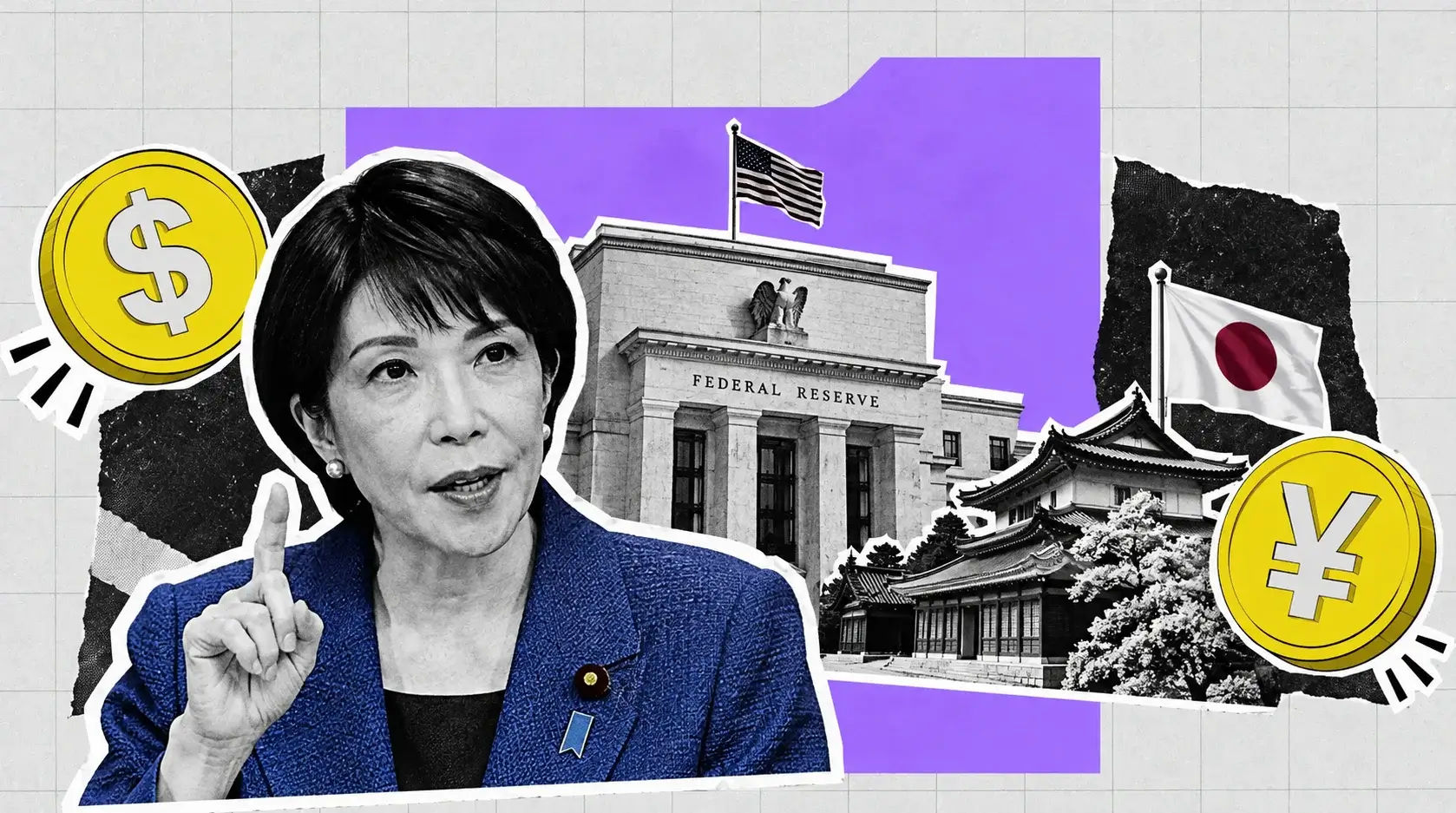
Prime Minister Sanae Takaichi's policy framework — increasingly referred to in Tokyo political circles as "Sanaenomics" rather than "Abenomics 2.0" because of its distinct investment-stimulation focus — depends on a specific FX equilibrium that the current crisis is testing. The administration is targeting the USD/JPY pair around 160 because that level makes Japanese asset investment attractive to foreign capital while preserving export competitiveness for Japanese manufacturers. Verbal interventions from Japanese officials intensify whenever the pair pushes meaningfully above 160 and ease whenever it pulls back into the 158-159 zone, which is the practical signal that Tokyo's preferred range hasn't shifted despite the political pressure from import-cost inflation. Takaichi's approval ratings remain remarkably elevated despite the Middle East tensions — FNN polling shows 70% support, ANN reports 62%, while Mainichi, Asahi, and Yomiuri surveys place her between 53% and 66%. That political capital matters because it gives the administration room to maintain its FX policy framework even as households absorb higher energy costs. The strategy works through a self-reinforcing logic: weak yen attracts foreign investment into Japan, that investment generates jobs and wage growth, the labor shortage compounds wage pressures upward, military spending increases break the long-standing taboo on defense expenditure expansion, and the cumulative effect produces the kind of nominal growth that allows public debt levels to decline even as tax revenues increase. The plan was working before the Iran war erupted in late February. Now Tokyo is fighting to maintain the framework against a genuine exogenous shock that's forcing energy import costs higher than the strategy was designed to accommodate.
The BoJ's Impossible Position — 80% of Economists Now Expect April Hold
The Bank of Japan has been backed into a corner that bond market positioning is already pricing aggressively. According to a Bloomberg survey of 51 economists, approximately 80% now expect the Governing Council to hold the overnight rate steady at the upcoming April policy meeting — a meaningful jump from the March survey when 32% leaned toward immediate tightening. The expectation has shifted toward June for the cycle's resumption, with 57% of economists now expecting that timing. The BoJ's reluctance reflects a specific policy dilemma: the central bank wants inflation driven by sustained wage pressure rather than by cost-push effects from energy imports, and the current price pressure is overwhelmingly the latter rather than the former. Hiking rates to combat cost-push inflation could destabilize the recovery, but holding rates allows inflation expectations to potentially de-anchor as energy costs feed through into broader consumer pricing. JP Morgan captures the dynamic precisely in its rate-differential framework: while the Federal Reserve and other major central banks have been pushed toward more hawkish posturing as energy prices feed inflation concerns, BoJ rate-hike expectations have not risen in parallel — meaning the interest rate differential continues to favor the dollar against the yen even as macro fundamentals shift elsewhere. The May 1 Fed meeting combined with the late-April BoJ decision creates a sequenced event window where the rate-differential picture either widens further (continued USD/JPY upside) or compresses (pullback toward the 158 support zone). Economists currently favor the former scenario more strongly than the latter.
Technical Architecture — 158.50 Floor, 159.65 Pivot, 160 Psychological Wall, 162-165 Beyond
The level structure on USD/JPY is unusually well-defined by both technical and policy considerations, and traders need precise mapping before committing capital either direction. Immediate support sits at 159.00 (intraday consolidation reference cited by UOB) followed by 158.75 (secondary intraday support), 158.50 (the structural floor that has held three rebounds since early April), 157.90-157.66 (the deeper support zone James Stanley has tracked through multiple webinar cycles), and 157.55 (the lower bound of the broader 1-3 week consolidation range identified by both UOB and Scotiabank). Below that floor structure, a clean breakdown would expose 156.95 and the deeper retracement targets toward 155-156. Above the current 159.48 print, the resistance architecture stacks at 159.60-159.65 (the immediate retest zone where Tuesday's high printed and where buyers will face the first real test), 159.45 (the level UOB highlights as a possible breakout trigger), 160.00 (the psychological wall that has triggered Tokyo verbal interventions repeatedly), 160.50 (the upper bound of the consolidation band per UOB and Scotiabank), and beyond that 161.95 and 165.00 as the deeper structural resistance levels that would come into play in a full breakout scenario. JP Morgan's 164 year-end target sits within the 162-165 zone that James Stanley has identified as the more meaningful intervention defense lines for Japanese authorities. Long positions established on rebounds from the 158.50 support can be increased on a clean break above 159.65, with the recognition that any push above 160 will likely trigger renewed verbal intervention from Tokyo. The 160 line is genuinely the level that defines whether this is consolidation or breakout, and the next two weeks will produce that resolution.
Verbal Intervention Mechanics and Why They Have Diminishing Returns
Tokyo's verbal intervention strategy has been the primary tool used to keep USD/JPY from running through the 160 pivot, but the marginal effectiveness of each successive warning is visibly declining. Finance Ministry officials have repeatedly issued statements expressing concern about excessive yen weakness whenever the pair approaches 160, and the rhetoric typically produces a 30-50 pip pullback that lasts hours rather than days before the underlying fundamental pressure reasserts itself. The diminishing returns happen because verbal intervention works only if speculators believe physical intervention is genuinely imminent, and right now the calculation favors the speculators — the macro fundamentals (energy import deficit, BoJ reluctance to hike, U.S. rate differential) all argue for higher USD/JPY, which means actual physical intervention through Ministry of Finance dollar selling would be fighting the structural tide. Coordinated intervention with the U.S. Treasury would be more effective but politically complex given the broader U.S. policy posture, and unilateral Japanese intervention historically loses momentum within days when fundamentals haven't shifted. The clock is working against Tokyo on this dimension. Each week the Hormuz situation persists, each week the energy import bill compounds, each week the BoJ holds rates flat, the structural case for USD/JPY continuation higher strengthens. Japanese authorities can buy time with rhetoric, but they cannot reverse the underlying macro forces without either coordinated international intervention or a genuine resolution of the Iran crisis that releases energy import pressure.
The Self-Fulfilling Cycle Takaichi Is Trying to Break
Japan's underlying economic challenge that Takaichi's policy framework is designed to address operates through a self-reinforcing dynamic that the FX market hasn't fully internalized. With expectations of little to no GDP growth ingrained across the private sector for over a decade, Japanese households and corporations have systematically favored savings over investment, which mechanically reduces capital formation and slows the productive capacity expansion that would otherwise drive growth — creating exactly the slow-growth outcome that justified the precautionary savings behavior in the first place. The cycle perpetuates itself across multiple decades, and breaking it requires either coordinated policy intervention to incentivize investment or a genuine shift in growth expectations that prompts the private sector to redeploy savings into productive assets. Takaichi's framework attempts both simultaneously through tax incentives, regulatory reform, and explicit verbal commitment to higher trend growth — but the success depends critically on whether the macro environment cooperates. The current crisis is producing exactly the wrong kind of inflation (cost-push from energy imports rather than demand-pull from wage pressure), exactly the wrong kind of trade balance shift (deficit widening from import costs rather than surplus expansion from competitive exports), and exactly the wrong kind of FX dynamic (forced dollar buying for import settlement rather than capital inflow attraction). If Takaichi cannot stabilize the energy situation through diplomatic pressure on Iran resolution or strategic reserve releases, the underlying Sanaenomics framework gets compromised before it has time to demonstrate results.
Cross-Yen Pairs Setup — EUR/JPY and GBP/JPY Dynamics
The yen weakness narrative extends across the cross-pair complex with implications that traders positioning the USD/JPY trade should incorporate. The dynamic that James Stanley has been highlighting in successive webinars applies symmetrically: when the yen weakens, it weakens against most major counterparts simultaneously, producing tradeable setups in EUR/JPY and GBP/JPY that often move with greater magnitude than the USD/JPY pair itself because the cross calculations amplify the yen-specific weakness. EUR/JPY has been a regular appearance in price-action setups precisely because the euro side carries its own complexities (Hormuz exposure for European energy buyers, ECB policy uncertainty) that compound with the yen-side weakness to produce volatile setups. GBP/JPY similarly benefits from sterling's relative resilience this week (UK CPI at 3.3%, BoE July hike odds near 48%) combined with yen weakness — the pair has been holding above 215.00 with momentum fading, suggesting consolidation before the next directional move. The cleanest expression of pure yen weakness right now is probably USD/JPY itself because it captures both the dollar-side support from rate differentials and the yen-side weakness from energy imports without introducing the third-currency complications that affect the crosses. For traders building diversified yen-short books, the combination of long USD/JPY, long EUR/JPY, and long GBP/JPY produces meaningful exposure to the structural weakness without overconcentrating in any single dollar position.
Read More
-
Yen Stalls at 160 Despite a 3% JGB and Tokyo Core CPI at 2.0% — Intervention Sits at 164, Friday's Payrolls Decide
02.09.2026 · TradingNEWS ArchiveEnergy
-
QQQ ETF ($739) Fades From an Early Tech Rally as a 77.9 ISM Prices Index Meets Micron's $61.5B Guide — $760 Record Test Ahead
01.10.2026 · TradingNEWS ArchiveStocks
-
XRPR and XRPI Follow XRP's $1.49 Test as Spot Funds Hold 1.16B XRP and a 1 Billion Token Escrow Release Lands — $1.70 in Play
01.10.2026 · TradingNEWS ArchiveCrypto
-
November NG Slips Below $3 as Decade-High Storage Meets Capped LNG Exports — $2.75 in Sight
01.10.2026 · TradingNEWS ArchiveCommodities
-
Dollar-Yen at 158 Presses Toward 160 as a 363 bp Carry Gap Meets Katayama-Bessent Intervention Risk — 159 in Sight
01.10.2026 · TradingNEWS ArchiveForex
Friday CPI and the BoJ Sequencing That Defines the Next Two Weeks
The near-term event calendar carries specific catalysts that will likely resolve the current consolidation in either direction. Friday's release of Japan's March CPI represents the last major data point before the upcoming BoJ policy decision, and the print will heavily influence positioning into that meeting. A hot CPI print would intensify the policy dilemma — strengthen the case for hawkish action while leaving the BoJ politically constrained to act on cost-push inflation that monetary policy cannot effectively address. A cool print would reinforce the dovish hold expectations and likely produce additional USD/JPY upside as positioning unwinds further yen support. The BoJ meeting itself carries asymmetric risk — markets are positioned for a hold, so any surprise hawkish action would produce sharp yen strengthening (potentially 200-300 pips of immediate USD/JPY downside), while confirmation of the dovish hold simply validates current positioning without producing fresh impulse moves. The Federal Reserve meeting on April 29-30 follows directly, with consensus pricing a near-certain hold but watching the accompanying language for any subtle dovish shifts that would compress the rate differential and pressure USD/JPY lower. Across this two-week event window, the realistic range is likely 157.55-160.50 as both UOB and Scotiabank have framed, with the directional resolution depending on whether the Hormuz situation produces additional energy price escalation or shows signs of meaningful diplomatic progress.
The Iran Resolution Scenario That Could Reverse Everything
The bullish USD/JPY thesis carries one specific tail risk that traders need to size against rather than dismiss: a sudden Iran diplomatic breakthrough that releases energy import pressure on Japan and produces rapid yen recovery. The current setup has Japan as one of the most sensitive currencies globally to Iran resolution because the energy-import transmission mechanism is so direct and the yen has carried so much of the cumulative pressure already. A clean ceasefire combined with Hormuz reopening that takes Brent back to $80-85 territory would simultaneously reduce Japan's import bill substantially, narrow the trade deficit, ease BoJ inflation concerns, and remove the primary structural argument for continued USD/JPY upside. Under that scenario, the pair could retrace toward 156-157 within weeks rather than months, and positioning that ignored the asymmetric risk would face material drawdowns. The probability of clean resolution remains low given Iran's refusal to attend talks and the continued naval blockade, but the magnitude of the move under that scenario is large enough to justify defined-risk position management rather than naked long exposure. JP Morgan's bearish yen view explicitly references the energy channel as the primary driver, which means any meaningful improvement on that dimension would force a reassessment of the year-end 164 target.
The USD/JPY Trade Verdict Across Time Horizons
The actionable framework breaks down with clarity across time horizons matched to specific risk parameters. Near-term across the next five trading sessions: the recommendation is buy on dips toward 158.50-159.00 with stops below 158.00, targeting 159.65 as the first profit-taking zone and 160.00 as the second. The 159.65 retest carries asymmetric risk-reward at current levels — upside to 160 represents only modest gains while downside to the 158.50 support represents meaningful drawdown if the breakout fails. Medium-term across one to four weeks: buy with conviction on confirmed break above 160 with volume, targeting 161.95 and ultimately 162-164 as JP Morgan's year-end framework projects. The combination of energy import pressure compounding weekly, BoJ holding rates with 80% economist consensus, rate differentials favoring the dollar, Sanaenomics framework explicitly accommodating yen weakness near 160, and verbal intervention showing diminishing marginal returns collectively describes an environment where the structural setup favors continued USD/JPY upside despite the political resistance from Tokyo. Long-term across three to six months: moderately bullish with the JP Morgan 164 target as the operative reference. The structural factors driving the current setup (Japanese energy import dependency, BoJ policy constraints, U.S. rate maintenance) all point toward continued upward pressure on the pair through the remainder of 2026 absent a clean Iran resolution. Risks to respect across all horizons: a sudden Iran ceasefire and Hormuz reopening producing rapid yen recovery, coordinated U.S.-Japan FX intervention if the pair pushes meaningfully above 162-165, surprise BoJ hawkish pivot at the June meeting if April data shows accelerating inflation, and broader risk-off events triggering safe-haven yen demand that overrides fundamental weakness. Position sizing discipline that works: scale into long exposure on weakness rather than chasing strength at the highs, treat 158.00 as the hard stop where the medium-term thesis fails, respect the 160 psychological line as a level where intervention risk spikes, and prepare for sharp 200-300 pip moves around the BoJ and Fed event windows that can produce stop-runs in either direction. For traders building diversified currency exposure, USD/JPY at 159.48 represents one of the cleanest expressions of the current macro environment — Japan's structural energy vulnerability combined with Tokyo's policy framework that effectively accepts yen weakness as the cost of growth stimulation creates an ongoing setup where each successive week of Iran-driven pressure compounds the directional bias. The next two weeks through the Friday CPI release, the BoJ decision, and the Fed meeting will likely produce the resolution that defines whether this is a 162-164 trade by summer or a corrective pullback toward 156-157, and the 160 line is the specific pivot that will signal which scenario is materializing in real time.