Wall Street Melts Up — SPX 7,542 (+1.5%), Nasdaq +2.4%, Dow 51,817 — as Crude Cracks Under $80 on U.S.-Iran Truce, SpaceX Rips 8%
Equities surged across the board as a Hormuz reopening ripped 4 months of war, Brent down 4.8% to $83.16 and the VIX leaking below 17.68 | That's TradingNEWS
Key Points
- S&P 500 +1.49% to ~7,542, Nasdaq +2.38% to ~26,500, Dow +1.20% to ~51,817, Russell 2000 +0.79%.
- WTI crude crashed 5.2% under $80.46 and Brent fell 4.8% to $83.16 on the U.S.-Iran Hormuz deal.
- SpaceX ripped 8.1% to $173.95; Fox sank 15% on its $22B Roku bid as Wednesday's Fed decision looms.
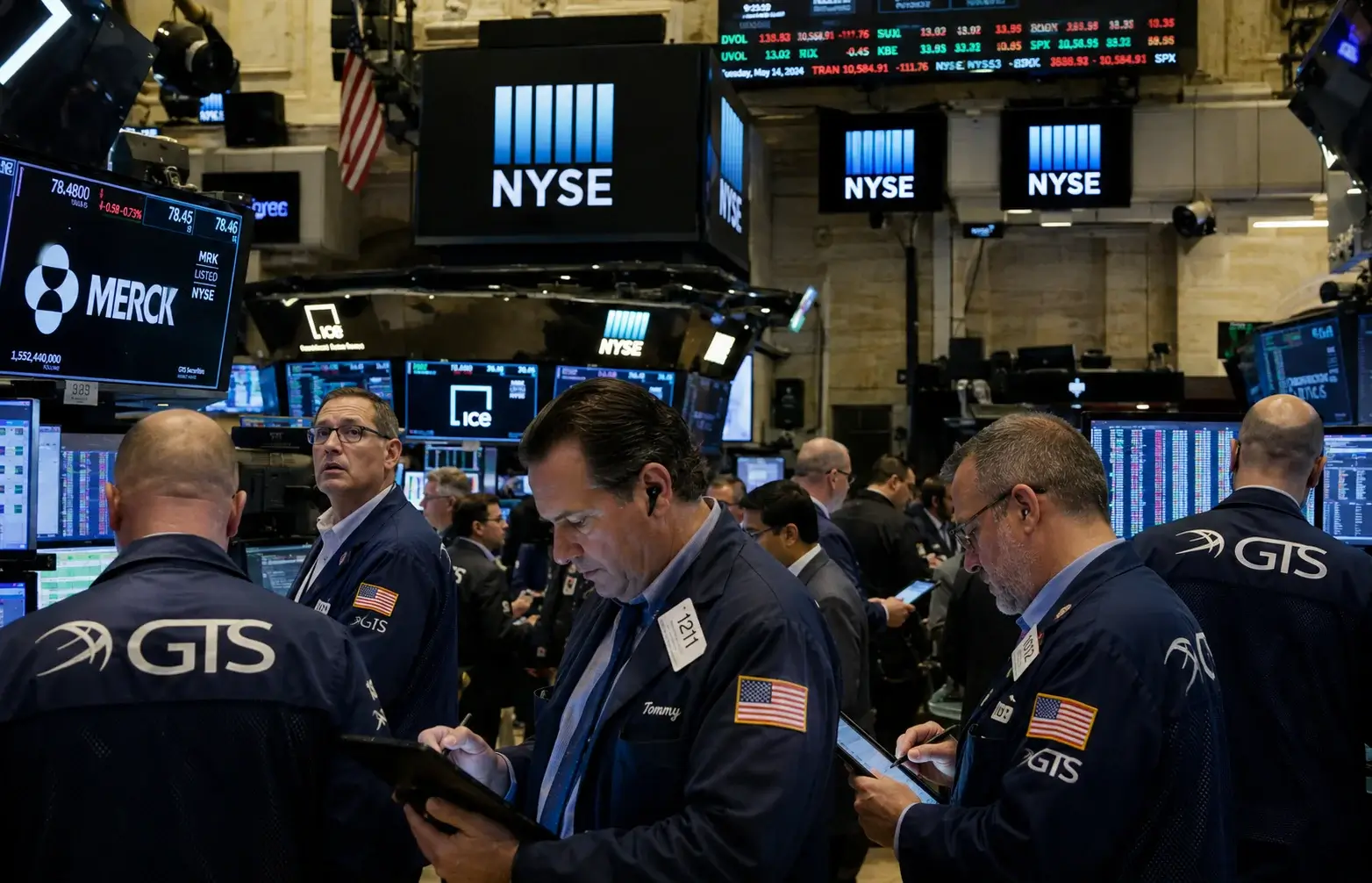
Wall Street ripped higher out of the gate Monday after President Trump declared the U.S.-Iran war over and ordered the Strait of Hormuz reopened, and the move is exactly what you'd draw up for a peace-dividend session: equities surging, crude collapsing, and the whole risk complex catching a violent bid. The S&P 500 jumped 1.49% to trade near 7,542, building on Friday's 7,431.46 close. The Nasdaq Composite did the heavy lifting, up 2.38% toward 26,500 after settling Friday at 25,888.84. The Dow Jones Industrial Average added 1.20% to roughly 51,817 off its 51,202.26 Friday print, and the Russell 2000 lagged the pack at 0.79%, pushing near 2,967 from 2,943.99.
The thesis driving the tape is clean and it's loud: four months of war premium got ripped out of oil in a single Sunday social-media post, and every asset that had been pricing geopolitical risk repriced at once. Trump said the deal with Iran is complete, that Hormuz reopens without a toll, and that the U.S. naval blockade of Iranian ports ends immediately. "Ships of the World, start your engines," he wrote. The desk took him at his word. The question that hangs over the whole session — and the reason this isn't a clean melt-up — is that the rally runs face-first into a Federal Reserve meeting that starts tomorrow, with 4.2% inflation sitting in the way of the easy-money story the bulls want to tell.
Crude Got Cut in Half From the War Highs
The center of gravity Monday is the oil pit. West Texas Intermediate snapped below $80 for the first time since March, last down 5.2% near $80.46. Brent shed roughly 4.8% to trade around $83.16, dropping under $83.40 at the lows. That's a stunning round-trip when you stack it against where this commodity was just weeks ago. Crude briefly touched $117 a barrel at the height of the Hormuz standoff, when Trump's deadline for Iran to reopen the strait passed without resolution and the price of insurance against a closed waterway went vertical. Before the war kicked off in late February, oil traded near $70.
The mechanics of the collapse are straightforward. The International Energy Agency had pegged the daily shortfall from the blocked strait at roughly 14 million barrels — a fifth of seaborne crude flows choked off, fuel shortages spreading across importing nations, and a war premium baked into every barrel on the planet. Reopen the chokepoint toll-free, pull the blockade, and that premium has nothing left to stand on. The move tracked overseas first: India's Sensex tore 1,695 points higher, up 2.30% to 75,527.95, on relief that import bills and pump prices finally get to fall. The selling in crude is the buying in everything else, and that inverse relationship is the entire personality of this session.
Energy equities are the obvious casualty. When the barrel rolls over this hard, the producers and the oilfield names give back the gains they booked through the conflict, and the sector flipped from the year's geopolitical winner to Monday's drag almost on the open. The flip side is the demand-side relief — anything that burns fuel as an input cost gets a tailwind, and that's a piece of why the breadth under the surface skews more constructive than the headline laggards suggest.
The Open: A Gap-Up Built Overnight
This session was written while America slept. Asia detonated first. Japan's Nikkei 225 soared 5.5% in morning trading, South Korea's Kospi jumped as much as 5.7%, Taiwan's Taiex climbed 2.7%, and Australia's ASX 200 tacked on about 1.5%. Europe followed the same script. By the time U.S. futures came alive, contracts on the S&P 500 were up 1.3% by 7:45 a.m. in New York, and the gap-up was locked in before a single share changed hands on the floor.
The cash open confirmed the futures rather than fading them, which is the tell that matters. Plenty of gap-up mornings get sold the moment the bell rings as fast money fades the overnight enthusiasm. Not this one. Buyers pressed the open and the indexes extended through the first hour, with the Nasdaq leading and the broad tape holding green. The premarket movers — space names higher, media names lower, energy softening — carried straight into regular hours intact. That follow-through is the difference between a gap that fills and a gap that becomes the day's floor, and through the early session the floor held.
Tech Out Front, Breadth Playing Catch-Up
The leadership tells you what kind of rally this is. The Nasdaq Composite's 2.38% rip more than doubled the Dow's 1.20% and tripled the Russell 2000's 0.79%, and that spread is the fingerprint of a risk-on move powered by the highest-beta corners of the market rather than a broad, even-handed advance. The Nasdaq-100 carried the same character into Friday's 29,635.95 close and pressed higher again Monday as the megacap and semiconductor complex caught the peace bid.
That narrow-leadership setup cuts both ways. On one hand, the appetite for duration and risk — the willingness to pay up for growth the second the geopolitical cloud lifts — signals real conviction, not a defensive grind. On the other, when the smallest 2,000 names manage less than 1% on a day the headline reads like a melt-up, it says the move is being carried by a concentrated set of winners rather than the whole field. The chip group is the swing factor here. Semiconductors got smoked at the start of the month — the Nasdaq's 4.18% drubbing on June 4 was a chip-led rout tied to Broadcom's failure to lift its AI outlook — so any session where the group reclaims ground does outsized work for the index. Monday it reclaimed ground.
SpaceX Keeps Ripping After Its Record Debut
The single loudest stock on the tape isn't a forty-year-old blue chip. SpaceX, fresh off the largest IPO on record, climbed 8.1% to $173.95 in early trading, extending a debut that already rewrote the rulebook. The company opened on the Nasdaq at $150 against a $135 offering price, surged more than 20% within moments of its first print, and closed its opening session 19% higher at $161.11. The listing raised $75 billion — capital earmarked for data-center and compute expansion after Musk folded his xAI startup into the company in February — and pushed the market value above $2 trillion.
Musk poured fuel on it over the weekend, claiming the company could clear $1 trillion in revenue by 2030 and that he'd be surprised if it didn't top that figure in 2031. The number is the kind of thing that gets mocked until it doesn't, and the tape is treating the debut as a gravitational event for the entire space and satellite complex. The Starlink-and-rockets story has dragged adjacent names higher for weeks, and Monday's continuation puts SPCX at the front of the momentum cohort that money is using to express maximum risk appetite. Nothing about an 8% follow-through day on a stock this size is normal. It's the clearest read on how aggressively the crowd wants to lean into risk with the war headline cleared.
Fox–Roku Blows a Hole in the Media Tape
The day's ugliest single-name move belongs to Fox. Shares of the media giant cratered 15% after it confirmed a $22 billion deal to acquire Roku, a price tag the Street is reading as a steep overpay for a streaming platform whose own stock barely moved on the news. Roku edged down about 1%, erasing premarket gains and giving back ground after a 20% rip on Friday's report that a deal was coming. When the acquirer drops 15% and the target slips, the message from the tape is unambiguous: the buyer is paying up and the holders of the buyer are not having it.
The $22 billion bet is a swing at the streaming pivot — Fox planting a flag in connected-TV distribution rather than ceding the living room — but the market is pricing execution risk and dilution rather than synergy. Deals this size in a sector this contested rarely get a clean reception, and Fox's drop dragged on the broader communication-services group even as the index ripped around it. It's a useful reminder that under a 1.5% S&P print there are still names getting taken to the woodshed, and the breadth math has to absorb a megacap M&A blowup on a day everything else is green.
The Fed Is the Wall This Rally Has to Climb
Here's the catch that keeps Monday from being a victory lap. The Federal Open Market Committee convenes June 16-17, with the rate decision landing Wednesday, and it's the first meeting under new Chair Kevin Warsh, who took the chair on May 15 and inherited a badly split committee. The money is pricing near-certainty on a hold — fed funds futures put the probability of no change around 98% to 99%, leaving the target range pinned at 3.50% to 3.75%. So far, so calm.
The problem is what sits underneath that hold. May CPI ran 4.2% year over year, the hottest print in three years, with the headline up 0.5% on the month and core at 2.9% annually. That's not a backdrop that lets a central bank ease, and it's hot enough that a sliver of the conversation has shifted from when cuts arrive to whether a hike is back on the table this year. The May jobs report didn't help the doves either — payrolls added 172,000 against an 80,000 consensus, more than double the call, which fed the higher-for-longer narrative and shoved the 10-year yield above 4.5% when it printed.
Now layer Monday's oil crash on top. A barrel falling from $117 toward $80 is a disinflationary hammer — energy was the single biggest driver of that 4.2% May reading, and crude collapsing this fast pulls directly at the inflation math the Fed is staring at. The rally is effectively front-running a world where the war premium that juiced prices reverses and gives Warsh room he didn't have a week ago. That's the bull case in one sentence. The bear case is that Wednesday's statement and presser come before any of that shows up in the data, and a hawkish hold from a new chair eager to establish credibility could slam the door on the peace trade in an afternoon.
Yields, the Dollar, and a Fear Gauge Leaking Lower
The cross-currents in rates are the most interesting tension on the board. The 10-year yield had been camped above 4.5% — it spiked past 4.53% after the May payrolls shock — as the market braced for a Fed with no reason to cut. Monday's oil collapse pulls the other way, handing the bond market a disinflationary impulse that argues for lower yields even as the hot labor and CPI prints argue for higher. Those two forces are wrestling into a Wednesday decision that will settle the argument one way or the other.
Volatility is voting for calm. The VIX closed Friday at 17.68, down better than 9% on the session, and the risk-on melt-up Monday pressed it lower still, draining the hedging demand that had kept the gauge elevated through the war. A fear gauge bleeding into the mid-to-high teens on a day equities rip and oil craters is the market telling you it believes the peace headline and is unwinding protection. The dollar softened on the risk-on rotation as haven demand faded, the same impulse pulling money out of crude and into equities. The whole macro picture is a coordinated unwind of the war trade — sell the safety, buy the risk, fade the premium — and it's running clean until the Fed steps in front of it.
The Sector Tape: Energy Down, Almost Everything Else Up
Drill into the sectors and the session's logic snaps into focus. Energy is the laggard, full stop — when crude gets cut this hard, the producers and services names can't fight the barrel, and the group that led on the way up through the conflict gave back the most on the way down. That's the price of the peace dividend, and it's a feature of the move rather than a bug.
Everything that benefits from cheaper fuel and lower geopolitical risk caught the bid. Technology and communication services led on the megacap and semiconductor recovery, with the chip names doing the index-level heavy lifting after their early-June beating. The consumer and transport-adjacent corners that eat fuel as a cost line got a tailwind from the crude collapse. Financials extended Friday's strength — Goldman Sachs had ripped 2.57%, JPMorgan 2.25%, on the prior session, and the rate-sensitive group likes a world where war risk drains out of the curve. The breadth picture is better than the Russell's 0.79% suggests once you strip out the energy drag and the Fox blowup; under those two specific weights, participation skews green.
Breadth, Positioning, and the Juneteenth Wrinkle
This is a holiday-shortened week, and that matters for how the tape behaves. U.S. markets close Friday for Juneteenth, which compresses the trading calendar around a Fed decision and turns Thursday into a de facto pre-holiday session where positioning gets squared early. Light, holiday-thinned volume tends to exaggerate moves in both directions, so whatever Wednesday's Fed verdict delivers gets amplified into a four-day week with a long weekend on the other side.
Read More
-
Yen Stalls at 160 Despite a 3% JGB and Tokyo Core CPI at 2.0% — Intervention Sits at 164, Friday's Payrolls Decide
02.09.2026 · TradingNEWS ArchiveEnergy
-
CHAT Fund Holds $96.37 as Korean Memory and Chip Exposure Drive a 109.73% Year — Break of $98.02 Opens $105.20
18.09.2026 · TradingNEWS ArchiveStocks
-
First-Generation XRPR and XRPI Ride XRP's Rebound to $1.386 as Spot Funds Post First Outflow — Break of $1.40 Opens $1.54
18.09.2026 · TradingNEWS ArchiveCrypto
-
NG Holds $2.9255 as Storage Surplus Narrows From 5.5% to 3.7% in 3 Weeks — Break of $3.00 Opens $3.15
18.09.2026 · TradingNEWS ArchiveCommodities
-
Dollar Surges to 157.90 as BoJ's Divided Hike Fails to Lift the Yen — Break of 158.87 Opens 159
18.09.2026 · TradingNEWS ArchiveForex
The positioning setup into Monday was defensive. The early-June chip rout and the war escalation had pushed money toward hedges and away from the highest-beta names, which is precisely why a peace headline produces a melt-up — there's a short base and an underweight in risk that has to get covered and rebuilt in a hurry. The violence of the Nasdaq's 2.38% move and SpaceX's 8% follow-through is the signature of a crowd that was leaning the wrong way scrambling to get long. The risk in that setup is symmetry: a tape that gaps this hard on relief can give it back just as fast if the Fed disappoints, and a thin pre-holiday session is the worst place to be caught offside.
The Technical Picture: Where the S&P Has to Hold
The chart frames the stakes. The S&P 500 had rebounded off its 50-day moving average near 7,230 in recent sessions, with the first Fibonacci retracement of the March-through-June rally sitting below at roughly 7,118 as the line in the sand on any pullback. Monday's surge toward 7,542 puts daylight between the cash index and those support shelves, and the move clears the recent congestion that had capped the tape since the early-June drawdown.
Momentum had reset in a way that left room to run. The Relative Strength Index had cooled from above 70 — overbought — back toward 50 over the month, working off the froth without breaking the uptrend, which is the kind of base that lets an index gap and extend rather than immediately exhaust. The structure now is constructive as long as 7,230 holds on the next retest; lose it and the 7,118 Fibonacci shelf becomes the test that defines whether this was a genuine breakout or a war-relief spike that gets retraced. The Nasdaq's reclaim of ground above its early-June wreckage carries the same conditional optimism — the recovery is real, but it's leaning on a Fed outcome that's still 48 hours away.
Session Verdict: Bullish, With the Fed Holding the Detonator
The tape Monday is bullish and it isn't close. A war ended, oil fell off a cliff, every major index ripped, volatility drained, and the highest-beta corners of the market led the charge — that's a risk-on session with conviction behind it, not a hollow gap that faded by lunch. The S&P near 7,542, the Nasdaq pressing 26,500, the Dow north of 51,800, crude under $80, and a fear gauge leaking toward the mid-teens all point the same direction.
The honest read keeps one hand on the brake. This is a melt-up front-running a disinflationary oil shock into a Fed meeting where 4.2% inflation hasn't yet caught up to the new reality, led by a narrow cohort, in a holiday-thinned week with the decision landing Wednesday. The bulls are betting that cheaper crude hands Warsh the cover to sound less hawkish; the bears are betting a new chair plants a flag on credibility and refuses to validate the rally before the data confirms it. Both can't be right, and the answer comes in 48 hours. For now the verdict is bullish — peace dividend, oil crash, risk on — but it's a bullish session sitting on top of a binary event, and the Fed is the one holding the detonator.