Stock Market Today - Wall Street Rebounds as AMD–Meta AI Pact Lifts Dow Back Toward 49,200 and S&P 500 Near 6,875
Dow, S&P 500 and Nasdaq climb after Monday’s rout as AMD spikes on the $100B-plus Meta GPU deal, Novo Nordisk sinks on GLP-1 price cuts, Bitcoin hovers near $63K and gold eases to $5,140 with Trump’s new 10% tariff in force | That's TradingNEWS
Stock Market Rebound Under AI Shock And Tariff Overhang
Major Indices Recover After Monday’s Hit
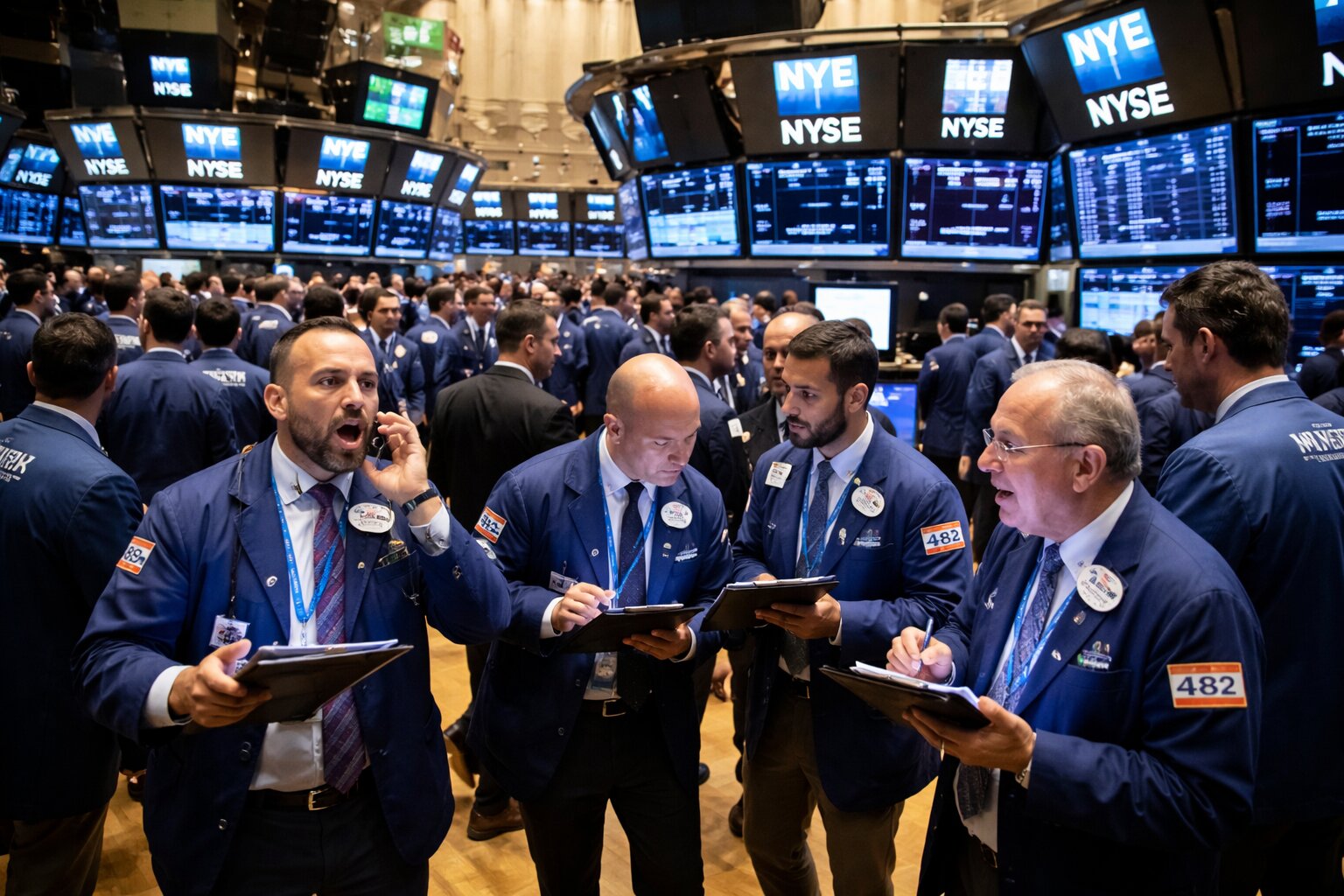
U.S. equities opened firmly higher as risk appetite returned a day after a tariff-driven, AI-fear selloff. The Dow Jones Industrial Average climbed about 0.8% to roughly 49,200, adding more than 380 points. The S&P 500 traded near 6,875, up around 0.6%, while the Nasdaq Composite advanced roughly 0.9% toward 22,800. The Russell 2000 gained about 1%, extending the recent trend where asset-heavy, domestically focused names outperform capital-light software. The VIX eased to around 20.2, down roughly 0.8, signaling a partial release of Monday’s stress, while the 10-year Treasury yield hovered close to 4.05%, showing no bond panic despite the new tariff layer.
Tariffs At 10%: Smaller Hit Than Feared, But Not Harmless
The new global 10% U.S. import duty came into force for an initial 150-day window under Temporary Section 122 rules. The market had braced for 15% after President Donald Trump flagged the higher rate over the weekend, so the actual implementation counts as a marginal positive surprise. A customs notice confirmed the 10% surcharge applies to “imported articles of every country” unless specifically exempt. The administration is already drafting a formal order that could push the rate up to 15% and preparing sector-specific “national security” probes that may add targeted levies later. European equities traded slightly lower as the Stoxx 600 slipped about 0.1%, with Brussels and Tokyo arguing the flat 10% duty leaves them worse off than previous bilateral deals.
Macro Mood: Confidence Ticks Up, But Tail Risk Rises
The macro tape stayed mixed. The Conference Board’s consumer confidence index rose from 89.0 in January to 91.2 in February, beating expectations around 88, but remains far below the triple-digit readings that marked the late-2024 risk-on phase. Confidence improved mainly among people under 35, while older cohorts weakened. At the same time, Apollo chief economist Torsten Slok lifted his estimate of “tail risk” for the economy from 10% to 30%, citing elevated asset prices, debt loads and the potential for a sudden sentiment break. The U.S. Dollar Index traded near 97.9, up around 0.3%, supported by fading expectations of aggressive Fed cuts and by the notion that a broad 10% tariff, if it cools goods prices, could create more room for rate reductions later.
Fed Voices: AI Productivity, Unemployment And Rates
Central-bank commentary focused squarely on AI. Fed Governor Lisa Cook warned that an AI-driven productivity boom could paradoxically lead to higher measured unemployment without signaling real economic slack. If AI boosts output while displacing workers, standard demand-side policy may not fix the job losses without reigniting inflation. Cook argued that education and labor-market policy, not rate cuts, would need to carry the adjustment. Chicago Fed President Austan Goolsbee reinforced the hawkish tone, arguing that the Fed should not be cutting further while inflation remains above the 2% target and households still list prices as a top concern. Other officials, including Michael Barr and Philip Jefferson, have already said that sustained productivity gains from AI could temporarily push the neutral rate higher, limiting how far policy can ease.
AI Infrastructure: AMD Turns Into The Day’s Reference Trade
The most aggressive repricing took place in AI hardware. Advanced Micro Devices, Inc. (AMD) jumped between 7% and 11% after sealing a multi-year partnership with Meta Platforms, Inc. (META). The deal covers up to 6 gigawatts of AMD Instinct GPUs, plus AI-optimized CPUs, to power Meta’s next-generation AI data centers. The first 1-gigawatt tranche is slated to ship in the second half of 2026, anchored by MI450 GPUs inside AMD’s Helios rack systems. To secure that capacity, Meta received a performance-based warrant for up to 160 million AMD shares. With AMD’s share count just above 1.6 billion, Meta could end up near a 10% economic stake if all performance milestones are met. The warrant vests in stages tied to shipment milestones, effectively aligning Meta’s long-term capex cycle with AMD’s own market value.
GPU Landscape: Nvidia Still Dominant But No Longer Alone
Meta’s deal comes only a week after it reiterated using “millions” of NVIDIA Corporation (NVDA) GPUs across its footprint and signed a separate long-term partnership. That message is clear: Meta will not abandon NVDA; instead, it will diversify. Nvidia shares traded roughly flat to modestly lower, showing a mild rotation rather than capitulation. For the market, the key implication is competitive normalization. The AI compute story shifts from a near-monopoly narrative toward a duopoly or tri-opoly where NVDA, AMD and potentially custom silicon from other hyperscalers battle for share. That caps valuation upside for Nvidia at the margin and strengthens AMD’s position as the default second source for data-center AI workloads.
AI Fear Trade: From Software Carnage To Selective Stabilisation
Monday’s AI liquidation slammed capital-light software names with heavy human or legacy exposure. International Business Machines Corporation (IBM), Datadog, Inc. (DDOG), CrowdStrike Holdings, Inc. (CRWD) and AppLovin Corporation (APP) dropped around 13%, 11%, 10% and 9% respectively, as investors attempted to price in the risk that new AI tools hollow out revenue lines. Tuesday brought a more selective reset. IBM rebounded roughly 4.5%, leading the Dow, while DDOG and CRWD managed modest gains. APP slid another 2.5%, signaling that the market is not ready to forgive names where AI could cannibalise core advertising and optimisation spend.
Software Benchmark: CRM, NOW And IGV Try To Find A Floor
The broader software complex, tracked by the iShares Expanded Tech-Software Sector ETF (IGV), was up about 1%, but that only chips away at a drawdown of more than 30% from the 52-week high. High-quality franchises with strong installed bases, such as Salesforce, Inc. (CRM) and ServiceNow, Inc. (NOW), attracted bargain hunters. CRM gained roughly 5%, NOW around 3%, as investors differentiated between platforms that can embed AI as a feature versus those that risk being displaced. Mizuho’s desk highlighted that every new Anthropic headline is being treated as incremental competition for software, even when that’s unfair, making traders reluctant to “get cute” ahead of the next AI product reveal. Many are simply stepping aside rather than trying to trade each launch.
Salesforce: Options Price A Violent Post-Earnings Swing
The options market is braced for a violent move in CRM once earnings hit Wednesday after the close. Implied volatility points to a swing of up to 9% in either direction by the end of the week. From Monday’s close, that translates into upside back above roughly $194 or downside toward $162, which would be a new three-year low. Consensus looks for adjusted EPS of $3.05 on revenue of $11.18 billion, a 12% year-over-year increase. Despite the stock losing about one-third of its value year-to-date, analysts remain heavily skewed to the positive side: 15 of 20 tracked ratings are Buys, with an average price target near $313, implying more than 75% upside from Monday’s close. A miss or cautious guide would therefore collide with still-optimistic expectations and could easily justify the downside scenario the options market is flagging.
Home Depot: Solid Execution In A Frozen Housing Turnover World
The Home Depot, Inc. (HD) printed a respectable quarter. Q4 revenue fell about 4% to $38.2 billion, slightly below the nearly $38.3 billion Street forecast, but adjusted EPS landed at $2.72, crushing the $2.54 consensus. Same-store sales rose 0.4% against expectations for a 0.4% decline, driven by higher ticket sizes even as transaction counts slipped. For the full year, revenue reached $164.68 billion and EPS $14.69, both slightly ahead of estimates. Same-store sales grew 0.3% versus expectations near 0.2%. Management reiterated guidance from its December investor day, forecasting total sales growth of 2.5%–4.5% and flat to 4% EPS growth in the new fiscal year. The stock jumped about 3% to around $389, leaving it up roughly 10% year-to-date. CFO Richard McPhail noted that housing turnover has been “frozen” for three years but that Home Depot is still gaining share as underlying demand in big-ticket projects slowly normalises from the 2023 shock.
Hims & Hers, Whirlpool, FedEx: Divergent Post-Earnings Paths
Hims & Hers Health, Inc. (HIMS) reported Q4 EPS of $0.08, beating forecasts around $0.05, although down from $0.11 a year earlier. Revenue came in at $617.8 million, roughly in line with expectations. Shares fell 5%–7% as the market focused on softer near-term guidance and the regulatory overhang around compounded GLP-1 products, even though management guided 2026 revenue to $2.7–$2.9 billion, slightly above the $2.74 billion consensus mid-point.
Household-goods name Whirlpool Corporation (WHR) tumbled roughly 8%–9% after a report that it will issue about $800 million in new shares to pay down debt. The dilution and message about balance-sheet constraints hit sentiment hard.
FedEx Corporation (FDX) edged about 0.5% higher after filing suit against the U.S. government over the tariff structure, signalling that large corporates will challenge the trade framework in court rather than absorb a 10% blanket surcharge without resistance.
Read More
-
Yen Stalls at 160 Despite a 3% JGB and Tokyo Core CPI at 2.0% — Intervention Sits at 164, Friday's Payrolls Decide
02.09.2026 · TradingNEWS ArchiveEnergy
-
QQQ ETF ($739) Fades From an Early Tech Rally as a 77.9 ISM Prices Index Meets Micron's $61.5B Guide — $760 Record Test Ahead
01.10.2026 · TradingNEWS ArchiveStocks
-
XRPR and XRPI Follow XRP's $1.49 Test as Spot Funds Hold 1.16B XRP and a 1 Billion Token Escrow Release Lands — $1.70 in Play
01.10.2026 · TradingNEWS ArchiveCrypto
-
November NG Slips Below $3 as Decade-High Storage Meets Capped LNG Exports — $2.75 in Sight
01.10.2026 · TradingNEWS ArchiveCommodities
-
Dollar-Yen at 158 Presses Toward 160 as a 363 bp Carry Gap Meets Katayama-Bessent Intervention Risk — 159 in Sight
01.10.2026 · TradingNEWS ArchiveForex
Novo Nordisk And GLP-1: From Hyper-Growth To Margin Compression
The heaviest pressure in healthcare remained on Novo Nordisk A/S (NVO). U.S.-listed shares dropped about 3.5% in early trading after a 16% plunge Monday, leaving the stock down roughly 56% over the past 12 months and at a near five-year low. The trigger was new data showing that obesity therapy CagriSema delivered about 23% weight loss over 84 weeks, versus around 25.5% for Eli Lilly and Company (LLY)’s Zepbound. The drug works, but the absence of a clear superiority narrative forces the market to reprice growth and margin expectations.
Before the bell, Novo announced that from Jan. 1, 2027, list prices for Wegovy 2.4-mg, Ozempic injections across multiple doses and Rybelsus 7-mg and 14-mg tablets will be cut to $675 per month. That implies roughly 50% cuts to Wegovy and about 35% reductions for Ozempic relative to current list prices near $1,000. The company framed the move as a way to ease access barriers for patients whose out-of-pocket costs are directly tied to list price. Novo stressed that direct-to-consumer “self-pay” prices will not change, but the margin structure for reimbursed business clearly tightens. LLY slipped about 1.5%, but remains up roughly 20% over the past year, underscoring how much more vulnerable Novo’s multiple was to any disappointment.
Bitcoin, Gold, Oil And The Dollar: Risk Assets Still On The Defensive
Digital assets remained under pressure. Bitcoin (BTC-USD) traded near $63,000–$63,800, after touching lows around $62,850 and falling from overnight highs close to $65,000. BTC is down more than 19% this month and on track for its worst monthly performance since June 2022, when the collapse of TerraUSD, Three Arrows Capital and BlockFi detonated the prior cycle. It is also heading for a fifth straight monthly decline, the longest losing streak since 2018. The move came alongside broad risk-off flows after Trump’s tariff escalation and renewed AI disruption fears. Despite the “digital gold” branding, flows still treat Bitcoin as a high-beta risk asset, not a primary crisis hedge.
By contrast, classic commodities showed a mixed profile. Gold futures fell about 1.7% to roughly $5,140 an ounce, while silver eased about 0.7% to near $85.95. The pullback follows recent all-time highs and reflects some profit-taking as the dollar firmed. West Texas Intermediate (WTI) crude traded around $65.9–$66.8 a barrel, up roughly 0.7% intraday, while Brent sat near $71.2, both helped by renewed focus on U.S.–Iran nuclear tensions and the risk of supply disruptions. The stronger Dollar Index near 97.9 capped the upside but did not knock oil off its rebound trajectory.
AI, Credit And Assets: Dimon, Goldman And Market Structure
Macro positioning debates concentrated on AI and asset-price froth. Jamie Dimon warned that markets increasingly resemble 2005–2007, with rising asset prices, high leverage and a sense that nothing can go wrong. He flagged that “a couple of people” are doing “dumb things” again, and that investors are becoming too comfortable with rich valuations and high volumes.
Goldman Sachs strategists highlighted the outperformance of companies with heavy physical asset bases over those reliant on human or digital capital. Their “HALO” basket—“heavy assets, low obsolescence”—focused on sectors like utilities, basic resources and energy, and has outpaced a capital-light basket by roughly 35% since early 2025. European names such as ASML Holding, Safran, LVMH, Air Liquide and Airbus sit in the asset-intensive group, while L’Oréal, Adyen, DSV and Siemens Healthineers anchor the more vulnerable capital-light cohort. The shift fits with the move into asset-heavy, AI-resistant stories and with the resilience of indices like the Dow and Stoxx 600 compared with high-multiple software.
Waymo, Anthropic And Second-Order AI Plays
AI’s second-order winners and private valuations also stayed in focus. Waymo, owned by Alphabet Inc. (GOOG), announced an expansion of driverless robotaxi service into Dallas, Houston, San Antonio and Orlando, bringing operations to 10 markets and targeting 1 million rides per week by year-end. Shares of GOOG were modestly lower on the day but the strategy reinforces the idea that AI-enabled physical services can scale beyond a few tech hubs.
On the private side, Anthropic opened a secondary sale process allowing current and former employees to cash out at a valuation near $350 billion, after a recent fundraising put the company around $380 billion post-money. The firm lined up roughly $5–6 billion of demand for those shares. That gap between public market AI anxiety and sky-high private valuations underlines how critical actual revenue migration will be over the next 12–24 months.
Financials, Private Credit And Blue Owl
The AI and rate backdrop also hit alternative credit. Blue Owl Capital Inc. (OWL) slipped about 2% after Deutsche Bank downgraded the stock from Buy to Hold and cut its price target from $15 to $10, implying modest downside from current levels near $10.3. OWL has dropped about 52% over the last year and 30% year-to-date. The downgrade cited slowing fee-related earnings and worries that private credit portfolios loaded with software-linked loans may face stress exactly as regulators and retail investors push deeper into the asset class.
Market Stance: Positioning And Verdicts
The tape shows a market that remains nervous about AI disruption and tariffs, but unwilling to abandon equities while growth holds and the Fed stays patient. The Dow, S&P 500 and Nasdaq are in a cautious Bullish Hold zone: pullbacks driven by AI panic and tariff headlines are opportunities to scale in selectively, not reasons to abandon risk wholesale.
AMD is a clear Buy. The 6-gigawatt META deal, potential 10% equity stake and H2-2026 shipment ramp justify a premium multiple as long as execution hits the first 1-gigawatt milestone. Short-term spikes can overshoot, but on any normal dip AMD remains one of the cleanest liquid expressions of the non-Nvidia AI infrastructure trade.
High-quality software such as CRM and NOW, plus the broader IGV basket, sits in Speculative Hold territory ahead of earnings and AI product cycles. Valuations have corrected, but new AI entrants such as Anthropic keep pressure high. Upside will depend on management proving that AI is an accelerant to revenue, not a substitute.
Healthcare GLP-1 names have shifted from momentum to stock-picker terrain. NVO moves to High-Risk Hold after the CagriSema and price-cut shock. A 50% Wegovy and 35% Ozempic list-price reduction from 2027 compresses margins and blurs the edge versus LLY. The story still has runway but no longer deserves a “can’t-lose” growth premium.
In macro hedges, gold is a Core Hold after the run toward $5,000+ and the latest 1.7% pullback. Tariffs, high debt and AI-driven uncertainty still support a structural bid. Bitcoin remains a High-Beta Hold/Bearish short term. A 19% February slide and a five-month losing streak signal that it trades as pure risk, not a safe haven, when tariffs and AI fears collide.
Overall, the market is pivoting away from pure software and intangible plays toward tangible assets, AI infrastructure and companies with pricing power. The rebound is real, but volatility around AI headlines and tariff policy ensures the next leg higher will be noisy, not smooth.