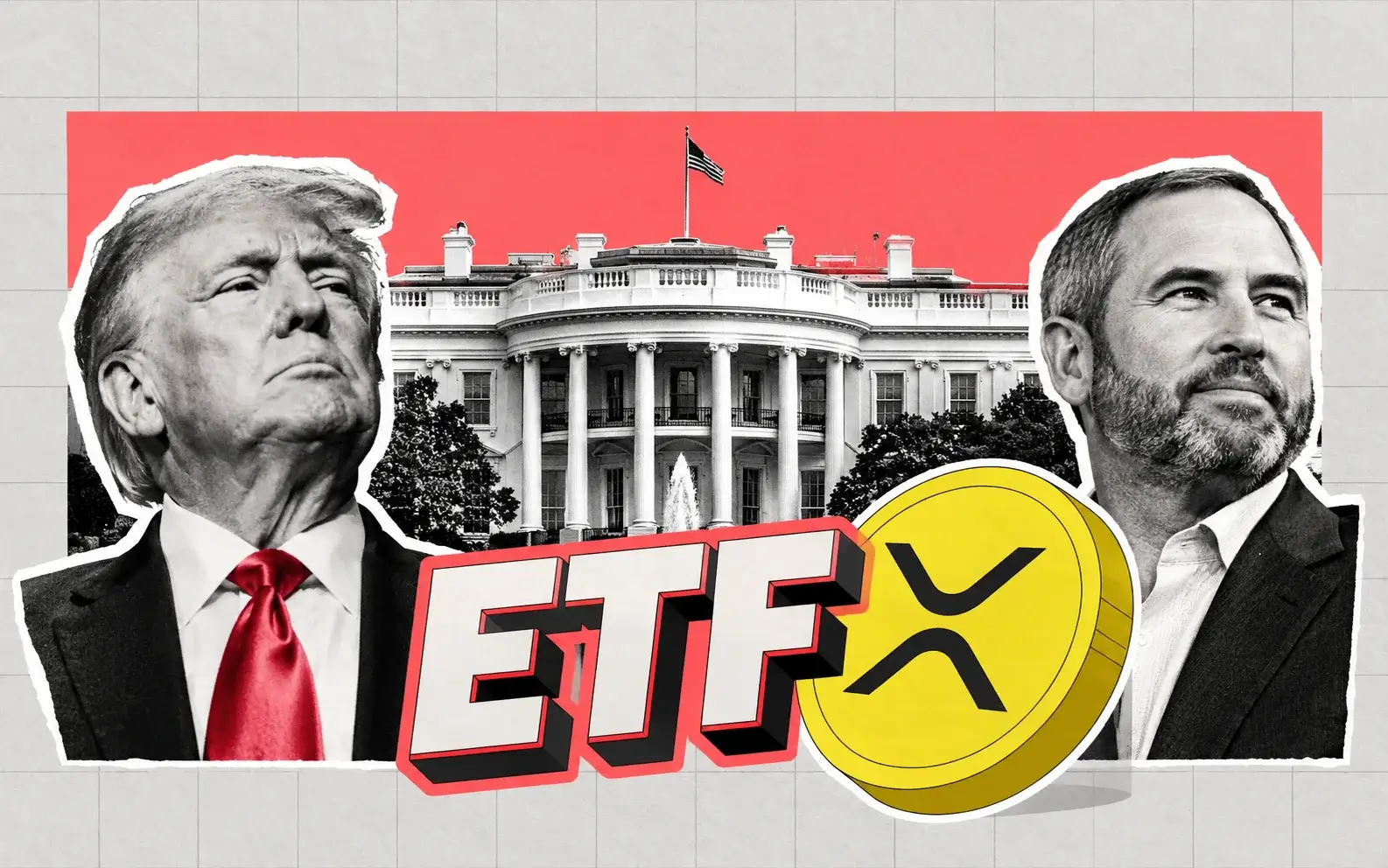
XRP ETFs Keep Buying While Price Won't Budge — XRPI and XRPR Pinned at $1.30 as $1.4B in Inflows Meets a 1.16B-XRP Sell Wall
he spot XRP ETF complex set its strongest inflow month of 2026 in May without a single outflow day | That's TradingNEWS
Key Points
- XRPI near $7.45 and XRPR near $10.55 track spot to $1.30 as the 7-fund complex holds ~$1.4B with 840M+ XRP locked.
- May set 2026's strongest XRP ETF inflow month with no outflow day, yet a 1.16B-XRP sell wall near $1.45 caps price.
- The divergence is the setup: persistent inflows plus a June CLARITY Act vote against crowded shorts load a squeeze.
There is one fact about the spot XRP ETF complex that matters more than any price print, and it's a contradiction: nearly $1.4 billion has flowed into these funds since launch, May was the strongest inflow month of 2026 with not a single outflow day, and yet XRP and its ETF wrappers have barely moved. XRPI is changing hands near $7.45 and XRPR near $10.55, both tracking a spot XRP price pinned at $1.30, well below where the funds launched in late 2025 and trapped in a months-long consolidation. That divergence — robust, accelerating institutional demand colliding with a stubbornly depressed underlying — is one of the most instructive setups in the entire crypto-ETF landscape, and it's the heart of this forecast. When persistent buying fails to move price, two things are usually happening at once: a large supply overhang is absorbing every dollar of demand, and a coiled spring is building for when that supply clears. The XRP ETF complex is sitting on exactly that tension, and with a regulatory catalyst on the June calendar, the divergence is the asymmetric opportunity. The funds keep buying while the price refuses to budge, and understanding why is the whole game.
Where the funds trade right now
The ETF prices are a clean mirror of the depressed spot token. XRPI is trading around $7.45, near the lower end of its $6.50 to $23.53 annual range — roughly 15% above its floor and about 68% below its 52-week ceiling, a configuration that captures the magnitude of XRP's drawdown from $3.65 to $1.30 in mirror image. REX-Osprey's XRPR sits near $10.55 with a most recent NAV around $10.76, while Bitwise's spot XRP fund trades in the mid-teens and Franklin Templeton's XRPZ rounds out the access points. All of them are down with spot on the day as the broad crypto complex takes a risk-off hit — the CoinDesk 20 index fell better than 2%, Bitcoin slid under $73,000 on a record ETF outflow streak, and XRP retreated to $1.30 in sympathy. The ETF complex moves tick-for-tick with the underlying token, so the funds carry the same weakness, the same support tests, and the same catalyst exposure as spot XRP. The prices are depressed, the range is wide, and the funds are sitting in the lower third of their post-launch bands, exactly where the divergence between flows and price is most stark.
The complex: seven funds, $1.4B, 840M+ XRP locked
The structure of the XRP ETF market has matured fast since launch. Seven U.S. spot XRP ETFs now operate, anchored by REX-Osprey's XRPR and the XRPI wrapper, alongside offerings from Bitwise, Canary Capital, Franklin Templeton, Grayscale, and 21Shares. Collectively they manage roughly $1.2 billion to $1.4 billion in assets, with cumulative net inflows since the November 2025 launch reaching approximately $1.39 billion and locking up more than 840 million XRP tokens — supply pulled out of circulation and into custody. That locked supply is the structural bull case in miniature: every token held by an ETF is a token that can't be sold on the open market, gradually tightening the float. The funds are accessible through any standard brokerage — Fidelity, Schwab, Vanguard, Robinhood — which broadens the buyer base well beyond crypto-native exchanges and brings traditional wealth-management capital into XRP for the first time. The complex has grown into a genuine institutional on-ramp in roughly six months, and the 840 million tokens locked away are a slow-burn supply sink that strengthens the longer-term setup even as the near-term price stays pinned.
May's record inflows: not a single outflow day
The demand side of the divergence is striking and worth dwelling on, because it's the opposite of what's happening in Bitcoin. While spot Bitcoin ETFs just logged a record ten-day, $2.97 billion outflow streak, the XRP ETF complex did the reverse — May became the strongest monthly inflow period of 2026, surpassing April's $81.59 million, and remarkably the funds did not record a single outflow day during the entire month. That's a display of persistent, one-directional institutional and retail demand at a time when capital was fleeing Bitcoin and Ethereum. Franklin Templeton's XRPZ has been the primary inflow magnet recently, with daily inflows jumping from $730,400 to $1.48 million on the back of CLARITY Act progress, as Franklin's distribution network through traditional asset-management channels made the wrapper the institutional access point of choice. XRPI and XRPR are absorbing flow proportionally but at smaller magnitudes than the Franklin vehicle. The contrast with the Bitcoin exodus is the key relative-value signal: capital is rotating toward XRP specifically, accumulating into weakness without a single down day, which tells you the institutional conviction here is building, not breaking.
Why $1.4 billion hasn't moved the price: the sell wall
Here's the answer to the central puzzle. Nearly $1.4 billion in cumulative inflows has failed to lift XRP because a massive supply overhang is absorbing every dollar of demand — a 1.16 billion XRP break-even sell wall sitting near $1.45 that has capped the price all year. That wall represents a large cohort of holders who bought near that level and are selling into any rally back toward their break-even, creating a ceiling that the ETF inflows haven't been able to punch through. The mechanism is simple supply-and-demand: institutional buying through the funds provides steady demand, but it's been matched almost exactly by the selling pressure from that 1.16 billion-token band, so price grinds sideways near $1.30 to $1.45 rather than breaking out. This is actually the constructive part of the setup. A sell wall is a finite supply — once those tokens are absorbed, the overhang clears, and the same persistent ETF demand that couldn't move price through the wall suddenly meets thin air above it. The divergence between heavy inflows and flat price isn't a sign the demand is failing; it's a sign the demand is steadily eating through a supply ceiling that, once gone, removes the cap entirely.
The CLARITY Act is the catalyst that clears the path
The single biggest near-term catalyst for the XRP ETF complex is the CLARITY Act, and its timing is the reason the funds are coiled rather than dead. The U.S. crypto regulatory framework has drawn coordinated backing from the SEC, Senate Republicans, and Ripple, with a Senate vote pending in June and the mid-month window — roughly the 15th through the 18th — flagged as the likely period for the legislation to advance. The CLARITY Act matters more for XRP than almost any other asset because the token spent years under a legal cloud, and a formal framework removes the last structural overhang that kept conservative institutions cautious. The Franklin Templeton inflow surge on CLARITY Act progress is the proof that institutional capital is already positioning for it — daily inflows doubling on regulatory headlines. A catalyst with a calendar date, landing into a complex that's accumulating without a single outflow day and an underlying with crowded short positioning, is the kind of asymmetric setup that can clear the sell wall in a hurry. If the Act advances and the 1.16 billion-token overhang gets absorbed in a wave of post-regulatory demand, the coil releases. The CLARITY Act is the event that turns the divergence into a breakout.
The on-chain backdrop is improving
Beneath the flat price, the network fundamentals are quietly strengthening, which reinforces the bull case for the funds. XRP Ledger activity has climbed to its highest level since March, RLUSD stablecoin supply has surpassed $1.65 billion — a nearly 3% increase from late April — and the exchange flow data is constructive: the Binance withdrawal-to-deposit metric shows withdrawals at 51.5% versus deposits at 48.4%, meaning more XRP is leaving exchanges than arriving. That outflow from exchanges historically reduces near-term sell pressure, because tokens moved to self-custody or staking aren't sitting ready to dump. The on-chain story does not match the price action, and that mismatch is precisely the divergence that creates the asymmetric setup if a catalyst delivers. Rising ledger usage, growing stablecoin supply on the network, and tokens leaving exchanges all point to genuine adoption and accumulation happening underneath a price that's frozen by the sell wall. The fundamentals are improving in lockstep with the ETF inflows, and both are being masked by the supply overhang — which is exactly the condition that precedes a sharp move once the overhang clears.
The bear case: Goldman's exit and the macro tax
The bullish setup has real counterweights, and the most significant is institutional positioning that cuts the other way. The single largest datapoint working against the thesis is Goldman Sachs's complete liquidation of its XRP ETF holdings in the first quarter — the bank unwound a position that had reached $154 million by the end of 2025, exited its entire Solana ETF book in the same window, and rotated the proceeds into Circle, Galaxy Digital, and Coinbase equity positions. A major institution fully exiting is a genuine negative signal, evidence that not all smart money shares the accumulation thesis. Layered on top is the macro tax hitting the entire complex: the Iran-driven risk-off, oil ripping toward $90, a firming dollar, reaccelerating inflation, and the broad crypto weakness that has Bitcoin bleeding a record ETF streak and the whole asset class sitting out Wall Street's AI rally. The Crypto Fear and Greed Index has compressed to around 28, in Fear territory but not yet at the capitulation extremes that mark bottoms. The bear case is that the sell wall holds, the macro stays hostile, the CLARITY Act slips, and the funds keep bleeding alongside spot. Goldman's exit is the warning that the divergence could resolve down, not up.
Read More
-
Yen Stalls at 160 Despite a 3% JGB and Tokyo Core CPI at 2.0% — Intervention Sits at 164, Friday's Payrolls Decide
02.09.2026 · TradingNEWS ArchiveEnergy
-
GLD ETF Sheds Value With Bullion as North American Funds Stay $7.7B in the Red
10.09.2026 · TradingNEWS ArchiveStocks
-
XRP ETF Flows: 7 Funds Split $1.682B With the Complex at Just 1.68% of Market Cap
10.09.2026 · TradingNEWS ArchiveCrypto
-
NG Breaks $2.90 With Production at 113 Bcf/d and LNG Feedgas Capped at 18.3 Bcf/d
10.09.2026 · TradingNEWS ArchiveCommodities
-
USD/JPY Holds Below the 157.23 Average as 2 Central Banks Tighten in 48 Hours
10.09.2026 · TradingNEWS ArchiveForex
The map for the funds is anchored to the spot token's levels. The critical spot support is $1.30, with the broader $1.30 to $1.50 demand zone that's held all year — for the ETFs, that translates to XRPI defending its $7.58 prior-close support near the $7.45 area and XRPR holding above $10.50. The decisive resistance is the $1.45 spot level where the 1.16 billion-XRP break-even wall sits; clearing it on volume is what unlocks the next leg, and a break through there would carry XRPI toward the $8.10 to $8.30 zone and XRPR toward $11.50-plus. One trading desk has flagged a $10.50 price target for XRPR as the coil resolves on the CLARITY Act catalyst. On the downside, a spot break below $1.30 that confirms the bearish structure would drag XRPI toward its annual floor near $6.50 and XRPR toward the $10 handle. The ETF prices are pure leverage to the spot move through the sell wall — pinned below $1.45, they grind; through $1.45, they break out. The range to trade is defined by the wall above and the $1.30 floor below, and the June catalyst is the most likely trigger to force the resolution.
Forecast and verdict
The verdict is cautiously bullish with a clear catalyst-driven asymmetry, and the divergence at the core of this complex is what makes it compelling. The XRP ETF funds — XRPI near $7.45, XRPR near $10.55 — are pinned by a spot token stuck at $1.30, but the setup underneath is the most constructive among the crypto-ETF complexes: a record May inflow month with not a single outflow day, $1.4 billion in cumulative demand, 840 million-plus tokens locked away, improving on-chain activity, tokens leaving exchanges, and a CLARITY Act vote on the June calendar — all stacked against a finite 1.16 billion-token sell wall that the persistent buying is steadily absorbing. The base case for June is continued coiling that defends the $1.30 spot floor and the funds' lower supports into the mid-month CLARITY Act window, with the potential for a sharp breakout if the Act advances and the demand finally punches through the $1.45 wall, carrying XRPR toward the $10.50-plus target. The bullish flip requires spot to hold $1.30, the sell wall to clear, and the regulatory catalyst to land — and the steady ETF accumulation is the force eating through the overhang. What invalidates the bull case is a spot break below $1.30 that drags the funds toward their annual floors, most likely if Goldman's exit proves prescient, the CLARITY Act slips, and the macro risk-off intensifies. What invalidates the bear case is exactly what the flow data is setting up: persistent inflows absorbing the last of the sell wall into a regulatory catalyst that releases the coil. The funds keep buying while the price won't move — and history says that when accumulation this persistent meets a finite supply ceiling and a hard catalyst, the resolution tends to be violent and to the upside. Respect the $1.30 floor, watch the $1.45 wall, and circle mid-June.