XRP ETFs Locked Away 994.7M Tokens and Still Destroyed $516M of Capital
The average cost basis is $1.478 against XRP at $1.15, and three funds hold 82% of assets | That's TradingNEWS
Key Points
- XRPR jumped 12.44% to $9.81 as XRP ripped 14.71% to $1.15
- Seven XRP ETFs hold $994 million in assets against $1.51 billion of cumulative inflows
- Monthly flows collapsed 79% from $131.94 million in May to $27.29 million in July
The seven-fund US spot XRP exchange-traded fund complex finally got the session it has been waiting nine months for, and it still leaves the category underwater by every measure that matters.
XRP ripped 14.71% to $1.15 and ran toward $1.20 for a two-month high on Thursday. REX-Osprey's XRPR responded with a 12.44% gain to $9.81. Volatility Shares' XRPI last confirmed at $5.87 against XRP at $0.9972, which puts the arithmetic near $6.75 at the current spot level.
Now the numbers underneath. As of August 17, the seven funds held combined assets of $994 million while custodying 994,700,000 XRP tokens. Those two figures produce a mark of essentially $0.999 per token, confirming the complex is valued at prevailing spot.
Cumulative net inflows since the November 2025 launch have reached roughly $1.51 billion.
Investors have put $1.51 billion into these products and the products hold $994 million. The gap is $516 million of destroyed capital — 34% of everything allocated.
The average cost basis across the complex sits at $1.478 per token. At $1.15, XRP needs to rise 28.5% simply to return the category's aggregate holder base to breakeven.
Product-level performance makes it concrete. The Bitwise fund was down 41.7% year-to-date through July 30. Franklin Templeton's XRPZ was down 43.1% through August 6. Anyone holding since the November 2025 launches is down between 40% and 50% depending on entry point and fee level. Anyone who added during the January rally toward $2.41 is down closer to 58%.
The flow engine that was supposed to fix this has collapsed. Monthly inflows ran $131.94 million in May, $59.46 million in June and $27.29 million in July — a 79% decline from the peak across three months.
One week in August produced $1.01 million, a 93% collapse from the $14.86 million the prior week.
The category has locked away 994.7 million XRP and it has not been enough.
Three Funds Hold 82% of the Assets
The league table is where the category's real structure shows, and it is more concentrated than the seven-fund headline suggests.
Bitwise leads on cumulative net inflows at $510.21 million — 33% of the $1.51 billion category total — against current assets of $312.82 million. That is $197 million of capital destruction inside the largest fund alone.
Canary Capital's XRPC follows at $468.12 million of cumulative inflows against roughly $250 million of assets, with shares at $11.36. Franklin Templeton's XRPZ sits at $426.53 million cumulative against roughly $254 million, trading at $11.62 and carrying the lowest fee in the lineup at 0.15%.
Those three funds hold 82% of the category's assets.
The remaining four are marginal or worse. Grayscale's GXRP has given back more than half its $131.46 million of cumulative inflows. The 21Shares TOXR has never been cumulatively positive at any point in its life.
REX-Osprey's XRPR carries a distinct historical claim as the first spot XRP ETF to trade, debuting on the Cboe BZX Exchange on September 18, 2025 before Canary's launch. It holds roughly $96 million in assets at a 0.75% expense ratio — the highest fee in the lineup.
First-to-market status did not translate into asset leadership. Canary claimed that within days.
Volatility Shares' XRPI is the structural outlier. It is a futures-based product tracking CME XRP futures contracts rather than holding spot XRP directly, which means six of the seven hold physical tokens. Its assets under management stood at $84.1 million on August 5 after a $591,100 redemption.
That distinction matters enormously for anyone holding it. XRPI has lost 23% across four months on daily-reset drag alone, breaking its $6.50 June floor and trading at $5.87 while the spot funds tracked the token more cleanly.
Seven competing products launching simultaneously fragmented available institutional demand across a category that has never exceeded $1.4 billion in total assets. For context, BlackRock's Bitcoin fund alone carries assets in the tens of billions.
The Grayscale Problem
One issuer in this complex has been a net seller of the asset its fund exists to hold, and that deserves direct treatment.
Regulatory filings show the Grayscale XRP Trust sold more than 103 million XRP, worth roughly $180.78 million, during the first half of 2026.
An issuer liquidating close to a fifth of a billion dollars of the underlying asset while the category is trying to establish institutional credibility is a distinct category of headwind. Those sales hit the open market as supply at exactly the moment the other six funds were attempting to absorb it.
Grayscale's cumulative inflows total $131.46 million and it has given back more than half of that. The fund is running in reverse.
The mechanics are familiar to anyone who watched the Bitcoin category in 2024. Grayscale's products originated as trusts with different fee structures and holder bases, and conversion to an ETF wrapper enabled redemptions that had previously been impossible. Legacy holders exit, the trust sells the underlying to meet redemptions, and the category's aggregate flow figure absorbs the damage.
The offset is that this is finite. A trust with $131.46 million of cumulative inflows cannot bleed indefinitely, and more than half is already gone.
The broader accounting is documented in the Bitwise fund's own filings. At June 30, 2026 the trust held 286,838,445 XRP acquired at a cost of $480.06 million against a fair value of $299.23 million — an unrealized loss of $180.83 million on a single fund, per Bitwise's Form 10-Q filed with the SEC.
The comparison to December 31, 2025 shows the accumulation pattern. At year-end the fund held 131,223,200 XRP at a cost of $265.678 million and a fair value of $239.758 million.
Across six months the fund more than doubled its token count from 131.2 million to 286.8 million while its cost basis rose from $265.7 million to $480.1 million and its fair value moved from $239.8 million to $299.2 million.
It bought 155.6 million tokens for $214.4 million and the entire holding is worth $299.2 million.
That is the category in one filing.
994.7 Million Tokens and What They Represent
The supply absorption is real and it is the strongest argument the bulls have.
ETF-locked XRP has climbed from roughly 478 million tokens in January 2026 to over 900 million by June and 994.7 million as of August 17 — more than a doubling in eight months, achieved entirely while the price fell.
That accumulation regardless of declining price is the defining feature of the complex. Institutions kept buying and locking XRP through the wrappers throughout the drawdown, building a structural position that grows month after month.
The scale check tempers it. At 994.7 million tokens against a 100 billion maximum supply and roughly 62.5 billion circulating, the ETF complex has immobilized approximately 0.99% of total supply and 1.59% of the float.
Less than 1% of total supply after nine months of trading.
Set that against the supply entering circulation on the other side. Ripple releases up to 1 billion XRP per month from escrow, and while most is re-locked, the net monthly release runs 200 million to 400 million tokens. ETF absorption runs roughly 109 million monthly.
The escrow releases two to four times what the wrappers absorb, every month, without interruption.
That arithmetic is the reason 994.7 million locked tokens have produced no price effect. The funds are absorbing supply on one side while escrow unlocks, long-term-holder profit-taking and the break-even sell wall add it back on the other.
The right way to frame the ETF inflows is as a floor rather than a launchpad. Persistent accumulation provides downside support — every token locked in XRPI, XRPR and the other funds is spot supply removed from the open market as long as units stay outstanding.
Free-float elasticity on the downside is reduced. That is genuine and it explains why the $1.00 level held every test this year despite ETF inflows collapsing 79%.
It does not explain how the price rises. That requires either escrow releases stopping or ETF absorption multiplying, and only one of those is achievable.
The Flow Collapse in Sequence
Reading the monthly progression makes the deterioration unmistakable.
May delivered $131.94 million and became the strongest inflow month of 2026 without a single day of net outflows — an achievement unmatched by any other altcoin ETF class, and notable given Bitcoin's funds bled a record $4.4 billion across the same window.
June fell to $59.46 million, a 55% decline. July fell to $27.29 million, a further 54% decline and a 79% drop from the May peak. The 2026 contribution to cumulative flows totals $329 million, averaging $55 million monthly across six months.
August has been worse. The week ending August 8 took in $1.01 million against $14.86 million the prior week — a 93% collapse. Spot XRP ETFs recorded zero flows on 11 of July's 22 trading days.
The daily prints show how thin the market has become. August 5 produced a $3.58 million net outflow. August 6 reversed it with a $3.45 million inflow, of which Bitwise supplied $2.89 million and Franklin Templeton $561,560.
Two issuers supplied nearly the entire day. That is not an institutional allocation channel — it is two desks rebalancing.
The comparison to the launch period is the sharpest. The funds gathered $666 million in their first month of trading in November 2025 and recorded 30 consecutive sessions of net inflows with no outflows, contributing to a 45% reduction in exchange-held XRP from 3.95 billion to 2.6 billion tokens.
Nine months later a strong week is $15 million.
The category-level comparison across crypto in July puts it in context: Bitcoin funds took $172.43 million, Ethereum $365.17 million, Solana $14.62 million, XRP $27.29 million, Chainlink $4.54 million and Hedera $3.00 million.
XRP outdrew Solana and nothing else that matters.
XRPI Is Not What Most Holders Think It Is
The structural distinction between the two headline tickers is the single most expensive misunderstanding in this complex.
XRPI is identified as a futures-based product tracking CME XRP futures contracts rather than holding spot XRP directly. That means six of the seven funds hold physical tokens and one does not.
The consequence is daily-reset drag. Futures-based crypto products roll contracts, incur basis costs, and compound negatively in volatile sideways markets regardless of where the underlying finishes.
The evidence is in the price. XRPI has lost 23% across four months on daily-reset drag, breaking its $6.50 June floor to trade at $5.87. The 52-week range runs $6.50 to $23.53 — and the fund has traded beneath the bottom of that range.
Compare that to the spot funds. Canary's XRPC at $11.36 and Franklin's XRPZ at $11.62 have tracked the token's decline without the additional structural bleed.
The share-price levels across the complex are simply the arithmetic of XRP at roughly $1.00 against launch-period levels above $2. The pure spot products track the token, and the token has halved. XRPI has done worse than that.
XRPR sits between them. Live since September 18, 2025 at a 0.75% expense ratio, it broke its $9.50 floor to reach $8.75 before Thursday's 12.44% recovery to $9.81. The 52-week high sits at $25.99, meaning the fund has retraced roughly 62% from its peak.
The leveraged products are a separate category entirely. Teucrium's XXRP at $25.50 gained 23.52%, XRPT at $26.99 added 23.30% and ProShares' UXRP at $12.30 rose 23.40% on Thursday — roughly 1.6 times XRP's own 14.71% move.
Those instruments suit short-term positioning and destroy capital held across chop, which is exactly what nine months of range-bound trading has delivered.
For anyone wanting XRP exposure through a wrapper, the fee-and-structure ranking is straightforward: Franklin's XRPZ at 0.15% holding spot is the cleanest, and XRPI at futures-based exposure with a 23% four-month structural loss is the most expensive way to be right.
The CLARITY Act Is the Only Thing That Changes This
The category is functioning as a binary option on legislation and that framing is now literal.
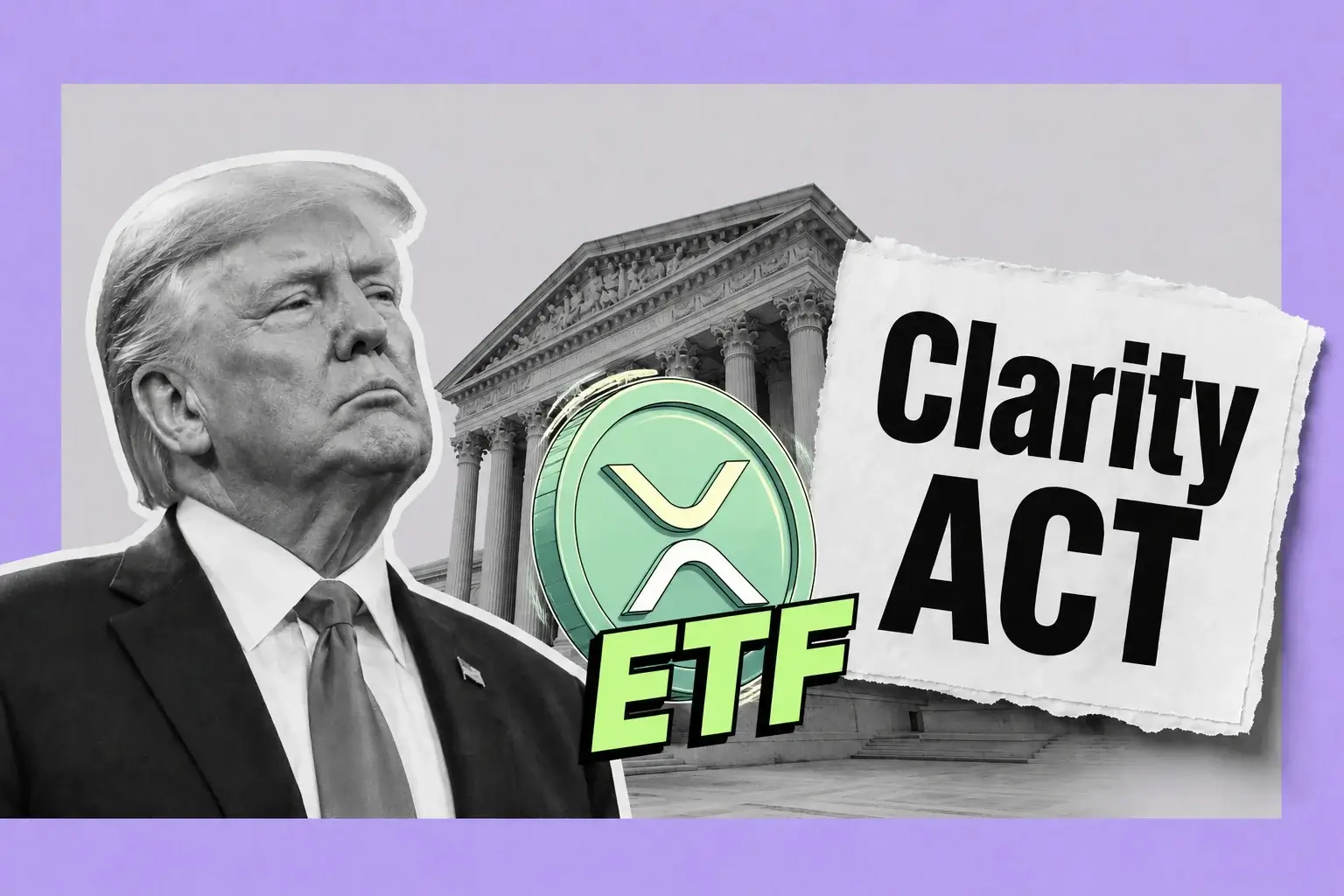
The CLARITY Act cleared committee with all 13 Republicans voting yes on a bipartisan 15-9 amendment. XRP is one Senate floor vote from being codified as a digital commodity under federal law.
That vote is scheduled for September 15 after the bill was sidelined on July 27 without action, with the Majority Leader confirming it would be queued once the chamber returned from August recess. The White House added weight this week, hosting the chief executives of Coinbase, Kraken, Robinhood, Ripple, Gemini and Chainlink with the President calling for passage.
The mechanism matters more than the headline. A federal commodity classification removes the compliance barrier that currently prevents fiduciary-grade capital from allocating freely. XRP lacks that classification today, which is precisely why platform allocators have not cleared it for model portfolios.
The projected impact is a $4 billion to $8 billion inflow wave — four to eight times the category's entire nine-month cumulative total of $1.51 billion.
The missing player is BlackRock. The firm has denied filing but is widely expected to enter eventually, and its arrival would reshape the category the way IBIT reshaped Bitcoin's.
The bull case therefore rests on two specific events with dates or near-dates attached, rather than on network adoption or token utility.
The bear case is that this has been the thesis since January and it has not paid. Prediction markets assigned roughly 30% to 33% odds of the CLARITY Act becoming law in 2026 as of early August. Bitcoin ETFs returned to $1.32 billion of inflows in March 2026 while XRP ETFs recorded $31 million of net outflows in the same month.
Legislation is the only variable that has ever mattered for this category, and it has slipped repeatedly.
Twenty-six days to the vote, with the complex priced at $994 million.
Where the Divergence Actually Sits
The paradox at the centre of this category deserves stating precisely because it cuts both ways.
The flows have been genuinely impressive relative to the price. The complex posted its strongest inflow month of 2026 in May without a single outflow day — unmatched by any other altcoin ETF class — while Bitcoin's funds bled a record amount in the same window. ETF-locked tokens nearly doubled from 478 million in January to over 900 million by June.
Institutions kept buying at depressed prices. That behaviour is the signature of allocation-building rather than tactical trading, and it continues until a target allocation is filled.
Against that, the price has done nothing and the reason is arithmetic rather than sentiment. Steady, retail-led ETF demand cannot overpower Ripple's escrow releases, long-term holders trimming into strength, and a break-even sell wall sitting above.
The category is absorbing supply on one side while the escrow schedule adds it back on the other at two to four times the rate.
What the flows have delivered is a floor. The $1.00 level held every test through 2026 despite ETF inflows collapsing 79% from their May peak and despite Grayscale liquidating $180.78 million of the underlying. Prediction markets put 70% odds on a sub-$1 print during 2026 and it has not come.
That floor is worth something. It is not worth the 40% to 50% drawdown holders have absorbed to obtain it.
The right framing is that the ETF layer has converted XRP from a volatile speculative token into a range-bound one with a documented institutional bid at the bottom. That is a structural improvement in the asset's character and a structural disappointment in its returns.
Cathie Wood's ARK allocated 19.88% to XRP in its new CoinDesk 20 ETF, making it the third-largest holding. That is meaningful institutional validation arriving through a diversified wrapper rather than a single-asset one.
Which may be the category's actual future. Seven single-asset funds fragmenting $1.51 billion is a worse structure than one index product holding XRP alongside its peers.
Read More
-
Yen Stalls at 160 Despite a 3% JGB and Tokyo Core CPI at 2.0% — Intervention Sits at 164, Friday's Payrolls Decide
02.09.2026 · TradingNEWS ArchiveEnergy
-
QQQ ETF ($706.22) Slides 7.4% Below Its High as the Market Reprices the AI Capex Bill — $686.57 Target if $700 Breaks
22.10.2026 · TradingNEWS ArchiveStocks
-
XRPI ($7.00) and XRPR ($10.74) Slide Toward 52-Week Lows as Spot XRP ETF Flows Stall at $708,510
22.10.2026 · TradingNEWS ArchiveCrypto
-
NG ($2.775) Decoupled From Europe’s €88 Gas Crisis as LNG Feedgas Hits 18.9 Bcf/d — $3.30 Upside on Cold Weather
22.10.2026 · TradingNEWS ArchiveCommodities
-
Dollar-Yen (157.35) Loses 157.65 as the Yen Rallies on Haven Demand — 155 Target if 156 Breaks
22.10.2026 · TradingNEWS ArchiveForex
Levels, Targets and What Kills the Setup
Three scenarios with defined triggers.
The bull path requires the September 15 cloture vote to pass. Statutory clarity replaces interpretive guidance, platform allocators clear XRP for model portfolios, and cumulative inflows begin closing toward the $4 billion to $8 billion unlock estimate. XRP reclaims $1.20 and targets $1.36 at the 200-day moving average. The funds re-rate directly with the token: XRPR toward $11, XRPI toward $7.60, XRPC toward $13.40 and XRPZ toward $13.70. Category assets clear $1.2 billion for the first time since June.
The base case is continuation at the current pace. Flows run $1 million to $10 million weekly with two issuers supplying nearly all of it. XRP holds $1.05 to $1.25, the complex's assets stay between $980 million and $1.15 billion, and cumulative inflows drift toward $1.55 billion by month-end. XRPR holds $9.00 to $10.50, XRPI $6.20 to $7.00. No structural change and the category ends the year exactly where it started.
The bear case triggers on a September 15 failure. The bill pushes past the midterms, the regulatory discount persists into 2027, and the $4 billion unlock estimate becomes a 2028 story. XRP loses $1.03 and retests $1.00, with $0.95 and the $0.85 to $0.90 band beneath. Category assets fall through $900 million. XRPR breaks $8.50 toward $8.00, XRPI toward $5.50 and its all-time lows.
The additional risk in the bear case is issuer consolidation. Seven products sharing $994 million of assets means the smaller funds are not commercially viable — 21Shares' TOXR has never been cumulatively positive and Grayscale is running in reverse. Fund closures in a category this small would compound the sentiment damage.
Watch two numbers. Weekly category flows need to sustain above $15 million to signal the collapse has bottomed. And the gap between cumulative inflows at $1.51 billion and assets at $994 million needs to narrow, which only happens if the token rises.
The vote is the whole trade. Everything else is noise around a binary.
The Verdict: Buy the Option, Not the Wrapper
The XRP ETF complex at $994 million of assets against $1.51 billion of cumulative inflows is one of the clearest capital-destruction records in the ETF industry.
Thursday delivered the move the category has waited nine months for. XRP ripped 14.71% to $1.15 and ran toward $1.20 on the Treasury liquidity signal, the SEC's crypto exemption framework and Ripple's $275 million bond issuance. XRPR gained 12.44% to $9.81. The leveraged wrappers added better than 23%.
It changes nothing structural. The complex holds 994.7 million tokens marked at essentially $0.999 each. The average cost basis is $1.478, meaning XRP needs a 28.5% advance from $1.15 just to return holders to breakeven. Bitwise's own filing shows 286.8 million tokens acquired for $480.06 million and carried at $299.23 million — a $180.83 million unrealized loss in the category's largest fund.
The flow engine has died. May at $131.94 million, June at $59.46 million, July at $27.29 million, and one August week at $1.01 million. Three funds hold 82% of assets, Grayscale has sold $180.78 million of the underlying, and 21Shares has never been cumulatively positive.
What is genuinely new is the legislation. All 13 Republicans voted yes on a bipartisan 15-9 committee amendment, and XRP sits one Senate floor vote from federal digital-commodity status. That vote is September 15 and the projected unlock is $4 billion to $8 billion — four to eight times everything the category has raised since launch.
The trade is defined by that date. Buy the spot wrappers rather than the futures product: Franklin's XRPZ at a 0.15% fee holding physical tokens is the cleanest expression, and XRPI's 23% four-month structural loss on daily-reset drag is the most expensive way to be correct.
Size it as an option premium. The downside is bounded by a documented institutional floor that has held $1.00 all year against 70% prediction-market odds of a sub-$1 print. The upside requires a Senate vote that has slipped twice.
Twenty-six days. Everything in this category resolves on one roll call.