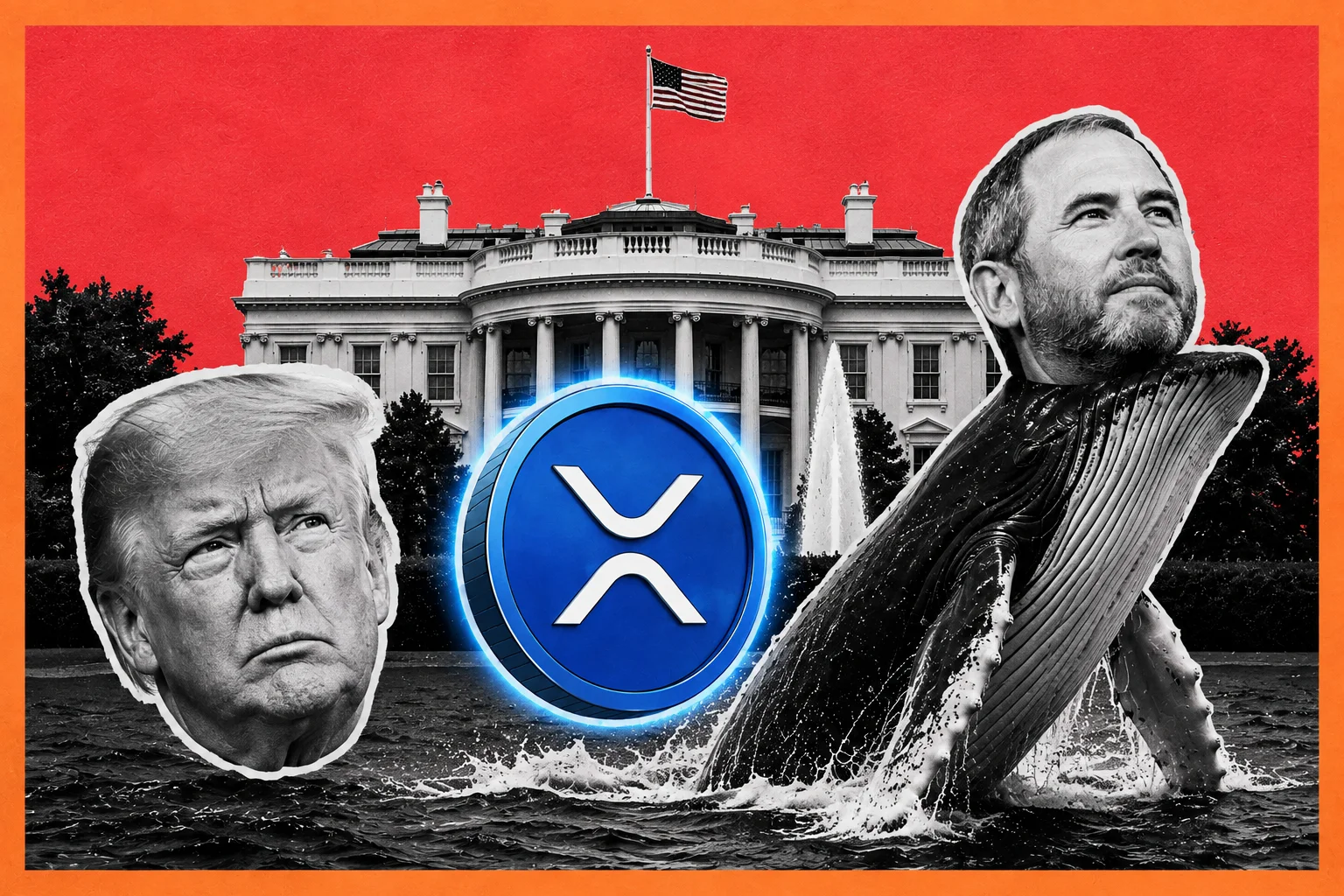
XRP ETFs Sit on a $1.478 Average Cost Basis With Assets 32% Below $1.47B of Cumulative Inflows
Combined assets across the seven US spot funds stand at $994M against 994.7M XRP locked in custody | That's TradingNEWS
As of August 17, 2026, seven XRP spot exchange-traded funds are trading in the United States with combined assets under management of $994 million and 994.7 million XRP tokens locked in custody. Those two figures produce a mark of essentially $0.999 per token, which confirms the complex is valued at prevailing spot as XRP fights to defend the $1.00 level after a rejection at $1.007.
The lineup spans six issuers holding spot XRP directly in institutional custody plus one futures-based product. The tickers are Bitwise's XRP, Canary Capital's XRPC, Franklin Templeton's XRPZ, Grayscale's GXRP, REX-Osprey's XRPR and 21Shares' TOXR, with the seventh slot variously identified as Volatility Shares' XRPI tracking CME XRP futures contracts or the Bitwise 10 Index product. All trade on major US exchanges including NYSE, NYSE Arca, Nasdaq and Cboe.
Distribution is the category's strongest feature. All seven are accessible through standard brokerage accounts including Fidelity, Schwab, Vanguard and Robinhood, and they are eligible for individual retirement accounts. No crypto wallet or private key management is required. That access architecture is what separates a regulated wrapper from direct custody and it is the entire commercial rationale for the products.
The scale comparison against the established complexes frames how small the category remains. Bitcoin's twelve US spot funds hold $76.6 billion in total net assets, and BlackRock's IBIT alone accounts for roughly $46 billion of that on 734,261 coins. Ethereum's complex carries approximately $10.9 billion of cumulative net flow with ETHA managing $16.1 billion. XRP's $994 million represents 1.3% of the Bitcoin category and roughly 6% of ETHA on its own. Against XRP's market capitalisation, the funds hold under 1% of circulating supply, which is insufficient to set the marginal price regardless of flow direction.
The Cost Basis Problem: $1.478 Against $1.00 Spot
The most consequential arithmetic in the XRP ETF story sits in the gap between contributed capital and current assets. Cumulative net inflows across the complex have reached roughly $1.47 billion since the first fund launched in November 2025, with one measure placing the figure above $1.50 billion by early March 2026. Assets now stand at $994 million.
Dividing cumulative inflows by tokens held produces the implied entry price. Roughly $1.47 billion contributed against 994.7 million tokens implies an average cost basis near $1.478 per XRP. Against spot at $1.00, that leaves the aggregate holder base approximately 32.3% underwater, and the $476 million gap between inflows and assets represents 32.4% of the capital contributed.
The behavioural consequence mirrors what has constrained Bitcoin's ETF complex. IBIT holds 734,261 coins at a cost basis near $83,080 against spot at $63,260, producing a $17.61 billion unrealised loss with the basis 29.2% above the market. XRP's funds carry a proportionally similar deficit at 32.3%, which means the same mechanism applies: every dollar of appreciation toward $1.478 moves a cohort closer to break-even, and break-even is where redemption pressure concentrates.
The distinction from Bitcoin is one of scale rather than structure. A $476 million paper loss spread across seven funds is a fraction of the $17.61 billion sitting in one Bitcoin fund, which means the XRP overhang is less capable of overwhelming the market on the way up. It also means the complex has less capacity to absorb selling. Five primary spot funds held $927.78 million in combined net assets as of early June 2026, and the growth to $994 million across ten weeks came almost entirely from token accumulation rather than from appreciation, since XRP has fallen through that period.
The Fee War: Franklin at 0.19% Against REX-Osprey at 0.75%
Cost differentiation is the sharpest competitive axis in the category and the spread is the widest in spot crypto products. Franklin Templeton's XRPZ carries a 0.19% expense ratio, the lowest base fee in spot crypto ETF history, backed by a firm managing $1.5 trillion in assets and with a waiver running until the fund reaches $1 billion in AUM. At the other end, REX-Osprey's XRPR charges 0.75%, the highest in the lineup.
The middle of the range clusters tightly. Bitwise's XRP is cited at 0.25% and 0.34% depending on source and waiver status, Grayscale's GXRP at 0.35% with its fee waiver having expired February 24, 2026, and 21Shares' TOXR at 0.39%. Canary Capital's XRPC sits at 0.50%. The full range across all seven products including the futures-based option spans 0.19% to 0.94%.
That 56-basis-point gap between the cheapest and most expensive spot fund is material for a long-term holder. On a $100,000 position the difference between 0.19% and 0.75% is $560 annually, which compounds against an asset that has fallen 46% year to date. Several issuers have run temporary fee waivers to attract early assets, and the expiry of those waivers is the mechanism through which reported costs rise without any announcement.
The Grayscale waiver expiry illustrates the dynamic precisely. GXRP originated as a private trust holding approximately $14 million in assets before converting to an ETF structure, and Grayscale's institutional brand recognition and custodial infrastructure make it a preferred choice for certain institutional mandates. Its 0.35% headline sits above Franklin's 0.19% and Bitwise's waived rate, which means the fund now competes on distribution and custody relationships rather than on price. The pattern replicates Bitcoin, where Grayscale's higher-fee GBTC bled $5.3 billion while IBIT at 0.25% absorbed the category.
Canary's XRPC: First Mover and Largest by Assets
Canary Capital delivered the launch that established the category. XRPC began trading on November 13, 2025 with $59 million in first-day volume, setting a global 2025 record for an ETF debut and drawing $245 million to $250 million in inflows. It remains the largest fund by assets across the complex.
The path to that launch was unconventional. Canary Capital chief executive Steven McClurg indicated at Ripple Swell 2025 that the firm aimed to launch within the week using a no-delay amendment that could make the registration effective within 20 days. That mechanism let a smaller issuer beat larger competitors to market, and first-mover advantage captured most of the early inflows.
Canary's 0.50% fee is the second-highest among spot products, which makes its asset leadership a distribution and timing outcome rather than a pricing one. A fund charging 0.50% while Franklin charges 0.19% retains assets through inertia and institutional relationships, and the differential creates a persistent switching incentive that has not yet triggered.
The comparison with the Bitcoin category suggests what follows. GBTC entered the Bitcoin ETF era as the largest fund by assets by an enormous margin and subsequently shed $5.329 billion as holders rotated to lower-cost vehicles, while IBIT captured 70% to 80% of category inflows on a 0.25% fee and $62 billion of lifetime gross inflows. If XRP follows that template, Canary's asset lead is a depreciating advantage and Franklin's 0.19% is the structural one. The distinction is that XRP's complex launched with competitive pricing from day one rather than converting a legacy high-fee trust, which compresses the rotation opportunity.
Bitwise Secures the Single-Letter Ticker and the Liquidity Crown
Bitwise took a different route to prominence and it has proved durable. The Bitwise XRP ETF launched on November 20, 2025 and secured the ultra-rare single-letter ticker "XRP" on NYSE Arca, reporting more than $100 million in inflows during its opening days. It quickly became the most liquid option in the category with the highest daily trading volume among XRP ETFs.
Liquidity leadership matters more than asset leadership for a specific investor cohort. The highest daily volume produces the tightest bid-ask spreads, which makes Bitwise the preferred choice for traders prioritising execution cost over holding cost. For an institution entering or exiting in size, spread compression outweighs a 15-basis-point fee difference.
The ticker itself carries commercial value beyond convenience. A single-letter symbol matching the underlying asset name means search traffic, order-entry defaults and retail recognition all route to Bitwise, and that advantage is permanent rather than competed away. Bitwise has been among the more aggressive players in the crypto ETF space since 2017, entering the XRP race with roughly $5 billion in firm assets against Grayscale's $40 billion and 21Shares' $7 billion at the time of filing.
The structural split between Canary's asset lead and Bitwise's volume lead has held for nine months, which suggests the two advantages serve different buyers rather than converging. Canary captured allocation-driven institutional money that arrived first and stayed. Bitwise captured trading flow that requires depth. Franklin captured cost-sensitive long-term holders. That segmentation is more stable than Bitcoin's winner-take-most outcome, and it explains why no single XRP fund dominates category flows the way IBIT dominates Bitcoin's.
21Shares, REX-Osprey and the Futures-Based Seventh Slot
The remaining products serve narrower mandates. 21Shares' TOXR trades on Nasdaq at 0.39%, backed by the firm's established European crypto exchange-traded product infrastructure, and it launched within the same window as Canary. 21Shares uses the ETP designation rather than ETF, though functionally for investors it trades identically.
REX-Osprey's XRPR holds a distinct historical claim as the very first spot XRP ETF to begin trading, debuting on the Cboe BZX Exchange before Canary's launch. At 0.75% it carries the highest fee in the lineup, and specific structural features may justify that premium in certain distribution contexts. First-to-market status did not translate into asset leadership, which Canary claimed within days.
The seventh slot is where source reporting diverges and it matters for accuracy. Volatility Shares' XRPI is identified as a futures-based product tracking CME XRP futures contracts rather than holding spot XRP directly, which means six of the seven hold physical tokens. A separate accounting places the Bitwise 10 Index product in that slot. Either way, the aggregate figure of 994.7 million XRP locked reflects spot holdings.
Leveraged and pending products sit outside the seven. Teucrium's 2x Long Daily XRP ETF attracted $306 million in assets, and ProShares launched an Ultra XRP product. On the pending side, WisdomTree filed an XRP ETF and CoinShares proposed a fund under the ticker XRPL. Those additions would deepen the category without changing its economics, since the constraint on XRP ETF demand has never been available shelf space.
From Settlement to the Pre-Thanksgiving Rush
The regulatory sequence that enabled the category is the most important context for evaluating it. Spot XRP ETFs became possible only after the Securities and Exchange Commission resolved the long-running legal uncertainty around XRP's status, and the SEC-Ripple lawsuit formally concluded in August 2025, confirming that secondary-market XRP is not a security.
The listing mechanism followed one month later. In September 2025 the SEC adopted generic listing standards that cut approval timelines dramatically, and spot XRP ETFs launched via auto-effective S-1 filings under those new standards. That combination meant approvals came in a wave rather than sequentially, because multiple issuers had registration statements sitting ready.
Ripple chief executive Brad Garlinghouse described the resulting rush of near-simultaneous launches as a pre-Thanksgiving rush when Bitwise's fund debuted in November 2025. REX-Osprey went first on Cboe BZX, Canary followed on November 13, and Grayscale, Bitwise and Franklin Templeton all began trading within days, bringing liquidity and driving fees down.
Institutional preparation was visible on-chain before the funds launched. More than 80 million XRP transferred to Coinbase Custody during the first half of November 2025, confirming issuer seeding ahead of the debuts. That advance positioning is why the funds could report meaningful inflows in their opening sessions rather than building assets gradually. XRP's classification was subsequently reinforced by the March 17, 2026 joint SEC-CFTC action covering sixteen assets including Ethereum and Solana, which means the token now carries the clearest regulatory status of any major altcoin.
$1 Billion in 33 Days, Then the Plateau
The launch trajectory was among the strongest in ETF history and the subsequent flattening is the story. US spot XRP ETFs recorded no single net outflow day during their first month of trading. Cumulative inflows crossed $1 billion by December 16, 2025, making XRP the fastest digital asset to reach that milestone since Ethereum's ETF launch.
That pace did not persist. By early March 2026 cumulative inflows had grown to over $1.50 billion across five spot funds with more than 769 million XRP locked across their combined custody arrangements. From $1 billion in 33 days to $1.5 billion across the following eleven weeks represents a sharp deceleration, and the figure has since settled near $1.47 billion on some measures.
Flow persistence through price weakness was read as institutional conviction rather than momentum chasing. Inflows holding steady even as XRP's price experienced volatility suggested institutions were making considered allocation decisions, and money arriving every week through a 20% drawdown was treated as genuine information about accumulation at prevailing prices.
Token accumulation has continued even as dollar inflows stalled, which is the detail that separates the two measures. The funds held 769 million XRP in early March, roughly 840 million by May, approximately 970 million by mid-summer and 994.7 million now. Adding 226 million tokens since March while cumulative dollar inflows moved from $1.50 billion to $1.47 billion means the funds have been buying more tokens with less money as the price fell. That is mechanically what an ETF does when creations arrive at lower prices, and it explains how the complex crossed $1 billion in AUM in June before falling back to $994 million.
May's $131.94 Million Peak and the Eight-Week Streak
The category's high-water mark came in late spring. May 2026 was the strongest month yet for the complex with $131.94 million in net inflows, and as of late June the funds had strung together eight consecutive weeks of positive flows.
That streak was the strongest evidence available for the institutional thesis. Eight weeks of uninterrupted inflows across a period when XRP fell materially indicates buyers were adding on weakness rather than chasing strength, and $131.94 million in a single month against a category holding roughly $1 billion represents 13% asset growth from flow alone.
The scale problem persisted through the streak. Ripple releases one billion XRP monthly from escrow through an automatic unlock running since 2017, with most relocked and a net 200 to 300 million tokens reaching the market. At $1.00 per token that is $200 million to $300 million of monthly supply against $131.94 million of monthly fund demand in the best month the complex has recorded. The portion of escrow that stays in circulation each month outweighs a full week of ETF buying, which means the funds were not merely failing to lift the price; they were swimming against new supply while trying.
That arithmetic is the definitive explanation for why an eight-week inflow streak coincided with a falling price. Exchange reserves fell to a seven-year low of roughly 1.6 billion XRP from 3.76 billion at the October 2025 peak, the funds absorbed 970 million tokens, long-term holders moved coins into private wallets, and the price declined 46% year to date. A shrinking float cannot lift a price on its own; it requires sustained buying that exceeds new supply, and the ETF complex has never reached that threshold.
Read More
-
Yen Stalls at 160 Despite a 3% JGB and Tokyo Core CPI at 2.0% — Intervention Sits at 164, Friday's Payrolls Decide
02.09.2026 · TradingNEWS ArchiveEnergy
-
QQQ ETF ($706.22) Slides 7.4% Below Its High as the Market Reprices the AI Capex Bill — $686.57 Target if $700 Breaks
22.10.2026 · TradingNEWS ArchiveStocks
-
XRPI ($7.00) and XRPR ($10.74) Slide Toward 52-Week Lows as Spot XRP ETF Flows Stall at $708,510
22.10.2026 · TradingNEWS ArchiveCrypto
-
NG ($2.775) Decoupled From Europe’s €88 Gas Crisis as LNG Feedgas Hits 18.9 Bcf/d — $3.30 Upside on Cold Weather
22.10.2026 · TradingNEWS ArchiveCommodities
-
Dollar-Yen (157.35) Loses 157.65 as the Yen Rallies on Haven Demand — 155 Target if 156 Breaks
22.10.2026 · TradingNEWS ArchiveForex
The 93% August Collapse and the Four-Week Test
The demand channel has now broken down. XRP ETF inflows collapsed 93% during August, ending the run that had reached eight consecutive positive weeks. That reversal removes the single element of the bull case that was visible in flow data rather than inferred from supply metrics.
The evaluation thresholds have been made explicit and they are worth holding as a framework. Four consecutive weeks above $10 million in net inflows would signal a trend reversal. Four consecutive weeks below $5 million would confirm the August collapse is structural rather than seasonal. Weekly flow reports publish every Monday, which makes today's data the first of four readings that resolve the question.
Those thresholds are strikingly low relative to the launch period. A category that absorbed $1 billion in 33 days is now being assessed against whether it can sustain $10 million weekly, which is $520 million annualised against $200 million to $300 million of monthly escrow supply. Even the reversal threshold leaves the funds short of the token issuance they compete against.
The cross-asset comparison provides context on whether the collapse is XRP-specific. Bitcoin ETFs shed roughly $390 million across the week from August 10 to August 14, including a $57.6 million outflow on Friday, the third consecutive negative session, with year-to-date flows approximately $4.5 billion in the red. Ethereum's complex recorded a $14.59 million outflow on August 10 before turning positive on the 12th and 13th. Solana funds attracted capital and bucked the broader trend. That pattern describes sector-wide caution with rotation toward newer products, which means XRP's 93% decline is partly macro and partly competitive rather than a verdict on the asset.
Escrow Supply Overwhelms the Entire Fund Complex
The structural constraint on XRP ETF effectiveness is a supply mechanism no other major cryptocurrency carries. Ripple controls approximately 36 billion XRP in escrow and releases one billion monthly, with the net portion reaching the market running 200 to 300 million tokens.
The scale comparison is decisive. Thirty-six billion tokens held by a single entity against seven funds holding 994.7 million means Ripple's escrow is 36 times the size of the entire ETF complex. At $1.00 per token, a net monthly release of 250 million represents $250 million entering the market against a fund category worth $994 million in total. The escrow delivers roughly a quarter of the entire complex's value every month.
The comparison with Bitcoin's supply dynamics clarifies the disadvantage. Bitcoin's issuance is algorithmic, declining and fully anticipated, and its largest corporate holder controls 840,447 coins representing roughly 4% of the 21 million cap. XRP's largest holder controls 36 billion of 100 billion tokens with discretionary release authority. The existence of a large, concentrated holder with the ability to sell at any time creates a persistent overhang that no other major cryptocurrency faces.
Ripple has reduced its programmatic sales in recent quarters, which mitigates the flow without removing the stock. Recent treasury movements have drawn scrutiny, with $50.5 million in XRP moved to an unknown wallet and 49 million tokens remaining there, and plausible explanations include liquidity seeding for custody clients tied to first-half partnerships with DXC Technology, Kyobo Life Insurance and Thailand's Kbank, or RLUSD expansion requiring base-layer liquidity on the XRP Ledger. If those tokens return to a Ripple treasury address or are re-escrowed, the transfer was routine treasury management.
RLUSD Crosses to the Ledger as the Demand Case Shifts
The fundamental development most relevant to future ETF demand happened on-chain rather than in fund flows. For the first time, more of Ripple's RLUSD stablecoin lives on the XRP Ledger than on Ethereum, with $810 million or 51.7% on XRPL against $756 million or 48.3% on Ethereum. A month earlier Ethereum led by more than $300 million.
That reversal addresses the central bear objection to the ETF thesis. RLUSD has been Ripple's most successful product, reaching roughly $1.78 billion in market capitalisation across more than 40 blockchain networks, and it had been growing without generating XRP demand. Stablecoin volume concentrated on Ethereum made RLUSD growth token-neutral. Volume shifting toward the XRP Ledger is the specific condition under which the bridge currency mechanism begins generating real demand.
The transmission runs through base-layer liquidity. RLUSD minting on XRPL requires XRP for transaction fees and for the liquidity pools routing conversions, so ledger-resident stablecoin volume creates structural demand that Ethereum-resident volume does not. A $300 million swing in relative positioning across one month, verified on-chain, is the first datapoint suggesting that channel is opening.
The institutional business supplies the longer-dated case. More than 300 financial institutions use RippleNet with On-Demand Liquidity volumes exceeding $15 billion annually, though roughly 40% of partners actively use XRP for settlement today. Full conversion from messaging-only usage to token settlement remains the key variable, and the custody partnerships announced during the first half of 2026 create a mechanism through which institutional adoption generates token demand without requiring partners to convert their payment rails. As RLUSD grows as a payments and settlement instrument, it deepens XRP's role as the bridge asset in those flows, strengthening the fundamental case that institutional capital would underwrite.
CLARITY on September 15 and the $4 to $8 Billion Estimate
The catalyst the category has been waiting for now sits on a firm date. The Senate cloture vote on crypto market-structure legislation is scheduled for September 15, 2026, requiring 60 affirmative votes to overcome a filibuster. It is a procedural vote on the motion to proceed rather than final passage.
The vote arithmetic is the obstacle. Republicans hold 53 seats and at least two are expected to vote against, leaving supporters near 50 dependable votes against the 60-vote threshold. Three items remained open entering August: ethics enforcement, illicit finance provisions and stablecoin yield. Committee-stage voting produced a bipartisan 15-9 amendment with all 13 Republicans in favour, which is the most constructive procedural signal available. The Senate reconvenes September 14, one day before the vote.
The estimated impact on XRP ETF flows specifically is the most consequential number in the entire analysis. Passage is expected to trigger $4 billion to $8 billion in XRP ETF inflows, several times what the funds have absorbed since launch. Against a complex holding $994 million in assets, inflows at the low end would quadruple the category and at the high end would multiply it eightfold.
The critical qualifier is that XRP's own regulatory status is already resolved. The August 2025 settlement confirmed secondary-market XRP is not a security, and the March 17, 2026 joint classification covered the token alongside Ethereum and Solana. CLARITY would harden agency guidance into statute rather than change XRP's treatment, which means the $4 billion to $8 billion estimate reflects institutional mandates requiring statutory rather than administrative certainty. Even under an optimistic scenario, most operational provisions covering registration would not take effect until late 2027 since regulators require time to write implementing rules, and comprehensive legislation would otherwise wait for the next Congress with enactment unlikely before mid-2027.
The Forecast: What Breaks the Plateau
The bullish path requires three confirmations in sequence. First, this week's flow report and the three that follow deliver four consecutive readings above $10 million in net inflows, the stated threshold for a trend reversal after the 93% August collapse. Second, XRP holds $1.00 and clears the $1.02 resistance that rejected the most recent attempt, which would begin closing the 32.3% gap between spot and the funds' $1.478 implied cost basis. Third, the September 15 cloture vote clears 60 votes, activating the $4 billion to $8 billion inflow estimate that would take the complex from $994 million to multiples of its current size.
The bearish path requires only continuation. Four consecutive weekly readings below $5 million would confirm the August collapse is structural, and with net escrow supply of 200 million to 300 million tokens monthly outweighing a full week of fund buying even at peak flow rates, a structurally impaired demand channel means the funds cannot offset issuance. A break of $0.993 support would extend XRP's losing August streak to a fifth consecutive year and push the complex's paper loss beyond $476 million.
The base case is a continued plateau. Token holdings have grown from 769 million in March to 994.7 million now while cumulative dollar inflows moved sideways from $1.50 billion to $1.47 billion, which describes creations arriving at progressively lower prices rather than accelerating demand. That pattern persists until either the price moves or the flow rate changes, and neither has a scheduled catalyst before September 15.
The asymmetry favours the category on structure and disfavours it on scale. Seven funds with full brokerage and IRA access, fees from 0.19% to 0.75% creating genuine competition, 994.7 million tokens locked out of a float where exchange reserves have halved to a seven-year low of 1.6 billion, resolved regulatory classification, RLUSD crossing to majority XRP Ledger residency at 51.7%, and a $4 billion to $8 billion inflow estimate on CLARITY passage all argue the infrastructure is built and waiting. Against that, $994 million of assets against a 36 billion token escrow, a 93% inflow collapse, a $476 million aggregate paper loss, and a monthly supply release that exceeded the best month the complex ever recorded all argue the plateau holds. Four consecutive weeks above $10 million would change the flow picture. September 15 is the only event that would change the category.